Showing posts with label translation. Show all posts

Monday, 31 August 2026

Guest review by Peter Crawley: THE JOURNAL OF HÉLÈNE BERR: a Young Jewish Woman's Life in Occupied Paris, translated from French by David Bellos


"The beauty in this in many ways tragic journal is the awakening of spirit, the blossoming of defiance and the hardening of determination not to be beaten by the ranks of evil."

Peter studied social, political and economic geography, and later languages at The Goethe Institut in Freiburg-im-Breisgau, Germany. Having written aural histories, obituaries and magazine articles throughout his life, in 2011 he returned to writing full-time. His first published novel, Mazzeri, about the shaman of Corsica, was published by Troubador in 2013. Subsequent works include Ontreto (Lipari, Sicily), Boarding House Reach (Norfolk), The Wind Between Two Worlds (London), The Truth in Fiction (short stories), What you Don’t Know About Me (a novella), and Constant Tides (Messina, Sicily), which has been translated into Italian. Theo’s Voice, a story of aphasia, is his latest work. Peter’s interests include listening to and researching personal histories and landscapes, believing that both our epoch and our surroundings shape us as much as our DNA. He lives in Midhurst, West Sussex, with his wife, Carol, and is currently writing a second novel set in Lipari, Sicily.

These days, if one was to lose an hour or two to the second-hand bookstalls of the Left Bank, or an afternoon to the gentle majesty of the Jardins de Tuileries, one might be forgiven for thinking le vieux Paris was forever thus – light of heart, perhaps even carefree. Yet the city was not always so.

In June 1940, Hélène Berr was nineteen when the German Army marched down the Champs-Élysées; she was studying English language and literature at the Sorbonne where, later, she was awarded the coveted Diplôme d’Études Supérieures for her thesis on ‘Shakespeare’s Interpretation of Roman History’. Born into a middle-class, secular Jewish family, Hélène was what some would have called strong-willed and others independent. Her father, a former artillery lieutenant wounded in the First World War, was deputy chairman of a major chemical and industrial group, and, as such, Raymond Berr was deemed by the Nazis to be a person of use, which meant his family were afforded protected status; a status that endured only until they were deported on the 27th of March 1944, Hélène’s twenty-third birthday. Two years earlier, the young woman had begun a diary, in which she recorded the passage of twists and turns that led her to that wretched day; a diary she deposited, often only pages at a time, with Andrée Bardieu, the cook who had remained in her father’s employ for more than half a century.

The first page of Hélène’s Journal, as it has become known in David Bellos’ brilliantly empathic translation, finds her wandering down the Avenue Victor Hugo, her thoughts consumed with the challenges of falling out of love with Gérard and in love with Jean, both of whom subsequently fled the country to join Free French Forces and in doing so survived the war. What these entries don’t tell us, however, is that by this time Hélène was working for the L’Entraide Temporaire, a clandestine organization committed to saving Jewish children from deportation. A letter to her sister, written on the day Hélène was arrested, reveals her use of codewords – Henri for her father; Minnie for her mother, Gaston Bébert for police station, Marcel for the police – and many of the entries describe her shepherding orphaned children to safety, while disguising their true destination. The narrative is almost poetic in its flow and the writing of the highest quality, yet the beauty in this in many ways tragic journal is the awakening of spirit, the blossoming of defiance and the hardening of determination not to be beaten by the ranks of evil, both foreign and domestic.

Some would call Hélène’s Journal a rite of passage through a dystopian landscape in which Jewish adults, adolescents and children were considered less than human and therefore treated inhumanely; I would call it an awakening, if not a clarion call. And to those who turn a tin ear to the Holocaust, I would say read this story of a young woman’s resistance – a resistance both physical and intellectual – and rage that one so talented, so compassionate and courageous, should be taken from the world before her time.

Much of her Journal is given over to philosophy and reflection, to the agonies and ecstasies of adolescence, and to the price one pays for being both ordinary and otherwise. Hélène understood her life was soon to end, and in one passage reasons that after death one lives on, if only in the memory of those still living. Now, because of her Journal, the name Hélène Berr will live on and remind us how truly fortunate we are to be light of heart and carefree.

There are three other exceptional books that deserve mention: the first is Anne Sebba’s Les Parisiennes (Weidenfeld and Nicolson), a fascinating and meticulously researched account of how the women of the city ‘lived, loved and died’ through the occupation; the second is Irène Némirovsky’s Suite Française (Vintage) which, although classified as fiction, provides a stark reminder of what it took to survive; and the third is A Life In Secrets (Abacus), Sarah Helm’s exceptional history of ‘Vera Atkins and the lost agents of the Special Operations Executive’, in which we come to know the women, and some of the men, parachuted into France during the Second World War, the majority of whom were never to return. Neither Irène Némirovsky nor Hélène Berr lived to see the war’s end; both were murdered, brutally, by the Nazis.

Like so many, their names must never be forgotten.

The Journal of Hélène Berr is published by MacLehose Press. The French edition is published by Tallandier.


Peter's latest novel, Theo's Voice, is published by Troubador

Monday, 19 January 2026

Guest review by Graeme Fife: GOD'S SECRETARIES - the Making of the King James Bible, by Adam Nicolson


"Nicolson relates the arguments dispassionately with perception, in lively writing: deft portraits of characters, strengths, quirks and all."

Graeme Fife
 is a regular reviewer here. He has written many plays, stories, features and talks for radio, stage plays and articles for newspapers and magazines, and is a regular contributor to BBC Radio 4's From Our Own Correspondent. He's the author of a string of books - children's stories, biography, works of history and fiction. His novel of the French Revolution, No Common Assassin, tells the story of Charlotte Corday. His new novel, Memory's Ransom, a compelling wartime story, is published by Conrad Press.

*

tantum religio potuit suadere malorum. (Lucretius De rerum natura)

‘I have glorified God in Greek and Latin, the consecrated languages spoken by the Lord on Earth’: Christopher Smart, Jubilate Agno)

Many of us grew up with the sonorities of the King James Bible attuning our ear to the glories of the English language. Nicolson tells a story not only of the remarkable process of rendering the original Greek and Hebrew in what was, effectively, an entirely new language, he broadens his canvas to create a sharp portrait of the England into which James I of Scotland came as successor to Elizabeth I, under whose aegis the turbulence of religious division and factional rivalry had extended a reign of terror, the vicious excesses of extremism visited on the people of a nation subject to the caprices of a succession of bigoted monarchs dealing with vicissitudes of creed and the challenge of external enemies beholden to a different faith and pretended universal church.

The James Bible was not the first vernacular edition of the sacred text and many former translators had suffered vicious intolerance for their desire to make the Bible available to all God’s children, releasing it from the stranglehold of Latin. James, his childhood blighted by neglect and the persecution visited on his mother, was an awkward, socially inept man but a man of books, quick in temper but studious in manner. Under his immediate supervision, a gathering of groups of scholars set about rendering the Bible in a language which would make scripture available to be read in church and intelligible to every listener. Nicolson’s account of how this highly complex operation evolved and succeeded is riveting. He explores not only the process of translation per se, but the interaction of scholars in all their egocentricities, vanities, personal likes and dislikes. How to coordinate the work of teams of Translators – the approving capital was added at the time – to produce an integral work? It was a fiendishly difficult task and I quote one example only of many to illustrate how beautifully they succeeded in evincing a melodious and accurate translation based on ‘heard rhythm’ the majesty of a new English matching the majesty of the sentiment enshrined in scripture itself, but also a plain simplicity and directness, which delivered to the people as a whole a call to and retaining their attention. ‘Behold: I tell you a mystery…’

James came to a country riven with faction and disagreement, himself very shortly the target of a group of Catholic fanatics who wished to restore their faith to the land and its people: the gunpowder conspirators. The new King sought peace and consensus, to be, as it were, the sun that shone on all as against the effect of other faiths which kept people in ‘ignorance and darkness’.

Studied reference was made to those versions which had preceded this new rendition and I don’t quote the Tyndale here, let Nicolson make his own assessment, but the new reading delivers what he calls ‘a pace of deliberate and magisterial slowness … as solemn and orderly as the beginning of a steady and majestic march’. These are word written to be heard, remember, for their simplicity of effect and for their emotional power: ‘and the Spirit of God moved upon the face of the waters.’

Now, in the Hebrew the word means ‘surface’ but at the time in English that meant ‘the superficies or upper part’ and thereby drains any sense of the deep force of the creative power deployed by the Demiurge and ‘face’ has, as Nicolson nicely stresses ‘a rich plain Englishness to it’. That is, above all, the beauty of this Bible, the move away from the denser, often tangled diction of the contemporary dramatists to the language which would, later, inform so much of the homespun diction of the American founding fathers and on to the work of a novelist like Melville, a glorious, heartfelt simplicity which gives, for example, Lincoln’s Gettysburg address such emotional strength, even its melodious sway. Moreover, punctuation used as a sort of musical notation, rests and pauses to increase the dramatic effect in recital.

There are anecdotes aplenty and I particularly enjoyed the tale of one of the Translators, Miles Smith, Bishop of Gloucester – and most were, as well as eminent scholars and linguists, in holy orders - being so bored by a sermon that he walked out and made for the ale-house. Some were insufferable bores and pedants themselves but, in sum, they produced an astonishingly fine work which no other version rivals. T S Eliot said of the New English Bible (yawn) that it ‘astonishes in its combination of the vulgar, the trivial and the pedantic’. It’s flat and entirely lacks the sensitive concentration on words that any true translation absolutely requires; it also lacks soul and musicality, both of which inform the James Bible. As a clarion for peace in a quarrelsome, fissile realm, what better?

There were objectors – this was religion - and Nicolson relates the arguments dispassionately with perception, in lively writing: deft portraits of characters, strengths, quirks and all. As for James, a man of books himself – he once said that he would be glad to be held captive along with the other chained prisoners in a library of protected books – his inspiration and authority unleashed a work of English in what some regard to be its apogee of style.

God's Secretaries is published by Harper Perennial

More of Graeme's choices:


The Go-Between by L P Hartley

Monday, 31 May 2021

Independent Bookseller feature no. 13: John Newman of The Newham Bookshop, IN MEMORY OF MEMORY by Maria Stepanova, translated by Sasha Dugdale


"Part travelogue and part philosophical, social and historical enquiry, written with intelligence. wit and great perceptiveness."

John with colleague Vivian Archer
The Newham Bookshop was established in 1979 by local parents as part an educational charity, as a non-stigmatising gateway to literacy and numeracy support for adults and a source of income for the various projects. We have always been underpinned by values that are inclusive and which celebrate diversity. THE focus is on multiculturalism - valuing everyone and learning from each other in a vibrantly diverse part of East London. We are community-focused, supporting local and London-wide events, conferences and festivals.

I've personally been involved with the shop since the mid 80’s, first as an employee in 1989, then children’s buyer. Vivian Archer, manager since 1987, encouraged me to return to bookselling when John and Jean, stalwarts of the children’s shop, retired. I have never regretted the move for one moment and despite the almost ceaseless changes within the industry I never ever wake up reluctant to go to work! 

We've been supported by many authors over the years, with regular events and signings. One of our earliest and most important supporters was the late writer and compiler of oral histories Gilda O’Neill, who was always generous with her time and never missed an opportunity to point people in our direction. Benjamin Zephaniah and Michael Rosen have also been hugely supportive, giving us the confidence to develop the events which are now integral to our business. More recently we've enjoyed working with a host of locally-based authors, including Courttia Newland, Onjali Q. Rauf, Salena Godden, Irenosen Okoji, Vaseem Khan and Luan Goldie. It's a must for bookshops to cultivate relationships with authors and illustrators and develop ways of working together.

During these periods of enforced isolation over the last fourteen months I have found myself slowing down and as I have adapted to having less choice about how I spend both my working and social life. It has also occurred to me that I have rediscovered a sense of freedom to do two things I have not immersed myself in as thoroughly since childhood, namely being outside in nature and being inside with a book. I have had so much time to walk, read and reflect on both of these activities without distraction for long periods and it has been both a solace and a boon in these sad and difficult times. Suddenly books that I might have put aside to read later were being read and digested.

Into this unexpected space I received a proof copy of this particular book and I knew I wanted to revisit it when I was kindly asked to submit a review as I had found it both stimulating and engaging for a number of reasons. As a lover of books, it is difficult not to be drawn to Fitzcarraldo Editions, an imprint that takes its name from the typeset it uses and which houses pages between blue or white covers which just to hold is an aesthetically pleasing experience.

I studied history as an undergraduate in the late 1970’s and within this I had also taken a course on the Emancipation of the Jews in Europe taught by the late Chimen Abramsky. At the same time, I knew little about the day to day lives of Russian Jewry in the late Tsarist and Soviet periods. Stepanova’s family lived through and ultimately her branch of her family survived these times although others were victims of Pogroms and the Holocaust itself. How they did so is revealed through shared memories, correspondence and other artefacts.

The book began in the author's mind when aged ten but the major impetus came when the author engaged with the contents of her late Grandmother's Moscow apartment which provided links to a journey across time and place to locate members of her family and the worlds they inhabited. What follows is part travelogue and part philosophical, social and historical enquiry written with intelligence, wit and great perceptiveness.

Stepanova, in partnership with her English translator, has created a wide ranging, beautifully written exploration of a family history which links to major events and social history in Russia and parts of Europe where her ancestors and their descendants studied and made lives for themselves over the course of the Twentieth Century. There are enlightening sections on the large numbers of Russian women, including her own great grandmother, who studied medicine in Paris before the First World War as well as a son’s moving letters to his mother from the Siege of Leningrad. Stepanova seems to question how does one put these lives into the context of their times and how do we know whether in relation to Post Memory if “things were better back then”

W.G Sebald is something of a torchbearer as Stepanova introduces links to other personages and their artistic legacy which often coincide with my own interests and preoccupations as does the writing of Sebald himself. These memorably emerge as essays within the book taking in themes which include the self-portraits of Rembrandt and photographer Francesca Woodman and the art of Joseph Cornell. Perhaps most movingly, Stepanova revisits Charlotte Saloman’s haunting “Life? Or Theatre” a work that I first encountered when I saw some of the original paintings in Amsterdam in 1988. The essays had me turning to my bookshelves and Googling images of the works under discussion

Anecdotes are many and I have no space to share them here but they seem to reveal as much about the human condition as anything else and highlight the impact of family secrets and links to personal histories we can perhaps all identify with. What survives does not always link us reliably or definitively to the past as Stepanova herself discovers. “Here is time passing, the human is washed away but objects keep their outline” Maybe it is the tangible things that matter most. I certainly think so as although I have my memories and photos aplenty I am best able conjure up one of my own grandmothers each time I use her bone-handled tomato knife.

In Memory of Memory is published by Fitzcarraldo Editions 2021

Read more independent bookseller features:

Books and Ink, Banbury (now Winchcombe)


Monday, 26 April 2021

Guest review by Jon Appleton: LONELY CASTLE IN THE MIRROR by Mizuki Tsujimura, translated by Philip Gabriel


"Originally published in Japan in 2017 where it won prizes and became a bestseller. Its prize-worthiness isn’t in question as you read..."

Jon Appleton
is a freelance writer and editor based in London.


A number of reviewers of this parish have connections to the children’s book world but we don’t generally review books for young readers here. Today I’m reviewing a novel about children.

Lonely Castle in the Mirror was originally published in Japan in 2017 where it won prizes and became a bestseller. Its prize-worthiness isn’t in question as you read but perhaps it’s only when you reach the poignant Publisher’s Note, written for the English-language translation, at the very end that its popularity is explained.

The story is told mostly from the perspective of Year 8 student Kokoro, whom we learn early is bullied so relentlessly at school that she stops going, even finding herself unable to begin again at the new school her sympathetic parents and former teacher have found her. She is confined to spending the hours of 9 to 5 each weekday alone trapped in her bedroom.

That is until a strange effect in her bedroom mirror transports her to another dimension, into a many-roomed castle where she meets six other children – of course there are seven children altogether; all the tropes of traditional tales were here – who have also found formal education untenable. They are set a year-long challenge by the sinister girl in a wolf mask who calls herself the Wolf Queen.

‘You are all lost Little Red Riding Hoods,’ the Wolf Queen said. ‘From now until next March, you will need to search for the key that will unlock the Wishing Room. The person who finds it will have the right to enter and their wish will be granted.’

But this privilege comes at the expense of others’ ambition and safety. And in other ways, too, the world of the castle is no more kind or democratic than life in the classroom. There are rules to obey – and rules that unexpectedly change – and soon routines form. The children can enter and leave the castle as long as they do so within the hours of 9 to 5. But they can’t abandon the tensions and rivalries of adolescence. You might think they’ve forfeited one classroom for another.

Allusions to children’s literature abound – from Hans Christian Andersen to anime, via Harry Potter and The Chronicles of Narnia – which give the story a kind of timelessness, but this is not a dreamy, reflective novel. Each chapter spans a month in the characters’ year-long challenge and I felt propelled through the story by a kind of bruising inertia. However, its intricate plotting and attention to detail give the novel a necessary tenderness too. The depiction of Japanese society, its culture and philosophies add huge interest for those of us reading the attentive translation.

A new novel that reminded me of I’m the King of the Castle by Susan Hill and Penelope Farmer’s A Castle of Bone, Lonely Castle in the Sky will no doubt conjure other novels in readers’ mind but will be memorable for its own unsettling power.

Lonely Castle in the Mirror is published by Doubleday.

Jon is a regular reviewer here with a knack for finding great new reads as well as older publications you may have missed. Here are more of his pieces:


Memorial by Bryan Washington

Shuggie Bain by Douglas Stewart

The Dutch House by Ann Patchett

The Biscuit Factory Girls by Elsie Mason

An Honest Man by Ben Fergusson

Clock Dance by Anne Tyler

Carnivore by Jonathan Lyon

Commonwealth by Ann Patchett

- and Jon's own novel, Ready to Love, is reviewed here by Sophie Masson:


Monday, 2 December 2019

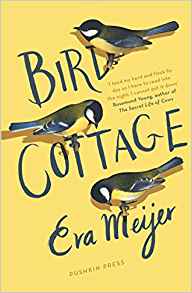
Guest review by Daniel Hahn: BIRD COTTAGE by Eva Meijer, translated by Antoinette Fawcett


"As much as anything, this is a book about communication and about relationships ... the reader feels a real warmth and joy emanating from the curious friendships that are its heart."

Daniel Hahn is a writer, editor and translator. "One way or another, most of my work involves books. I write them, translate them, edit them and review them. Quite a lot of what I do has a particular focus either on international writing / translation or on children's literature." A former chair of the Translators Association and the Society of Authors, as well as national programme director of the British Centre for Literary Translation and trustee for the Society of Authors, he has worked with a number of other organisations working with literature, literacy and free expression, including English PEN, The Children's Bookshow and Modern Poetry in Translation. In 2017 he established a new prize for debut literary translation - the TA First Translation Prize. More on Daniel's website.

Bird Cottage is based on the life of a real person, and a very unlikely life it was. But the novel itself feels somehow unlikely, too, not least because it took a Dutch writer to discover the story and evolve it into this excellent novel, to be beautifully translated by a woman in the north of England, and a copy of the published translation sent to me at home in East Sussex . . . just down the road from where the real story took place. Until Bird Cottage (originally Het Vogelhuis) popped through my letterbox, I had never even heard of Gwendolen Howard.

Len – as she was known – was born at the end of the nineteenth century, she had an Edwardian childhood in Wales, then moved to London to be a professional violinist. Becoming restless in her early forties, she gave up this career to retire to a cottage in Sussex, where she lived for four decades, with her windows kept always open to let the birds in. Birds were her passion, and she built a life to be shared with them – they had the run of her cottage at all times, and she befriended them, named them, studied them, and wrote about them. As a musician, she could differentiate between their songs, writing them down in musical notation.

Author and translator create two voices for the book: the main narrative thread, giving us Len’s telling of her life in the first person (novelist Meijer’s attempt to make sense of a person through a narrative), and short interspersed pieces of what are ostensibly Len’s own ornithological writings, focusing on one particular favourite of hers, a great tit called Star.

Bird Cottage examines the great turning point in Len’s life – what led to it, and its consequences – as she decides to rebel against social expectation and withdraw almost entirely from human society, from the inadequacies of human relationships and of human linguistic communication. (Worrying at these limitations is both a natural and a stressful thing for a novelist to engage with.) Along with her isolation, she attains a kind of emotional detachment from what is happening elsewhere – the death of members on her family, even the consequences of war.

Meijer herself is a writer about animals (a new non-fiction study of animal communication, Animal Languages, is also just out in English), and one of the things that interests her is Len’s place in the professional ornithological world. Her published work was best-selling, and widely translated, but dismissed by the scientific community, not only because she was inadequately qualified, and a woman besides (though this, too), but because her methodology was outside the prevailing scientific fashion. Her observational research involved watching birds close-up in something not too different from their natural habitat, rather than laboratory observation – at the time, the common practice was behaviourist study in lab conditions. Her desire to observe birds in the most natural, unconfined environment possible blurs the boundaries of her world and theirs, which in turn narrows the focus of Meijer’s story to one of the most extraordinary intimacy.

So this is a true story, which relies on the historical evidence that exists for Len Howard’s unusual life (the line separating fact and fiction here is a fuzzy one, of course); but there’s much more to it than just the curiosity value. This is not a piece of documentary but a novel, driven by some beautiful writing and by appealingly believable characters. The careful characterisation applies not least to the birds themselves, several of which (of whom?) recur as Len comes to know them well. As much as anything, this is a book about communication and about relationships, and – surprising though this may be – the reader feels a real warmth and joy emanating from the curious friendships that are its heart.

A post-script: when you’ve read the book (and you should), read Antoinette Fawcett’s fascinating piece in Asymptote about the lengths she to which she went to produce the translation.

Bird Cottage is published by Pushkin Press.

Monday, 25 November 2019

Independent bookseller feature No.11: Orb's Bookshop, Aberdeen: DRIVE YOUR PLOW OVER THE BONES OF THE DEAD, by Olga Tokarczuk, translated by Antonia Lloyd-Jones


"This is the kind of book we love to stock at Orb’s – something a bit different, something you might not stumble across in every bookshop."

We (Maureen Ross and Dawn Finch) are two of the volunteers who run Orb’s Community Bookshop in Huntly, Aberdeenshire. This is a small rural town in the middle of many farming communities and we are the only bookshop for over an hour’s drive in any direction. The bookshop was threatened with closure and the local writers group, Huntly Writers, stepped in and raised the money required to keep it open. This December we’re celebrating out tenth anniversary! We do everything from going out to schools and literary events with our pop-up bookshop, to making sure our shelves contain books that you might not find in mainstream bookshops. We don’t try to compete with supermarkets or The River That Shall Not Be Named, because we can’t match the super-massive discounts they offer, and we don’t feel those prices give a fair deal to authors. We tend to stock things other bookshops don’t and we have a mix of old and new books and we have a gentle specialism in things like nature books, poetry and diverse and inclusive children’s books. We also stock books by local writers and poets, and have many books by our most famous former resident, Victorian fantasy writer George MacDonald.

A book that we’ve enjoyed very much recently is Drive Your Plow Over the Bones of the Dead by Olga Tokarczuk – published by independent publisher, Fitzcarraldo Editions. This was a book that was originally published in Polish but was translated into English in 2018 by Antonia Lloyd-Jones and in 2019 it had a wider release. It won the Nobel Prize for Literature in 2018, and has been on many other award lists since including the Booker Prize.

The plot revolves around an older woman who lives in a rural Polish village close to the Czech border. She studies astrology and translates William Blake, adores nature and wildlife, and misses her two dogs. When her neighbour shows up dead, Janina appears fascinated by the death and writes to the local police with her theory that the wild animals of the forest have killed her neighbour because he was a hunter. The chief of police does not believe her – but when he too is found dead, and then the village's fur farmer vanishes, people start to take a second look at Janina’s theories.

Orb’s team member Maureen says: “I first came across Drive Your Plow in a newspaper article about crime novels. I'm addicted to crime fiction and immediately ordered a copy. From the start this book captivated me with every word and I read every word which is unusual for me as a greedy and impatient reader. The book is much much more than a murder mystery although it is a very clever mystery tale. Janina is an acerbic and tough eccentric woman in her sixties, with a mordant sense of humour and a passionate belief in justice and freedom for all creatures not just humans. The tale is linked in with the work of the visionary poet William Blake - a direct quotation from him serves as the title of the book - and this in itself together with some intriguing information about astrological systems kept me delighted from start to finish. The geography and meaning of borders was also given a place in the building atmosphere of what it is like to experience the world from a totally different perspective. I loved this book and will re-read it again and again. I have never wanted to re-read a book before but this is finally the one. So much in it. Thank you Olga for the fabulous wit and intelligence of this story."

Orb’s team member Dawn is also a great fan of this book. She says, “Maureen recommended this one to me and I know it’s an oft repeated phrase, but I genuinely could not put it down. I’m not a crime novel reader so I wasn’t immediately convinced, but I am a sucker for a book in translation and that lured me in. Drive Your Plow feels different from the very first pages. Janina comes across as so real that you are drawn into her life and her world. This was one of those books that I found myself slowing down to read because I wanted to be part of Janina’s life for a while longer. I’ll be honest with you, I think I still miss her. I love it when a book does that to me.”

This is the kind of book we love to stock at Orb’s – something a bit different, something you might not stumble across in every bookshop. We hope that’s what our customers are looking for – the kind of personal contact and recommendation that comes from people who really do love books!

Drive your Plow over the Bones of the Dead is published by Fitzcarraldo Books


Maureen on Harry Potter night at the local library


Monday, 22 July 2019

THIRD ANNIVERSARY POST No.1 by guest Jill Paton Walsh: SCENES FROM A CHILDHOOD by Jon Fosse, translated by Damion Searls

Photograph by Julia Hedgecoe

"What an extraordinary writer Jon Fosse is!"

Jill Paton Walsh has been a professional author since 1966.  She has written for children of many ages, from toddlers to teenagers,  has written five literary novels and more recently four detective stories with her own detective. She has also been pursuing the cast of characters in Dorothy L Sayers' famous Lord Peter Wimsey stories into their later adult lives.

She has lectured extensively about children's literature, predominantly in the United States, where her children's books have won several major prizes.  In the UK one of her adult novels, Knowledge of Angels, was a near miss for the 1994 Man Booker prize. 

She is that odd person – an Oxford graduate happily resident in Cambridge.  


My grand-daughter Catherine has grown up in Australia, so I have not seen very much of her during her childhood. She was rather sporty and talkative and not much interested in reading. Now she is in England for her gap year, and is visiting me regularly in Cambridge. Of course she has changed in many ways, but the most striking to me is that for her Heffer’s is the central sanctum of the city.

She is suddenly reading voraciously and buying books with all her spare cash.

With the excuse that she wants to know what I think of this author and that, she is controlling my own reading, concentrating on titles like Normal People by Sally Rooney, which I managed to read half way through… but at 82 I quickly found that teenaged sex was not fascinating for me.

However, she recently demanded that I read a book by a writer I must confess I had never heard of - Scenes from a Childhood  by Jon Fosse, translated from Norwegian by Damian Searles, and published by Fitzcarraldo Editions.

This is a collection of short stories of a strange and fragmented kind. When Catherine mentioned it to me I thought first of Schumann, and then inaccurately of Chekhov. But I was quickly very intrigued by the copy Catherine bought for me.

Jon Fosse is, as one begins to read his stories, almost impossibly artless. The scenes from childhood are raw fragments of recollection, about as coherent as fragments of china lying broken on a floor. They are not arranged, nor threaded together at all - not in any sense I at first recognised as narrated - almost literally artless. Everything is in the present tense. It is not of course particularly original to write in the present tense - nor to write a narrative imitating strains of thought - that goes back at least as far as Dorothy Richardson. I have attempted narrative in the continuous present myself, hoping to capture the immediacy of experience, and awareness of the physical context in every remembered event of one’s life.

But I have never before encountered a work of literature in which total realism, including realistic representation of the fragmented nature of recollection is being carefully employed. It is not even evident if the fragments of disconnected events are in any kind of order. It is like looking at a jigsaw puzzle with the pieces laid out helter-skelter on a table, none of them yet fitted together.

Very gradually a broken picture emerges of growing up in Norway - of family and friends, and any episode in which the narrator hurt himself and bled. That sounds harrowing, and it is - but it casts a deep light of joy on fragments of remembered moments of happiness. It is completely convincing, in the way it might be if someone were telling you what happened when they fell in the river, or broke a limb or some other traumatic or puzzling event, recalled, not understood, and recounted without any art or interpretation at all. Now and then what is remembered, is a later memory of an earlier one, still unvarnished, and unstructured.

Of course there is in a way a narrative voice; and this narrator conveys with startling and moving clarity the experience of not understanding the adult world around him.

This book ought to be depressing, so bleak and without order is the narrative; but in fact it is exhilarating to be reminded what the world is really like to innocent eyes, when the pieces don’t fit together, and understanding is not yet achieved.

Of course one result of reading the book is to feel that meaning and understanding are undercut, they are shown to be a construct. What we truly experience is not coherence…. and the fragmented pieces are mesmerising….

What an extraordinary writer Jon Fosse is! I did not expect, at my age to be offered a new view of the world, nor to find, at last, a common vision with my grand-daughter.

Scenes from a Childhood, translated by Damion Searls, is published by Fitzcarraldo Editions.


Monday, 5 February 2018

Guest review by Leslie Wilson: BABYLON BERLIN by Volker Kutscher, translated by Niall Sellar


"A cracking good read, brilliantly plotted..."


Leslie Wilson is the author of two novels for adults and two for young adults. Last Train from Kummersdorf was shortlisted for the Guardian Children's Fiction Prize and the Branford Boase Award; Saving Rafael was nominated for the Carnegie Medal and Highly Commended for the Southern Schools Book Award. Both deal with Nazi Germany. Leslie Wilson is half German, was brought up bilingual, and has spent considerable amounts of time in Germany. She is currently working on a novel for adults, set in the very early nineteenth century.

My grandfather and his younger brother Erich Rösel were both German policemen; Uncle Erich was a member of the Kriminalpolizei (CID) in Berlin. Alas, I only met him once and I know nothing about his career except that, as a working class lad, he must have started at the bottom. But reading Babylon Berlin, I wonder how much the novel resembles the reality that Erich knew.

He’d have been one of the police constables that Gereon Rath and his superior officers deploy in the novel, on stakeouts, doing door to door investigations; footsloggers. Gereon Rath, by contrast, is a detective inspector, the son of a high-ranking Rhineland police officer. Unfortunately for him, an injudicious shooting in Cologne (he killed the trigger-happy son of a major newspaper publisher; in the line of duty, but a bad move) got him moved to Berlin. Now he’s in the Vice Squad instead of the Murder Squad, which feels like a punishment. Rath is ambitious, frustrated, under a slight cloud; not much of a team player, and with a troubled relationship with his distinguished father; all good stuff for a crime fiction hero.

It’s 1929, and Berlin is a hotbed of crime, corruption, and political conflict. Communists and Trotskyites are fomenting revolution in Germany; Nazis and other right-wingers, yearning to fight the Allies and defeat them this time, are acquiring arms and building up illegal armies. The Social Democratic city government is trying, sometimes brutally, to keep a lid on the boiling pot. It’s a city of savage contrasts; in poverty-stricken, left-wing Neukölln a gigantic Karstadt department store is being constructed (later, alas,destroyed by Allied bombs; it was an impressive building). Here Rath, fighting vertigo, and his Chief Inspector, Wolter, capture a fleeing porn actor on the top of the scaffolding.

It’s a city that anyone familiar with the literature and the media of the period will recognise. There are mafia-style organisations, tolerated by the police because they keep a kind of order among thieves. Fritz Lang portrayed these in his brilliant film M, where the gangs track down a child-murderer; I can’t help seeing Marlow, in the novel, as Gustav Gründgens,who played the gang boss in M. The porn actors are straight out of George Grosz; so are the women they screw for the camera.There are transvestites, there are dancing girls and drugs. (Rath himself snorts cocaine on occasion.)

Some of the police are historical figures; particularly Superintendant Ernst Gennat, a noted eccentric, addicted to cake and thus known as ‘the fat man of the murder squad.’ His office was said to contain sagging velvet armchairs, an axe used by a murderer, and the head of a woman that was once fished, wrapped in paper, from the river Spree. (I can’t understand why Kutscher doesn’t mention these details.) Gennat’s intelligence and sophistication as a police investigator certainly feature in the plot. Incidentally, it was Gennat who coined the expression ‘serial killer.’

Babylon Berlin is a cracking good read, with its own mutilated body fished from the Spree, and brilliantly plotted; it keeps you guessing, which is what any keen crime reader wants. There’s a love interest, too; Rath develops a troubled relationship with the lovely Charlotte, a stenographer in the Murder Squad who aspires to become a police officer herself. I can’t help sympathising with her when she calls him an arsehole. At least he recognises the fact - but I wouldn’t want my daughter to marry him.

What gripped me was the complex and convincing portrayal of the city: I’ve already got the second novel in the series. I read it in German first; what I did miss in the (competent, occasionally sloppy) translation was the complexity of language and a lot of the irony, which Berliners do so well. Some texture is lost thereby.

I know from experience that it’s near-impossible to render Berlin dialect into English. I would have liked to see the army officer-jargon of the police brought into the English version, for that demonstrates how military an institution the 1920s German police were. But then, I suppose there are layers of meaning in the Montalbano books that are lost to me, because I can only enjoy them in translation.

Babylon Berlin is published by Sandstone Press. Original title: Der nasse Fisch, Gereon Rath’s Erster Fall.