Showing posts with label Paris. Show all posts

Monday, 31 August 2026

Guest review by Peter Crawley: THE JOURNAL OF HÉLÈNE BERR: a Young Jewish Woman's Life in Occupied Paris, translated from French by David Bellos


"The beauty in this in many ways tragic journal is the awakening of spirit, the blossoming of defiance and the hardening of determination not to be beaten by the ranks of evil."

Peter studied social, political and economic geography, and later languages at The Goethe Institut in Freiburg-im-Breisgau, Germany. Having written aural histories, obituaries and magazine articles throughout his life, in 2011 he returned to writing full-time. His first published novel, Mazzeri, about the shaman of Corsica, was published by Troubador in 2013. Subsequent works include Ontreto (Lipari, Sicily), Boarding House Reach (Norfolk), The Wind Between Two Worlds (London), The Truth in Fiction (short stories), What you Don’t Know About Me (a novella), and Constant Tides (Messina, Sicily), which has been translated into Italian. Theo’s Voice, a story of aphasia, is his latest work. Peter’s interests include listening to and researching personal histories and landscapes, believing that both our epoch and our surroundings shape us as much as our DNA. He lives in Midhurst, West Sussex, with his wife, Carol, and is currently writing a second novel set in Lipari, Sicily.

These days, if one was to lose an hour or two to the second-hand bookstalls of the Left Bank, or an afternoon to the gentle majesty of the Jardins de Tuileries, one might be forgiven for thinking le vieux Paris was forever thus – light of heart, perhaps even carefree. Yet the city was not always so.

In June 1940, Hélène Berr was nineteen when the German Army marched down the Champs-Élysées; she was studying English language and literature at the Sorbonne where, later, she was awarded the coveted Diplôme d’Études Supérieures for her thesis on ‘Shakespeare’s Interpretation of Roman History’. Born into a middle-class, secular Jewish family, Hélène was what some would have called strong-willed and others independent. Her father, a former artillery lieutenant wounded in the First World War, was deputy chairman of a major chemical and industrial group, and, as such, Raymond Berr was deemed by the Nazis to be a person of use, which meant his family were afforded protected status; a status that endured only until they were deported on the 27th of March 1944, Hélène’s twenty-third birthday. Two years earlier, the young woman had begun a diary, in which she recorded the passage of twists and turns that led her to that wretched day; a diary she deposited, often only pages at a time, with Andrée Bardieu, the cook who had remained in her father’s employ for more than half a century.

The first page of Hélène’s Journal, as it has become known in David Bellos’ brilliantly empathic translation, finds her wandering down the Avenue Victor Hugo, her thoughts consumed with the challenges of falling out of love with Gérard and in love with Jean, both of whom subsequently fled the country to join Free French Forces and in doing so survived the war. What these entries don’t tell us, however, is that by this time Hélène was working for the L’Entraide Temporaire, a clandestine organization committed to saving Jewish children from deportation. A letter to her sister, written on the day Hélène was arrested, reveals her use of codewords – Henri for her father; Minnie for her mother, Gaston Bébert for police station, Marcel for the police – and many of the entries describe her shepherding orphaned children to safety, while disguising their true destination. The narrative is almost poetic in its flow and the writing of the highest quality, yet the beauty in this in many ways tragic journal is the awakening of spirit, the blossoming of defiance and the hardening of determination not to be beaten by the ranks of evil, both foreign and domestic.

Some would call Hélène’s Journal a rite of passage through a dystopian landscape in which Jewish adults, adolescents and children were considered less than human and therefore treated inhumanely; I would call it an awakening, if not a clarion call. And to those who turn a tin ear to the Holocaust, I would say read this story of a young woman’s resistance – a resistance both physical and intellectual – and rage that one so talented, so compassionate and courageous, should be taken from the world before her time.

Much of her Journal is given over to philosophy and reflection, to the agonies and ecstasies of adolescence, and to the price one pays for being both ordinary and otherwise. Hélène understood her life was soon to end, and in one passage reasons that after death one lives on, if only in the memory of those still living. Now, because of her Journal, the name Hélène Berr will live on and remind us how truly fortunate we are to be light of heart and carefree.

There are three other exceptional books that deserve mention: the first is Anne Sebba’s Les Parisiennes (Weidenfeld and Nicolson), a fascinating and meticulously researched account of how the women of the city ‘lived, loved and died’ through the occupation; the second is Irène Némirovsky’s Suite Française (Vintage) which, although classified as fiction, provides a stark reminder of what it took to survive; and the third is A Life In Secrets (Abacus), Sarah Helm’s exceptional history of ‘Vera Atkins and the lost agents of the Special Operations Executive’, in which we come to know the women, and some of the men, parachuted into France during the Second World War, the majority of whom were never to return. Neither Irène Némirovsky nor Hélène Berr lived to see the war’s end; both were murdered, brutally, by the Nazis.

Like so many, their names must never be forgotten.

The Journal of Hélène Berr is published by MacLehose Press. The French edition is published by Tallandier.


Peter's latest novel, Theo's Voice, is published by Troubador

Monday, 18 July 2022

Guest review by Yvonne Coppard: THE ELEGANCE OF THE HEDGEHOG by Muriel Barbery, translated from the French by Alison Anderson


"There is joy, there is humour, there is sorrow: here is Life, writ large in all its complexity."

Yvonne Coppard
is a Writing Fellow of the Royal Literary Fund and writer of fiction for children and adults. See more on her website.


Sometimes, there is a fine line to be drawn between the craft of beautiful writing and the pompous display of a writer’s skill. The Elegance of the Hedgehog invites you to choose which side of the fence you favour. Its publication provoked heated discussion. It seems to be a love-it-or-hate-it read. Certainly, it’s a book that demands proper attention, not one you want to pack for a lazy beach read. The joy of this book is the portrayal of the eccentric and entertaining characters; also in its cultural and philosophical references and entertaining observations of people and society. This novel made me stop reading and think for a while. If you want a thrilling, can’t-put-down book, look away now. This one take time and effort.

Renée Michel is the concierge for the eight fashionable apartments at No 7, Rue de Grenelle in Paris. To the residents she is the drab stereotype of an uneducated, middle aged woman with little self-awareness and few aspirations. She wears dreary clothes, eats cheap food and watches daytime TV. She is reliable, good at her job, but she lives a small life. Renée fosters this perception because it’s good for business, but she is hiding in plain sight. She is an autodidact, an acute observer, well versed in art, philosophy, music, literature and gourmet dining.

In one of the upper floor apartments, twelve-year old Paloma Josse lives a privileged life with her parents and sister. But she too, is playing a stereotype while hiding her real self. Like Renée, Paloma is much more intelligent and observant than she seems. Her outlook on life is both precocious and pretentious. She hates the world she has been born into and has decided to end her life on her thirteenth birthday by burning the apartment down, unless she is presented with a compelling reason not to. Meanwhile, Paloma has her suspicions about Madame Michel not being quite what she seems.

When a new tenant, the fabulously wealthy and cultured Ozu Kakuro, moves into the building an unlikely but deep bond develops between the three characters. Comfortable with each other, they reveal something of their true selves and undergo a degree of personal transformation.

There is joy, there is humour, there is sorrow: here is Life, writ large in all its complexity. The Elegance of the Hedgehog is worth the time and effort – and a shout out to Alison Anderson for a superb translation, too.

The Elegance of the Hedgehog is published by Gallic Books.

Yvonne is a regular reviewer here. For more of her choices, see:

The Beekeeper of Aleppo by Christy Lefteri

Flaneuse by Lauren Elkin

Plainsong by Kent Haruf

The Outrageous Fortune of Abel Morgan by Cynthia Jefferies

Adventures in Human Being by Gavin Francis

American Dirt by Jeanine Cummins


Monday, 20 June 2022

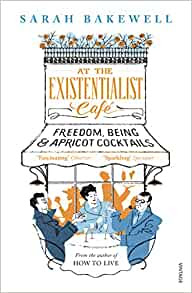
Guest review by Graeme Fife: AT THE EXISTENTIALIST CAFĒ - FREEDOM, BEING & APRICOT COCKTAILS by Sarah Bakewell


"Bakewell has sailed what might have been tempestuous waters with assurance, understanding, sympathy and love."

Graeme Fife is a regular reviewer here. He has written many plays, stories, features and talks for radio, stage plays and articles for newspapers and magazines, and is a regular contributor to BBC Radio 4's From Our Own Correspondent. He's the author of a string of books - children's stories, biography, works of history and fiction. His novel of the French Revolution, No Common Assassin, tells the story of Charlotte Corday.

Philosophy…brilliant minds describing society as it could, should be? The crux is language. Imannuel Kant speaks of Ding an sich which we may translate ‘the thing itself’. Fine, but what is thing in this or any application? From universal thing we move to the mystery of being … the essence of humankind? The core, impression, elusive oneness of One? Philosophy can be a trial and I’ve always found it baffling, often beautiful in many respects, but a cerebration too far in most. I therefore came to Sarah Bakewell’s At the Existentialist Café: Freedom, Being and Apricot Cocktails, captivated by her wonderful study of Montaigne in How to Live, more drawn by cocktails and the company of the people drinking them in the Paris café – de Beauvoir, Sartre and their friend Aron – than by the inevitable task of coping with more rarefied talk of disquisition and the quests and riddles, byways and shadowy alleys down which ‘love of wisdom’ may lead, numb-headed as this must seem, be. How foolish. All this before I’d read a page? There’s so much more.

The context of the book, beyond the intellectual thinking and talking shop of the Latin Quarter cafés in Paris, animates its narrative. Between the two wars, all Europe was in turmoil. About Germany we know, too well; in Britain, too, the faltering of all that had been certain and the shocking prospect of uncertainty: foundations of the old order rocked, ancient empires blown away. No system of thought was safe from question, now. France, a nation deeply divided on many fault lines for a long time, saw a brief ascendancy of the Left: socialism and communism offered, apparently, an answer to, through challenge of, the domination of the Establishment namely accepted wisdom, rooted tradition, all that was sure, innate, even benevolent before that very Establishment oversaw the horrors, the devastation of land and wholesale slaughter, 1914-18.

Bakewell is particularly astute in exploring the climate of Occupied France and the moral dilemmas it threw up: Patriotic or Personal? Nation or Friend? Protest – violent or non-violent? Discuss. Thought of itself can be arid and off-putting. What counts equally is the heart of the story not its clothes and jewellery.

To Paris came news of phenomenology, a philosophical approach to knowledge and understanding which originated with Husserl in Germany, a country whence so many of the modern thinkers had come. I attempt no definitions here. Bakewell’s learning and clarity deserve better than any amateurish upstaging. That said, from the intense deliberations of the threesome in a café over its famous apricot cocktails came the enunciation of a way of thinking about human affairs christened existentialism…ah, existence. How, in this new cosmos when all seemingly permanent structures had been near shattered, even obliterated, to consider humanity’s place and purpose? Perhaps by looking, just that, looking at what’s there still, a kind of permanence. Greek phenomenon means 'that which appears, is visible’. Simple? Far from it and Bakewell is a wonderful guide. Her clarity – and passion – for and about the subject informs a story which could so easily threaten to overwhelm.

She investigates a process of thought about the entanglements of morality imposed by new order which had eroded certitude to a degree unimaginable hitherto. More than a starting anew, a need to address a wholly different problem. ‘A future humanity living in isolated pods beneath the Earth’s surface’ as E M Forster imagined in a short story? Huxley’s Brave New World? As Bakewell writes of commentators on this disintegration: ‘They set out to detect and capture the quality of experience as we live it rather than according to the frameworks suggested by traditional philosophy, psychology, Marxism, Hegelianism, structuralism or any other of the -isms and disciplines that explain our lives away.’ Add, for example, that the French Revolution foundered, in large part, because the small-minded bigots at its heart, the drivers of its bloody excesses, believed, that virtue or, in their word, civisme, being a good egg in Whitehall parlance, could be inculcated by law and edict.

From that age of Fascism, a violent curse out of the perverted sense of rectitude imparted by a weighted fist, Bakewell cites Paul Ricoeur, a pioneer of the new thinking: ‘The relentless persecution of this man (a Czech activist) proves that, in the event of a people’s extreme abjection, philosophical pleading for subjectivity is becoming the citizen’s only recourse against the tyrant.’ Subjectivity? Feeling. Humanity.

Bakewell has sailed what might have been tempestuous waters with assurance, understanding, sympathy and love. It’s a story that needed to be told on issues which demand consideration.

At the Existentialist Café is published by Other Press (NY).


Read this Q & A with Graeme about his novel of the French Revolution, No Common Assassin


Monday, 9 December 2019

Guest review by Yvonne Coppard: FLÂNEUSE by Lauren Elkin


"It has motivated me to ditch the car, don the trainers and become a flâneuse myself, wandering the city in which I live but know so little about."


Yvonne Coppard is a writer of children’s fiction, non-fiction for adults and occasional columns and articles in a variety of publications. She is currently a Writing Fellow of the Royal Literary Fund, working with businesses and public service organisations to promote clear, understandable English in written communication. See more on her website.

Trying to describe what this book is and why I loved it will be a challenge. It’s part memoir; part cultural commentary; literary biography and history, underpinned by a skilful evocation of our human need for connection.

The term flâneuse is Elkin’s adaptation from the masculine noun ‘flaneur’: an idle, aimless wanderer. The flâneuse, like her male counterpart, walks the streets with no other purpose than to blend and observe. The seemingly small point about adapting language is actually fundamental to Elkin’s approach; she is a woman reclaiming territory that was traditionally assumed to be exclusively male. Although the term ‘flâneuse’ already existed, the Dictionnaire Vivant de la Langue Francaise defines it as ‘a lounge chair’. Elkin’s perspective is clear: search for images of ‘flâneuse’, she says, and you get: “a drawing of George Sand, a picture of a young woman sitting on a Parisian bench and a few images of outdoor furniture…. Is that some kind of joke? The only kind of curious idling a woman does is lying down?”

Elkin is a native New Yorker with experience of life in Tokyo, Venice, London and Paris, which is now her permanent home. She has negotiated the nuances that must be grappled with in order to make the change from tourist to resident; she understands the difference between living in a community and feeling integrated into it. Elkin’s account is infused with the keen observation and insight that being an outsider affords. She includes slices of the lives of flâneuses who have gone before her: writer Virginia Woolf; artist Sophie Calle; journalist Martha Gellhorn and film-maker Agnes Varda, among others. All of them were keen observers of the environments they moved through and blended into. Their stories are fused with Elkin’s developing insights into her own experience.

“Why do I walk? I walk because I like it. I like the rhythm of it, my shadow always a little ahead of me on the pavement… Walking is mapping with your feet. It helps you piece a city together, connecting up neighbourhoods that might otherwise have remained discrete entities, different planets bound to each other, sustained yet remote.”

Established in Paris, Elkin falls in love and agrees to move with her French boyfriend when he takes a job in Tokyo. Uprooted, displaced and unnurtured, Elkin struggles to connect with her new home and, ultimately, her partner. Her description of the final stages of their soured relationship is powerful.

“Dead words, dead tongue, dead of disuse, my mouth stuck shut… I said in your language, which I have come to speak, ta langue, ta langue dans ma bouche, and you’ve brought me to this place where my new tongue lies flat in my mouth. A crack in the road, the sidewalk blistered, how long has it been since I left New York concrete for Paris cobblestones? Why am I here, where I can’t ask for aspirin, or sleeping pills, where the yogurt aisle is a tofu aisle? I can’t think straight, I can’t make one thought lead to another, I just tell you I hate it and hate it, and I mean you, and before we know it I am breaking things and jumping up and down and screaming at you in your tongue, in my tongue, in my mother tongue. My mother spoiled me, you say. But you have spoiled us. I never thought I’d be here.”

The breadth of Elkin’s sweep across art, literature, history and politics is impressive, signalling its roots in the post-graduate research that led her to write the book, but her own story is the connecting thread that unifies the whole. Ultimately, it is the uplifting and inspirational account of a search for the true self, and the landscape that resonates with the soul. It’s a book that I think will be satisfying to return to again and again over the years, offering something fresh each time. Meanwhile, it has motivated me to ditch the car, don the trainers and become a flâneuse myself, wandering the city in which I live but know so little about.

Flâneuse is published by Chatto and Windus.

Monday, 16 July 2018

Guest review by Michael Lawrence - SHAKESPEARE AND COMPANY by Sylvia Beach


"Authentic or not, Mr Whitman’s shop filled both a gap and a need, not least for cold hard-up souls like me, eager for words they could understand and a spot of free warmth in which to pore over them."

 Between 1995 and 2015 I published a number of stories and forty-something books for children and teenagers. One of the books - Young Dracula - inspired five CBBC-TV series of that name; a series I didn’t like and which earned me little more than a fleeting ‘originator’ end credit and a handful of beans. While I enjoyed writing many of my books, others were such a tussle with editors and their various chippers-in that frustration and out-and-out rage became the order of many a day. When the new head of a certain publishing house informed me that my new ideas were ‘very funny with strong narrative voices but a little quirky and out-there at a time when we are looking for something a lot more obvious’ I knew it was time to move on. I’m still moving. Still writing too (it’s hard to give up), but not for children.

If we’d been of a similar generation, Sylvia Beach is someone I would very much like to have known. She preceded me by quite some way, but the bookshop described in this memoir - the name of it at least - had some relevance for me early on.

At the tenderish age of twenty-one I was a freelance photographer in London, taking pictures for the Financial Times, publishers, advertising agencies and so on. That meant a lot of snaps of politicians, pop stars, cereal packets, and women in various states of undress. But this was the so-called Swinging Sixties and I was bored with the parties and zipping round town in taxis just before dawn, so I handed the keys to my balconied flat in Pimlico - along with all my furnishings - to a BBC makeup girl of my acquaintance and hightailed it to Paris to try my hand at writing while starving. (I turned out to have a real gift for the second of these.) While renting an icy garret at the top of the Hotel Novelty at Odéon, I made frequent visits to the Shakespeare and Company bookshop on the Rue de la Bûcherie near Notre Dame. There I discovered treasures banned in England, such as Henry Miller’s Tropic of Cancer, The Black Book by Lawrence Durrell, and Maurice Girodias’s Traveller’s Companion series. I also met a French composer who wanted help with a letter to the Dean of St Paul’s to offer him a piece of music he’d written in honour of Winston Churchill, who’d just died.

But this wasn’t Sylvia Beach’s Shakespeare and Company. Sylvia, a New Jersey expatriate, opened the original Shakespeare and Company – a lending library as well as a bookshop – on the morning of November 19th, 1919. Specialising in books written in or translated into English, in no time her shop became an essential meeting place for visiting English-speaking authors, some of whom used it as their Paris mailing address. The shop more usually associated with Sylvia was in the Rue de l’Odéon, but her first Shakespeare and Company was situated just round the corner in the Rue Dupuytren. When I came across the address of that shop some twenty five years after my impoverished sojourn at the Hotel Novelty my jaw hit my chest. The Novelty was at 10 Rue Dupuytren. Sylvia’s first shop was at number eight – right next door. It was like finding the bones of old Will himself in your sock drawer.

It was from 8 Rue Dupuytren that Gertrude Stein is said to have borrowed around seventy books in the two years before the shop moved to those larger premises. It was at number 8 that Sylvia, with no previous publishing experience, volunteered to produce the first edition of Ulysses in book form, in the process becoming James Joyce’s most vigorous champion. At that shop and its successor she entertained, in one way or another, many writers of contemporary or subsequent legend - Hemingway, Scott Fitzgerald, Ford Maddox Ford, Ezra Pound, D H Lawrence and many others. There ought to be a commemorative plaque on the wall of 8 Rue Dupuytren, but there isn’t. There’s no indication whatsoever that the original Shakespeare and Company was housed there.

Sylvia ceased trading in 1941 after refusing to sell an officer of the occupying German forces her last copy of Finnegans Wake from her window display. Shortly afterwards she found herself in an internment camp, where she was held for six months. Almost exactly a decade after she shut up shop for the last time, an American bookseller called George Whitman adopted the name Shakespeare and Company for his own shop in the Rue de la Bûcherie, apparently with Sylvia’s blessing. The by-then celebrated banner gave George’s establishment a ready-made pedigree which to this day draws literary pilgrims by the planeload, many believing that they’re visiting the shop associated with all those famous writers of the past.

Authentic or not, Mr Whitman’s shop, now run by his daughter – Sylvia Beach Whitman – filled both a gap and a need, not least for cold hard-up souls like me, eager for words they could understand and a spot of free warmth in which to pore over them.

Some of the above is covered in more detail in my memoir Milking the Novelty, a copy of which, I’m happy to report, has found a place in the Rue de la Bûcherie Shakespeare and Company archive.

Shakespeare and Company is published by Bison Books.