Showing posts with label New York. Show all posts

Monday, 21 April 2025

Guest review by Cindy Jefferies: LILLIAN BOXFISH TAKES A WALK by Kathleen Rooney


"Lillian charmed me into her life."

First published in 2001 for children, Cindy Jefferies found success with her Fame School series with Usborne Books, obtaining 22 foreign rights deals. Latterly writing fiction for adults as Cynthia Jefferies, her first title The Outrageous Fortune of Abel Morgan was published in 2018, followed a year later by The Honourable Life of Thomas Chayne, set during the English Civil Wars, followed in 2019. Both titles are now available in paperback.

Two words. Flâneuse, something I certainly am, though perhaps not to the extent Lillian Boxfish is: and anhedonia, something I don’t suffer from but a word I had come across for the first time in an online article I was reading recently. I had never seen the word before, but being distracted for a moment I neglected to look it up. Then, with the serendipity I so love in life, a few days later, there it was again, in the book I was reviewing. Wikipedia will give you a useful definition if you don’t know the word but I won’t enlighten you here, because to do so might spoil your pleasure a little, in reading Lillian Boxfish Takes a Walk.

Kathleen Rooney’s novel was a slow burn for me. There was the happy anticipation of encountering a character who shares my enjoyment of wandering alone through the streets. Also, it is always a pleasure to handle a Daunt paperback. The substantial cover and the high quality of the paper, smooth and sensuous to the touch, both delight. However, there was no street map, to help me with Lillian’s walk through Manhattan on her cold, New Year’s Eve night. I thought it would be essential, and mourned the lack as soon as riffling through the pages revealed it.

My only experience of New York is being driven through the city at speed to try and catch a plane. (Fortunately for me it had been delayed and I caught it.) My feet have never walked these streets and I feared that my lack of knowledge would spoil the novel experience. So, I started to read, a little disengaged; but as the book had been a present from my daughter I felt I should give it a go. I’m very glad I did. The wistfulness at the lack of a street plan was soon forgotten, as Lillian charmed me into her life.

Lillian Boxfish is inspired partly by the real, highest paid female advertising copywriter in the world during the 1930’s. The author’s notes expand on this but I won’t here. Suffice it to say that in this unusual and enjoyable novel there are written adverts, poetry, humour, memories and walking. Take a trip to your local, independent bookshop; walking if possible, and seek out this book.

I was going to leave you with one of the rhymes scattered through its pages, but decided instead on one sentence that has, sadly, perhaps never been more true.

People who command respect are never as widely known as people who command attention.

Lilian Boxfish Takes a Walk is published by Daunt Books.

More of Cindy's choices for Writers Review:


Monday, 30 January 2023

Guest review by John Case: I AM NOT RAYMOND WALLACE by Sam Kenyon


"Sam Kenyon's stunning debut novel ... a beautifully written story of love, loss and redemption; a tale of the emotional costs we can so often suffer for failing to be true to our true selves ..."

Training initially as an actor, John Case spent his early 20s working in theatre in the UK, before moving into the Arts and Heritage Sector, working as a senior manager with Surrey County Council’s Cultural Service Department, covering Performing Arts, Libraries and Heritage. Since 2020 John has been the Festival Director of the Rye Arts Festival, one of the South-East’s largest multi-arts festival, held every September since 1971. John is now working on the establishment of an exciting new project - The Rye Bay Book Festival, which he hopes to launch in 2024.

‘It is Monday October 14th, 1963, Raymond is twenty-one years old, and by the time he leaves Manhattan a mere three months later, on January 8th, 1964, he will have made the greatest mistake of his life.’

So ends the first paragraph of Sam Kenyon’s stunning debut novel, spanning a 30 year period from Manhattan in the winter of 1963, a month before President Kennedy is assassinated, to Paris in 2003. It is a beautifully written story of love, loss and redemption; a tale of the emotional costs we can so often suffer for failing to be true to our true selves; of the role that parental pressure can exert throughout our lives, but it’s also a snapshot of the wider intolerance that existed in 1960s America towards homosexuality; a time when homosexuality was still considered by many to be a ‘disease’ that could, at best, be cured by the psychiatrist or by religious correction. A time when gay men were forced into a dangerous illicit underworld, where to gain entry to gay bars and clubs meant knowing that particular secret ‘knock’ on the door to gain entry, and where the danger of arrest or attack was ever present. It was also a time when the The New York Times could actively publish scaremongering articles about an homosexual epidemic spreading across America - ‘They’re sick, you know? The result of inadequate parenting; absent or detached fathers, overbearing mothers; lack of significant masculine figure in the household…”

Into this 1960s world comes Raymond Wallace, a virginal 21 year old, newly minted from Cambridge University, to work at the offices of  The New York Times on a three-month bursary, where he is assigned to work with top journalist Robert C. Doty (a real life figure, but in Kenyon’s novel Doty is fictionalised) to undertake research for a leading article about the ‘growth of overt homosexuality’ in New York city. Remember we are still four years away from the Sexual Offences Act 1967 in the UK which permitted homosexual acts between two consenting adults over the age of 21, and even further away from legalisation in the United States.

Raymond, encouraged by Doty to venture into the hidden underworld of the gay bars of Manhattan, meets the charismatic Joey Maniscalco, and quickly begins an intense relationship, a relationship that will last physically for a mere three months, but one that will resonate across a generation for the next thirty years.

The relationship between Raymond and Joey is liberating, joyful, loving and beautifully brought to life by Kenyon. Even the intimate sex scenes, which can so often be the downfall of many a writer, work well here, blending perfectly within the main narrative. Both these men will, in time, become famous - Joey, a free spirt, confident in his own sexuality, supported by his beloved Papa, possesses a rare singing talent, whilst Raymond, the ironic observer, the recorder of stories, will find fame as a writer. Kenyon is adept at creating fascinating believable characters - Joey’s relationship with his loving Papa contrasts with the intense controlling relationship Raymond himself has with his own mother, desperate to see her son live a stiflingly conventional life, and who is instrumental in Raymond’s decision to walk away from Joey and return to England, eventually marrying and having a son of his own called Joe.

The novel is divided into three parts - the first covers the intense relationship of Raymond and Joey over that winter of 1963/4, the second, epistolic in form, taking place 20 years later, are letters sent by Joey’s Papa to Raymond, and unsent letters by Raymond to Joey,. The third part, set in Paris, see’s Raymond’s son, Joe, seek out Joey, who has now become a world famous classical singer. The three separate parts and the range of characters and timescales demand a deft, accomplished writing style and Kenyon pulls this off admirably.

It is difficult to write about this book without giving too much away, and I don’t want to spoil the final part, so do grab a copy and read it. I’m pleased to say that despite a significant sadness that takes place, Kenyon does give us, and his characters, a happy ending, and happy endings are something that we all need, particularly right now!

Full praise to Nathan Evans and Justin David from that wonderful independent publisher, Inkandescent, for giving us Sam Kenyon’s novel. This book deserves a very wide audience, as its themes are universal, irrespective of sexuality.

I am not Raymond Wallace is published by Inkandescent.

Sam Kenyon is a writer, composer, performer and teacher. His most recent theatre work is Miss Littlewood exploring the life of Joan Littlewood, which opened at the RSC in 2018. Find out more from his website.

Inkandescent Publishers: website

Rye Arts Festival website

Monday, 30 May 2022

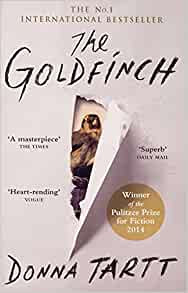
THE GOLDFINCH by Donna Tartt


"Donna Tartt is a simply wonderful writer: I was captivated by her descriptions of art, the deft characterisations of even the most minor characters, the setting of scene, the insights and honesty."

Linda Newbery edits Writers Review. Best known for fiction for children and young adults, with titles including the Costa Category winner Set in Stone, she has also published one novel for adults, Quarter Past Two on a Wednesday Afternoon, and is currently working on another. Her latest title, This Book is Cruelty Free: Animals and Us, is a guide to compassionate living for teenagers and adults.

I didn't rush to read The Goldfinch, having given up on Donna Tartt's The Little Friend after reading about a third. Although that's something I rarely do, I was finding it a chore rather than a pleasure; hence my delay in reading this. Now, though, nine years after publication, I've completed it and am full of admiration.

My reading was hybrid: part reading, part listening to the audio version (wonderfully read by David Pittu). At more than 770 pages it's a brick of a book, too heavy to carry on buses and trains, and this tactic made the length seem less daunting, though before long I was absorbed and by the end felt the sense of loss at finishing that great books can leave you with, and a need to return to several episodes for a second reading.  

Aged thirteen, Theo Decker survives an explosion that kills his mother and dominates his life from then on. Minutes before the catastrophe, the pair had been admiring The Goldfinch, a painting by the Dutch artist Carel Fabritius, in a New York gallery. In the confusion that follows, the boy tries to help a dying man and a strange, intense bond is formed between them, one that will dictate the course of the adult Theo's life. This elderly man, Welty, a furniture restorer, asks of Theo two things: to take the goldfinch painting, and to go to his shop with a warning for his colleague. Welty's charge, a girl a little younger than Theo, is also badly injured in the explosion, and the two will form a close attachment.

The painting's totemic significance stays with us to the end, prompting meditations on the meaning of art, the power of communication, and the sense of loss. Fabritius was himself killed in a gunpowder explosion at the age of 32, and The Goldfinch (Het puttertje in Dutch) may have been in his workshop at the time. It's a small trompe l'oeil painting showing a beautiful but pitiable finch chained by one leg to a wall-mounted box: kept as a pet or ornament, suffering, unable to escape. That Fabritius painted it in the year of his death adds poignancy. In real life it's safely in the Mauritshuis in The Hague, but in Tartt's novel the painting is taken by Theo who for various reasons keeps it, the secrecy weighing heavy on him: "How had I ever thought I would keep it hidden? I'd meant to deal with the painting for years, get it back where it belonged, and yet somehow I had kept on and on finding reasons not to. To think of it wrapped and sealed uptown make me feel self-erased, blanked-out, as if burying it away had only increased its power and given it a more vital and terrible form. Somehow, even shrouded and entombed in the storage locker, it had worked itself free and into some fraudulent public narrative, a radiance that glowed in the mind of the world."

Theo's father having deserted the family, Theo is for a while looked after by the wealthy parents of a school acquaintance, later being claimed when his father reappears and takes him to a haphazard life in Las Vegas. Here he meets Boris, a Ukrainian boy used to fending for himself, until circumstances force a return to New York. Home and employment are provided by the kindly, self-contained James Hobart (Hobie), Welty's business partner, who introduces Theo to the techniques of furniture restoration. The love with which Hobie practises his craft is touching: "Hobie lived and wafted like some great sea mammal in his own mild atmosphere, the dark brown of tea-stains and tobacco, where every clock in the house said something different, and time didn't actually correspond to the standard measure but instead meandered along at its own sedate tick-tock, obeying the pace of his antique-crowded back-water ... In blameless quiet, he buried himself in his work, steam-bending veneers or hand-threading table legs with a chisel, and his happy absorption floated up from the workshop and diffused through the house with the warmth of a wood-burning stove in winter ... " We sense that lasting security, and mutual love with Pippa, the damaged girl, could be Theo's future, were it not for his involvement in dubious sale deals and the re-emergence of Boris with a revelation that leads him into serious crime. 

It's partly a coming-of-age story, partly a crime thriller, and I admit that the convolutions of the latter plot lost me somewhat; I'd struggle to explain in detail who was who and exactly what happened. But, beyond being concerned for the fate of Theo and the painting, this wasn't what interested me most. Donna Tartt is a simply wonderful writer: I was captivated by her descriptions of art, the deft characterisations of even the most minor characters, the setting of scene, the insights and honesty, in this narrative supposedly written by Theo himself. I marked several passages that particularly struck me, but really could have noted something on almost every page - an indication of a brilliant novel. Surely if I return now to The Little Friend I'll find the same qualities there.

The Goldfinch is published by Little, Brown


Monday, 9 December 2019

Guest review by Yvonne Coppard: FLÂNEUSE by Lauren Elkin


"It has motivated me to ditch the car, don the trainers and become a flâneuse myself, wandering the city in which I live but know so little about."


Yvonne Coppard is a writer of children’s fiction, non-fiction for adults and occasional columns and articles in a variety of publications. She is currently a Writing Fellow of the Royal Literary Fund, working with businesses and public service organisations to promote clear, understandable English in written communication. See more on her website.

Trying to describe what this book is and why I loved it will be a challenge. It’s part memoir; part cultural commentary; literary biography and history, underpinned by a skilful evocation of our human need for connection.

The term flâneuse is Elkin’s adaptation from the masculine noun ‘flaneur’: an idle, aimless wanderer. The flâneuse, like her male counterpart, walks the streets with no other purpose than to blend and observe. The seemingly small point about adapting language is actually fundamental to Elkin’s approach; she is a woman reclaiming territory that was traditionally assumed to be exclusively male. Although the term ‘flâneuse’ already existed, the Dictionnaire Vivant de la Langue Francaise defines it as ‘a lounge chair’. Elkin’s perspective is clear: search for images of ‘flâneuse’, she says, and you get: “a drawing of George Sand, a picture of a young woman sitting on a Parisian bench and a few images of outdoor furniture…. Is that some kind of joke? The only kind of curious idling a woman does is lying down?”

Elkin is a native New Yorker with experience of life in Tokyo, Venice, London and Paris, which is now her permanent home. She has negotiated the nuances that must be grappled with in order to make the change from tourist to resident; she understands the difference between living in a community and feeling integrated into it. Elkin’s account is infused with the keen observation and insight that being an outsider affords. She includes slices of the lives of flâneuses who have gone before her: writer Virginia Woolf; artist Sophie Calle; journalist Martha Gellhorn and film-maker Agnes Varda, among others. All of them were keen observers of the environments they moved through and blended into. Their stories are fused with Elkin’s developing insights into her own experience.

“Why do I walk? I walk because I like it. I like the rhythm of it, my shadow always a little ahead of me on the pavement… Walking is mapping with your feet. It helps you piece a city together, connecting up neighbourhoods that might otherwise have remained discrete entities, different planets bound to each other, sustained yet remote.”

Established in Paris, Elkin falls in love and agrees to move with her French boyfriend when he takes a job in Tokyo. Uprooted, displaced and unnurtured, Elkin struggles to connect with her new home and, ultimately, her partner. Her description of the final stages of their soured relationship is powerful.

“Dead words, dead tongue, dead of disuse, my mouth stuck shut… I said in your language, which I have come to speak, ta langue, ta langue dans ma bouche, and you’ve brought me to this place where my new tongue lies flat in my mouth. A crack in the road, the sidewalk blistered, how long has it been since I left New York concrete for Paris cobblestones? Why am I here, where I can’t ask for aspirin, or sleeping pills, where the yogurt aisle is a tofu aisle? I can’t think straight, I can’t make one thought lead to another, I just tell you I hate it and hate it, and I mean you, and before we know it I am breaking things and jumping up and down and screaming at you in your tongue, in my tongue, in my mother tongue. My mother spoiled me, you say. But you have spoiled us. I never thought I’d be here.”

The breadth of Elkin’s sweep across art, literature, history and politics is impressive, signalling its roots in the post-graduate research that led her to write the book, but her own story is the connecting thread that unifies the whole. Ultimately, it is the uplifting and inspirational account of a search for the true self, and the landscape that resonates with the soul. It’s a book that I think will be satisfying to return to again and again over the years, offering something fresh each time. Meanwhile, it has motivated me to ditch the car, don the trainers and become a flâneuse myself, wandering the city in which I live but know so little about.

Flâneuse is published by Chatto and Windus.