Showing posts with label relationships. Show all posts

Monday, 17 August 2026

Guest review by Cindy Jefferies: THE NEEDLE'S EYE by Margaret Drabble


"A master of her craft."

First published in 2001 for children, Cindy Jefferies found success with her Fame School series with Usborne Books, obtaining 22 foreign rights deals. Latterly writing fiction for adults as Cynthia Jefferies, her first title The Outrageous Fortune of Abel Morgan was published in 2018, followed a year later by The Honourable Life of Thomas Chayne, set during the English Civil Wars, followed in 2019. Both titles are now available in paperback.

I admired Margaret Drabble’s work so much that I read each of her novels, one after the other, through my late teenage years. Eventually, in 1972, the year The Needle’s Eye was first published, her sixth novel, I married and took myself off to the West Coast of Scotland, burying myself in the Highlands while I raised twins. I don’t think I have read anything from her since then. Then, last year on my birthday, one of those twins, my daughter, gave me The Needle’s Eye as a present. It took a while to reach the top of my reading pile but eventually it got there and I devoured it!

Reading her for the first time in fifty-odd years I was struck how different her writing is from my memory of it. In the 70’s I read each novel almost as a thriller. I couldn’t put them down. I had totally forgotten the reflective pace of her work, the many words used to set the scene. But then, this novel is a world away from our shiny, frenetic pace of life today. It is the world of my youth, of draughts, knitting children’s jumpers, coal dust, washing up at the sink, not possessing a car. It was a world where sexual equality was a toddler, constantly falling over. It was also a world where I was thirsty for literature.

Fifty years on, it took me a few pages to get into The Needle’s Eye. I found myself impatient for ‘something to happen’. Had I really galloped through her books in my twenties? If so, what a lot I had missed, and yet, I remember stopping to read a word, a phrase, a sentence several times, sometimes aloud to savour the taste of it, thrilled to read a master at work. The truth is, half a century on, one is not the same person. I couldn’t possibly read it as if I were twenty. But then I relaxed and decided to read with no prior expectations, as if I’d never read any of Margaret Drabble’s work. And the miracle happened. The long, slow unwinding of the plot that demands you attend to the depth of her writing. There it is, and it felt like coming home.

Rose marries against her parents wishes and renounces her inheritance. Her marriage is difficult and she eventually separates from Christopher. When she meets Simon, an unhappily married barrister, they become friends and he is able to give her legal advice. He can’t understand why she insists on living in a run down street. Is she simply stubborn? As he gets to know her better he admires her more. She fights for her children, distraught that she might lose them. She wishes to live a real life, as other people do, not a life of privilege. Her family and estranged husband might view her intransigence as stubborn foolishness but Simon eventually sees the real depth of her character.

Margaret Drabble is a master of her craft. I love the way she can paint a brief picture of something that will have little effect on the story but which lives with me, long after I have finished the book. The woman in a shop, telling of the pram cover she was knitting, rather than getting on with the purchase. The boat, seen out at sea, then glanced at again, closer in, and then, when only the author is left to see, it disembarks several disorientated men who scuttle away. We are left to wonder whether they are perhaps refugees, or illegal migrants of one sort or another. They are part of a different story, one that has not been told, at least not in this book. Each time, these glimpses of other lives enrich the novel, giving it a depth that remains unexpected, every time it happens.

In contrast, we get enough detail about Simon and Rose to feel we know them very well from their thoughts as well as their decisions, although there will always be things about them we will never know, things maybe they don’t know themselves.

There are a few later novels from this writer that I have never read. I now want to revisit The Millstone, one I have read before, but also I will find one that I can come to honestly fresh. Thank you, lovely daughter, for reintroducing me to a writer I didn’t know how much I had missed!

The Needle's Eye is published by Canongate.

More reviews by Cindy:

The Master by Colm Toibin  


The Wolf Border by Sarah Hall


Thirteen Moons by Charles Frazier


Monday, 17 November 2025

SPECIAL FEATURE: Q&A with Sheena Wilkinson about her new novel MISS McVEY TAKES CHARGE


"I’m always keen to be historically accurate but of course Felicity, and to a lesser extent April, represent the more forward-thinking people of their time ..."

Miss McVey Takes Charge: Yorkshire,1936. April McVey is in charge of True Minds Marriage Bureau, trying to find happy futures for the lovelorn of Easterbridge, while the menace of fascism marches through the country.

After two years of matchmaking, she thinks she has seen it all. But when an old friend arrives from Ireland, with a broken heart that’s well beyond April’s experience, and then a young nun asks her to find a match for her lonely brother, the consequences are shattering.

And as political turmoil reaches their own community, will April have the courage to take charge and do the right thing?

Sheena answers questions from Linda Newbery.

Linda: First, congratulations! It's lovely to see this in print, with such an enticing cover. It'll be a treat for readers of Mrs Hart's Marriage Bureau, while for those who haven't yet read that, it'll surely send them to it. Did you already have a sequel in mind while you were finishing the first book?

Sheena: Yes and no! I wrote Mrs Hart’s Marriage Bureau as a standalone, but the acquiring editor at HarperCollins Ireland was very enthusiastic about its obvious series potential. Which got me thinking… So in my final edit I did drop in a few details I could pick up on for the sequel.

As it turned out, as is the way in publishing, that editor moved on and HarperCollins didn’t offer for the sequel next book because of what they termed ‘disappointing sales’ of Mrs Hart. But by then, encouraged by hundreds of reader reviews which asked for another story, I had written it! I couldn’t bear those readers not to get their sequel, and by then I had put a year’s hard work into it.

I had considered self-publishing but to be honest I was stalling, overwhelmed by what seemed the scariness of it, when Writers Review Publishing invited me on board. I was so thrilled! I was lucky enough to work with Michelle Griffin, the freelance editor who’d worked on Mrs Hart and so knew – and loved – the world, and with Niall McCormack, the illustrator who had designed four of my previous covers. He has a gorgeous style and a real understanding of the aesthetics of the period, and I adore what he’s done.

Linda: I like the way you show April and Felicity adjusting to their lives together - managing domestic and practical details as well as, in April's case, questioning Felicity's commitment. Did you find it tricky to strike the right balance between acceptance of same-sex relationships and giving a realistic impression of attitudes at that time?

Sheena: It was something to think very carefully about, but this is my seventh historical novel, albeit only my second for adults, so treading that line has become very natural. I’m always keen to be historically accurate but of course Felicity, and to a lesser extent April, represent the more forward-thinking people of their time. Because I have a range of characters it was easy enough to show a convincing spread of attitudes, not only about sexuality but about, for example, greyhound racing, which was a hugely-popular sport at the time, with some characters enjoying it without questioning the ethics, and others voicing the opinion that it’s cruel, which is more in keeping with modern sensibilities (and, I know, yours).

Linda: It's just as much Evelyn's story as April's, and this enables you to set some of the scenes in Lisnacashan, the town in northern Ireland where April grew up. When talking about the first book, you said that you'd chosen to set it in Yorkshire, rather than Ireland, to avoid some of the religious divisions that would hamper things in the marriage bureau, but did you immediately see a way to use those here?

Sheena: It's funny, but I never really thought about that until this question! The answer is that when you set anything in Northern Ireland, especially in the past, you simply can’t get away from engaging with religion. It’s just there in the ether and so it found its way into the book. It’s ironic, perhaps, that Protestant Irish Evelyn falls in love with a Catholic Englishman … I come from a mixed background myself which I think informs my outlook on life and my work and helps me to see things in a balanced way.

Linda: You've described the first book as 'feelgood feminism' which is just as apt here - romantic elements and will-they-won't-they combined with awareness of the growing threat of Fascism, which comes close to home in the form of meetings in Easterbridge, a march in nearby Leeds and violence towards some of your characters. There are phrases here that are all too relevant to the worrying surge of the far right in today's public life and politics, and in fact the current situation has worsened during the time you were writing and editing the book. Did you adapt what you were writing in the light of that?

Sheena: The book was a long time in the making, and it rested for a full year before the final edit in the spring of 2025. Even in that year, as you say, things grew much worse for women and other marginalised groups and we’ve seen a surge in far-right attitudes across the world. When Martha comments on the ‘nastiness’ in the atmosphere, I felt very sad that she could be commenting on Britain and other countries today. The best historical fiction should show us ourselves as well as our ancestors: I wish that Miss McVey Takes Charge wasn’t quite so relevant to today’s struggles, but I was grateful for the chance to explore the tension between the political and the personal, and the frustration of feeling up against what feels like an overwhelming tide of bigotry and hatred, in the relatively cosy world of Easterbridge.

Everyone knows about the Battle of Cable Street, which is mentioned at the end of the novel, but the Battle of Holbeck Moor in Leeds on 27th September 1936 is less famous. There was no way Felicity wouldn’t have attended that anti-fascist rally, so I always knew it would form an important part of the narrative. I’ve often written about real-life events but this is the first time I’ve put my fictional characters right in the thick of the action.

Linda: The story ends at a time when the threat of war in Europe is looming. Do you have any plans to continue the story of April and Felicity farther into the 30s or even into the war years?

Sheena: At present I don’t have any such plans. I’ve a novel nearly ready for submission which is set among the staff of a Belfast girls’ school in the 1920s, and my work in progress is a dual timeline set between 2024 and World War 2. So there are no immediate plans to go back to Easterbridge. Having said that, I love April and her friends and if I felt that there was a new story to tell – and, crucially, readers wanting it —I’d love to go back and tell it. And yes, Easterbridge at war would be the ideal focus. I can imagine the Colonel opening up his home to evacuees and the Mill running first aid classes.

As for the structure, I will always highlight the female perspective, but I like giving the men their say too. I love the challenge of writing from a male point of view, and both Fabian (in Mrs Hart’s Marriage Bureau) and Charlie (in Miss McVey Takes Charge) are the closest I have come to writing romantic heroes. I have to admit I fell in love with Charlie a bit so I hope readers do too!

Linda: The novel is cleverly plotted and moves on at quite a pace. Are you a detailed planner - did you plot each episode before you started writing? Were there any that grew out of the telling, and surprised you? Did any of the characters develop in ways you hadn't quite planned?

Sheena: I do plan, yes, and because of having three viewpoint characters I have to think about who’s best placed to carry the narrative at any given point. But that generally happens as the story unfolds rather than in advance. I always have a big notebook full of notes and planning but I don’t over-plan and I love to be surprised.

The first scene came to me in Shropshire in autumn 2023. I was walking in the woods and playing out the conversation between April and Margaret, who enlists the bureau’s help to find a wife for her brother, Charlie. I saw her as a handsome, but very plainly-dressed young girl, and then I thought, Good lord, she wants to be a nun! And that ushered in Charlie’s background and his faith – I hadn’t actually sat down and planned that, which seems odd now as it’s absolutely fundamental to the conflicts of the story. I love being open to that kind of thing; it makes the writing much more exciting.

Linda: Besides reading, are there other things you do to immerse yourself thoroughly in the social life of the 1930s - fashion, food, manners, idioms, etc?

Sheena: Oh yes! I have always been a geek about history and especially the kind that’s not too long ago. I read a lot of 1930s fiction, from Noel Streatfeild to Dorothy Whipple, and l love reading about the minutiae of daily life. I can get lost for hours on websites full of 1930s dress patterns and the like, and I love nothing better than a day at a museum, especially the kind with reconstructed houses, etc.

I was always very close to my granny, who was born in 1908 and lived until she was 96, and I loved hearing her stories about ‘the olden days’. She would have been a contemporary of the main characters and I’ve given April, Felicity and Evelyn some of her frocks, based on old photos of Gran and Aunt Annie and their chums on church outings and the like. Of course the snaps are all in black and white so I’ve had to guess at the colours. Isn’t that an ideal metaphor for what historical novelists try to do?

Linda: It absolutely is! Thanks, Sheena - I hope Miss McVey will continue to win the hearts of readers.

Miss McVey Takes Charge is published by Writers Review Publishing.

See also: Q&A with Sheena about Mrs Hart's Marriage Bureau


Also from Writers Review Publishing:

The Poet's Wife by Judith Allnatt

Monday, 4 August 2025

NINTH BIRTHDAY SPECIAL FEATURE: guest Michèle Roberts chooses OFFSHORE by Penelope Fitzgerald


 "Her genius is to record her characters’ flounderings with infinite compassion. Her imagination works as a kind of embrace, both tender and supremely intelligent."

Photograph: Viv Pegram
Michèle Roberts
is half-French and half-English. She has published fifteen novels, plus poetry, memoir, essays and artist's books. Her first cookery book French Cooking for One came out in 2024. She is a Fellow of the Royal Society of Literature, a Chevalier dans l'Ordre des Arts et des Lettres, and Professor Emeritus at the University of East Anglia. She lives in London.


My (highly subjective) definition of a classic novel is one that I regularly re-read. Penelope Fitzgerald’s Offshore (1979) perfectly fits that bill. I enjoy it more every time I read it, relishing its celebration of unconventional attitudes, its sharp observations of the thrills and dangers of life afloat, its wry, dry humour that makes me burst out laughing. Fitzgerald’s humour is rooted in her lack of sentimentality, her honesty about human behaviour, the messes we make, our illogical yearnings, the way we sabotage ourselves. Her genius is to record her characters’ flounderings with infinite compassion. Her imagination works as a kind of embrace, both tender and supremely intelligent.

The novel’s ending is pre-figured in its beginning. Grace, a leaky old barge with a rotting anchor, no cabin doors and unreliable plumbing, is moored at Battersea Reach on the river Thames. Other nearby boats are in similarly dodgy condition. Sooner or later, we begin to suspect, disaster will occur; possibly even drowning.

On board these rickety, rackety craft live an eccentric crew of neighbours, all lovers of the water in different ways. Chief among them, on Grace, is Nenna James, her two young daughters Martha and Tilda. Nenna is estranged from her husband, who skulks in a rented room in far off north-east London. One strand of the engaging plot concerns Nenna’s hapless attempts to stay afloat morally and financially, to keep an eye on her truant children, to deal with her need for love and sex. Fitzgerald draws splendid sketches of the earnest priest visiting from the local convent school Martha and Tilda attend, the hopeful marine artist trying to sell his boat while knowing it is riddled with leaks, the chancer-thief hiding his stash of stolen hairdryers below decks on another craft nearby, the kindly ex-naval stalwart who tries always to do the right thing: “Duty is what no-one else will do at the moment. Fortunately he did not have to define duty. War service … and his whole temperament before and since, had done that before him.” Even Nenna’s cat, Stripey, is given a portrait, a place in the story.

Fitzgerald writes well about men. In these pages they may be unheroic, self-deluding and occasionally incompetent (just like the female characters) but they are never mocked. Richard, the ex-naval officer, says to Nenna: “I can’t for the life of me see why, if you really feel something, it’s got to be talked about. In fact, I should have thought it lost something, if you follow me, if you put it into words.” Later in the chapter he does manage to pursue his conversation with Nenna, and to act on his feelings. When they return from a trip in his dinghy and tie up alongside his boat, Lord Jim, he realises “He had to do the right thing. A captain goes last onto his ship, but a man goes first into a tricky situation … Their sense of control wavered, ebbed, and changed places.”

Nenna’s younger daughter Tilda regularly swarms up the mast of the barge, the better to survey the movements of people below, the swelling tides, the shifting light. These are all lovingly, beautifully and accurately described. Tilda stands for the novelist herself, sometimes seemingly omniscient and sometimes inhabiting a close-up perspective, surveying the world she inhabits and has brought into being and valuing its goodness mingled with its flaws.

The major delight of this short, packed novel, for me, lies in its brilliant writing, which of course creates and illuminates its story and its characters. In the gap between land and river, wharf and deck, Penelope Fitzgerald entrancingly suggests that we can find and explore both freedom and belonging.

Offshore is published by Harper Collins.


Monday, 28 April 2025

Q&A: Jane Rogers interviews Linda Newbery about THE ONE TRUE THING


"Each of the three characters - plus Adam, first appearing as a young artist, who isn't a viewpoint character but is equally important - finds, or tries to find, the activity that gives purpose and meaning to life ... "

Linda answers questions from our regular contributor Jane Rogers.

When the ground shifts, where is one true thing to be found?

Jane, in her twenties, is left parentless when her father dies suddenly; a second shock follows when his Will reveals the existence of a son no-one knew of. Now Wildings, the family home, must be sold. Spanning two generations, the novel tells the story of Bridget, Jane’s mother, trapped in an unhappy marriage on which her career depends, and of stone-carver Meg, who wants only independence but is enmeshed in conflicting loyalties and desires when Adam, a young artist, enters their lives, to devastating effect.

Now far from Wildings, Meg is bound by a promise to support Jane in her loss. Having thought of herself as an observer who saw everything, she’s forced to realise how much she failed to see – and the cost to those she loves ...
 
Jane: Congratulations, Linda! Re-reading this book (Jane read an earlier draft) transported me back to the beauties of Wildings and filled me with admiration all over again, for your clever plotting and beautiful descriptions of nature. I’m interested in the way you can shift between writing for children, and adult fiction. In your best-known book for young readers, Lob, you conjure a beautifully innocent child’s view of the world, where love of nature and a powerful imagination are the key ingredients. And that book appeals to adult readers too, because we all have a nostalgia for that kind of innocence.

In complete contrast, The One True Thing is a very grown-up novel, in its exploration of a whole range of sexual relationships: Bridget and Anthony’s marriage shifts through passion and intimacy to downright hostility and back, via infidelity, to a benign accommodation with one another; we learn of Meg’s lesbian love affair with Carrie, who dumps her for a man; there are hints of incestuous attraction between two other characters. How conscious are you of your readership, as you are writing? And does a story always present itself clearly to you as either YA or adult?

Linda: The One True Thing was never going to be anything other than an adult novel, and that's true of my work in progress, too. With teenage fiction there have been times when the boundaries (if there are boundaries) have been less clear: for example with Set in Stone, which I began as a YA novel but for fairly sophisticated readers, and with the hope (which I always have) that it would be enjoyed by adults too. Sometimes I find that a story wants to go in a direction I hadn't planned at the start, and that's what happened with Set in Stone, which caused some controversy when it won the Costa Children's Prize. Some argued - and I'd agree - that it isn't a children's book. But the eligibility for that category does include age groups up to and including YA, so the same could and probably has been said of other winners more suitable for the upper end of young readers. But I won't write any more YA - my focus now is on adult fiction, alternating with stories for young children. 

Jane: The creation of Bridget’s garden is at the heart of the book. Did you have to do a lot of research, or were you already a gardening expert?

Linda: I certainly wouldn't call myself an expert, but I do know quite a lot about gardening and had a clear idea of Bridget's style and approach. I did need to research Chelsea Flower Show garden criteria for the particular year in which two of my characters make a small artisan garden. At the time I was writing the novel, I attended a talk by James Alexander Sinclair, who lives locally and is a Chelsea judge; after the event I emailed him with a few questions, which he very kindly answered, showing me where to find out more.

Jane: Where did the novel spring from? Can you talk us through the inspiration, the starting points? Or maybe I should say, the seeds?  I was fascinated by the precise descriptions of Meg’s work as a stone mason, and I note the book is dedicated to a stone-mason. Can you carve stone? Is this another of your hidden talents?

Linda: I can't exactly remember the starting point - several years ago - but I do seem to have developed a fascination with stone. That started with my late mother's photograph of a caryatid at Copped Hall in Essex, which set me off on The Shell House - Graveney Hall in my novel is based on Copped Hall, inhabited by a fictitious family, but almost destroyed by a devastating fire in 1917, just as the real mansion was. The caryatid, and the sculptor who made it, didn't feature as much as I'd expected, the novel being concerned with a First World War relationship and with a young photographer who discovers the ruins in the present day. So, fairly soon after I'd finished it, I began another novel more focused on stone-carving: Set in Stone. While doing some hands-on research for that one with a local stonemason, Bernard Johnson, I learned to appreciate the beauty of letter-carving, and wanted to have a go. My efforts are very clumsy compared to Bernard's exquisite work (which you can see on his website) but at least I had the tools in my hands and began to understand something of the materials and techniques. I wanted my present-day stone-carver in the new novel to be female, and the character of Meg grew from there, along with how she'd fit around the other characters. 

Jane: What is your writing process? In this novel, Bridget, Meg and Jane all have their own stories and points of view, which are intercut. Did you write them like this, or work on each woman’s story-line separately?

Linda: I seem to have to work like that, moving back and forth in time and/or with intercutting viewpoints - my work in progress has a similar structure, and so do several of my young adult novels (Set in Stone, Sisterland, The Shell House). I don't think I could do it by working on each character individually, because so much depends on the juxtaposition, and what I want the reader to think, wonder, predict or piece together at any one point. When finishing a section from one point of view, I need to leave off for a while, go and do something else, then return (probably next day) with my head in the viewpoint of another character. 

Jane: I hope you won’t mind me saying that I found a lot of you in this novel; yoga, gardening, Extinction Rebellion! 

Linda: Yes, at times while writing I feared that I was using up everything I knew and could write about with authority ... but luckily there are more interests left over (photography, animal activism, an artist I've been intrigued by for many years) for the novel I'm working on now. In The One True Thing, each of the three characters - plus Adam, first appearing as a young artist, who isn't a viewpoint character but is equally important - finds, or tries to find, the activity that gives purpose and meaning to life. Meg is the one who uses the phrase, but it's significant for all of them. 

Jane: I know this novel has been a long time coming to fruition (sorry about the gardening metaphors!) Both you and I, and indeed many other writers, have had trouble finding a publisher for a completed novel – can you tell us the publishing history of this book?

Linda: Sadly, it can be very difficult for an author, even a well-established one, to find a publisher if her or his sales are less than spectacular - and that category includes most of us! Having published only one adult novel before (Quarter Past Two on a Wednesday Afternoon, in paperback as Missing Rose) I'm not yet established as a writer for adults, and I've heard from you and from other acquaintances that much better-known authors than me are finding it a struggle. The One True Thing was submitted, but isn't what publishers are looking for at present, and even though most praised the writing, characters, etc., they clearly didn't think they could make money from it. Although it's tough being rejected, I never lost the sense that readers would enjoy my novel, so I refused to give up on it. 

I'm grateful to Fiona Mountain, a well-regarded and traditionally published author of historical fiction who I met through a reading group, for telling me how and why she had self-published her latest novel, Keeper of Secrets (which I recommend). When I discussed this possibility with friends Celia Rees and Cindy Jefferies, both of whom have wide experience of the publishing industry, Celia had the brilliant idea of forming an imprint, Writers Review Publishing, linked to this blog. That was a moment of epiphany! I'd felt diffident about publishing and promoting my own book as a solo effort, but being part of an author collaborative would be really rewarding - helping other writers to launch new books or reissue backlist titles that deserve to reach new readers, and all benefitting from joint publicity. It was so liberating to find that everything I needed was available: cover designers, interior layout designers, proofreaders, publicists. It had never occurred to me that I could commision my own audio book, but I've now done that through Audio Factory, choosing my preferred narrator. 

It didn't take long to assemble three of us - Judith Allnatt, Mary Hoffman and myself - to be part of the launch. Both their titles are excellent reissues: Judith's The Poet's Wife tells the story of Patty, the wife of poet John Clare, while Mary's David: the Unauthorised Autobiography imagines the life of the model for Michelangelo's iconic sculpture. Two other well-established writers, Dennis Hamley and Sheena Wilkinson, will publish with us later this year. How we progress will depend on what comes our way - though we already have plans for 2026. Watch this space!

The One True Thing is published by Writers Review Publishing. The cover design is by Owen Gent.

Jane Rogers' short story collection, Fire Ready, is published by Comma Press. Read more here.


The other two launch titles for Writers Review Publishing are Judith Allnatt's The Poet's Wife and Mary Hoffman's David: the Unauthorised Autobiography


Monday, 8 January 2024

SPECIAL FEATURE: Q & A with Julia Jarman about her novel THE WIDOWS' WINE CLUB


"It’s hard to define ‘voice’ but you can’t get going without it, and when I found my writing-for-adults voice it was a joy, like talking to a friend."

Julia Jarman, a regular contributor to Writers Review, has been writing children’s books for forty years, and still is. Cheeky Chick is her latest picture book. Recently, though, she turned her hand to ‘golden years’ women’s fiction and The Widows' Wine Club was the happy result. 

Linda: The starting premise of your novel is a brilliant one, with instant appeal. Were you always aware of how the novel would end for each of the three characters?

Julia: You told me it was a brilliant premise, Linda, when I first mooted the idea. I wasn’t so sure. I had a title in mind, I think, Widows In Love, and saw it as a rom-com. Three widowed women looking for love. It was as vague as that. I didn’t have specific outcomes in mind. I wrote the first draft to find out. You and other friends had begun writing for adults, after several years of successfully writing for children. I wondered ‘Can I?’ – as I like a new challenge - and you said firmly, ‘Yes you can!’

Linda: Did you find it equally easy to engage with each of the three main viewpoint characters? I know that the novel has been several years in the making – how have they developed during this time?

Julia: It has been a very long time in the making! I got the idea soon after my husband died in 2009 and thought of it as ‘Peter’s last gift to me’ but also felt guilty for exploiting the situation. It felt like an invasion of privacy, his privacy, our privacy, and that feeling may have held me up. But Peter had always encouraged my writing and said ‘use anything you like’ when I’d expressed similar reservations in the past. Sweary Viv was the first character who arrived in my head, probably because she is most like me, but I’ve also got a prim and proper side – believe it or not! – and was downright Puritanical in my youth, so I easily identified with Janet and knew where she was coming from. Zelda turned up, and aware of the ‘appropriation’ issue, because she’s mixed race and I am not, I hesitated, but she soon felt very real and insisted on staying and I loved her, so I thoroughly researched to find out as much as I could about her circumstances and carried on writing. All three developed over time. I discovered them as they discovered themselves, becoming more complex, acquiring ‘layers’ as I wrote and re-wrote, drawing on memory, research and imagination.

Linda: I especially like the Pitmen Painters scene. Is this an exhibition that has particular resonance for you?

Julia: Yes! Like Viv, the first I heard of it was when I went to see Lee Hall’s play, Pitmen Painters. It said, it enacted, what I believed, that human beings are makers, that we are more alive, more ourselves, more human when we create. That is what one of the characters says in the play. When he is working down the pit for the bosses he is not truly alive, not truly himself, but when he draws or paints, when he is depicting his reality, expressing his truth, he is. When I eventually stepped into the gallery to see the exhibition I felt I’d entered a holy place, embodying that truth.

I should also say that my father was a coal miner, briefly, three days and that was enough for him. He was put down the pit when he was fourteen and felt that a life in the mines would kill him, spiritually if not physically, though he wouldn’t have put it like that. He thought that no one should have to do that, and I felt that I was connecting with him.

Adèle: Tell us a little about the journey the manuscript took on the way to becoming the book it is today.

Julia: It had a lot of rejections, mostly nice rejections, but nonetheless disheartening. It first went out with the title A Second Summer, to fourteen mainstream publishers of women’s fiction, at the beginning of 2021. Some didn’t respond. Most did, complimenting me on ’wonderfully drawn characters’ ‘the balance of humour and depth’, ‘captivating style’ etc, but then came the ‘but not for me’ for a variety of reasons. Caroline, my agent concluded that it didn’t have the ‘SOH, the stand-out hook’ essential for commercial fiction and there was no point in sending it out again till it did. I was a bit nonplussed as I thought the SOH was the basic premise. Three women hit hard by grief, are looking for love. Will they find it? But I licked my wounds, re-read and re-wrote it, bearing in mind the feedback I’d had from editors and lay-readers. Several said they were confused by the to and fro-ing between the three characters, so I tried to put that right. I also strengthened a thread with an unpleasant minor character, making her more unpleasant, adding plot twists. I sent it out to more readers, including Georgia Bowers, librarian i/c of women’s fiction at Bedford libraries (and a writer herself), asking her to be ruthless in her criticism. Would she buy it for the library? She got back saying yes she would, but not with that title. She suggested The Widows’ Wine Club which I now think is its SOH.

In June 2022 my agent sent The Widows’ Wine Club out to nine smaller publishers of commercial fiction, and I got eight more rejections. Then came an expression of interest from Boldwood Books, a brand new publisher, only three years old. Editor Sarah Ritherdon had ‘thoroughly enjoyed’ my novel but had lots of doubts. It was hard to launch debut authors, she said. My 35 years as a children’s author counted for nothing. She asked my agent, ‘Had Julia got famous friends who would plug her book? Could Julia write more books? Quickly!’ Boldwood didn’t take one-offs. They only did multiple-book deals and their marketing plan required second and third books only months after the first. Gulp. The Widows’ Wine Club had taken me at least ten years. Could I write the next in ten months? Yes, said my friends – and I have!

Adèle: How many drafts did you go through? (I think the answer might be inspiring to other writers.)

Julia: Umpteen. I lost count. Ten at least, and I do a lot of re-writing as I write.

Adèle: Is any character in the novel based on a real person? I’m assuming all three widows have bits of you in their DNA!

Julia: Assumption correct about use of my own DNA! I’ve said quite a lot about this to Linda. As to the ‘real person’ question, I’m going to hide behind the standard disclaimer ‘any resemblance to actual persons, living or dead, is purely coincidental’. I’ll risk saying that some of the characters are composites of people I’ve met, but sorry - that’s as far as I’m going!

Celia: This is your first novel for adults – when and why did you decide to write for an adult audience? How difficult did you find it to make the move from a writing career that was well established to this very different and challenging market?

Julia: I think the story dictates the audience, so when I have a story in my head I ask myself, consciously or unconsciously, is this a picture book for under-5s, a chapter book for 8-12 or a book for teens? This story was clearly for adults. The difficulty was finding the time to write it as I was very committed to the world of children’s literature and that for me included a lot of school visits. I was finding it hard to find uninterrupted time to write longer fiction for children, and was veering more and more towards picture books, which I love writing, when Covid changed all our lives. Suddenly I had time on my hands and a story in my head, partly written, for adults. I fished out my widows.

Writing for adults is, I think, easier than writing for children, which is why so many writers going the other way, or having a ‘go’ for their first book, come a cropper. They think – heaven knows why – that it must be easier. It isn’t. When you are writing for children you have to be aware that you’re writing for an intelligent audience, probably more intelligent than you the writer, but your readers haven’t had as much experience as you. They don’t know lots of stuff that you know, so you have to impart information and explain concepts in a non-patronising way that respects their intelligence. By comparison when you write for adults, you can assume their experience is much the same as yours. It’s therefore easier to find your ‘voice’ as a writer for adults. It’s hard to define ‘voice’ but you can’t get going without it, and when I found my writing-for-adults voice it was a joy, like talking to a friend.

Celia: The Widows' Wine Club is bittersweet in the truest sense. How hard was it to find the right balance between humour and pathos?

Julia: I didn’t think about this. I just told it how it was, being as true as I could to my experience and that of other widows I’d spoken to. I am I think, unconsciously funny. I come across as funny even when I’m crying inside . I’m not sure why this is, but looking back I think I’ve always made people laugh. A testimonial I like said, ‘People laugh a lot in Julia’s company and if they don’t, she does. She is serious but splendidly without solemnity.’ If that was the verdict on my books I would be happy.

Celia: Your widows are an attractive and likeable group who will appeal to many readers. I understand that you're working on a sequel. Will there be more after that?

Julia: I’ve just delivered the sequel which has a new main character, Libby Allgood. I’m hoping that readers will love Libby as much as they love Viv, Janet and Zelda, and not be disappointed by this change of focus. Reviews have made it clear that readers want the sequel to tell them more about the three Muscateers, and it will, a bit. But they will have to wait for the third book to learn a lot more about all four when I take them on another adventure.

The Widows' Wine Club is published by Boldwood. Widows on the Wine Path will be published on 3rd April.


Monday, 30 January 2023

Guest review by John Case: I AM NOT RAYMOND WALLACE by Sam Kenyon


"Sam Kenyon's stunning debut novel ... a beautifully written story of love, loss and redemption; a tale of the emotional costs we can so often suffer for failing to be true to our true selves ..."

Training initially as an actor, John Case spent his early 20s working in theatre in the UK, before moving into the Arts and Heritage Sector, working as a senior manager with Surrey County Council’s Cultural Service Department, covering Performing Arts, Libraries and Heritage. Since 2020 John has been the Festival Director of the Rye Arts Festival, one of the South-East’s largest multi-arts festival, held every September since 1971. John is now working on the establishment of an exciting new project - The Rye Bay Book Festival, which he hopes to launch in 2024.

‘It is Monday October 14th, 1963, Raymond is twenty-one years old, and by the time he leaves Manhattan a mere three months later, on January 8th, 1964, he will have made the greatest mistake of his life.’

So ends the first paragraph of Sam Kenyon’s stunning debut novel, spanning a 30 year period from Manhattan in the winter of 1963, a month before President Kennedy is assassinated, to Paris in 2003. It is a beautifully written story of love, loss and redemption; a tale of the emotional costs we can so often suffer for failing to be true to our true selves; of the role that parental pressure can exert throughout our lives, but it’s also a snapshot of the wider intolerance that existed in 1960s America towards homosexuality; a time when homosexuality was still considered by many to be a ‘disease’ that could, at best, be cured by the psychiatrist or by religious correction. A time when gay men were forced into a dangerous illicit underworld, where to gain entry to gay bars and clubs meant knowing that particular secret ‘knock’ on the door to gain entry, and where the danger of arrest or attack was ever present. It was also a time when the The New York Times could actively publish scaremongering articles about an homosexual epidemic spreading across America - ‘They’re sick, you know? The result of inadequate parenting; absent or detached fathers, overbearing mothers; lack of significant masculine figure in the household…”

Into this 1960s world comes Raymond Wallace, a virginal 21 year old, newly minted from Cambridge University, to work at the offices of  The New York Times on a three-month bursary, where he is assigned to work with top journalist Robert C. Doty (a real life figure, but in Kenyon’s novel Doty is fictionalised) to undertake research for a leading article about the ‘growth of overt homosexuality’ in New York city. Remember we are still four years away from the Sexual Offences Act 1967 in the UK which permitted homosexual acts between two consenting adults over the age of 21, and even further away from legalisation in the United States.

Raymond, encouraged by Doty to venture into the hidden underworld of the gay bars of Manhattan, meets the charismatic Joey Maniscalco, and quickly begins an intense relationship, a relationship that will last physically for a mere three months, but one that will resonate across a generation for the next thirty years.

The relationship between Raymond and Joey is liberating, joyful, loving and beautifully brought to life by Kenyon. Even the intimate sex scenes, which can so often be the downfall of many a writer, work well here, blending perfectly within the main narrative. Both these men will, in time, become famous - Joey, a free spirt, confident in his own sexuality, supported by his beloved Papa, possesses a rare singing talent, whilst Raymond, the ironic observer, the recorder of stories, will find fame as a writer. Kenyon is adept at creating fascinating believable characters - Joey’s relationship with his loving Papa contrasts with the intense controlling relationship Raymond himself has with his own mother, desperate to see her son live a stiflingly conventional life, and who is instrumental in Raymond’s decision to walk away from Joey and return to England, eventually marrying and having a son of his own called Joe.

The novel is divided into three parts - the first covers the intense relationship of Raymond and Joey over that winter of 1963/4, the second, epistolic in form, taking place 20 years later, are letters sent by Joey’s Papa to Raymond, and unsent letters by Raymond to Joey,. The third part, set in Paris, see’s Raymond’s son, Joe, seek out Joey, who has now become a world famous classical singer. The three separate parts and the range of characters and timescales demand a deft, accomplished writing style and Kenyon pulls this off admirably.

It is difficult to write about this book without giving too much away, and I don’t want to spoil the final part, so do grab a copy and read it. I’m pleased to say that despite a significant sadness that takes place, Kenyon does give us, and his characters, a happy ending, and happy endings are something that we all need, particularly right now!

Full praise to Nathan Evans and Justin David from that wonderful independent publisher, Inkandescent, for giving us Sam Kenyon’s novel. This book deserves a very wide audience, as its themes are universal, irrespective of sexuality.

I am not Raymond Wallace is published by Inkandescent.

Sam Kenyon is a writer, composer, performer and teacher. His most recent theatre work is Miss Littlewood exploring the life of Joan Littlewood, which opened at the RSC in 2018. Find out more from his website.

Inkandescent Publishers: website

Rye Arts Festival website

Monday, 4 July 2022

Guest review by Sue Clark: REASONS TO BE CHEERFUL by Nina Stibbe


"Humour is as hard – some would say harder – to pin down on the page than so-called serious stuff ... That’s why, when comedy works, it is such a joy."

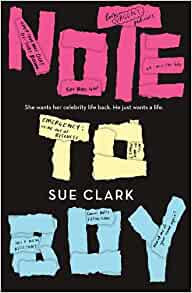
Sue Clark’s comic fiction, Note to Boy, was published in 2020 and received a PenCraft Award for Literary Excellence. She’s been a writer virtually all her professional life. Before her first novel, she was a comedy scriptwriter for BBC radio and TV, as well a journalist, copywriter, PR and jill-of-all-writing-trades. Note to Boy has been described as ‘both funny and tragic’, ‘warm, funny and life-enhancing,’ and just plain ‘terrific.’ She’s currently working on her second novel, another comic creation. Find more on her website and on Twitter: @SueClarkAuthor

I love all kinds of comedic writing – novels, plays, films, TV shows, stand-up routines – bring them on! However, one thing I can never get my head around is why comedy is so often dismissed as a lesser art. As anyone who’s ever tried writing it will confirm, humour is as hard – some would say harder – to pin down on the page than so-called serious stuff. I know. I’ve spent a lot of my time trying! That’s why, when comedy works, it is such a joy.

In Reasons To Be Cheerful, Nina Stibbe manages the extraordinary feat of writing a comic novel that makes you laugh, while reflecting quite deep thoughts about what it meant to grow up in the English provinces in the 1980s. I’m aware, as I write this, that all views on books are subjective, and those on humorous books particularly personal. What tickles my funny bone, may bring yours out in a nasty rash. You may not agree but, for me, Reasons To Be Cheerful is that rare thing, a comedy triumph.

I picked up Stibbe’s book up during the darkest days of the pandemic, mainly, I confess, because of its title. In dire need of cheering up, I hoped this tale of eighteen-year-old Lizzie Vogel, aspiring writer and guerrilla dentist, as she navigates the tricky passage to adulthood, might hit the spot. I wasn’t disappointed. I laughed – once I read the description of trousers worn hoisted high in the “European way” I knew I was in for a treat – but I was also bowled over by its moments of insight.

Winner of both the 2019 Bollinger Everyman Wodehouse prize for Comic Fiction and the 2020 Comedy Women in Print (CWIP) prize, Reasons To Be Cheerful takes Lizzie, also the subject of two of Stibbe’s earlier volumes, Men at the Helm and Paradise Lodge, to the brink of womanhood.

The book teems with entertaining, richly observed characters and absurd situations, mainly centred around the goings-on in the dodgy dental surgery in Leicester. The characters are comic creations, true, but comic creations with depth and heart, whom you mostly care about and are invested in.

Lizzie herself is wonderfully bright and idiosyncratic, rivalling Adrian Mole for endearing naiveté and know-it-all pretension. Like him, she has ambitions to be a writer. I might be wrong, but I feel her character was inspired, at least in part, by the young Miss Stibbe, since they apparently share a love for words and an interest in teeth.

The story, told in Lizzie’s voice, chronicles her chaotic family, and a disparate gang of friends and work colleagues. These include: Adèle, her gloriously uninhibited mother, who believes, “a thoughtful visitor should aim to be fifteen minutes late … and slightly drunk”; Lizzie’s boss, Mr Wintergreen, a monstrous and incompetent dentist who employs Lizzie as his assistant and creepily insists she holds his cigarettes to his mouth for him as he smokes; and Andy, the boy who delivers the dental plates, and becomes Lizzie’s first boyfriend and the object of her sexual desire, though he prefers birding.

The less pleasant side of the 1980s is acutely and dryly observed, from the fashions – one character sports “apricot hair and matching lipstick” – to odious Mr Wintergreen’s racism and Lizzie’s sexist-but-hilarious list of Things Men Don’t Like Women Doing, which she fantasises about sending to a women’s magazine. It includes: “… having a dog, talking about sport, laughing loudly, spending money on fripperies, disagreeing with them, chatting on the phone, climbing trees, talking about dogs, mowing the lawn in flip-flops ...”

Stibbe has the knack – shared by writers like David Nicholls and Kate Atkinson – of holding up a humorous mirror to everyday life without teetering over into caricature. She clearly loves her characters and wants you to root for them – apart from Mr Wintergreen. And every now and then she drops in a line or two that touches your heart and, mid-guffaw, you find you have something in your eye.

To be able to locate that bittersweet spot where absurdity meets truth, and a belly laugh catches in the throat is a gift given to few writers. Nina Stibbe, I believe, has it.

A lesser art, indeed!

Reasons to be Cheerful is published by Penguin.

Sue Clark's Note to Boy is published by Unbound.

Monday, 15 February 2021

Guest review by Jon Appleton: MEMORIAL by Bryan Washington


"Memorial is about the impossibilities of love as well as its opportunities ... sometimes tragic, often very funny, always true."

Jon Appleton is a freelance writer and editor based in London.

Just when Benson and Mike consider their relationship has run its course, but are afraid to call it quits (for the reasons that keep couples together), two significant things happen to Mike.

His mother, Mitsuko, arrives from Japan for a visit while his estranged father lays dying in Osaka (Mike is Japanese-American). Mike flees his life in Houston, Texas, leaving Ben with Mitsuko. Something big has already happened to Ben, before he met Mike, which we discover halfway through the story – something he has learned to accommodate but not entirely.

The first part of Memorial is narrated by Ben and deals with his experiences at work, with his friends and family, and his new unlikely flatmate, the dour and laconic mother-in-law. Ben adjusts to living without Mike in their apartment but can he move on without Mike in his life?

The second part of the novel is from Mike’s point of view in Japan. Whereas Ben’s paragraphs are bite-size and brittle (his voice is caustic at times), Mike’s are longer, more elliptical. It is through Mike we learn the story of their coming together and their falling apart.

As his father’s health deteriorates, Mike must take charge of the restaurant he runs – ironically, poignantly, the restaurant is named after his former wife. Mike negotiates new relationships with customers and staff and, like Ben, is offered the chance of new love. But he faces his lover’s dilemma: what does he want?

In the third section, Mike returns to Texas and both men have to make decisions – or do they?

Memorial is about the impossibilities of love as well as its opportunities. The novel challenges the foundations on which we construct our adult lives (including how we re-cast our parents). It poses the question: what is home? Mike writes:

‘I used to wonder what Ma meant when I asked her about Japan, because I could only remember so much of that shit from when I was younger, and she’d tell me it was different from home, but also the same. It was her home, not mine. But it was still home. Whatever that means.’

He also suggests that ‘You shouldn’t make a home out of other people’; people change, but ‘you’re stuck in whatever your idea of home was.’ He says this to his new lover, who doesn’t think it’s a problem. ‘We’ll all have plenty of homes in this life. It’s when you don’t that there’s an issue. That’s settling.’ Another acquaintance challenges Mike’s right to claim Japan as home: ‘But you’re not from here. You get to leave.’

For all his bluster, Ben is equally flummoxed. He tries to pin their projected break-up on Mike but Mitsuko is having none of it.

‘So Mike’s going home, I say and Mitsuko looks my way.

You could also say he’s leaving it, she says.’

Words trip over each other in quickfire banter. The novel brilliantly shows how language gets in the way of how we act and feel. Parents and children tiptoe round each other, wary of causing offence and intruding but equally wanting to make their bedrock beliefs crystal clear.

The novel is full of truisms, line after line, but in Washington’s hands they are never trite but malleable. Early in the book, Mike says, ‘Just because something isn’t working doesn’t mean it’s broken. You just have to want to fix it.’ Easy, right? Can you fault the logic of ‘We take our memories wherever we go, and what’s left are the ones that stick around, and that’s how we make a life’? Other arguments include: is good enough good enough? What about the policy that if something happens we deal with it? Words can be both weapons and shields.

Sometimes, you forget how people are, Mike suggests. And then they remind you. But there are some things you can never forget. Ben, an African-American, is all too aware of hard-line and casual racism. Both men acutely sensitive to homophobia. This is America in 2021 – this is life.

Memorial is sometimes tragic, often very funny, always true. A vital novel, which I’m so glad I’ve read and happily recommend.

------

Memorial is published by Atlantic Books.

Jon is a regular reviewer here. Read more of his choices:

Shuggie Bain by Douglas Stewart

The Dutch House by Ann Patchett


An Honest Man by Ben Fergusson

Clock Dance by Anne Tyler

Carnivore by Jonathan Lyon

Commonwealth by Ann Patchett


Monday, 1 February 2021

Guest review by Sue Purkiss: THE WILD SILENCE by Raynor Winn


"Often, a sequel is a rather paler version of the book it follows. That is not the case here ..." 

Sue Purkiss
writes for children and young people. She has been a Royal Literary Fellow at Exeter and Bristol Universities, and has also taught English and worked with young offenders. Her latest novel for children, Jack Fortune and the Search for the Hidden Valley, is an adventure story set in the Himalayas at the end of the 18th century, featuring plant hunters, a sacred mountain – and its mysterious guardian! For more information, see Sue's website. She also has her own literary review blog, A Fool on a Hill (where this review first appeared), and is a contributor to The History Girls.

This book is a sequel to The Salt Path (which I reviewed in 2018 - the link is below). That was the story of how Raynor Winn and her husband Moth, in their fifties, lost everything after a dispute with someone who had been a lifelong friend over investments: they had to walk out of their beloved Welsh farmhouse with virtually nothing. On top of that, Moth was diagnosed with a cruel terminal disease, corticobasal degeneration, or CBD; he had about two years, they were told.

There are many things that emerge from The Salt Path and its successor, The Wild Silence. But one of the main elements is the rock-solid relationship between Raynor and Moth. So when they found themselves in this terrible situation, the one thing Raynor was not going to do was to simply accept the diagnosis and the doctor's advice - which was to avoid all strain and rest as much as possible.

Another element - which is explored even more thoroughly in this second book - is Raynor's profound connection with the land, with nature. Brought up on a farm, shy with other people, nature is her solace and her inspiration. So perhaps it wasn't surprising that she should turn to nature for relief. She suggested that, against all the dictates of caution and common sense, they should take to the wild and walk the South-West Coastal Path - despite the fact that Moth could hardly walk and would have trouble carrying a pack. (In any case, they had so little money to buy food or any other necessities that their packs must have been relatively - but only relatively - light.)

And it worked. They had an extraordinary journey, which resulted not in a miracle cure, but certainly in an improvement in Moth's condition. And at the end of it, a stranger offered them a refuge - a flat in Polruan, where they could live while Moth did a degree in sustainable agriculture, which he hoped would then bring him emploment.

This is where the second book picks up the story.

Often, a sequel is a rather paler version of the book it follows. That is not the case here. It seems to me that Raynor has gained confidence in her writing - not surprisingly, considering the huge success of The Salt Path. She writes absolutely beautifully in this book, and very effectively investigates subtle and complex ideas and emotions - as well, of course, as providing rich and evocative descriptions of nature.

The structure of the book is complex. She is exploring different aspects and periods of her life simultaneously; in the first section she is taking care of her mother, who has been taken to hospital following a stroke. Alongside this we find that she and Moth are still, three years later, in Polruan, and that Moth, despite increasing weakness, is nearing completion of his degree - whereas Raynor has become increasingly reclusive and anxious about meeting people. She has to make a terrible decision about her mother's care, and, staying in her mother's cottage, memories come back to her of her childhood. We begin to see that her current state is rooted in the past, and we find out how she met Moth, and how their relationship developed.

Later, she describes how the writing of The Salt Path  came about. In the beginning, she knows nothing about publishing and has no expectations of success - she is writing about their extraordinary journey in order to capture it for Moth, who, to her dismay, is losing his memories of it. But of course it does become a success, and this leads to a new phase of their lives, when a wealthy businessman asks the two of them to take care of a farm he has bought, which is exhausted from intensive farming and almost devoid of wildlife. He wants them to bring it back to life, to re-nature it. At first, they are doubtful: the house is a damp and crumbling wreck, the farm will take a lot of work to enable the land to recover. But, never able to resist a challenge, they take it on.

In the last section of the book, they decide to undertake another ambitious walk: Moth is getting weaker, and they are convinced that what he needs, as before, is to literally and metaphorically stretch himself.

So they go to Iceland, with their friends Dave and Julie, whom they met on their first walk. They only have two weeks, which unfortunately fall at the end of the Icelandic summer and at the beginning of its fierce winter. Crazy? Well, perhaps - but when did that ever stop them?

Here is an example of Raynor's writing. She is describing the process of writing, of reliving, the coastal walk.

I stood in the dim evening light, faced the wall and spread my arms wide and the rain came stinging on gale-force winds, pounding my face, battering the rucksack. Winds roaring through granite-block cliffs, hurling crows through wild grey skies.

Here's another:

The soft rain became vertical rods of connection between land and sky, drops bouncing from the river with the force of a pebble, leaving ripples expanding and reflecting.

Enjoy.

The Wild Silence is published by Michael Joseph.

Read Sue Purkiss' review of The Salt Path


Monday, 16 November 2020

Guest review by Anne Cassidy: MONOGAMY by Sue Miller


" ... raises the issue of how we perceive the past. Does a recently-discovered fact about a partner of many years throw a shadow over the entire relationship?"

Anne Cassidy
writes crime fiction for teenagers. She has published over forty novels for young adults. She writes dark crime fiction and is best known for Looking for JJ which was shortlisted for the Carnegie medal. Moth Girls was published by Hot Key in 2016 and concerns the disappearance of two twelve year old girls. Her latest novel No Virgin describes the aftermath of a rape.


Monogamy appears, at first, to be a story about an older couple who have been together for a long time and are about to experience the heartache of infidelity. The story is told from two points of view; the wife, Annie and her husband, Graham. Both have been married before and have come together as experienced rather than damaged people. They seem like opposites; she is small and reserved, he is big and enjoys being the centre of attention. Their marriage has been long and even though they are very different, they have found happiness with each other. Graham, though, has recently strayed and is regretful. An unexpected and devastating event takes place which changes everything.

It’s a story that raises the issue of how we perceive the past. Does a recently-discovered fact about a partner of many years throw a shadow over the entire relationship? Annie struggles to accept what she has found out.

Sue Miller writes about relationships beautifully. Her characters have different, sometimes contradictory sides; Graham is attracted to a newly divorced woman but his love for Annie still consumes him. He acts on this attraction and hates himself for it. Annie is faithful finding what she needs in the marriage but her professional life has been unfulfilling.

Perception of the past is nicely highlighted when Annie meets a man she once had a romantic dalliance with thirty years before. She remembers the brief encounter intensely. He mistakes her for a different woman, though. This misremembered tryst symbolises the problems with perception of the past. Annie has to decide whether she can live with her new knowledge and forgive her husband of so many years.

I love Sue Miller’s books because they are full of flawed people who should make the right choices but don’t always. It’s not an uplifting book but it’s satisfying because it seems so truthful. 

Monogamy is published by Bloomsbury.    

See also Anne Cassidy's review of Elizabeth is Missing, by Emma Healey


Monogamy is published by Bloomsbury.