Showing posts with label Jon Appleton. Show all posts

Monday, 14 September 2026

Guest review by Jon Appleton: THE WELL by Elizabeth Jolley


"Wickedly funny, harrowing, mischievous and moving, The Well deserves its status as modern Australian classic."

Jon Appleton
is a freelance writer and editor based in London.


‘I don’t want other people coming here poking about in our lives. Kathy I want to tell you this so that we can go on the way we were.’

The 1980s were a fantastic time for Australian women writers. Interest was high: platforms to read and speak abounded in every state, awards and grants liberated authors from teaching loads and other work, colour supplements profiled their lives with each new book. There were even critical books and collections of essays devoted solely to women writers.

No wonder. The standard was dazzling, the personnel intriguingly diverse. There were younger writers like Helen Garner and Kate Grenville, writers embarking on the literary life in their 40s and 50s, like Marion Halligan and Olga Masters, and long-established writers being given new consideration, like Thea Astley, Jessica Anderson and Amy Witting.

Then there was Elizabeth Jolley, something of an outlier.

Jolley was born in Birmingham, in 1923, and migrated to Australia in 1959 with her academic husband and three children. (One of whom had been born within weeks of Mr Jolley’s first wife’s daughter’s birth …) Elizabeth Jolley had a trunkload of manuscripts on arrival which were relentlessly rejected by editors for 15 years until a local press snapped up a collection of short stories, and then another, and then a novel.

After which novels and short story collections poured forth, making her one of the most prolific of all Australian writers, which was a distorted picture as much of the work had been begun, and abandoned, and refashioned, before making it into print. She won award after award and attracted ravishing reviews, domestically and abroad – her books regularly appeared in the UK and America.

On panels, she cut a striking figure – with short, cropped grey hair, she had a clipped, almost girlish voice. She was very tall and habitually wore hippyish skirts and flat sandals. She peered out through squinty spectacles.

I read her stories avidly but if you’ve never encountered her work, here’s a list of reliable ingredients in a work by Elizabeth Jolley.

· Sexual obsession, especially between women

· Fathers and daughters

· Sexual abuse

· Leider music (Jolley’s mother was Viennese)

· The liberating sensation of dance

· Small-town oppression

· Nurses and patients

· Sexual repression, especially in prim, professional women

· The freedom and danger of frontier country

· A novelist’s obsession with their subject material (and its consumption of them)

You’ll find them all in her 1986 novel, The Well, one of Jolley’s best known works, and winner of Australia’s top literary prize, the Miles Franklin Award.

Late in the book, Jolley rallies: ‘She had not come home, at sixteen, from boarding school, in the middle of a term, to keep house for her father, her grandmother having died suddenly, and not learned how to speak to the men.’

The woman in question is Hester Harper, middle-aged or older, fighting to keep control of the only person she has been allowed to love; a feckless, rather vapid social-climber called Kathy, who she takes in from an orphanage – or was it jail? – as a young teenager and with whom she cultivates a totally interdependent life in a remote country town.

But inevitably the outside world encroaches, perhaps most dangerously of all, a young man they strike down whilst driving at night. There are no witnesses, and they pitch the body into an abandoned well on their property. But it turns out he isn’t dead – he’s also a thief - and he joins a throng of men determined to destroy the women’s privacy.

‘She understood too, at once, that she needed to be looked after, cared for, more than ever. She had never felt so afraid and so alone.’

And so resourceful, determined Miss Hester Harper – despite her ailing physical and mental well-being – will stop at nothing to preserve her sanctuary – but at what cost?

Wickedly funny, harrowing, mischievous and moving, The Well deserves its status as modern Australian classic. I’m pleased it’s just been reissued by Virago for today’s readers to enjoy.

The Well is published by Virago Modern Classics.

More of Jon's recommendations:

Whistler by Ann Patchett


Clock Dance by Anne Tyler

An Honest Man by Ben Fergusson


Monday, 1 June 2026

Guest feature by Jon Appleton: 'This is the Time We Have' - my decade with Ann Patchett


"I’ve reviewed Ann Patchett’s most recent decade of writing here on Writers Review across various posts. Maybe you’ve been reading alongside me, but if you’ve yet to read her work, perhaps I might suggest a roadmap ... "

Jon Appleton
is a freelance editor and writer. He publishes his research into the history of children's literature in a free e-zine called the gab. Visit: lettersfromrobin.com/the-gab

There is a moment about 50 pages into Whistler, Ann Patchett’s new novel, her tenth, where the narrator, 53-year-old Daphne Fuller, is speaking with Jonathan, her husband of two decades, and her senior by almost as many years. Jonathan is adjusting to retirement but Daphne isn’t ready for that change. They’re talking about their lives – what’s worked for them so far, and what may work for them in the future. Or not.

Jonathan looks at Daphne and says, ‘This is the time we have.’

Later in the novel, ‘They had nothing but time’ is even more resonant.

For me, these are a-ha moments, where a decade of reading thrillingly coalesced. I’ve actually been a fan of Ann Patchett for much longer than that – since her Women’s Prize-winning novel Bel Canto – but my appreciation has deepened over the last five books, a mixture of fiction and non-fiction.

Patchett’s novels are about the time we have available to us and the memories we can fit within the framework of now. These aren’t ‘what if’ scenarios but ‘what can we do with what’s happened’. She once wrote of her own personal experience: ‘we were so in the middle of history that we had no way to understand what we were seeing.’*  Her novels reveal a process of restricted reclamation. That means rejecting a bunch of things that don’t fit – and people, too. The people we can make room for aren’t necessarily our nearest and dearest. That often makes things … awkward.

Jonathan was widowed when he and Daphne met. Weirdly enough, they met in a professional capacity – surgical Jonathan treated Daphne’s dad, Buddy Zabriskie, late in life. Jonathan had two daughters with his first wife. Daphne does her best to get on with her stepchildren but she knows the limitations of the relationship. She sees what they see: ‘You make me sad, was what she was saying. You who weren’t supposed to be here.’ But here she is. They’re dealing with it.

Another brilliant line gives us ‘when you start to wonder about who you’ve hurt in this life, you can easily lose your mind.’ That’s Eddie Triplett advising against retrospective angst. He’s the disrupter of the novel. More than 40 years ago, he was briefly married to Daphne’s mother, Abigail, after she’d divorced Buddy, her girls’ father. In divorcing Eddie, Abigail not only banished him from the family but the publishing house for whom they both worked. The reason was apparently simple. One night, when Daphne was nine and her younger sister was fighting for her life in hospital, Eddie took Daphne – whom he adored and was fiercely adored by in turn – for a drive, and ran the car off the road. He smashed his foot and Daphne’s face was cut – she also had to free herself from the wreckage to seek help in deep snow. Nobody died, as Abigail has always admitted. So why the fierce ejection? Could there be another reason?

After Daphne meets Eddie unexpectedly one day in New York’s Metropolitan Museum of Art in the first pages of the novel, they have to address that reason.

She also has to finally explain that night to Leda, her brilliant sister, and so, alongside the story of Daphne and Eddie’s renewed acquaintance, we revisit the events of January 1980 and ultimately learn the story of a story Eddie told Daphne in the smashed-up car about a horse called Whistler which illustrates the many ways we fail each other and what a truly spectacular – yet almost mythic – thing it is to be capable of offering unequivocal loyalty.

Most of us will never manage that. We might be ‘decent people, smart people’, like the characters in this book, but acts of transcendence are generally elusive.

This dilemma applies to the characters in Tom Lake, Patchett’s previous novel, set during the Coronavirus lockdown where a mother reclaims her family – no mean feat, in the circumstances – and bows to their request to explain her past. It’s true, too, of Commonwealth, Patchett’s glorious seventh novel, which also concerns a moment in the past that shatters the status quo and a reciprocal moment in the present which has its own deep repercussions. But Commonwealth delves and weaves between the decades in a way that Whistler doesn’t. Whistler felt like a slighter novel as I read it – it’s certainly shorter – but the funny thing is, it’s stayed in my mind more vividly than any other Patchett novel I’ve read. Whistler makes fewer promises but to my mind it delivers most assuredly on the pledges it makes.

And actually, if you read Whistler (which I hope you do), you might agree with me that Buddy Zabriskie, though perhaps a failure as a husband and father, manages the transcendental.

While we’re speaking of fathers, I should mention that Daphne and Leda had a third – after Eddie, Abigail married again, an author, and lived with him for forty years, bearing him two sons. Daphne hasn’t ever felt attached to Lucas, but there he is, in her life, anyway, and in her story. And I should also mention that Ann Patchett herself has had three fathers. She wrote about them in an essay called Three Fathers in her essay collection, These Precious Days. She also has an older, surgical husband, and has narrated the audiobook of Whistler. Know that her non-fiction and fiction flow into each other unapologetically. It’s the time she has, right?

I’ve reviewed Ann Patchett’s most recent decade of writing here on Writers Review across various posts. Maybe you’ve been reading alongside me, but if you’ve yet to read her work, perhaps I might suggest a roadmap.

I would start with Commonwealth, and then segue into the essays in These Precious Days.

Then I’d dive into her exotic novels – where she comes as close to ‘what if’ as she dares – Bel Canto and State of Wonder.

Then I’d read The Dutch House.

And then Whistler – and hope you’ll feel as willing as I do to go where she’ll take us next.

Whistler is published by Bloomsbury.


Jon's other reviews of Ann Patchett:


*From ‘These Precious Days’, These Precious Days by Ann Patchett, Bloomsbury, 2021

Monday, 29 December 2025

BOOKS OF THE YEAR Part 3: chosen by our contributors


Here's the final part of our roundup and our chance to thank our reviewers for their generous contributions throughout the year. We couldn't do this without you! Thanks too to all our followers. We hope everyone's found something here - or maybe several titles - to add to your reading pile for 2026.

John Newman
chooses something old and something new: My reconnection with the work of Rosemary Sutcliff continued this year and I was really thrilled to find a second hand hardback edition of Knight’s Fee complete with Charles Keeping illustrations. I f could not recall reading of how Randal, an abandoned kennel boy overcomes adversity to become a knight. Sutcliff brilliantly uses his rise to explore how the Saxon and Norman population find a common enemy in the French and those attempting to usurp the throne at the end of the eleventh century.

Sometimes picking up a proof copy can lead to a major reading experience. Such is the case with Solvej Balle’s On the Calculation of Volume. The story of how an antiquarian book dealer awakes continuously on the 18th November and how she attempts to adapt is told a day at a time. I'm now up to Volume 3 of a planned septology and I can’t stop recommending them.

John Newman is an independent booksellers at Newham Books. 

Penny Dolan chooses A Voice in the Night by Simon Mason, the fourth in his excellent ‘DI Wilkins’ crime series: Two murders, set in a rather unlovely Oxford: the stabbing of a security guard and a mysterious death-by-drowning of a retired academic.

DCS Wainwright, the ruthless new Superintendent at Thames Valley Police, wants both murders solved. She also wants one of two officers out of the service. Will it be handsome, black, college-educated DI Raymond Wilkins? Or his ‘past partner’: trailer-trash, trackie-bottomed, single-parent DI Ryan Wilkins, who must have ‘no responsibility’, yet somehow fixes on essential facts?

Though each Wilkins goes their own way in sorting out the mystery, they also face painful responsibilities in their own lives. A Voice in the Night, with its compelling heart, makes my Book of the Year 2025, though I must add that the three earlier DI Wilkins novels are worth reading first.

Mary Hoffman
: My fiction-reading has involved a lot of re-reads. I discovered Elly Griffiths’ wonderful Ruth Galloway series of detective novels in June and have read all fifteen and am now re-reading them. The first is The Crossing Places and I heartily recommend them. The heroine is middle-aged, not slim and fashionable, but is a forensic archaeologist. Yet Ruth Galloway is not short of male admirers.

I’ve also been re-reading my way through my extensive Anne Tyler collection and am six books in so far. I got the latest Jackson Brodie novel by Kate Atkinson at Christmas last year – Murder at the Sign of the Rook (Doubleday), so of course I then had to re-read all the others. And I belong to a book group which also sometimes supplies titles I know already, including my own choice, The Leopard (Collins and Harvill Press) by Giuseppe Tommasi di Lampedusa, partly inspired by the recent Netflix series, which played fast and loose with the plot but was beautifully cast and filmed. It was first published in Italy in 1958 and the English translation two years later, both after the author’s death. I must have first read it in sixth form; anyway, I seem always to have known it and it remains one of my favourite books. 

Other favourite re-reads of the years have been Hilary Mantel’s The Mirror and the Light, which I enjoyed much more second time round and Irène Nemirovsky’s Suite Française, which ditto. Our last book club title of the Year is Pip Williams’ The Dictionary of Lost Words and it is a corker.  It may be hard to write a page-turner about a (fictional) girl helping to compile the OED, but Williams has done it. Happy reading!

Mark Davies has also chosen The Dictionary of Lost Words: Set largely in Oxford, the novel is structured to track the creation of the Oxford English Dictionary in the late nineteenth and early twentieth centuries through the life of the first-person character, Esme. As the daughter of one of the editors, Esme's awareness of the significance of words begins as a small child. As a adult, she is employed at the Dictionary, and determines to try to include 'lost' words of a more feminine derivation, having realised that the Dictionary was a male-dominated domain: the editors and compilers were men, the majority of cited sources were written by men, and most of the researchers were men. By retrieving otherwise ignored or mislaid words, and by talking to working class women, Esme collects the basis of her own small alternative 'Lost Words' dictionary. This feminist theme is interwoven with the simultaneous activities of the suffragette movement and the nursing of soldiers injured in the First World War, making the book both engaging, thought-provoking, and educational.

Mark Davies is an Oxford local historian, public speaker and guide. His latest publications are A Jericho Scrapbook: Inside an Oxford Community Saved from Destruction and Jericho - a Celebration.

Jane Dalton: My pick is The Glass Hotel by Emily St John Mandel. Ostensibly a warning of the devastation wreaked by ponzi schemes, this strange and haunting novel carries an undercurrent of a world in which women pay the price for men’s crimes and selfishness.

Chief among them is Vincent, who at school was straight-As pupil but whose talents go unrecognised. Without a career, she becomes a fake trophy wife to the "super-rich" Jonathan Alkaitis, while her half-brother Paul plagiarises her video work. He squanders his college education funded by his mother, whereas Vincent is haunted by the loss of her own beloved mother.

The many different shifts in time, perspective and tenses - present and past, including Paul justifying his actions to a therapist in later years - make for a read that’s as unsettling as offensive messages written on a hotel window - a key plot point.At the end, I had to return to the start to better relish the nuances and detail of the rich narrative in context.

Jane Dalton is a journalist for the Independent. Her first novel is currently out on submission to publishers. 

Leslie Wilson's choice is When I Was, by Miranda Miller. What struck me about this novel was the vulnerability of people trying to be adults, and somehow never managing it; the deeply insecure parents are imprisoned by their class and difficult background, trying to negotiate the world without enough tools to do so, at least not enough to fool other adults that they know what they're doing, and aren't we all like that at times? The four children are also struggling through their lives, particularly the youngest, an observant, sometimes truculent little girl who loves her parents in spite of their failings. The family relationships ring absolutely true.

There are passages of wonderful comedy, particularly the abortive excursion to Brighton in a hire car, which turns out a disaster, particularly for the car. There's  also deep and devastating sadness. Engaging, perceptive and compassionate, this is a novel that’s hard to put down.

Leslie Wilson’s latest novel is The War’s Not Over Yet.

Jane Rogers
chooses Juice by Tim Winton: I love Winton’s work but I’d read enough utterly depressing cli-fi dystopias to feel reluctant about starting this. Juice is set in a lawless, scorched, barren Australia 200 years in the future – how could it not be grim? But Winton is a compelling writer. His narrator spins his tale to save his own life, at the hands of a lone killer who holds him, and the child he is trying to protect, captive. There are layers and layers of suspense, not just about the narrator but about his mother, wife, and child, and about the violent climate justice organisation both he and his captor have worked for (the chief targets are heirs to Big Oil). Winton is brilliant at raising complex moral issues; blame, revenge, honesty, and love. The astonishing humanity of the story makes it much much more than the recital of bleakness I was fearing. And his introduction of honourable AI in the final third of the novel raises questions which continue to haunt me.

Jane Rogers' latest publication is a short story collection, Fire-Ready.

Becky Jones:
 The book I loved most this year was The Wedding People by Alison Espach. It was the first book for a long time that hooked me on the very first page. Phoebe, a divorced academic, arrives at the Cornwall Inn to find she is the only guest who is not there for the elaborate week-long wedding of Lila and Gary. When the bride realises, she is furious – this depressed stranger could ruin her meticulously planned celebrations. As things pan out, however, Phoebe becomes important to her in ways neither of them could have imagined.

What I loved about this book was the writing – sometimes I find myself aware of the craft of writing which can sometimes detract from the enjoyment as a reader. But with this book, I could admire the writing whilst laughing and crying and being fully absorbed in the story. The premise was perfect – a week-long wedding in a hotel. It was a stage set for drama, full of surprises with wonderful, fully formed characters and sparkling, funny dialogue. But what I loved most was the way themes of loneliness, depression, grief and being different were treated with such humour. An uplifting read.

Becky Jones' first novel, Searching for Amy, was published this year.

David Breakell
has chosen The Master and Margarita by Mikhail Bulgakov, translated by Hugh Aplin: Written in the era of Stalin's show trials, this political satire cum fantasy horror was finally published only when the author - and Stalin himself - were both long dead. In a surreal Moscow where most of the humane, moral characters are to be found in a mental institution, Bulgakov skewers Soviet society with prose which is, at turns, darkly comic and terrifying. For me, its most compelling aspect is the 'novel within a novel': the eponymous Master is struggling to complete his manuscript, a historical novel which reimagines a single day - the day of Christ's crucifixion - from the point of view of Pontius Pilate. In the hours after Christ's death, Pilate tries, unsuccessfully, to alleviate his sense of guilt. Sprinkled through the text of the main narrative, these chapters provide a brilliant counterpoint to its satirical message. But also perhaps hope for the Master and Margarita.

David Breakell's first novel is The Alchemist of Genoa - read a Q&A with David next Monday.

The choice of Alison Layland is Audrey Magee's The Colony: There’s something about islands, and I realised recently that I've visited quite a few in my reading this year, all of them as exciting and intriguing an experience as a real-life trip across the sea currents.

In The Colony, the inhabitants of a small island off the coast of Ireland are visited by an English artist and a French linguist, who battle one another for the soul of the island’s people and their language, to the bewilderment of the islanders themselves. In a microcosm of colonialism, their desires and actions have profound consequences. This is a beautifully written, engaging read with brilliant characterisation and dialogue, and so much between the lines.

Other excellent island-based novels I’ve read this year are: Little Great Island by Kate Woodworth; Wild Dark Shore by Charlotte McConaghy; Muckle Flugga  by Michael Pedersen; Island by Jane Rogers. Maybe I’ve been drawn to island-set novels recently as my novel, After the Clearances, is largely set on the fictional island of Ynys Hudol, inspired by Bardsey off the north-west coast of Wales.

Alison Layland's latest publication is After the Clearances.

Nick Manns
recommends Forbidden Notebook by Alba de Céspedes: In Rome, one Sunday in November 1950, Valeria Cossati walks into a tobacconist’s and asks the shopkeeper for cigarettes and a child’s exercise book. The shopkeeper says it’s forbidden to sell non-tobacco products on a Sunday. With sudden urgency (‘I need it’), Cossati persuades him to break the law, and with the notebook hidden beneath her coat, walks into the street, past a watching policeman.

‘I need it’ marks the point when de Céspedes’ character steps beyond the role of compliant housewife and selfless mother and speaks for herself. The ‘forbidden notebook’ – her diary of domestic events – becomes a document of resistance: reports from a strange country.

Written five years after the fall of Italian fascism; 18 months after the publication of The Second Sex, Valeria Cossati walks towards our own time. She says, ‘This is what I saw; this is what I worked out.’

Nick Manns has written four novels for young adults and is the founder-director of Dyslexia Lifeline.  

Paul Dowswell couldn't decide on just one, so chose three! Firstly, A Village in the Third Reich. Julia Boyd, who also wrote the fascinating Travellers in the Third Reich about tourism in Hitler’s Germany, excels in this captivating account of the Nazi-era lives of the people of Oberstdorf in the Bavarian Alps. Not a good bedtime read for anyone worried about the state of the world; It gave me nightmares.

Secondly, Long Island by Colm Toibin. I loved Brooklyn, both film and book, so was keen to catch up with Eilis Lacey, Tony Fiorello and Jim Farrell. We’re now in the 1970s and all is not well. Toibin writes so well about the longings and disappointments of his characters and leaves us on a cliff edge. I eagerly await the third instalment.

Lastly, Abbey Road. David Hepworth is a music journalist with a keen eye for the sort of ‘fancy that’ information my fellow music trainspotters love. He's also a successful publisher with a keen understanding of the £££ that oils the wheels of art. This book is a highly readable history of the famous London studio and, simultaneously, the history of recorded sound.

Paul Dowswell's latest title is Aliens: the Chequered History of Britain's Wartime Refugees

From our own Adèle Geras: Andrew Michael Hurley’s Saltwash is a book that lingers in your mind long after you finish reading it. It’s not as frightening as some of his others (try Starveacre for the most terrifying last paragraph I’ve read in years) but it does have what Hurley has always excelled at: an atmosphere that settles around you as you read like drizzle in an out of season seaside town. This is exactly what Saltwash is. I’m very partial to such settings. A man goes to meet a friend in the oddest seaside hotel you’ve ever visited. The friend isn’t there at first but turns up later. There’s a big party on that night, as it happens, and many strange guests are ready to attend. I shan’t say another word! Merry Christmas to all WR readers.

Adele Geras' latest novel, under the pseudonym Hope Adams, is Dangerous Women.

Linda Sargent'
s choice is What you are looking for is in the Library by Michiko Aoyama, translated by Alison Watts: a Japanese bestseller and it’s easy to see why. The story unfolds as we follow the interlinking lives of five characters from a range of ages and backgrounds, but all are at some kind of turning point in their life. They arrive at a community centre/library and are directed to the librarian Sayuri Komachi, who has an uncanny, almost magical, gift for deep empathy and she directs them to seemingly unlikely books that turn out to be exactly what they need. All the while she makes tiny felt gifts and all five of the characters in this story are given one, which is also significant in their progress too. I especially liked Masao’s crab which ends up on his daughter’s bag and is a pathway to their greater connection too. It is a book about community, connection, listening and kindness. Perfect for these somewhat overwhelming times in the world and emphasising the necessary treasure provided by libraries and librarians. I loved it.

Linda Sargent's most recent publication is Tosh's Island.

Jon Appleton
chooses The Light of Day by Christopher Stephens and Louise Radnofsky, a compelling addition to the canon of queer British history.

Roger Butler was the first British man to publicly admit his homosexuality, lighting a touchpaper at a time (1960) when society condemned ‘inversion’, before sexual acts between consenting men were legalised. Christopher Stephens was a young Oxford student who became the older man’s friend and was gifted, upon Roger’s death, an episodic letter which revealed not only the unrequited longing Roger had for him (about which he knew) but the man’s extraordinary life as a private citizen turned activist during the early years of gay liberation. Extracts are interspersed with Christopher’s reflections on the friendship, on his own story, on the tricky matter of offering the right levels of affection and admiration to those we revere – not just in their lifetime but after they’ve died. It’s a compelling mix and part of the reason it’s my book of the year is that just a few streets away from where Christopher visited Roger in East Oxford, I made visits to my own friend and hero, writer Jan Mark, and since her death I have grappled with many of the questions Christopher confronts.

Jon Appleton is editor of the gab, which celebrates 20th century children’s literature: lettersfromrobin.com/the-gab

And finally ... a great note to finish on, with good advice for all of us! Venkatesh Swamy recommends Slow Down and Be Here Now, by Laura Brand, illustrated by Freya Hartas. These are times where the normal is rush, rush, rush. One keeps lurching from crisis to crisis and leaps from opportunity to perceived opportunity. For many, life has become one merry-go-round with no stop button. There have been days when I feel that I have been shot out of a cannon. Here’s a book for those moments. 

Slow Down and Be Here Now is a book that immediately needs to be introduced into children’s lives (maybe adults too). As are other titles in the Slow Down series. Written by Laura Brand and illustrated by Freya Hartas, it starts off with a simple tip - Be Here Now! 

Each of the short 46 chapters is fascinating and some of my favourites are: Watch a Duck Coat its Feathers, See a Grasshopper Jump, Watch a Family of Hermit Crabs Move House. And if I get the time, I will do just that. 

The book’s premise? When it is almost impossible to find joy, feel peace or follow curiosity, there are ways you can look after yourself, calm your body and mind, and being immersed in nature is just one of them. All you need do to see them is slow down.

Venkatesh Swami is the proprietor, with Swati Roy, of Eureka! Bookstore in New Delhi.

We'll be back to normal next week. Follow us for a great reading recommendation every Monday!

Monday, 22 January 2024

Guest review by Jon Appleton: THE PLOT by Jean Hanff Korelitz


"We’re spared none of the agony of revelation. Truly, I felt I was being drawn through a mangle..."

Jon Appleton is a freelance writer and editor based in London.

I suspect that many readers of this blog are genetically fascinated – and appalled – by the idea of novels about writers. As if being a writer isn’t challenging enough, why invent the tortured life of a comrade to add to the maelstrom of creative woe and anxiety in the world?

Maybe it’s cathartic.

I’m about to read Last Resort by Andrew Lipstein (Weidenfeld & Nicolson, 2022). Here’s the blurb:

Caleb Horowitz is twenty-seven, and his wildest dreams are about to come true. His manuscript has caught the attention of the literary agent, who offers him fame, fortune and a taste of the literary life. He can't wait for his book to be shopped around to every editor in New York, except one: Avi Dietsch, a college rival and the novel's 'inspiration.'

When Avi gets his hands on the manuscript, he sees nothing but theft - and opportunity. And so Caleb is forced to make a Faustian bargain, one that tests his theories of success, ambition and the limits of art.

Sounds juicy, doesn’t it? (I guess there have always been a lot of novels about novelists and always will be.) But the book I want to persuade you to read is The Plot, a wholly persuasive thriller by Jean Hanff Korelitz, a new writer to me, who has also written The Undoing, which is a ‘major TV series’ and a host of other novels which I’m keen to discover.

Here’s the blurb:

When a young writer dies before completing his first novel, his teacher, Jake, (himself a failed novelist) helps himself to its plot. The resulting book is a phenomenal success. But what if somebody out there knows?

Somebody does. And if Jake can't figure out who he's dealing with, he risks something far worse than the loss of his career.

A beautifully simple idea. What really impressed me about this thriller was how long it takes for Jake to not only seize upon the genius of stealing the story – it’s told to him in conversation, in a brilliantly awkward encounter between two egocentric misfits; and Jake, to his credit, is a grafter; he’s published three failed novels – before it occurs to him to write Crib. So it’s agonising to watch how swiftly successful he becomes knowing, inevitably, he’ll be undone in a long, painful, suspenseful, drawn-out exposure. And I think we know early who will engineer his downfall – the title has a clever second meaning – but we’re spared none of the agony of revelation. Truly, I felt I was being drawn through a mangle as the months and weeks passed.

The writing is grimly witty. Jean Hanff Korelitz acknowledges in the afterword that writers are ‘hard on ourselves. In fact, you couldn’t hope to meet a more self-flagellating bunch of creatives anywhere. And yet, at the end of the day, we are the lucky ones.’ She also spoke of being allowed to write uninterrupted but supported by her immediate family during the lockdowns of 2020. These ambiguities flavour the novel.

Stephen King is an admirer of the book, and we know he’s a huge fan of taking the writing game seriously but also sending it up. I hope readers of Writers Review will embrace this fantastically bracing novel and feel horror and relish in equal measure.

The Plot is published by Faber.

Jon is a regular contributor here. More of his choices:

Lonely Castle in the Mirror, by Mizuki Tsujimura, translated by Philip Gabriel


Shuggie Bain, by Douglas Stewart


Tom Lake, by Ann Patchett


An Honest Man, by Ben Fergusson


Monday, 2 January 2023

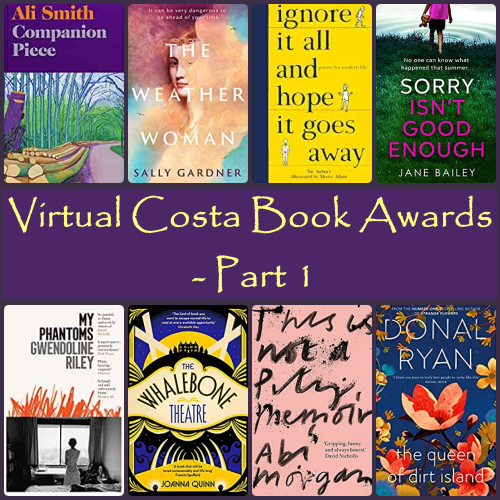
Virtual Costa Book Awards Part 3: Linda Newbery and guests


Here's the final batch of virtual awards. We're luckier than the real Costas - we can award as many as we like! For this final post, alongside some of our regular or previous guests we welcome two new ones: Louise Ellis-Barrett, editor of Armadillo, the online children's book magazine and blog, and author and screenwriter Frank Cottrell-Boyce. Thank you to all our guests for their choices, and congratulations to all our virtual winners.

JOHN NEWMAN of Newham Books awards the Virtual Costa Novel Prize to Seven Steeples by Sara Baume.


Sarah Baume’s latest work, shortlisted for the Goldsmiths Prize, traces seven years in the lives of Bell and Sigh as they inhabit a rented cottage in rural Ireland along with their two dogs. What they do in their cottage is never explained; instead the minutia of their lives is explored with real warmth and a level of detail never applied to their actual relationship. We learn about the contents of each room and how their routines shape them. We discover ways the cottage and its environs are changed by the weather and the seasons. This is a greater focus then how they adapt and relate to each over time. Even so, you feel they want to be together and there is something deeply reassuring about this. And all the time you wonder if they will ever climb an overshadowing mountain to view those Seven Steeples. This is a small book with big themes and not a word is wasted.

PENNY DOLAN's choice is a second Virtual Costa Novel Prize vote for Bonnie Garmus for Lessons in Chemistry (also chosen by Helena Pielichaty in Part 2):

Set in 1960’s America, the novel is about a brilliant young chemist, Elizabeth Zott, whose life’s purpose is scientific study, no matter what. And there is an awful lot of what in Zott’s life: an unschooled childhood; loneliness and loss, single motherhood, type-casting and brutal misogyny from the academic establishment.

Yet Lessons in Chemistry is a delight. As light and swift to read as a fairy tale, the sometimes painful plot turns with wit and humour until the clues and relationships click into place or as deserved. This is a book about determination, hope and the fight for equality, with a fictional heroine I could not help cheering for, despite the fact she would not care whether I did or not. Besides, how often does good fortune spring from one daughter stealing another’s perfectly packed lunchbox? Thank you, Bonnie Garmus, for a bright book in a dark time.

JON APPLETON awards the Virtual Costa First Novel Prize to Taymour Soomro for Other Names for Love:

A dazzling coming-of-age novel in which Fahad is flung from his comfortable, knowable London life into unfamiliar, primitive-seeming Pakistan at the demands of his formidable father who wants to mould his son in his own uncompromising image. Both father and son are grappling with their identities: Fahad is gay but is forced to be restrained and secretive while his outgoing, fearless father is facing the erosion of his authority and influence in his local community. The novel is about love and taboo and family ties, all sparely evoked with a strangely haunting immediacy. Perhaps most impressive of all is the way the story leaps across time and space to begin again, years later, losing none of the novel's cohesion.

LINDA NEWBERY awards the Virtual Costa Novel Prize to Patrick Gale for Mother's Boy:

Mother's Boy
is a thoroughly engrossing, moving and informative novel based on the life of the reclusive Cornish poet, Charles Causley - taking in his wartime experiences as a coder and his first forays into writing drama. The viewpoint alternates between Causley and his devoted mother, Laura, who has her own story. With a sure eye for detail Patrick Gale conjures social and domestic life and draws inferences from Causley's poetry and correspondence to portray his secretive inner life and sexuality. As I'd felt sure that Mother's Boy would feature strongly in the real Costas this year had they happened, it has to be my choice for the novel award.

JANE ROGERS awards the Virtual Costa Biography Prize to Osman Yousefzada for The Go-Between:

This memoir tells the magical tale of a Pashtun boy born into a poor immigrant community in Birmingham, who has become a world-celebrated artist and designer. His mother is a skilled seamstress but it is Osman, as a young boy, who chooses the fabric and delivers the garments. The loving descriptions of his mother’s fabrics reveals a fascination and talent which has since shaped his life, as a fashion designer for the likes of Beyonce and Lady Gaga. Both parents are illiterate, deeply devout Muslims. At puberty Osman, like other Pashtun boys, is banished to his father’s side, the world of men. He fares better than his sisters, though; they are removed from education around the age of 11, and from then onwards kept hidden from the sight of any men. Yousefzada finds himself torn between his people’s culture and the white culture he has to absorb at school, where racism and ignorance are meted out by pupils and teachers alike.

What is most compelling about this wonderful book is its child’s eye view of the complications and contradictions which surround him. He never judges, he simply tries to understand.

YVONNE COPPARD gives the Virtual Costa Biography Prize to Stanley Tucci for Taste - My Life in Food:

If you love Italian food, you will surely love this. Have a napkin handy just in case you start drooling. Stanley Tucci’s obsession with food borders on the disturbing in places - is he really joking when he insists that cutting spaghetti with a knife is an unforgiveable, if not capital, offence?

Tucci writes with warmth, wit and occasional flashes of insight about the life passion for good food that was instilled by his Italian American family. Humour, like the food, infuses everything, even the brief poignant passages touching on matters such the untimely death of his first wife.

Best of all, there are recipes scattered throughout the book. I will not be trying timpano anytime soon; Tucci’s savagely funny description of Christmases ruined by this monstrous culinary beast is persuasive. Thankfully, though, most of the recipes seem to infuse the very pages with aromas and tastes that will draw you into the kitchen to have a go.

LOUISE ELLIS-BARRETT awards the Virtual Costa Children's Book Prize to Belladonna by Adalyn Grace:

It was not a difficult choice to nominate the deliciously, captivatingly dark Belladonna as my book of the year. It is a richly imagined web of intrigue, a rich gothic romance, dark and spectacular. Jinxed as a baby to see all those around her fall and die, it is perhaps a wonder that Signa comes of age and reaches the time at which she will inherit her family wealth. Signa is a mystery; her life is full of mystery, one that only deepens as the story unfolds. Never far from her side Death makes a fascinating and dangerous shadow and primary character in the story causing us, as readers, to question our own preconceived ideas. I was quickly addicted to the writing, the characters and this story which promises and delivers so much. A sequel is promised in 2023, I for one cannot wait!  

FRANK COTTRELL-BOYCE awards the Virtual Costa Children's Book Prize to Lissa Evans for Wished:

It was unusually difficult to choose a winner as it’s been a year of terrific books by the likes of Maisie Chan, Phil Earle and SF Said but I’m going to go for Wished by Lissa Evans. Because - like Groundhog Day or The Phoenix and the Carpet - it takes a really simple, funny conceit and works it until every possible laugh, tear and scrap of wisdom has been wrung from it. Ed and Roo are sent to stay with an elderly neighbour - Miss Filey - while their house is being done up.
 
There they discover that Miss Filey’s birthday candles really do grant wishes. But only for as long as the candle is burning. LIssa Evan’s background is comedy and this is a VERY funny book. It contains the funniest cut from one scene to another I’ve ever come across. But it’s also full of heart and wisdom. When the children finally come to realise that Miss Filey has unfulfilled wishes of her own, I defy you not to shed a tear.

PATRICK GALE awards the Virtual Costa Novel Prize to Jessica Andrews for Milk Teeth:

My nomination is a fantastically original novel that was oddly overlooked given how well her debut, Saltwater, was received: Jessica Andrews' Milk Teeth.


What would you have chosen, in any of the five categories? (Novel, First Novel, Biography, Poetry, Children's). Please tell us in the comments!


Monday, 25 October 2021

Guest review by Jon Appleton: THE WEEKEND by Charlotte Wood


" ... And yet the hunger remains, the appetite for life. What’s the best you can hope for? That’s what The Weekend is about. A hungry novel."  

Jon Appleton is a freelance writer and editor living in London. He is a regular contributor to Writers Review.

‘Nobody wants you when you’re old. You have to shore things up before this point. You have to face up to the future, to the worst possibilities, you have to prepare yourself. Anticipate, adapt, accept.’

You might argue that reaching your eighth decade precludes you from having to learn and harness jargonistic alliterative slogans. (Although strictly speaking this is assonance, right?) But events such as the loss of a partner, a child, a friend can prove so destabilising that you’re reduced, in some respects, to learning your A, B, C all over again.

That’s where we find long-time friends Jude, the restaurateur, Wendy, the academic and Adele, the actress, in the aftermath of their close friend Sylvie’s death. The three women are spending a hot Australian Christmas at Sylvie’s home (in the absence of Sylvie’s partner) to clear it for sale and the conclusion of a chapter of their lives.

More oppressive than a dead friend is the inclinator, the platform that elevates – infantilises? passengers and baggage from the ground level to house level. Oh, and Wendy’s poor, dear dog Finn, who soils himself and inconveniences fastidious Jude but is perhaps all Wendy has left of Sylvie. His life so far beyond comfort and opportunity that it surely would better be ended with mercy and kindness. Gulp.

As the women set about their tasks, they engage and remember and rewrite history. They pride themselves on the sophistication of their inner lives and scorn those who lack such vivid interiors.

They might be old but they have expectations. You might not want lost looks, lost love, men or sex, The Weekend argues. What you really want, reasonably, is work. And money. Others might think you’re past it, somehow an encumbrance or liability, but these women know you can still make certain demands. You can trust a lived-in body, you know how it works – ‘you left it alone and it sorted itself out’.

So demanding of the world beyond them, and yet, a lot of the time it seems the best they can offer each other is tolerance or forbearance. Except, of course, when push comes to shove, as it does at the brisk ending. But if you can’t be brisk in old age, when can you?

Charlotte Wood is an Australian writer whose reputation is enhanced with each new publication; The Weekend, her last-but-one novel, was published here with a splash last year and deservedly so.

You’ll learn a lot about contemporary Australian life. You’ll understand where Australia has emerged from. (The surnames alone – Wendy Steegmuller, Adele Antoniades - are telling.) But interestingly, the cultural references are British – no mention of the Miles Franklin Award, instead the Booker Prize. The women reference the Mamas and the Papas from their youth, not The Seekers.

There’s always been a tension in Australia that anyone with ambition is punching above their weight – ‘the tall poppy syndrome’, it was called. How much worse is it for the high-flyers now diminished in old age, by themselves, by others, by society?

And yet the hunger remains, the appetite for life. What’s the best you can hope for? That’s what The Weekend is about. A hungry novel. I loved it and recommend it. So will you.

The Weekend is published by Weidenfeld and Nicolson.

More recent choices by Jon:

The Dutch House by Ann Patchett


Lonely Castle in the Mirror by Mizuki Tsujimura


Shuggie Bain by Douglas Stewart