Showing posts with label Jane Rogers. Show all posts

Monday, 16 March 2026

Guest review by Jane Rogers: THE MATCHBOX GIRL by Alice Jolly


"As with all the best historical fiction, Jolly has written a novel which is only too relevant to our times ... "

Jane Rogers has written ten novels, including The Testament of Jessie Lamb, Man-Booker longlisted and winner of the Arthur C Clarke Award 2012. Other works include Mr Wroe's Virgins (which she dramatised as a BBC drama series), and Promised Lands (Writers' Guild Best Fiction Award). Jane also writes short stories, radio drama and adaptations, and has taught writing to a wide range of students.

Her latest collection of climate-themed short stories, Fire-Ready, is out now in paperback; five of the stories were read on BBC Radio 4's Book at Bedtime in March 2026. For a review by Lesley Glaister, and a Q&A with Jane, see below. For more information, see Jane's website.

This is an extraordinarily ambitious novel, set in Vienna before and during World War 2, and based on real events.

In Vienna in 1934 there’s a progressive residential centre for children with learning difficulties, children who today would be termed neurodivergent. The director is kindly, humane scientist Dr A (the real life Asperger). Our heroine and narrator, Adelheid, is a mute 12 year old inpatient. She has an unusual mind, the kind of mind Dr A is researching in order to better understand and teach children like her.

Instead of speaking, Adelheid writes things down; her passion for the truth, her intelligence, and her eagle-eyed attention to detail, make her a valuable assistant to Dr A, and over time she progresses from patient to member of staff. These qualities also make her a brilliantly unbiassed chronicler of the Nazis’ growing power and influence over Viennese life. Initially, like everyone else, she’s thrilled by the pomp and pageantry, the marching and singing.

But gradually she notices that certain staff members are disappearing – fleeing to America, or simply vanishing overnight. Jewish people. She observes that Dr A is being put under increasing pressure to turn his patients into ‘useful’ citizens. And that those who are unlikely to ever be ‘useful’ are being transferred to the sinister Am Spiegelgrund, a new children’s hospital where visitors are not permitted, and children are never heard of again.

This is a truly heart-breaking coming of age story, as naïve, truth-seeking Adelheid gradually comes to understand not only the extent of Nazi wickedness, but also to recognise the necessity – for people like Dr A – of playing along with it, in order to retain any agency at all. It is a bitterly accurate portrayal of the way in which fascist thinking can creep into people’s lives, and how, without in any way subscribing to antisemitism or child euthanasia, bystanders can become complicit. As with all the best historical fiction, Jolly has written a novel which is only too relevant to our times.

The subject matter is tragic, but mercifully this novel is not only uplifting, but often comic, thanks to Adelheid’s eccentric and original narrating voice. Here’s a taster:

‘I begin this Story on the day of 25 July 1934, a moment well known in the History of my Country of Austria. Personally, I do not remember that Day for the same reasons as do others. The World is so Extremely Busy, many things Happening all at once. (Adelheid – Do not go off down a Tram Track. Stick to the Facts.) The point is that on this day here is Adelheid Brunner (twelve years old) and she is arriving at the World-Famous Weiner Kinderklinik or Vienna Children’s Hospital. She has in her pocket Franz Joseph, who is named after a Habsburg Emperor, but is a Rat.’

The Matchbox Girl is published by Bloomsbury.

Jane Rogers' Fire-Ready reviewed by Lesley Glaister.

A Q&A with Jane about Fire-Ready.


Monday, 29 December 2025

BOOKS OF THE YEAR Part 3: chosen by our contributors


Here's the final part of our roundup and our chance to thank our reviewers for their generous contributions throughout the year. We couldn't do this without you! Thanks too to all our followers. We hope everyone's found something here - or maybe several titles - to add to your reading pile for 2026.

John Newman
chooses something old and something new: My reconnection with the work of Rosemary Sutcliff continued this year and I was really thrilled to find a second hand hardback edition of Knight’s Fee complete with Charles Keeping illustrations. I f could not recall reading of how Randal, an abandoned kennel boy overcomes adversity to become a knight. Sutcliff brilliantly uses his rise to explore how the Saxon and Norman population find a common enemy in the French and those attempting to usurp the throne at the end of the eleventh century.

Sometimes picking up a proof copy can lead to a major reading experience. Such is the case with Solvej Balle’s On the Calculation of Volume. The story of how an antiquarian book dealer awakes continuously on the 18th November and how she attempts to adapt is told a day at a time. I'm now up to Volume 3 of a planned septology and I can’t stop recommending them.

John Newman is an independent booksellers at Newham Books. 

Penny Dolan chooses A Voice in the Night by Simon Mason, the fourth in his excellent ‘DI Wilkins’ crime series: Two murders, set in a rather unlovely Oxford: the stabbing of a security guard and a mysterious death-by-drowning of a retired academic.

DCS Wainwright, the ruthless new Superintendent at Thames Valley Police, wants both murders solved. She also wants one of two officers out of the service. Will it be handsome, black, college-educated DI Raymond Wilkins? Or his ‘past partner’: trailer-trash, trackie-bottomed, single-parent DI Ryan Wilkins, who must have ‘no responsibility’, yet somehow fixes on essential facts?

Though each Wilkins goes their own way in sorting out the mystery, they also face painful responsibilities in their own lives. A Voice in the Night, with its compelling heart, makes my Book of the Year 2025, though I must add that the three earlier DI Wilkins novels are worth reading first.

Mary Hoffman
: My fiction-reading has involved a lot of re-reads. I discovered Elly Griffiths’ wonderful Ruth Galloway series of detective novels in June and have read all fifteen and am now re-reading them. The first is The Crossing Places and I heartily recommend them. The heroine is middle-aged, not slim and fashionable, but is a forensic archaeologist. Yet Ruth Galloway is not short of male admirers.

I’ve also been re-reading my way through my extensive Anne Tyler collection and am six books in so far. I got the latest Jackson Brodie novel by Kate Atkinson at Christmas last year – Murder at the Sign of the Rook (Doubleday), so of course I then had to re-read all the others. And I belong to a book group which also sometimes supplies titles I know already, including my own choice, The Leopard (Collins and Harvill Press) by Giuseppe Tommasi di Lampedusa, partly inspired by the recent Netflix series, which played fast and loose with the plot but was beautifully cast and filmed. It was first published in Italy in 1958 and the English translation two years later, both after the author’s death. I must have first read it in sixth form; anyway, I seem always to have known it and it remains one of my favourite books. 

Other favourite re-reads of the years have been Hilary Mantel’s The Mirror and the Light, which I enjoyed much more second time round and Irène Nemirovsky’s Suite Française, which ditto. Our last book club title of the Year is Pip Williams’ The Dictionary of Lost Words and it is a corker.  It may be hard to write a page-turner about a (fictional) girl helping to compile the OED, but Williams has done it. Happy reading!

Mark Davies has also chosen The Dictionary of Lost Words: Set largely in Oxford, the novel is structured to track the creation of the Oxford English Dictionary in the late nineteenth and early twentieth centuries through the life of the first-person character, Esme. As the daughter of one of the editors, Esme's awareness of the significance of words begins as a small child. As a adult, she is employed at the Dictionary, and determines to try to include 'lost' words of a more feminine derivation, having realised that the Dictionary was a male-dominated domain: the editors and compilers were men, the majority of cited sources were written by men, and most of the researchers were men. By retrieving otherwise ignored or mislaid words, and by talking to working class women, Esme collects the basis of her own small alternative 'Lost Words' dictionary. This feminist theme is interwoven with the simultaneous activities of the suffragette movement and the nursing of soldiers injured in the First World War, making the book both engaging, thought-provoking, and educational.

Mark Davies is an Oxford local historian, public speaker and guide. His latest publications are A Jericho Scrapbook: Inside an Oxford Community Saved from Destruction and Jericho - a Celebration.

Jane Dalton: My pick is The Glass Hotel by Emily St John Mandel. Ostensibly a warning of the devastation wreaked by ponzi schemes, this strange and haunting novel carries an undercurrent of a world in which women pay the price for men’s crimes and selfishness.

Chief among them is Vincent, who at school was straight-As pupil but whose talents go unrecognised. Without a career, she becomes a fake trophy wife to the "super-rich" Jonathan Alkaitis, while her half-brother Paul plagiarises her video work. He squanders his college education funded by his mother, whereas Vincent is haunted by the loss of her own beloved mother.

The many different shifts in time, perspective and tenses - present and past, including Paul justifying his actions to a therapist in later years - make for a read that’s as unsettling as offensive messages written on a hotel window - a key plot point.At the end, I had to return to the start to better relish the nuances and detail of the rich narrative in context.

Jane Dalton is a journalist for the Independent. Her first novel is currently out on submission to publishers. 

Leslie Wilson's choice is When I Was, by Miranda Miller. What struck me about this novel was the vulnerability of people trying to be adults, and somehow never managing it; the deeply insecure parents are imprisoned by their class and difficult background, trying to negotiate the world without enough tools to do so, at least not enough to fool other adults that they know what they're doing, and aren't we all like that at times? The four children are also struggling through their lives, particularly the youngest, an observant, sometimes truculent little girl who loves her parents in spite of their failings. The family relationships ring absolutely true.

There are passages of wonderful comedy, particularly the abortive excursion to Brighton in a hire car, which turns out a disaster, particularly for the car. There's  also deep and devastating sadness. Engaging, perceptive and compassionate, this is a novel that’s hard to put down.

Leslie Wilson’s latest novel is The War’s Not Over Yet.

Jane Rogers
chooses Juice by Tim Winton: I love Winton’s work but I’d read enough utterly depressing cli-fi dystopias to feel reluctant about starting this. Juice is set in a lawless, scorched, barren Australia 200 years in the future – how could it not be grim? But Winton is a compelling writer. His narrator spins his tale to save his own life, at the hands of a lone killer who holds him, and the child he is trying to protect, captive. There are layers and layers of suspense, not just about the narrator but about his mother, wife, and child, and about the violent climate justice organisation both he and his captor have worked for (the chief targets are heirs to Big Oil). Winton is brilliant at raising complex moral issues; blame, revenge, honesty, and love. The astonishing humanity of the story makes it much much more than the recital of bleakness I was fearing. And his introduction of honourable AI in the final third of the novel raises questions which continue to haunt me.

Jane Rogers' latest publication is a short story collection, Fire-Ready.

Becky Jones:
 The book I loved most this year was The Wedding People by Alison Espach. It was the first book for a long time that hooked me on the very first page. Phoebe, a divorced academic, arrives at the Cornwall Inn to find she is the only guest who is not there for the elaborate week-long wedding of Lila and Gary. When the bride realises, she is furious – this depressed stranger could ruin her meticulously planned celebrations. As things pan out, however, Phoebe becomes important to her in ways neither of them could have imagined.

What I loved about this book was the writing – sometimes I find myself aware of the craft of writing which can sometimes detract from the enjoyment as a reader. But with this book, I could admire the writing whilst laughing and crying and being fully absorbed in the story. The premise was perfect – a week-long wedding in a hotel. It was a stage set for drama, full of surprises with wonderful, fully formed characters and sparkling, funny dialogue. But what I loved most was the way themes of loneliness, depression, grief and being different were treated with such humour. An uplifting read.

Becky Jones' first novel, Searching for Amy, was published this year.

David Breakell
has chosen The Master and Margarita by Mikhail Bulgakov, translated by Hugh Aplin: Written in the era of Stalin's show trials, this political satire cum fantasy horror was finally published only when the author - and Stalin himself - were both long dead. In a surreal Moscow where most of the humane, moral characters are to be found in a mental institution, Bulgakov skewers Soviet society with prose which is, at turns, darkly comic and terrifying. For me, its most compelling aspect is the 'novel within a novel': the eponymous Master is struggling to complete his manuscript, a historical novel which reimagines a single day - the day of Christ's crucifixion - from the point of view of Pontius Pilate. In the hours after Christ's death, Pilate tries, unsuccessfully, to alleviate his sense of guilt. Sprinkled through the text of the main narrative, these chapters provide a brilliant counterpoint to its satirical message. But also perhaps hope for the Master and Margarita.

David Breakell's first novel is The Alchemist of Genoa - read a Q&A with David next Monday.

The choice of Alison Layland is Audrey Magee's The Colony: There’s something about islands, and I realised recently that I've visited quite a few in my reading this year, all of them as exciting and intriguing an experience as a real-life trip across the sea currents.

In The Colony, the inhabitants of a small island off the coast of Ireland are visited by an English artist and a French linguist, who battle one another for the soul of the island’s people and their language, to the bewilderment of the islanders themselves. In a microcosm of colonialism, their desires and actions have profound consequences. This is a beautifully written, engaging read with brilliant characterisation and dialogue, and so much between the lines.

Other excellent island-based novels I’ve read this year are: Little Great Island by Kate Woodworth; Wild Dark Shore by Charlotte McConaghy; Muckle Flugga  by Michael Pedersen; Island by Jane Rogers. Maybe I’ve been drawn to island-set novels recently as my novel, After the Clearances, is largely set on the fictional island of Ynys Hudol, inspired by Bardsey off the north-west coast of Wales.

Alison Layland's latest publication is After the Clearances.

Nick Manns
recommends Forbidden Notebook by Alba de Céspedes: In Rome, one Sunday in November 1950, Valeria Cossati walks into a tobacconist’s and asks the shopkeeper for cigarettes and a child’s exercise book. The shopkeeper says it’s forbidden to sell non-tobacco products on a Sunday. With sudden urgency (‘I need it’), Cossati persuades him to break the law, and with the notebook hidden beneath her coat, walks into the street, past a watching policeman.

‘I need it’ marks the point when de Céspedes’ character steps beyond the role of compliant housewife and selfless mother and speaks for herself. The ‘forbidden notebook’ – her diary of domestic events – becomes a document of resistance: reports from a strange country.

Written five years after the fall of Italian fascism; 18 months after the publication of The Second Sex, Valeria Cossati walks towards our own time. She says, ‘This is what I saw; this is what I worked out.’

Nick Manns has written four novels for young adults and is the founder-director of Dyslexia Lifeline.  

Paul Dowswell couldn't decide on just one, so chose three! Firstly, A Village in the Third Reich. Julia Boyd, who also wrote the fascinating Travellers in the Third Reich about tourism in Hitler’s Germany, excels in this captivating account of the Nazi-era lives of the people of Oberstdorf in the Bavarian Alps. Not a good bedtime read for anyone worried about the state of the world; It gave me nightmares.

Secondly, Long Island by Colm Toibin. I loved Brooklyn, both film and book, so was keen to catch up with Eilis Lacey, Tony Fiorello and Jim Farrell. We’re now in the 1970s and all is not well. Toibin writes so well about the longings and disappointments of his characters and leaves us on a cliff edge. I eagerly await the third instalment.

Lastly, Abbey Road. David Hepworth is a music journalist with a keen eye for the sort of ‘fancy that’ information my fellow music trainspotters love. He's also a successful publisher with a keen understanding of the £££ that oils the wheels of art. This book is a highly readable history of the famous London studio and, simultaneously, the history of recorded sound.

Paul Dowswell's latest title is Aliens: the Chequered History of Britain's Wartime Refugees

From our own Adèle Geras: Andrew Michael Hurley’s Saltwash is a book that lingers in your mind long after you finish reading it. It’s not as frightening as some of his others (try Starveacre for the most terrifying last paragraph I’ve read in years) but it does have what Hurley has always excelled at: an atmosphere that settles around you as you read like drizzle in an out of season seaside town. This is exactly what Saltwash is. I’m very partial to such settings. A man goes to meet a friend in the oddest seaside hotel you’ve ever visited. The friend isn’t there at first but turns up later. There’s a big party on that night, as it happens, and many strange guests are ready to attend. I shan’t say another word! Merry Christmas to all WR readers.

Adele Geras' latest novel, under the pseudonym Hope Adams, is Dangerous Women.

Linda Sargent'
s choice is What you are looking for is in the Library by Michiko Aoyama, translated by Alison Watts: a Japanese bestseller and it’s easy to see why. The story unfolds as we follow the interlinking lives of five characters from a range of ages and backgrounds, but all are at some kind of turning point in their life. They arrive at a community centre/library and are directed to the librarian Sayuri Komachi, who has an uncanny, almost magical, gift for deep empathy and she directs them to seemingly unlikely books that turn out to be exactly what they need. All the while she makes tiny felt gifts and all five of the characters in this story are given one, which is also significant in their progress too. I especially liked Masao’s crab which ends up on his daughter’s bag and is a pathway to their greater connection too. It is a book about community, connection, listening and kindness. Perfect for these somewhat overwhelming times in the world and emphasising the necessary treasure provided by libraries and librarians. I loved it.

Linda Sargent's most recent publication is Tosh's Island.

Jon Appleton
chooses The Light of Day by Christopher Stephens and Louise Radnofsky, a compelling addition to the canon of queer British history.

Roger Butler was the first British man to publicly admit his homosexuality, lighting a touchpaper at a time (1960) when society condemned ‘inversion’, before sexual acts between consenting men were legalised. Christopher Stephens was a young Oxford student who became the older man’s friend and was gifted, upon Roger’s death, an episodic letter which revealed not only the unrequited longing Roger had for him (about which he knew) but the man’s extraordinary life as a private citizen turned activist during the early years of gay liberation. Extracts are interspersed with Christopher’s reflections on the friendship, on his own story, on the tricky matter of offering the right levels of affection and admiration to those we revere – not just in their lifetime but after they’ve died. It’s a compelling mix and part of the reason it’s my book of the year is that just a few streets away from where Christopher visited Roger in East Oxford, I made visits to my own friend and hero, writer Jan Mark, and since her death I have grappled with many of the questions Christopher confronts.

Jon Appleton is editor of the gab, which celebrates 20th century children’s literature: lettersfromrobin.com/the-gab

And finally ... a great note to finish on, with good advice for all of us! Venkatesh Swamy recommends Slow Down and Be Here Now, by Laura Brand, illustrated by Freya Hartas. These are times where the normal is rush, rush, rush. One keeps lurching from crisis to crisis and leaps from opportunity to perceived opportunity. For many, life has become one merry-go-round with no stop button. There have been days when I feel that I have been shot out of a cannon. Here’s a book for those moments. 

Slow Down and Be Here Now is a book that immediately needs to be introduced into children’s lives (maybe adults too). As are other titles in the Slow Down series. Written by Laura Brand and illustrated by Freya Hartas, it starts off with a simple tip - Be Here Now! 

Each of the short 46 chapters is fascinating and some of my favourites are: Watch a Duck Coat its Feathers, See a Grasshopper Jump, Watch a Family of Hermit Crabs Move House. And if I get the time, I will do just that. 

The book’s premise? When it is almost impossible to find joy, feel peace or follow curiosity, there are ways you can look after yourself, calm your body and mind, and being immersed in nature is just one of them. All you need do to see them is slow down.

Venkatesh Swami is the proprietor, with Swati Roy, of Eureka! Bookstore in New Delhi.

We'll be back to normal next week. Follow us for a great reading recommendation every Monday!

Monday, 21 July 2025

Guest review by Jane Rogers: STONE YARD DEVOTIONAL by Charlotte Wood


"I first read Stone Yard Devotional in great greedy gulps. It is intense and nakedly personal, and left me wanting more on every page."

Jane Rogers has written ten novels, including The Testament of Jessie Lamb, Man-Booker longlisted and winner of the Arthur C Clarke Award 2012. Other works include Mr Wroe's Virgins (which she dramatised as a BBC drama series), and Promised Lands (Writers' Guild Best Fiction Award). Jane also writes short stories, radio drama and adaptations, most recently of Anita Desai's Clear Light of Day which was a Radio 4 afternoon play. She has taught writing to a wide range of students.

Her new short story collection Fire-Ready, in which several of the stories are about the climate emergency now or in the future, is now available in paperback. For more information, see Jane's website.

I first read Stone Yard Devotional in great greedy gulps. It is intense and nakedly personal, and left me wanting more on every page. Afterwards I re-read it more slowly, with my writer’s head on, trying to work out how Charlotte Wood has made this, her seventh novel, so compelling.

At first glance it’s not riveting subject matter. A burnt-out environmental activist goes on retreat to a small religious community in rural New South Wales, near the town where she grew up. She then decides to stay there permanently.

If you were to pitch this idea to a publisher, I wouldn’t fancy your chances.

But the novel is, as they say, unputdownable, and has won accolades around the world including shortlisting for last year's Booker prize.

The unnamed narrator is initially bemused by the nuns’ prayers and psalms: ‘The words seem to make no sense. There’s a lot about evil-doers trying to destroy the psalm’s narrator. All day long they crush me. All this warbled by a bunch of nuns way out here on the high, dry Monaro plains, far from anywhere.’ Her critical observations of life in the nunnery are intercut with memories of her beloved parents and her grief at their early deaths.

Three events disrupt monastic life. The first is a plague of mice, caused by a drought in the north. First they nest in the piano; soon they have eaten all the electrical wiring and infested every room, to the point that nuns are emptying traps every hour and an excavator has to be brought in to dig a pit deep enough for the stinking corpses and the layers of lime which must cover them. ‘Opening the car door now takes mettle. Yesterday I lowered myself too heavily into the seat and felt a squirming sensation at my back that made me roar and hurl myself from the vehicle … A dozen mice exploded into the air from behind the cushion.’

The second is the discovery of the bones of Sister Jenny, who had gone missing after leaving the convent to work in a women’s refuge in Thailand. Covid shutdowns complicate the return of her remains, and her coffin is accompanied back by the third disruptor, Helen Parry. Now an internationally famous climate activist, and the convent’s most celebrated former member, Helen Parry is returning to her home town to visit her dying mother.

The tension between activism and retreat from the world is a vital thread running through the novel. Early on the narrator quotes to herself, firstly from Joan Baez: Action is the antidote to despair. And then in opposition, from Hippocrates, First, do no harm. She chronicles the harm done by even the most well-intentioned of activists (‘Every minuscule action after waking means slurping up resources, expelling waste, destroying habitat, etc’ ), and develops real respect for the nuns’ spiritual work; their slow careful observation, the depth of their attention. I was reminded of Death of a Salesman’s Willy Loman: ‘Attention must be paid.’

Other threads include mothers and daughters (the narrator was close to her earth-loving, honest, kindly mother; Helen Parry was beaten in public by hers, who spent long intervals in the local asylum, while Helen was left to bring herself up.)

In an interview for Literary Hub Wood says, ‘I realised early on that I have this place of silence and stasis, which is not good for a novel. I thought, I’m kind of writing a still life painting.’ Her solution is to use an episodic diary form, shifting seemingly randomly from one time period or place or event to another. In the course of a few pages she goes from the nuns’ diet, to their chickens eating live mice, to a childhood memory, to the arrival of Sister Jenny’s bones, to a dream, to pangs of guilt at having bullied Helen Parry as a child. The reader is expected to join the dots – the reader is an active player. And I believe this is the key to the novel’s strength. Wood cites W B Yeats as a powerful influence on her book, and the LitHub interview features a quote from him, which guided her in her work.

‘Only that which does not teach, which does not cry out, which does not condescend, which does not explain, is irresistible.’

Wood has followed his advice with consummate skill, and – to this reader at least – her novel is irresistible.

Stone Yard Devotional is published by Sceptre.

See also: a Q &A feature with Jane about Fire-Ready, her short story collection. 


Monday, 28 April 2025

Q&A: Jane Rogers interviews Linda Newbery about THE ONE TRUE THING


"Each of the three characters - plus Adam, first appearing as a young artist, who isn't a viewpoint character but is equally important - finds, or tries to find, the activity that gives purpose and meaning to life ... "

Linda answers questions from our regular contributor Jane Rogers.

When the ground shifts, where is one true thing to be found?

Jane, in her twenties, is left parentless when her father dies suddenly; a second shock follows when his Will reveals the existence of a son no-one knew of. Now Wildings, the family home, must be sold. Spanning two generations, the novel tells the story of Bridget, Jane’s mother, trapped in an unhappy marriage on which her career depends, and of stone-carver Meg, who wants only independence but is enmeshed in conflicting loyalties and desires when Adam, a young artist, enters their lives, to devastating effect.

Now far from Wildings, Meg is bound by a promise to support Jane in her loss. Having thought of herself as an observer who saw everything, she’s forced to realise how much she failed to see – and the cost to those she loves ...
 
Jane: Congratulations, Linda! Re-reading this book (Jane read an earlier draft) transported me back to the beauties of Wildings and filled me with admiration all over again, for your clever plotting and beautiful descriptions of nature. I’m interested in the way you can shift between writing for children, and adult fiction. In your best-known book for young readers, Lob, you conjure a beautifully innocent child’s view of the world, where love of nature and a powerful imagination are the key ingredients. And that book appeals to adult readers too, because we all have a nostalgia for that kind of innocence.

In complete contrast, The One True Thing is a very grown-up novel, in its exploration of a whole range of sexual relationships: Bridget and Anthony’s marriage shifts through passion and intimacy to downright hostility and back, via infidelity, to a benign accommodation with one another; we learn of Meg’s lesbian love affair with Carrie, who dumps her for a man; there are hints of incestuous attraction between two other characters. How conscious are you of your readership, as you are writing? And does a story always present itself clearly to you as either YA or adult?

Linda: The One True Thing was never going to be anything other than an adult novel, and that's true of my work in progress, too. With teenage fiction there have been times when the boundaries (if there are boundaries) have been less clear: for example with Set in Stone, which I began as a YA novel but for fairly sophisticated readers, and with the hope (which I always have) that it would be enjoyed by adults too. Sometimes I find that a story wants to go in a direction I hadn't planned at the start, and that's what happened with Set in Stone, which caused some controversy when it won the Costa Children's Prize. Some argued - and I'd agree - that it isn't a children's book. But the eligibility for that category does include age groups up to and including YA, so the same could and probably has been said of other winners more suitable for the upper end of young readers. But I won't write any more YA - my focus now is on adult fiction, alternating with stories for young children. 

Jane: The creation of Bridget’s garden is at the heart of the book. Did you have to do a lot of research, or were you already a gardening expert?

Linda: I certainly wouldn't call myself an expert, but I do know quite a lot about gardening and had a clear idea of Bridget's style and approach. I did need to research Chelsea Flower Show garden criteria for the particular year in which two of my characters make a small artisan garden. At the time I was writing the novel, I attended a talk by James Alexander Sinclair, who lives locally and is a Chelsea judge; after the event I emailed him with a few questions, which he very kindly answered, showing me where to find out more.

Jane: Where did the novel spring from? Can you talk us through the inspiration, the starting points? Or maybe I should say, the seeds?  I was fascinated by the precise descriptions of Meg’s work as a stone mason, and I note the book is dedicated to a stone-mason. Can you carve stone? Is this another of your hidden talents?

Linda: I can't exactly remember the starting point - several years ago - but I do seem to have developed a fascination with stone. That started with my late mother's photograph of a caryatid at Copped Hall in Essex, which set me off on The Shell House - Graveney Hall in my novel is based on Copped Hall, inhabited by a fictitious family, but almost destroyed by a devastating fire in 1917, just as the real mansion was. The caryatid, and the sculptor who made it, didn't feature as much as I'd expected, the novel being concerned with a First World War relationship and with a young photographer who discovers the ruins in the present day. So, fairly soon after I'd finished it, I began another novel more focused on stone-carving: Set in Stone. While doing some hands-on research for that one with a local stonemason, Bernard Johnson, I learned to appreciate the beauty of letter-carving, and wanted to have a go. My efforts are very clumsy compared to Bernard's exquisite work (which you can see on his website) but at least I had the tools in my hands and began to understand something of the materials and techniques. I wanted my present-day stone-carver in the new novel to be female, and the character of Meg grew from there, along with how she'd fit around the other characters. 

Jane: What is your writing process? In this novel, Bridget, Meg and Jane all have their own stories and points of view, which are intercut. Did you write them like this, or work on each woman’s story-line separately?

Linda: I seem to have to work like that, moving back and forth in time and/or with intercutting viewpoints - my work in progress has a similar structure, and so do several of my young adult novels (Set in Stone, Sisterland, The Shell House). I don't think I could do it by working on each character individually, because so much depends on the juxtaposition, and what I want the reader to think, wonder, predict or piece together at any one point. When finishing a section from one point of view, I need to leave off for a while, go and do something else, then return (probably next day) with my head in the viewpoint of another character. 

Jane: I hope you won’t mind me saying that I found a lot of you in this novel; yoga, gardening, Extinction Rebellion! 

Linda: Yes, at times while writing I feared that I was using up everything I knew and could write about with authority ... but luckily there are more interests left over (photography, animal activism, an artist I've been intrigued by for many years) for the novel I'm working on now. In The One True Thing, each of the three characters - plus Adam, first appearing as a young artist, who isn't a viewpoint character but is equally important - finds, or tries to find, the activity that gives purpose and meaning to life. Meg is the one who uses the phrase, but it's significant for all of them. 

Jane: I know this novel has been a long time coming to fruition (sorry about the gardening metaphors!) Both you and I, and indeed many other writers, have had trouble finding a publisher for a completed novel – can you tell us the publishing history of this book?

Linda: Sadly, it can be very difficult for an author, even a well-established one, to find a publisher if her or his sales are less than spectacular - and that category includes most of us! Having published only one adult novel before (Quarter Past Two on a Wednesday Afternoon, in paperback as Missing Rose) I'm not yet established as a writer for adults, and I've heard from you and from other acquaintances that much better-known authors than me are finding it a struggle. The One True Thing was submitted, but isn't what publishers are looking for at present, and even though most praised the writing, characters, etc., they clearly didn't think they could make money from it. Although it's tough being rejected, I never lost the sense that readers would enjoy my novel, so I refused to give up on it. 

I'm grateful to Fiona Mountain, a well-regarded and traditionally published author of historical fiction who I met through a reading group, for telling me how and why she had self-published her latest novel, Keeper of Secrets (which I recommend). When I discussed this possibility with friends Celia Rees and Cindy Jefferies, both of whom have wide experience of the publishing industry, Celia had the brilliant idea of forming an imprint, Writers Review Publishing, linked to this blog. That was a moment of epiphany! I'd felt diffident about publishing and promoting my own book as a solo effort, but being part of an author collaborative would be really rewarding - helping other writers to launch new books or reissue backlist titles that deserve to reach new readers, and all benefitting from joint publicity. It was so liberating to find that everything I needed was available: cover designers, interior layout designers, proofreaders, publicists. It had never occurred to me that I could commision my own audio book, but I've now done that through Audio Factory, choosing my preferred narrator. 

It didn't take long to assemble three of us - Judith Allnatt, Mary Hoffman and myself - to be part of the launch. Both their titles are excellent reissues: Judith's The Poet's Wife tells the story of Patty, the wife of poet John Clare, while Mary's David: the Unauthorised Autobiography imagines the life of the model for Michelangelo's iconic sculpture. Two other well-established writers, Dennis Hamley and Sheena Wilkinson, will publish with us later this year. How we progress will depend on what comes our way - though we already have plans for 2026. Watch this space!

The One True Thing is published by Writers Review Publishing. The cover design is by Owen Gent.

Jane Rogers' short story collection, Fire Ready, is published by Comma Press. Read more here.


The other two launch titles for Writers Review Publishing are Judith Allnatt's The Poet's Wife and Mary Hoffman's David: the Unauthorised Autobiography


Monday, 2 December 2024

Q&A: Jane Rogers on her new short story collection, FIRE-READY


"In fiction you can test things out and examine both sides of a question. I write to explore."

Photograph by Linda Newbery
Jane Rogers has written ten novels, plus radio drama and stories. Her subject matter ranges from the past to the present to the distant future. Prizes include the Arthur C Clarke Award, the Somerset Maugham Award and the Writers Guild Best Fiction Book Award. Jane’s new collection of short stories, Fire-Ready, was published by Comma Press this November. 

Jane teaches writing at all levels, currently running workshops for MsLexia and mentoring for Gold Dust. Find out more from her website. Here she answers questions from Linda Newbery.

Linda: First, congratulations on publishing your second collection of short stories, following Hitting Trees with Sticks (2012). In between, you’ve written two novels and several radio dramas and adaptations, including Clear Light of Day, a dramatisation of Anita Desai’s novel which was broadcast this summer on BBC Radio 4. What draws you to the short story form?

Jane: Thanks Linda. I think of myself really as a novelist, and I find the short story form extremely challenging. Very occasionally there's an idea which presents itself immediately as a short story (like the title story of Hitting Trees with Sticks), and that is great. But more often, it’s a question of endless revision and cutting and battling to actually locate the story in the mass of ideas and words of a first draft. As a reader, I used to think stories were slightly inferior to novels; then I read Alice Munro, and I realised that a really well-crafted story can contain as much as a novel, if the writer is skilful enough. But it is a different craft from writing a novel. I suppose I have written in lots of different forms; radio, TV, adaptation, novel and short story – I quite like a challenge! At the end of the day, I tend to feel more confident about my novels than my stories.

(By the way, off topic, I know many people now disapprove of Alice Munro so strongly that they have stopped reading her. Yes, it seems she behaved badly in her personal life. But quite frankly, if we stopped reading authors who have behaved badly – well, as King Lear says, Who shall ’scape whipping?)

L: One striking thing about this collection, and of your novels too, is the range of subjects and genres you cover. Here we move from the present to the near and more distant future; some stories could be classed as sci-fi, cli-fi (climate fiction) or even veer towards horror (Clearances) while others are tender explorations of domestic life and relationships, one of which, Treasure, I suspect comes from your own experience with a grandchild. A thread that links them is the struggle of ordinary people to find purpose in life, to make space for themselves, to appreciate everyday pleasures. Some are bound by duty or by the restrictions of lockdown; in more than one, the birth or prospect of a baby offers hope and a glimpse of uncomplicated innocence.

How did this collection come about? I see that several have been published before, while most are new. How did the idea of a new compilation come to you? Fire-Ready is the title story – was that always your choice of title, and does it suggest a unifying theme?

J: It’s a good question, and to begin with I couldn’t really figure out if this was a collection or not. I certainly didn’t sit down to write a collection – the stories have accumulated over years, and I was not able to find many common themes between them. My editor, Ra Page, was helpful here, because he identified four interlinked themes; the climate emergency, activism, and aging and relationships with children. Together we eliminated the weakest stories, and he suggested I write an additional cli-fi story, to even out the balance. So I have spent most of my writing time for the past 4 months working on the opening story, Hope. 

I was surprised when I realised how many are about parents (or a single parent) and children, but then I realised that in fact that is a central theme in several of my novels.

And re the title – I hope it does suggest a unifying theme. The term is actually used in Australian government warnings about bushfires. Farms in the path of fires have to be made ‘fire-ready’, that is to say, with sprinklers on the roof, shutters, reserves of water, an underground spot where important documents can be securely left, and so on. And more generally, characters in some of the other stories are trying to make their homes or lives ‘fire-ready’, in the sense that they know they will be tested.

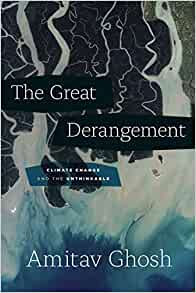
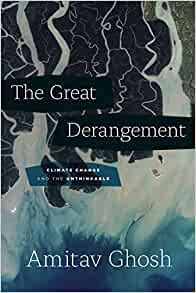
L: For one of your Writers Review contributions, you chose Amitav Ghosh’s The Great Derangement, in which he asks: ‘What is it about climate change that the mention of it should lead to banishment from the preserves of serious fiction?’ In the eight years since his book’s publication, that’s changed, with books such as The Overstory, Orbital and The Deluge featuring on shortlists. But still, fiction that portrays the climate emergency in the context of ordinary present-day lives seems rare. Some of your stories do just that – Fire-Ready, set in Australia, sees Kayla preparing for the very real threat of wildfire, while others look at likely changes to society and adaptations in our behaviour. Climate concerns run through this collection but without dominating – did you feel that the balance between bleakness and hope was important?

J: Like many people, I am haunted by the climate emergency, and the thought of the devastated world we are leaving to our descendants. I set out to write a novel on the topic, soon after reading The Great Derangement. To begin with I read as much future fiction as I could find, and quickly realised that novels which simply focus on a very bleak future are simultaneously depressing and rather preachy. There are a lot; I could give you a list of titles not to read, but that would be cruel! Two which deal with the topic much more imaginatively are Bewilderment by Richard Powers, and The Ministry for the Future by Kim Stanley Robinson. Both highly recommended. There’s no point in writing doom and gloom, everyone knows it and it doesn’t make anything better. I don’t think I was trying to create a balance between bleakness and hope (though I am glad if that’s the effect!) I think I was trying to examine specific situations through the minds and experiences of my characters. Human beings are wonderfully adaptable, so that even in bleak situations, hope and joy can be found. For example, in Hope, the child Kara who has been evacuated from a no-longer-viable Earth, is thrilled by the sight of distant stars and galaxies in deep space. As individuals, we feel pleasure as well as pain, and good writing describes individual experiences which are universally recognisable.

L: The hope in many of the stories comes through a kind of epiphany, and I love the way you show these – not in any flash-of-light sense but more a kind of quiet acceptance, especially for your older characters. More than one of these is faced with a rearrangement of their life following release from the duty of care to a relative or partner – situations I feel sure will resonate with many readers.

J: Yes, there’s quite a lot about growing older – I guess the topic is on my mind, now I’m in my eighth decade! Again, I’m interested in the pleasure, or relief, of letting things go in older age – as well as the grieving for the past. ‘Letting things go’ is probably the story I am most pleased with, because I was afraid readers might find it quite mad that my protagonist can happily lose himself for hours in sounds from the distant past; but so far the responses have been very positive.

L: There’s humour too, in Weeping Beech and in The DNA of Bats. You must have given a lot of thought to the ordering of the stories?

J: Ha. Indeed. And since I carefully ordered them, they have been re-ordered so many times by my editor that I honestly can’t tell if it works or not. Readers will have to let me know!

L: I want to ask about the final story, The Night Before, without giving too much away. Anyone who’s campaigned (as we both have) with Extinction Rebellion has been told, in connection with roadblocks etc, “I like what you do but not the way you’re going about it”. But what actually does make the kind of difference needed to confront the climate emergency? Your character here, Szandra, is on the brink of doing something most activists would (fortunately) baulk at – but can such an action be justified? She’s questioning herself about that, right up to the abrupt shock of the ending. Can you tell us how this story took shape?

J: It began as a ‘What if?’ What if you were asked to do something which is really dangerous, which will have tragic consequences, in the service of a cause in which you believe passionately? I love the fact that you can explore an idea in a story, test it out, see how far you can go. I have been asked if I agree with or condemn the characters’ plan in that story. And the answer is, neither. That’s not the point. Any more than I agree with or condemn Jessie Lamb’s action, in my novel of that name. The point is to honestly explore an idea, an action, the potential consequences. In fiction you can test things out and examine both sides of a question. I write to explore.

L: More generally, how does a short story idea come to you? Does it arrive in your head complete, as it were – I mean the shape of it, the point? Or do you discover that through writing?

J: It really varies, from story to story. That’s one of the maddening things about writing, isn’t it? It never gets any easier, you have to re-invent the wheel each time. I usually have a sense of what’s at the heart of the story, but how to reach that, or, as you put it, ‘the shape of it’ – that is something I have to work out as I go along.Weeping Beech, for example; my idea was for a tree surgeon who couldn’t bear to fell a beautiful tree. So he was conflicted. Gradually, as I worked on it, the conflict became externalised, and his opponent became, not his own appreciation of the tree, but a retired parks and gardens employee who knows all the old trees in the town. Other characters came in to take sides, and I was pleased (especially with the nosy neighbour!) because the story became funnier.

L. The reader learns to adapt quickly to each new story: learning not only about the characters and their relationships but about where we are in time, how society has changed and how new rules and conventions dominate their lives. You’re adept at conveying these things without overwhelming the reader. Does beginning a short story feel very different from beginning a novel?

J: You have to establish the world of the story very quickly – so yes, that is a difference. In a novel the reader is usually content to be drip-fed information that builds a picture of the novel’s world, and in fact, in a novel, that slow release of information can be part of the suspense. What’s fascinating is how little the reader needs, to understand they are in a different time and place. And that’s something I’ve learned through cutting my stories. For example, in Daytrip to Glastonbury, the opening paragraph describes the coach journey towards Glastonbury along recognisable A roads. But the coach stops at Wells. ‘From Wells the only way was by boat.’ Suddenly the reader is transported to a future where swathes of the country are underwater. No date or backstory is needed.

L. You’ve done a great deal of tuition and mentoring, at Sheffield Hallam and with Mslexia, Faber Academy and Oxford University Department of Continuing Education. What advice do you give to students about writing short stories?

J: Well, I could give you the outline of the five-day short story course I’m going to teach for Faber Academy in the new year . . . But that might be a bit much! I guess the single most important thing is CUT. It is amazing how much you can cut out of a story, and how every cut seems to improve it. All the cliches are true; Get in late, get out early. Cut adverbs. Strip down adjectives. Make every word work. I think short story as a craft is closer to poetry than it is to novel.

L. Finally, what are you working on now?

J: A novel! And it’s only tangentially about the climate emergency.

Thanks for your thoughtful questions, they have really made me focus on the stories and why I wrote them.

Fire-Ready is published by Comma Press.


Monday, 19 August 2024

Q&A: Jane Rogers interviews Lesley Glaister about her new novel, A PARTICULAR MAN


"I always like to be utterly certain of each character’s motivation at any one time – even if they aren’t sure of it themselves ..."

Lesley Glaister has written numerous novels, as well as short stories, drama and poetry. Alongside her writing she has worked as a tutor and mentor in Creative Writing in settings ranging from Crete to The University of St Andrews. Her most recent novel, A Particular Man, is set in the 1940s, and looks at love, marriage and sexuality in the post-war period. Find out more on her website.

Jane Rogers: Congratulations on your 14th (??) novel, Lesley! It’s a completely engrossing read, and your characters continue to haunt me, especially Starling and Aida, that unlikely couple who almost certainly will not live happily ever after.

My first question is probably foolish, but I found myself puzzling over whether the ‘particular man’ of the title was Starling, or the absent Edgar?

Lesley Glaister: Thank you, Jane. It’s my 16th or 17th novel, depending on whether you count my YA novel, Aphra’s Child. The title: A Particular Man, came late. I had several other working titles including A Hole in the Corner Affair – but no-one else seemed to like that!  A Particular Man jumped into my mind while I was washing up one evening and it immediately felt right. It has both the meanings that you suggest. Starling is a particular man, of course, and he’s the particular man Aida falls in love with. But in a larger sense, the particular man who drives the whole dynamic of the novel is the absent Edgar.

JR: Speaking of Edgar - one of the things I love in the book is that everyone has their own story and secrets; Clem’s affair with famous artist Corin; Starling’s forbidden homosexual love for Edgar; Aida’s attraction to Starling which she tries to blot out by getting engaged to Neville. But the link between all the characters is Edgar, as son, as brother, as beloved comrade. And he is dead, and remains a total mystery. We have no idea if he returned Starling’s love, and even Starling doesn’t know. What made you decide to keep such a key character blank?

LG: Ha, good question! It wasn’t a decision. When I set out to write this novel, which has connections with Blasted Things, set twenty-five years earlier, I intended that Edgar, who was an infant in that novel, should be a central character. I kept trying to write scenes for him but he remained stubbornly inanimate. I couldn’t breathe life into him, or see him or hear him, and eventually I realised he was dead. For me writing is full of discoveries like this, rather than decisions. But I did decide to leave ambiguous the question of whether Starling’s love might have been requited if Edgar had lived. I think it would or might have been, but Edgar died so, like Starling, we will never know. 

JR: Your writing is wonderfully vivid, transporting the reader instantly into the scenes and characters’ feelings you describe. Here’s an example taken at random:

Aida hurries out of the hammering rain into the puddled shelter of St Pancras. As arranged, he’s waiting outside W H Smith, and her heart jerks like a bad dog on a lead.

How much revision does it take to achieve this kind of economy and joyous precision?

LG: Thank you! That is a huge compliment coming from a writer of your calibre. The honest answer is that those kind of similes and metaphors just seem to come naturally. Like many writers (and, of course, many people who aren’t writers) I tend to think in metaphor most of the time. Sometimes I drive myself mad with my habit of always thinking things are like this or that other thing. I have to work much harder at revising other elements of the narrative though: scenes where people have to move and act, dialogue, shifts through time etc. I always cut huge swathes in the editing process, and hone and sharpen scenes to try and rid them of any flab. I always like to be utterly certain of each character’s motivation at any one time – even if they aren’t sure of it themselves. 

JR: The novel is set in 1946 and also refers back to the war years and to the experiences of prisoners of war in Singapore. You don’t acknowledge any sources, but I’m guessing you did a huge amount of research, because the post-war world you conjure feels totally authentic. The menus are a particular delight (lobster mayonnaise and chocolate meringue!) and there are lots of details which are new to me, e.g. the choice of demob suits offered to ex-servicemen.  Can you tell us a bit about researching the background?

LG: One of my main sources was a box of family memorabilia. This includes photographs, letters, and artefacts relating to my father and his family. My dad was a Far East Prisoner of War in World War 2, a fact that was never spoken about in our family while he was alive. It was only after his death that I became fascinated both by his experience and the silence that surrounded it. In 1994 I wrote a novel called Easy Peasy, which is about that silence within a family.  At the time I did a fair amount of research, met a friend of my father from his time in Burma, read letters and newsletters written at the time. The tobacco tin of sketches in A Particular Man, was a real thing, though in real life it was a secret diary written on minute scraps of paper, also wrecked by a trapped ant. I find this idea very resonant. A letter from Edgar that Aida reads out loud to her mother is, in part, a letter that my father sent his mother when he was on his voyage to Singapore. There were also letters from my dad’s sister Kitty, who was killed during the Blitz and I was keeping her in mind for the character of Aida – though of course I never knew her.

As well as this family research, I also read reams of fiction set (and preferably written) during or shortly after the war as well as social histories. I watched films and TV documentaries and visited the Imperial War Museum. From all of these sources, I magpied away details of everyday life, such as those you mentioned, and the vocabulary of the times too. And of course I spent a lot of time Googling!

JR: I very much enjoyed the unsent letters from Aida to Starling. It’s a clever way of letting the reader into her thoughts. You also have Starling’s diary entries to reveal his inner feelings. But the larger part of the novel is written in the third person, from the restricted points of view of Aida, Starling and Clementine. How did you arrive at that writerly choice?

LG: Point of View is one of my obsessions and that close third person viewpoint is my favourite position from which to write. It means there is as little of the narrator showing as possible and all the narrative is filtered through the consciousness of the character in question. Sometimes, because of this restriction, it can be frustrating. For instance, I might think up just the right word, or image, but know that it wouldn’t be in the character’s vocabulary, or experience. With each novel I write I tend to wait for the first inklings of a voice to arrive. If it arrives in first person, I’ll go with that. The novel I’m writing at the moment, which spins off in an unusual direction from this one, is in the first person. One point of view I haven’t attempted yet is an omniscient third person – it simply looks too hard to control. I enjoyed using the first person for the letters and diaries and found it gave me extra insight into the characters of Starling and Aida. It was also a way of getting through a great deal of story in a reasonably economical way. 

 JR: How difficult was it to write using the point of view of a gay man in 1946?

LG: Oddly, I didn’t find it hard at all. I did a fair amount of reading including from a book called Curing Queers: Mental Nurses and Their Patients 1935-74 by Tommy Dickinson, which was excellent. I also did a lot of Googling and I was careful to run it past a gay male reader to ensure I hadn’t made any real howlers. 

 JR: And, leading on from that question, where do you stand on the whole vexed issue of appropriation? Do you think it’s OK for writers to write about people from different cultural/racial/social backgrounds to their own?

LG: Yes I do!  Of course, if a writer pretends to be something they’re not in order to write from a particular viewpoint, that’s wrong. If a writer writes cruelly or inaccurately or causes any hurt from their writing, that’s wrong too. But I can’t see why any human being can’t sensitively and intuitively try to enter into the experience of any other. Surely that’s part of what creative writing is about?

JR: I know this novel was originally slated to be published by Sandstone, and that Sandstone then went into receivership. Can you tell us about the bumpy road to publication?

LG: A miserable tale!  It’s so hard to get a novel published these days unless one is already a best-seller or a new writer on the brink of being discovered. For those of us that have published several (or many) novels, none of which have won a major prize, or been turned into a major movie (or maybe even if they have) publishers just aren’t interested. We are quite simply, out of fashion. This is true in my experience of the major traditional publishers, at least. Fortunately, there are smaller independent publishers – Sandstone was one – which work on a similar model but have more regard for quality rather than simply profitability. Sandstone published Blasted Things and I’d signed a contract with them for A Particular Man before they went into liquidation. I was left rather in the wilderness until Bloodhound came to my rescue. They differ from traditional publishers in being more focused on selling digital and audio copies than hard copies of books, though they do produce these too. I am very grateful that they have not only published A Particular Man but will also be reissuing Blasted Things later this year.

 JR: Finally – the limericks! They are great fun. Are they all your own work? I knew you were a poet, but I didn’t know you had a talent for limericks!

LG: They were fun to do. I sometimes think of limericks when I’m out walking my dog – it seems to suit the rhythm of my walking. Sometimes that rhythm drives me nuts. Most of the ones in the novel are my own, though one is adapted from someone else’s and the one that Peter quotes to Starling towards the end is, as he says, ‘an old chestnut’.

Thanks for these lovely questions. You have really made me think!

JR: Thank you for your generous answers, and for a fascinating novel! I think I like it even more now I know how closely it is based on your own family’s experiences. 

A Particular Man is published by Bloodhound Books.

Jane Rogers' review choices for Writers Review:

How the One Armed Sister Sweeps her House by Cherie Jones


Home Fire by Kamila Shamsie


The Great Derangement by Amitav Ghosh


On dramatising No Longer at Ease by Chinua Achebe


Jane's dramatisation of Clear Light of Day by Anita Desai, about one family's troubles during the partition of India in 1946, is currently on Radio 4. Listen here to the first of two parts.