Showing posts with label loss. Show all posts

Monday, 24 August 2026

Special feature Q&A: Jane Dalton on her first novel THE SECOND LIFE OF ANTHONY B


Is someone playing a cruel trick, or is the impossible really happening?

Photograph by Sarah Widdowson
Jane Dalton
is a journalist at The Independent, where she writes about animal welfare as well as general news. She previously worked for The Sunday Times, where she was Regional Editor and an occasional book reviewer. She began her career at the Dover Express, where she launched a high-profile campaign against live exports. You can find out more from Jane's website, and read an interview about Jane’s animal activism and reporting here. 

The Second Life of Anthony B is her first novel.

What if the person you loved most sent you one final email?

Eight months after his wife Maggie dies, widower Anthony Bothwell switches on his computer and discovers an email—from her.

The message is so personal it could only have come from Maggie. And its warning is terrifying.

Is someone playing a cruel trick, or is the impossible really happening?

The emails from maggie.bothwell@theafterlife.org.uk keep coming.

As Anthony's certainty about life, death and everything in between begins to crumble, he replies. Their conversations become tender, funny and deeply moving.

But when a long-buried family secret is uncovered, grief turns to betrayal, and Anthony is forced to question everything he thought he knew about the woman he loved.

Then he meets Brooke, a fellow widow who offers him the chance to begin again.

Can Anthony uncover the truth behind the impossible emails—and find the courage to embrace a second chance?

Jane answers questions from Linda Newbery.

Linda: First, congratulations on publishing your debut novel! You’ve worked for years as a journalist for The Independent – is writing fiction something you’ve always wanted to do?

Jane: Thank you so much. Yes, I started writing my first novel when I was eight. It took me a few more decades to finish writing one, though. After a tumultuous journey to publication (more of that later) I was very lucky that my manuscript was picked up by Poolbeg Books, the Irish publisher that first discovered Maeve Binchy. Not that The Second Life of Anthony B is anything like her novels – it’s much weirder than that.

Linda: The novel is based around the striking premise that Anthony receives emails from his dead wife. Did the novel begin with this idea, or did you begin with the intention of writing a novel about bereavement before settling on this device?

Jane: It began with Maggie, an outspoken woman who’s also great fun. That blended with the idea of emails from beyond the grave, because wouldn’t everyone who’s lost someone very suddenly love to be able to have one final conversation with them? I wrote it for everyone who has ever wondered what happens to us after we die and whether any form of consciousness, such as the soul, survives. I also wrote it for anyone who’s ever wondered how their life would have been had they taken a different path; and for anyone who loves garden birds.

Linda: You’ve written a page-turning mystery which is often amusing, sometimes even farcical, and equally often moving, as we experience Anthony’s deep sense of loss alongside his questioning of how well he knew Maggie. Was this a difficult balance to achieve?

Jane: Funnily enough, it wasn’t difficult. The novel is partly about how couples communicate – or fail to, and Maggie and Anthony’s turbulent relationship allowed both the humour and the sorrow to emerge naturally. That’s how it ended up with depth and bittersweet.

Linda: Did the voice of Maggie (forthright, teasing, assertive) come to you immediately? Our sense of Maggie comes mainly through her emails.

Jane: Yes, it did. She was partly based on a former news editor I had who was a veteran tabloid journalist and who had a long-standing challenge for all reporters to find a “naughty vicar”. I exaggerated Maggie a bit to make her more outrageous – but not much more. On the surface Maggie is flamboyant and larger than life, but deep down she’s extremely vulnerable and sensitive. Anthony is quite different – much more grounded, but also sensitive. Each of them is lovable in their own way.

Linda: Anthony is a thoroughly sympathetic character, and I know that readers who’ve been bereaved, or who are close to someone who’s experienced a loss, will find much that resonates. How and why did you decide that your viewpoint character would be a man in his sixties?

Jane: I’m not entirely sure, but just before writing it I’d been reading a lot of high-quality literature that happened to have male lead characters, such as novels by Ian McEwan, David Mitchell and John Updike. I didn’t want to write another popular women’s novel with the tired trope of a young woman and her boyfriend troubles. I wanted to write something non-formulaic, unpredictable and without cliche. And I forced Anthony to question his assumptions about a lot of things, such as whether people have a soul, that life is short and that the course of life after 50 is fixed.

Linda: Anthony investigates the subject of communications from the dead as the novel progresses – was this part of your own research for the novel?

Jane: To some extent, but I wanted the focus of the narrative to be more on the effect on Anthony of receiving the emails, and how they change him as a person, from being a grumpy sceptic convinced his life is over to someone open-minded to new ideas and able to start afresh. Communicating with Maggie forces him to confront things he’s never admitted before and enables him to move on in life.

Linda: Did you have the whole plot mapped out before you began, or did the novel grow in ways that surprised you?

Jane: I didn’t map it out – I wrote it instinctively, and a great many things in it surprised me. Which is appropriate for the story, because I think the same things will surprise readers, too. I never imagined I’d write a creepy psychological suspense story or one about the afterlife or how it’s never too late for fresh starts.

Linda: I know that The Second Life of Anthony B has had a difficult path to publication – through no fault of yours! Can you tell us about that?

Jane: Getting to publication itself was a drama! My first publisher, Neem Tree Press, a lovely women-only company, was taken over by Unbound, a crowd-funding publisher, which, it transpired, was in difficulty, and the new company collapsed into administration just as my novel was due to be published. I was devastated, because I’d put everything I had into writing it.

Linda: At The Independent you specialise in covering issues of animal welfare / exploitation. Do you think this will feature in future novels? Is a second novel under way?

Jane: They say novelists should not write to champion a cause but I am thinking about it. How can I not? Much animal cruelty is so extreme that it needs tackling. In this novel, writing about the symbolism of birds and caring for them was a bonus. I have already drafted a second novel, albeit not part of my three-book contract with Poolbeg, so I have two more to go.

Linda: Thank you, Jane - I'm sure your novel will be much enjoyed by its readers!

The Second Life of Anthony B is published by Poolbeg.

Monday, 13 October 2025

ALBION by Anna Hope, reviewed by Linda Newbery


"Combines typical ingredients of the big house novel and family saga with deep questions about individual responsibility, whether wrongs of the past can be righted, how we adapt to climate change and nature loss, and what kind of future we can shape."

Linda Newbery
edits Writers Review. She is a writer, reviewer and active campaigner on animal and environmental issues. Her latest novel, published earlier this year, is The One True Thing. 
The big country house as a fictional setting has enduring appeal. Names come readily to mind: Downton Abbey, Brideshead, Manderley, Mansfield Park, Brandon Hall (see Graeme Fife's recent review of The Go-Between) and countless more, including the recent Saltburn. The house in Anna Hope's latest novel differs from these others in never being named, though it's certainly as grand as any of them - an eighteenth-century Greek Revivalist mansion standing in a thousand acres of Sussex pasture and woodland. The name we focus on isn't that of the house, but of the Albion Project - a ten-year rewilding project that certainly owes much to the influential and nearby Knepp Castle estate, obliquely referred to. As with the Knepp project, the ambition of owner Philip Ignatius Brooke and daughter Frannie is to extend beyond their own boundaries, creating a green corridor that will reach through Sussex and Kent countryside to the sea. 

Now Philip has died, and the novel's action takes place over five days in May during which the family reassembles for his funeral. Of his three children only Frannie, the eldest, still lives there, and is in the process of moving with her young daughter into the main house, while Philip's widow, Grace, will take over their cottage. Philip himself had inherited house and estate at just eighteen when both parents were killed in a car crash; he set up what became known as 'the English Woodstock', a festival known and fondly remembered as The Teddy Bears' Picnic. There he met his future wife, leading to a marriage from which she wishes she'd had the courage to escape. While she remained at home with the children,  he did escape - to New York, where he settled for years with another partner (and possibly another child?) before returning and zealously taking up the rewilding scheme.

Anna Hope loses no time in showing us the spiky relationships and resentments of the three grown-up children, Frannie, Isa and Milo. Frannie is named as heir in their father's will, to the disapproval of brother Milo; she in turn is impatient with Isa, who's barely been in contact; Milo, recovering from various kinds of addiction, plans an exclusive rural retreat in the grounds in which, bizarrely, he aims to convert the 1% who can afford it into benevolence that will benefit the whole of society. Frannie, faced with paying millions in inheritance tax, is desperate to find the money somehow, fretting as she tries to write her father's eulogy; Grace, relieved to exchange the house she hates for the cottage, has ambivalent feelings about her late husband and how she'll express them at his funeral. Isa, distancing herself from wealth and privilege, is a teacher in London, scornful of her sister's enterprise: "The shepherd's huts, the yurts, the caravan serving lattes to middle-aged white people while they sit on hay-bales and chatter about their Pilates teachers and their dogs. A theme park for solvent fifty-somethings, all of it about as wild as a fucking printed tea-towel." Meanwhile, seven-year-old Rowan is showing what her class teacher sees as a disturbing fascination with bodily decomposition after death.

Into this potent mix comes a young American PhD student, Clara, with a bombshell to drop. Most readers will see what's coming, but that doesn't lessen the impact when she chooses her moment to reveal the source of the estate's wealth. With mesmerising clarity, calmness and precision she compels the family to listen, making eloquent use of her encounter with Rowan playing with a box of shells.

What next? How will these descendants of Oliver Ignatius Brooke adjust to the knowledge of the vast injustices (more than one) that underpin their privilege?

I first came across this novel when it was dramatised as Radio 4's Book of the Week earlier this year. There, I thought the repercussions of Clara's revelation were disappointing, too glibly and swiftly dealt with, so I wanted to see how Anna Hope handles this in the novel. Even here, though, I'm not sure. There are various reconciliations: too many and still too quickly, because of the constraints of the five-day structure. Frannie is the one whose ending is left most open-ended and uncertain as she confronts difficult questions, both practical and ethical.

That reservation aside, I found Albion utterly compelling: it combines typical ingredients of the big house novel and family saga with deep questions about individual responsibility, whether - and how - wrongs of the past can be righted, how we adapt to climate change and nature loss, what kind of future we can attempt to shape and who will benefit. The pace is leisurely enough to draw us fully into the family's concerns, while never seeming slow; tensions crackle off the page while the depictions of the natural world are vivid and immediate, whether portraying the woodland in May extravagance, the brisk extermination of a pregnant mink or the dawn song of a nightingale. I hadn't read Anna Hope before, so this is a very impressive introduction.

Albion is published by Penguin.

See also Anna Hope's Expectation, reviewed by Claire Grint of Cogito Books, Hexham.

Linda Newbery's The One True Thing is published by Writers Review Publishing.

Monday, 15 September 2025

Guest review by Cindy Jefferies: THE HUMMINGBIRD by Sandro Veronesi, translated by Elena Pala


"Funny, serious, clever, controlled, sometimes a little demanding but always rewarding."

First published in 2001 for children, Cindy Jefferies found success with her Fame School series with Usborne Books, obtaining 22 foreign rights deals. Latterly writing fiction for adults as Cynthia Jefferies, her first title The Outrageous Fortune of Abel Morgan was published in 2018, followed a year later by The Honourable Life of Thomas Chayne, set during the English Civil Wars, followed in 2019. Both titles are now available in paperback.
 
Sandro Veronesi is an Italian writer who is the only person who has won the Premio Strega prize twice. His is a formidable talent, but he wears his skill lightly. His work is funny, serious, clever, controlled, sometimes a little demanding but always rewarding. He has every right to demand our attention, because what he writes, and how he writes it is often unexpected and usually brilliant.

His hero in this novel, Marco Carrera, is a man whose life seems to stand still. A series of misfortunes happen and he has to deal with them. He doesn’t always want to, they affect him deeply, but he invariably does what he can to help. His life is both ordinary and extraordinary, as many human lives are. Veronesi relates the entire life of this man, bringing in along the way many fascinating thoughts and facts, which, because they interest the writer, also interested this reader.

Did you realise that not many languages in Europe have a word to describe what you become if your child dies? Widow, widower, orphan, that’s it. We have to look to Sanskrit, many of the African diaspora languages, Hebrew, Arabic or ancient and modern Greek to find a word to describe it. Who knew? In case you worry that Veronesi is irredeemably gloomy he also quotes Lady Bracknell.

Did you know that the BBC, along with several countries, banned the 1933 song Gloomy Sunday, because it had inspired people to kill themselves? It was only unbanned in 2002. There are many versions of it around now, from Bjork to Billie Holliday.

There are some fascinating thoughts about seeing. Marco is an Ophthalmologist.

Marco loves Luisa all his life.

His father collected sci-fi novels.

Oddly, I can’t remember much about Marco’s mother except that she called him The Hummingbird because he stopped growing. Medical intervention eventually helped, after she had objected strenuously to her husband insisting on taking their son for treatment.

There is something about the direct way Veronesi tells us Marco’s story that is very touching, and the nearer we get to the end, the more touching it is.

The only other thing I can say, except to urge you to read this novel, is that the first paragraph said something conversationally, to me as a writer, that I so agreed with I had to put the book down and walk around for a few minutes before going on. That doesn’t often happen, but when it does it is curiously electrifying.

Thank you Sandro Veronesi, for the whole book: the plot, the characters, the musings and facts, even the occasional lists. And last, but by no means least, thank you for your fascinating and useful acknowledgements. I’m sure I shall have cause to refer to them again.

The Hummingbird is published by Weidenfeld & Nicolson.

Monday, 28 April 2025

Q&A: Jane Rogers interviews Linda Newbery about THE ONE TRUE THING


"Each of the three characters - plus Adam, first appearing as a young artist, who isn't a viewpoint character but is equally important - finds, or tries to find, the activity that gives purpose and meaning to life ... "

Linda answers questions from our regular contributor Jane Rogers.

When the ground shifts, where is one true thing to be found?

Jane, in her twenties, is left parentless when her father dies suddenly; a second shock follows when his Will reveals the existence of a son no-one knew of. Now Wildings, the family home, must be sold. Spanning two generations, the novel tells the story of Bridget, Jane’s mother, trapped in an unhappy marriage on which her career depends, and of stone-carver Meg, who wants only independence but is enmeshed in conflicting loyalties and desires when Adam, a young artist, enters their lives, to devastating effect.

Now far from Wildings, Meg is bound by a promise to support Jane in her loss. Having thought of herself as an observer who saw everything, she’s forced to realise how much she failed to see – and the cost to those she loves ...
 
Jane: Congratulations, Linda! Re-reading this book (Jane read an earlier draft) transported me back to the beauties of Wildings and filled me with admiration all over again, for your clever plotting and beautiful descriptions of nature. I’m interested in the way you can shift between writing for children, and adult fiction. In your best-known book for young readers, Lob, you conjure a beautifully innocent child’s view of the world, where love of nature and a powerful imagination are the key ingredients. And that book appeals to adult readers too, because we all have a nostalgia for that kind of innocence.

In complete contrast, The One True Thing is a very grown-up novel, in its exploration of a whole range of sexual relationships: Bridget and Anthony’s marriage shifts through passion and intimacy to downright hostility and back, via infidelity, to a benign accommodation with one another; we learn of Meg’s lesbian love affair with Carrie, who dumps her for a man; there are hints of incestuous attraction between two other characters. How conscious are you of your readership, as you are writing? And does a story always present itself clearly to you as either YA or adult?

Linda: The One True Thing was never going to be anything other than an adult novel, and that's true of my work in progress, too. With teenage fiction there have been times when the boundaries (if there are boundaries) have been less clear: for example with Set in Stone, which I began as a YA novel but for fairly sophisticated readers, and with the hope (which I always have) that it would be enjoyed by adults too. Sometimes I find that a story wants to go in a direction I hadn't planned at the start, and that's what happened with Set in Stone, which caused some controversy when it won the Costa Children's Prize. Some argued - and I'd agree - that it isn't a children's book. But the eligibility for that category does include age groups up to and including YA, so the same could and probably has been said of other winners more suitable for the upper end of young readers. But I won't write any more YA - my focus now is on adult fiction, alternating with stories for young children. 

Jane: The creation of Bridget’s garden is at the heart of the book. Did you have to do a lot of research, or were you already a gardening expert?

Linda: I certainly wouldn't call myself an expert, but I do know quite a lot about gardening and had a clear idea of Bridget's style and approach. I did need to research Chelsea Flower Show garden criteria for the particular year in which two of my characters make a small artisan garden. At the time I was writing the novel, I attended a talk by James Alexander Sinclair, who lives locally and is a Chelsea judge; after the event I emailed him with a few questions, which he very kindly answered, showing me where to find out more.

Jane: Where did the novel spring from? Can you talk us through the inspiration, the starting points? Or maybe I should say, the seeds?  I was fascinated by the precise descriptions of Meg’s work as a stone mason, and I note the book is dedicated to a stone-mason. Can you carve stone? Is this another of your hidden talents?

Linda: I can't exactly remember the starting point - several years ago - but I do seem to have developed a fascination with stone. That started with my late mother's photograph of a caryatid at Copped Hall in Essex, which set me off on The Shell House - Graveney Hall in my novel is based on Copped Hall, inhabited by a fictitious family, but almost destroyed by a devastating fire in 1917, just as the real mansion was. The caryatid, and the sculptor who made it, didn't feature as much as I'd expected, the novel being concerned with a First World War relationship and with a young photographer who discovers the ruins in the present day. So, fairly soon after I'd finished it, I began another novel more focused on stone-carving: Set in Stone. While doing some hands-on research for that one with a local stonemason, Bernard Johnson, I learned to appreciate the beauty of letter-carving, and wanted to have a go. My efforts are very clumsy compared to Bernard's exquisite work (which you can see on his website) but at least I had the tools in my hands and began to understand something of the materials and techniques. I wanted my present-day stone-carver in the new novel to be female, and the character of Meg grew from there, along with how she'd fit around the other characters. 

Jane: What is your writing process? In this novel, Bridget, Meg and Jane all have their own stories and points of view, which are intercut. Did you write them like this, or work on each woman’s story-line separately?

Linda: I seem to have to work like that, moving back and forth in time and/or with intercutting viewpoints - my work in progress has a similar structure, and so do several of my young adult novels (Set in Stone, Sisterland, The Shell House). I don't think I could do it by working on each character individually, because so much depends on the juxtaposition, and what I want the reader to think, wonder, predict or piece together at any one point. When finishing a section from one point of view, I need to leave off for a while, go and do something else, then return (probably next day) with my head in the viewpoint of another character. 

Jane: I hope you won’t mind me saying that I found a lot of you in this novel; yoga, gardening, Extinction Rebellion! 

Linda: Yes, at times while writing I feared that I was using up everything I knew and could write about with authority ... but luckily there are more interests left over (photography, animal activism, an artist I've been intrigued by for many years) for the novel I'm working on now. In The One True Thing, each of the three characters - plus Adam, first appearing as a young artist, who isn't a viewpoint character but is equally important - finds, or tries to find, the activity that gives purpose and meaning to life. Meg is the one who uses the phrase, but it's significant for all of them. 

Jane: I know this novel has been a long time coming to fruition (sorry about the gardening metaphors!) Both you and I, and indeed many other writers, have had trouble finding a publisher for a completed novel – can you tell us the publishing history of this book?

Linda: Sadly, it can be very difficult for an author, even a well-established one, to find a publisher if her or his sales are less than spectacular - and that category includes most of us! Having published only one adult novel before (Quarter Past Two on a Wednesday Afternoon, in paperback as Missing Rose) I'm not yet established as a writer for adults, and I've heard from you and from other acquaintances that much better-known authors than me are finding it a struggle. The One True Thing was submitted, but isn't what publishers are looking for at present, and even though most praised the writing, characters, etc., they clearly didn't think they could make money from it. Although it's tough being rejected, I never lost the sense that readers would enjoy my novel, so I refused to give up on it. 

I'm grateful to Fiona Mountain, a well-regarded and traditionally published author of historical fiction who I met through a reading group, for telling me how and why she had self-published her latest novel, Keeper of Secrets (which I recommend). When I discussed this possibility with friends Celia Rees and Cindy Jefferies, both of whom have wide experience of the publishing industry, Celia had the brilliant idea of forming an imprint, Writers Review Publishing, linked to this blog. That was a moment of epiphany! I'd felt diffident about publishing and promoting my own book as a solo effort, but being part of an author collaborative would be really rewarding - helping other writers to launch new books or reissue backlist titles that deserve to reach new readers, and all benefitting from joint publicity. It was so liberating to find that everything I needed was available: cover designers, interior layout designers, proofreaders, publicists. It had never occurred to me that I could commision my own audio book, but I've now done that through Audio Factory, choosing my preferred narrator. 

It didn't take long to assemble three of us - Judith Allnatt, Mary Hoffman and myself - to be part of the launch. Both their titles are excellent reissues: Judith's The Poet's Wife tells the story of Patty, the wife of poet John Clare, while Mary's David: the Unauthorised Autobiography imagines the life of the model for Michelangelo's iconic sculpture. Two other well-established writers, Dennis Hamley and Sheena Wilkinson, will publish with us later this year. How we progress will depend on what comes our way - though we already have plans for 2026. Watch this space!

The One True Thing is published by Writers Review Publishing. The cover design is by Owen Gent.

Jane Rogers' short story collection, Fire Ready, is published by Comma Press. Read more here.


The other two launch titles for Writers Review Publishing are Judith Allnatt's The Poet's Wife and Mary Hoffman's David: the Unauthorised Autobiography


Monday, 18 November 2024

Guest review by Linda Sargent: ALL THE BEAUTY IN THE WORLD by Patrick Bringley


"A truly life-affirming book full of riches to be savoured ... I loved it."

Linda Sargent
is a writer who worked as a publisher’s reader for David Fickling Books for twenty years. She has published short stories and articles and her first novel, Paper Wings, appeared in 2010; she is also the author of Words and Wings, a training guide to creative reminiscence work, available as a free download from her website. Over the past few years, she has been working along with Joe Brady and Leo Marcell, on the graphic novel Tosh's Island, published in October.

In Elizabeth Jennings’ poem, Into the Hour, she writes, “Grief’s surgery is over”, going on to use what may seem a surprising phrase of reaching “the time when grief begins to flower” and how through this process “Grief finds its good way home”. This book on dealing with profound loss, epitomises so many aspects of the poem. When Patrick’s brother, Tom, at twenty-six and just two years older than him, dies it is (unsurprisingly) a shattering blow. In the immediate aftermath, visiting an art gallery with his mother, the author, young and making his way upwards already on the ladder of the New Yorker magazine, experiences a sudden, profound echo of the atmosphere spent during his time by his brother’s hospital bed, “one of speechless mystery, beauty and pain” (p.31). And there he makes a decision to retreat into a calmer and, as it transpires, more healing and sustaining space for himself.

He leaves the New Yorker and gets a job as a Museum Guard at the Metropolitan Museum of Art in New York. Here, over ten years, he meditates on the many works of art held there, from the huge collection of ancient and classical works, paintings, sculptures and treasures from across the world, to more modern pieces, including quilts and furniture. And he takes us, the readers into this world along with him, giving us a chance to explore the pieces in a deeper and more meaningful way. It’s an open way too, he doesn’t preach, he shares. As well as his exploration and linking of art, life and the patterns of grief, the author also forms bonds and friendships in the community of other guards at the Met, a diverse and fascinating group. During this period, Patrick marries and now has two children and these biographical moments are expertly and lightly threaded through. Mostly, it focuses on the importance of having time to reflect, really reflect, on the way art and beauty can provide support during periods of struggle and grief. He manages to bring home the way even the greatest of art can function on this inclusively human level, at one point observing that in the end “all art is local”. He also talks about the “simplicity of stillness” amongst all this art, but adds: “…it is also about the head-down work of living and struggling and growing and creating”. Indeed. A truly life-affirming book full of riches to be savoured and I loved it.

There are illustrations in every chapter by Maya McMahon referencing some of the pieces he mentions. And at the end there is a comprehensive list and links to all the works of art mentioned.

All the Beauty in the World is published by Vintage.

Linda's graphic novel Tosh's Island, with Joe Brady and Leon Marcell, is published by David Fickling Books.


More of Linda's choices:


The Orchardist by Amanda Coplin


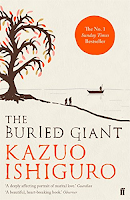
The Buried Giant by Kazuo Ishiguro


Monday, 4 March 2024

Guest review by Cindy Jefferies: WHEN THE DUST SETTLES by Lucy Easthope


"For the lay reader this is an extraordinary book. For a writer it is gold."

First published in 2001 for children, Cindy Jefferies found success with her Fame School series at Usborne Books, obtaining 22 foreign rights deals. More recently she has written fiction for adults as Cynthia Jefferies. Her first title under that name, The Outrageous Fortune of Abel Morgan, was published in 2018, followed a year later by The Honourable Life of Thomas Chayne. Both titles are set during the English Civil Wars.

I don’t usually review non-fiction. Not because I don’t read it. I read a lot for research but perhaps that’s it. I tend to review the novels I read for relaxation, while non fiction, however interesting, for some reason gets lumped with work, which is very unfair. This book, by Lucy Easthope, has propelled me out of my curmudgeonly attitude and made me determined to review more of the excellent non-fiction out there. In addition, this book would be a brilliant resource for many novelists. How could I not review it?

I came across Lucy Easthope’s name when I saw she had been booked to appear at our local Stroud book festival in November 2022. The strapline on the book is “Stories of love, loss and hope from an expert in disaster.” That intrigued me, and I booked tickets. It was electrifying! Lucy is a very engaging person. Cheerful, and yes…funny; a great speaker and absolutely devoted to her career in disaster management. But there’s much more to her than that, and she also seemed comfortable in referring occasionally to the ups and downs in her personal life. I learnt a lot that evening and my partner queued afterwards to buy a book and get it signed. I asked if I could borrow it some time but for that most prosaic of reasons, forgetfulness, it just didn’t happen. A year drifted by, then one day I happened to notice the book on his table.

“Oh! I meant to read that,” I said. “I’m going away on a writer’s retreat soon. Do you mind if I borrow it now?” And so I did.

Lucy Easthope has an engaging style and I was instantly hooked. She was telling me so much that I didn’t know. What a disaster expert is, for starters. And, chillingly, what the dust in the title can refer to. So much important work is done, even months and years after a disaster, analysing the dust created in a disaster such as the twin towers in the USA. Loved ones left behind want and need a body to say farewell to, but of course this is often impossible. DNA testing of such dust and fragments can result in tiny particles being found and identified long after the initial trauma has passed. Families are left with the horrific prospect of receiving minute amounts of matter several times, sometimes years apart. Then they have to decide whether to have yet another funeral to honour the person they loved and lost. One thing Easthope feels very strongly is that the people left behind have to be considered much more. What is vital to her is to help a person and a community to begin to recover, or at least start to move forwards.

In the hours and days after a disaster, whether a plane crash, a tsunami, a terrorist attack or a fire, multiple agencies swing into action. Police, ambulance workers, firemen, and all the science that goes with police work in a crime scene. We are all used to seeing these people on our TV screens and I had known that these things are rehearsed from time to time. Now I was reading an expert’s account of how what happens afterwards can make or break the recovery of those left behind. A blood-smeared cinema ticket could mean the world to someone who has almost nothing else to remember their loved one by. Such things, rather than being maudlin, can comfort, in the knowledge that the person was doing what they loved just before they died.

The blurb on the flyleaf of the this book tells us just how experienced Lucy Easthope is. She is the UK’s leading authority on recovering from disaster. From the 2004 Tsunami, 9/11, the 7/ 7 bombings, the Salisbury poisonings, Grenfell and the Covid 19 pandemic; she is the one who has answered the call, packed her bag and gone to support everyone involved. She holds authorities and government to account. She lets us see into the briefing rooms, how politics can get in the way and how simple thoughtlessness, or lack of understanding can make it so much harder for those left behind to begin to turn towards recovery. I am writing this during the Covid 19 enquiry. I have no doubt that Lucy Easthope will figure somewhere, unknown to most of us but vital to the process. For this was the overdue disaster, the one we really should have been ready for and weren’t.

For the lay reader this is an extraordinary book. For a writer it is gold. Between the pages we have an insight into exactly what goes on during, after and long after a disaster has happened. Any thriller writer who has a disaster in their plot would be well advised to read it.

I couldn’t take it in one breathless sitting. Occasionally it almost became tedious in the awful inevitability of what happens over and over again, although every disaster is also unique. But I was drawn back to it after a short break and never felt like abandoning her story. I simply had to read it to the end, and then sit and ponder.

Her matter of fact style helps to stop what she says ever being sensational or overwhelmingly ghastly. But we are dealing here with torn bodies and traumatised people. The people who pick up the pieces are so often heroic and almost broken by what they do. That Lucy Easthope is still standing is a testament to her desire as a young child, growing up near Hillsborough, to help, and she does this in spite of her own issues. We can thank her for thinking about us so carefully, and seeing through experience what works best to help us recover. We can all hope that a disaster never engulfs us, but if it does, she will be there somewhere: in the notes the recovery workers study, in the plans she has drawn up and usually in person, whether in a pop-up mortuary or a warm and welcoming place for families to gather. She strives to make sure the materials are there to ensure the proper collection and labelling of the remains of lives, so that eventually, those left behind can grieve and begin their own recovery. Little do we know how much we need her - so thank you, Lucy Easthope.

When the Dust Settles is published by Hodder.

Monday, 9 November 2020

Guest review by Graeme Fife: BRIGHT DAY by J B Priestley


"Simply, his work rings true, a powerful example of how honesty emerges through the challenges of emotional intelligence."

Graeme Fife has written many plays, stories, features and talks for radio, stage plays and articles for newspapers and magazines, and is now a regular contributor to BBC Radio 4's From Our Own Correspondent. He's the author of a string of books - children's stories, biography and works of history. Great Cycling Climbs, which brings together his books on the French Alps, is published by Thames and Hudson. He says, 'I urge everyone to buy from their independent bookshop, if they're lucky enough - as I am - to have one nearby. If not, by any means possible to counter the sprawl of the online consumer graball.'

Knowing Priestley through his plays and his experiments with shifts of time I now, belatedly, delight in his novels, discovering another side to a writer whose company I enjoy, whose work is rich in insight, tender and lyrical, muscular and unflinching, by turns. Priestley writes his own life into evocation of times he has known, lived through, learned from, without any blatant intrusion of autobiography. Simply, his work rings true, a powerful example of how honesty emerges through the challenges of emotional intelligence. Bright Day explores Priestley’s fascination with how the flux of time plays on our consciousness, by splitting the narrative between two eras of the central character’s life.

Set in part after the Second World War, the story begins in the lead-up to the First World War. Hope and confidence in those early years, a jaded sense of lost purpose in the aftermath of another shattering conflict, years later.

Gregory Dawson is staying in a hotel on the Cornish coast, working on a screenplay. Two guests arrive – people he knew as a young man in Bruddersford, thin disguise for Priestley’s native Bradford:

"My Bradford, where I was born and where I lived the most exciting and perhaps the most important years of my life is not really a town at all, it is a vast series of pictures in time and space…an autobiographical library…a hundred thousand succeeding states of mind, it is my childhood and
youth." 

Priestley captures the promise, and confusions, of youth, without sentimentality, tracing the progress of callow feelings, of unformed thought, in the gradual maturing of Dawson as a young man through his association with the Alingtons, a family of what seem to him brilliant individuals: sophisticated, stylish, wealthy. He’s drawn to their manifest poise, their sheer ease in a social milieu utterly strange to him, quite other. It’s part of his emergence into young manhood soon to be cast into the horror of the trenches. The shaping experience of war emerges only in casual allusion, but the imprint of that shocking reality resurfaces, almost subliminally, in the slow loss of any essential belief in the worth of what he is doing, labouring over a film script. It feels hollow. Hollywood’s charm has evanesced and, though this does not turn him into a cynic, it helps to impel him into revaluation of what those early years had exposed him to and a psychological blow whose implications he’s never explored or come to terms with. In disillusion, he finds elucidation.

The producer of the film he is writing spells out what underpins that disillusion: "... the power of movies…is frightening…What we are doing is filling a horrible vacuum, where once there were gods and goddesses and then afterwards saints and guardian angels. We are mythologists. We are the only licensed necromancers and wizards, shamans and medicine men. It is not the conscious mind, which we merely tickle but the deep unconscious that is our territory.’ 

And the deep unconscious is what Dawson learns to grapple with, painfully compelled but with frank courage. An old friendship, a renewed acquaintance, the triggers of memory, all push him to a realisation that he’s reached a natural terminus – both in his work and his life – where the call to change in both becomes irresistible.

From the tentative beginnings of his first years of work - in the cloth trade - his journey has taken him far geographically and intellectually, but it’s the need to reconsider, to re-examine, that lies at the heart of this beguiling story. From the New Year toast that father Alington proposes "to Nineteen Fourteen and all that it will bring us – peace, prosperity and friendship" to the recollection, years later, of how "an ageless secret self flitted through bewildering telescoped scenes that ran the chalk trenches of Picardy into Picadilly Circus and jammed Brigg Terrace and Canal Street into Hollywood and Beverley Hills…and cried 'Lost, lost, lost', searched and searched and could never find what was to be found".

But it is, finally, to be found and found through love. A woman Dawson meets on his completion of the script and decision to quit – despite lucrative offers of more work, work which he knows will only leave him feeling emptier – speaks of the death of her husband and repeats those words lost, lost, lost. But determined to confront the loss, she says "and the worst thing to do is turn your face away and hold yourself rigid and not let life go flowing through you. Do you see what I mean, Gregory?"

Bright Day is published by Great Northern Books

Other First World War books:

In Parenthesis by David Jones, reviewed by Graeme Fife

Now All Roads Lead to France by Matthew Hollis, reviewed by Celia Rees

My Dear, I Wanted to Tell You by Louisa Young, reviewed by Linda Newbery


Monday, 11 May 2020

Guest review by Judith Allnatt: TRIO by Sue Gee


"A beautiful novel about loss, the process of grieving and coming alive again to beauty, friendship and love."

Judith Allnatt writes short stories and novels for adults. Her novels have been variously shortlisted for the Portico Prize for Literature, the East Midlands Book Award and featured as a Radio 5 Live Book of the Month. Short stories have appeared in the Bridport Prize Anthology and the Commonwealth Short Story Awards, and have been broadcast on BBC Radio 4 and the World Service.

Judith’s latest novel, The Silk Factory, is an eerie story of love and memory drawing on both the Luddite weavers’ rebellions in the nineteenth century and a modern day haunting. She
 has lectured widely on Creative Writing for over two decades and is a Royal Literary Fund Fellow. She lives with her family in Northamptonshire and is working on her fifth novel. For more information and blog posts see Judith’s website. 
Twitter: @judithallnatt

Trio  
is a beautiful novel about loss, the process of grieving and coming alive again to beauty, friendship and love. The main character, Steven Coulter, is not part of the eponymous musical trio but a teacher who tragically loses his young wife and is paralysed by grief. A year later when a colleague, Frank Embleton, invites him to a concert given by his sister and two friends, the music moves him. He begins to open to new possibilities for involvement in the world beyond his daily classes and his lonely house on the Northumberland moors and to the chance of new relationships.

Music is a healing power throughout, allowing feelings to form and be acknowledged. It releases the expression of feelings that are beyond words, as when a fellow teacher, morose Mr Dunn, veteran of the Somme, weeps to hear a young chorister sing Once in Royal David’s City.

Many of the pleasures of Sue Gee’s novels are here. Remote moorlands, Bamburgh Castle, Lindisfarne and the country house, with its pele tower and haha, where the trio practises, are lyrically described. Her subtle observation of human behaviour and her nuanced dialogue provide tantalising glimpses of her characters’ secret desires.

Set in 1937, the novel balances themes of stability and fragility. The English country house seems timeless with its ancient cedar still with its childhood swing. Its grandfather clock acts as a symbol of continuity with its rising moon and reliable quarter hour peal. Yet beneath this is the continuous sense that all can be turned in a moment: through the ravages of TB, the sense of war stalking ever closer; through loves revealed and rejection turning worlds upside down.

In a bold move, the story transitions from 1937 to the present day in the last section, and follows the next generation of Steven’s family. Although this might seem disconcerting and a challenge for the reader to engage with a new character, I quickly became fond of Geoff and interested in his nostalgic journey to his past. At first I thought the main purpose of the section was to show the reader what had become of the original characters through and after the war. I soon came to realise that something much more subtle was also going on. Gee shows us the past inextricably bound up in the present; the strength of attachment to childhood places, memories triggered by chance encounters, the need, near the end of life, to make a pilgrimage to one’s roots and to honour one’s ancestors.

This is a gentle, thoughtful and elegiac novel where appreciating the texture of the writing is as enjoyable as working out the characters’ secrets. It has the rare depth of insight one has come to expect from Sue Gee’s novels and I found myself pondering on loss, love and time, long after the last poignant scene. 

Trio is published by Salt.

Monday, 24 February 2020

STARVE ACRE by Andrew Michael Hurley, reviewed by Adèle Geras


'The last scene is one that you will not ever forget. I guarantee this. Please, if you’re the kind of reader who does this, do not turn to the end first. Please …'


Adèle Geras is the author of many books for children and six novels for adults. Her seventh novel, Conviction, will appear in early 2021 published by Michael Joseph under the pseudonym, Hope Adams. She lives in Cambridge.

Andrew Michael Hurley has written three short novels. They’re all disturbing but this latest is the most worrying of all.

His work is not to everyone’s taste, and I know one person who actively shudders when she utters the names of his books, but I love them. What most appeals to me is the weaving together of careful, vivid writing about specific places, strange interactions between human beings and other human beings and also between people and …I don’t know what to call it. The Unnatural. The Supernatural. Other Forces. Ghosts. Folk Memory... take your pick. Some reviewers have referred to the genre Hurley writes in as ‘folk horror.’

Starve Acre is short enough to be a novella. Its story would be harrowing even with no supernatural elements. A couple, Richard and Juliette, are recovering from the death of their very young son, Ewan. They’ve moved into a house belonging to Richard’s parents. There’s a field close by called Starve Acre, that no one in the area will even approach. A giant gallows tree grew there long ago. Now, the field is barren. Centuries ago, three young men from the village were hanged there for crimes committed under the influence of Jack Grey, a malign presence, like some kind of devilish Green Man. Everyone shuns the field.

‘Local lore had it that the divine reprisal had not ended with the tree but had spread out across the common in a poisonous ripple, turning the grass black, seeping down into the earth like oil, suffocating the life out of the place.’

But Richard, an academic, assuages his pain at his son’s death by exploring: digging in the field eager to find the roots of that tree. He comes across the skeleton of a hare and takes it carefully home where he puts together the hare’s bones, like some horrid jigsaw puzzle. Juliette spends a great deal of time in what was Ewan’s room, weeping and recording what she’s sure is his voice, his presence. To her, he’s not dead at all, but still in the house. I don’t want to give anything away, but there’s a group of people, led by one Mrs Forde who might be able to help Juliette come to terms with her bereavement. They’re called The Beacons and they’re…. shall we say unusual? Hurley is very good with gatherings of odd people…they appear in all his novels.

We also learn that `Ewan is not just any child. He can’t even be classified as a ‘difficult’ child or one who’s suffering from autism, say. He is very much more than that…

And the hare that Richard has assembled becomes hugely important.

The last scene is one that you will not ever forget. I guarantee this. Please, if you’re the kind of reader who does this, do not turn to the end first. Please…

One reason for reading about tragic events is to give relief to the reader, through what the Greeks called catharsis. The pity and terror you feel for others helps you to confront your own sorrows. But where the pity is mixed with so much horror, it’s harder to be comforted. When the whole is written so powerfully and beautifully, the weight of the prose, and the bringing into your mind of a complete and carefully described landscape is a special kind of pleasure.

I read this book on my Kindle and I see I’ve underlined something…it shows up blue as I go through the pages. This is what it says and it’s a good motto for the whole novel:

‘What you go searching for and what you find aren’t always the same.’

Starve Acre is published by John Murray.


Monday, 7 January 2019

Guest review by Gwen Grant: WHAT LOVE COMES TO, new and selected poems by Ruth Stone


"Poems that shine with clarity, understanding and beauty."


Gwen Grant: I have been writing and publishing since 1968, the majority of my work for children but also publishing poetry. Private - Keep Out, which first came out in 1978, is to be re-issued in March 2019 by Penguin Vintage Children's Classics. 

The American poet Ruth Stone writes poems that shine with clarity, understanding and beauty, poems that I absolutely love and admire for their finely balanced, rhythmic elegance. Stone is witty, wise and, at times, funny, but she can also be a very tricky customer, for she has this great gift of being able to change course mid-poem, so that what seems all set for plain and simple will, quietly, unexpectedly, lead into much darker waters. It’s like being mugged by a feather. You don’t know it’s happened until you re-read a poem and find something new in it that you somehow missed before. Every Stone poem is a journey into a new understanding for she is a force of nature, a poet in possession of her world and ours.

In Second-Hand Coat, she begins with two words then in the following twelve short lines, turns this poem about an old coat into a surreal story of how, once it is taken home, it begins to talk, asking solicitously if its new owner has everything they need before leaving the house, the distinct impression being that it is speaking in the voice of the woman who once owned it. Alchemy of the highest order.

What Love Comes To is made up of new poems and poems selected from earlier books, witty, acerbic, hostile, elegiac, fierce poems, some political, some absorbed by science, some with rough sexual imagery, some deeply sensual and some so tender, you can hear the poet breathing, feel her heart beating.

All Ruth Stone’s poems have such integrity, you trust her to tell it how it is, which is a tall order for a woman who was no stranger to tragedy. Early in their marriage, Stone’s husband, Walter, killed himself, leaving her with three small girls to raise. She has said that all her poems are ‘love poems written to a dead man,’ whose suicide forced her to live in limbo. Yet Stone keeps this compact of honesty between herself and the reader, sparing herself nothing and, therefore, sparing the reader nothing. In Turn Your Eyes Away, so hard to read, so impossible to think of how hard it must have been to write, the Gendarme notifies her of the nature and death of the man she loved.

Each plain and unforgiving line of Turn Your Eyes Away stonily taps into the next line, telling the bleak sorrow of how Walter died. Of what happened when they pushed the door to his room open, of where his dead feet lay, then going on remorselessly to where his tagged body lies in the morgue. Then, almost before there is time to feel sadness for such suffering, Stone whirls around, remembering how they once lay together in a single bed, face to face, breath to breath, not wanting ever to part, that erotic love poem, the Song of Songs, lying open in the hotel’s Gideon Bible.

It is through Ruth Stone’s absolute honesty and unflinching gaze in this poem as in all her poems, that in these last lines, we are able to feel the passion and sexual desire these two had for each other; a love that seems to shatter sorrow, swipe death out of the way and burn up the page with longing.

In The Sperm and the Egg, another mid-course change poem, the egg hates the sperm and then the sperm hates the egg, wanting its tail back because then it was free. Dark waters here, for every reading throws up new thoughts. It is Ruth Stone’s genius that this poem ends with an absolutely apposite quotation from Hamlet. Then the lovely humour of Setting Type, where the semi-colon, the paragraph, the vocabulary and good punctuation get it together.

Finally, from The Widow's Muse, Poem XLII tells how the widow is triumphant having got through thirty years of widowhood, until her muse forces her to smell an old undershirt of Walter’s, which still retains his scent. At this, the widow whimpers with grief whereupon the muse knocks all the sense out of her. Harsh, hard and truthful.

Ruth Stone died in 2011, aged 96.

What Love Comes To is published by Bloodaxe Books.

Monday, 14 May 2018

Guest review by Anne Cassidy: IDAHO by Emily Ruskovich


Anne Cassidy writes crime fiction for teenagers. She has published over forty novels for young adults. She writes dark crime fiction and is best known for Looking for JJ which was shortlisted for the Carnegie medal. Moth Girls was published by Hot Key in 2016 and concerns the disappearance of two twelve year old girls. Her new novel No Virgin describes the aftermath of a rape.

Idaho is a startling first novel which centres on a family tragedy. In it we are told the story of Wade and Jenny and their daughters June and May. The tragedy is the explosion at the heart of the story and the writer circles around it for the rest of the book. We begin to understand the events through the eyes of a number of characters mainly those of Ann, the second wife of Wade.

Ann has a pressing interest in the events of that day and it is her discoveries and interpretations that lead to the reader’s understanding of what happened and crucially why. And yet it is only a subjective solution for this is no classic crime novel. It is a story of a family in crisis, of a man who has a chance to live again, of a woman trying to understand the actions that brought it all about.

Mostly though this is the story of family life. Wade and Jenny, a young couple expecting a baby, have to live out a winter marooned in the snowy mountain. Two young sisters June and May play together until June is too old to play with dolls and May’s grief for the loss of her playmate is beautifully and painfully realised. Wade has early stage dementia just as his father had; though the loss of memory brings a kind of relief as he no longer knows what happened to his family.

The tragedy touches many people’s lives; William and Beth who comfort the husband afterwards; Tom Clark, who paints images of the missing daughter as she gets older year by year; Eliot, the boy who lost his leg falling through a dock. We also touch on the guilt of the perpetrator, the self-flagellation of a person who cannot accept any forgiveness.

The writing is assured and poetic and the characters are presented with a tender touch. There is no one in this book that the writer does not care about.

Idaho is published by Vintage.


Monday, 23 October 2017

Guest review by Cindy Jefferies: DEAD BABIES AND SEASIDE TOWNS by Alice Jolly


"Jolly’s ability to write about tragedy without making it tragic is extraordinary."


Cindy Jefferies has been writing for for various publishers since 2001, with her Fame School titles being continually in print for over ten years, and translated into 16 languages. In 2016 she was invited to be artistic director of the children’s part of the inaugural Stroud Book Festival in Gloucestershire. Out of that came the idea for a children’s festival, of which she is joint co-ordinator with Rick Vick. She lives in Stroud, and splits her time between writing, festival work, refugee aid and looking after her young granddaughter. She is a member of the Society of Authors and the Scattered Authors' Society. Apart from enjoying a glass of wine with friends she likes parking her mini camper van on the land she owns with her sisters, having a brew-up and enjoying the wildlife.

Profoundly moving, this memoir begins with a traumatic pregnancy and tragic stillbirth. But as Alice Jolly tells us, she has never had much time for the me, me, me, of memoir. This award-winning book, published by Unbound and winner of both the V S Pritchett Award and the PEN Ackerley Award, is many things. It manages to be uplifting and controversial, occasionally funny as well as tragic, and asks at least as many questions as it gives answers.

What is it that drives us on, as human beings? That is the question that remained in my mind when I finished the book. The simple answer is the desire to succeed, but when does that become unreasonable, or foolish? When is it admirable, understandable? Alice Jolly retreated to one seaside town or another, places she describes as the “ultimate act of defiance,” to recuperate between miscarriages. At one point she likens herself and her husband to gamblers. “We have become like gamblers who have lost so much that only a win can save them. Good money after bad.” She tries hard to come to terms with the situation. Unlike so many, they already have one healthy child. Surely they should be happy with that? Perhaps only those who have suffered the loss of a stillborn child will understand, or maybe no one can ever really, at the deepest level, understand what drives another.

At its simplest, this book is about a woman who refuses to accept that her family is complete. But it is also about money. With money, so much more is possible. IVF, donor eggs, adoption, surrogacy. Do these possibilities ameliorate the situation, or make it worse? Other questions arise. Morality, the law, mental health, the impact on others. This is a personal story, but it is also more than that, and I think, an important book. It is, too, beautifully written, honest, and without self pity. I shied away from reading it for a long time because I thought I would find it too emotionally difficult. When I found the courage, my fear was totally unfounded. Not only did the language draw me in, it is also just so darned interesting.

Jolly’s ability to write about tragedy without making it tragic is extraordinary. By managing somehow to stand a little outside her experience she shields the reader, without compromising the truth. This is, perhaps, the writer’s detachment Leonard Woolf describes so well in his autobiography, World Within World. However arrived at, the treatment serves this book exceptionally well. There are thoughts, too about how to process difficulties, and the role of emotional authenticity. Nowadays, “Everybody has to be allowed to feel what they feel, express, process…..But now I begin to realise that there may be events too big to process. Sometimes the only way to survive is to get up and walk on without looking back.”

Alice Jolly surrounds her story with place and time, with just enough detail to make us feel the seasons and years as they pass. Brussels, London and Stroud are all places that have been called home, while the coast is not somewhere to live, but a place to retreat to from time to time. And there is the beautiful house up high in the Cotswolds: a house so draughty that the heating is pointless. The house takes time and energy and emotion while it is renovated, but at last it is beautifully restored, and contains a family that eventually, touchingly, feels complete.

Dead Babies and Seaside Towns is published by Unbound.