Showing posts with label rewilding. Show all posts

Monday, 13 October 2025

ALBION by Anna Hope, reviewed by Linda Newbery


"Combines typical ingredients of the big house novel and family saga with deep questions about individual responsibility, whether wrongs of the past can be righted, how we adapt to climate change and nature loss, and what kind of future we can shape."

Linda Newbery
edits Writers Review. She is a writer, reviewer and active campaigner on animal and environmental issues. Her latest novel, published earlier this year, is The One True Thing. 
The big country house as a fictional setting has enduring appeal. Names come readily to mind: Downton Abbey, Brideshead, Manderley, Mansfield Park, Brandon Hall (see Graeme Fife's recent review of The Go-Betweenand countless more, including the recent Saltburn. The house in Anna Hope's latest novel differs from these others in never being named, though it's certainly as grand as any of them - an eighteenth-century Greek Revivalist mansion standing in a thousand acres of Sussex pasture and woodland. The name we focus on isn't that of the house, but of the Albion Project - a ten-year rewilding project that certainly owes much to the influential and nearby Knepp Castle estate, obliquely referred to. As with the Knepp project, the ambition of owner Philip Ignatius Brooke and daughter Frannie is to extend beyond their own boundaries, creating a green corridor that will reach through Sussex and Kent countryside to the sea. 

Now Philip has died, and the novel's action takes place over five days in May during which the family reassembles for his funeral. Of his three children only Frannie, the eldest, still lives there, and is in the process of moving with her young daughter into the main house, while Philip's widow, Grace, will take over their cottage. Philip himself had inherited house and estate at just eighteen when both parents were killed in a car crash; he set up what became known as 'the English Woodstock', a festival known and fondly remembered as The Teddy Bears' Picnic. There he met his future wife, leading to a marriage from which she wishes she'd had the courage to escape. While she remained at home with the children,  he did escape - to New York, where he settled for years with another partner (and possibly another child?) before returning and zealously taking up the rewilding scheme.

Anna Hope loses no time in showing us the spiky relationships and resentments of the three grown-up children, Frannie, Isa and Milo. Frannie is named as heir in their father's will, to the disapproval of brother Milo; she in turn is impatient with Isa, who's barely been in contact; Milo, recovering from various kinds of addiction, plans an exclusive rural retreat in the grounds in which, bizarrely, he aims to convert the 1% who can afford it into benevolence that will benefit the whole of society. Frannie, faced with paying millions in inheritance tax, is desperate to find the money somehow, fretting as she tries to write her father's eulogy; Grace, relieved to exchange the house she hates for the cottage, has ambivalent feelings about her late husband and how she'll express them at his funeral. Isa, distancing herself from wealth and privilege, is a teacher in London, scornful of her sister's enterprise: "The shepherd's huts, the yurts, the caravan serving lattes to middle-aged white people while they sit on hay-bales and chatter about their Pilates teachers and their dogs. A theme park for solvent fifty-somethings, all of it about as wild as a fucking printed tea-towel." Meanwhile, seven-year-old Rowan is showing what her class teacher sees as a disturbing fascination with bodily decomposition after death.

Into this potent mix comes a young American PhD student, Clara, with a bombshell to drop. Most readers will see what's coming, but that doesn't lessen the impact when she chooses her moment to reveal the source of the estate's wealth. With mesmerising clarity, calmness and precision she compels the family to listen, making eloquent use of her encounter with Rowan playing with a box of shells.

What next? How will these descendants of Oliver Ignatius Brooke adjust to the knowledge of the vast injustices (more than one) that underpin their privilege?

I first came across this novel when it was dramatised as Radio 4's Book of the Week earlier this year. There, I thought the repercussions of Clara's revelation were disappointing, too glibly and swiftly dealt with, so I wanted to see how Anna Hope handles this in the novel. Even here, though, I'm not sure. There are various reconciliations: too many and still too quickly, because of the constraints of the five-day structure. Frannie is the one whose ending is left most open-ended and uncertain as she confronts difficult questions, both practical and ethical.

That reservation aside, I found Albion utterly compelling: it combines typical ingredients of the big house novel and family saga with deep questions about individual responsibility, whether - and how - wrongs of the past can be righted, how we adapt to climate change and nature loss, what kind of future we can attempt to shape and who will benefit. The pace is leisurely enough to draw us fully into the family's concerns, while never seeming slow; tensions crackle off the page while the depictions of the natural world are vivid and immediate, whether portraying the woodland in May extravagance, the brisk extermination of a pregnant mink or the dawn song of a nightingale. I hadn't read Anna Hope before, so this is a very impressive introduction.

Albion is published by Penguin.

See also Anna Hope's Expectation, reviewed by Claire Grint of Cogito Books, Hexham.

Linda Newbery's The One True Thing is published by Writers Review Publishing.

Monday, 21 February 2022

Guest review by Cindy Jefferies: THE WOLF BORDER by Sarah Hall


"She’s the real deal, and I really shouldn’t be admitting to not knowing her work until now!"


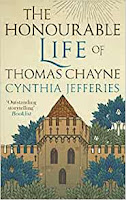
First published in 2001 for children, Cindy Jefferies found success with her Fame School series with Usborne Books, obtaining 22 foreign rights deals. Latterly writing fiction for adults as Cynthia Jefferies, her first title The Outrageous Fortune of Abel Morgan was published in 2018, followed a year later by The Honourable Life of Thomas Chayne, set during the English Civil Wars, followed in 2019. Both titles are now available in paperback.

I came to read Sarah Hall by way of a friend who recommended her. Hall is a multi award winner, including being shortlisted for the Man Booker twice so far. Surely she’ll win it one day. Why on earth hadn’t I come across her before? But I hadn’t, now I have and am eternally grateful to Claire, who put me right.

I like to support my local library, which is only a few yards away from my house. I love the randomness of what’s in and what’s out. The only Sarah Hall when I looked online was The Wolf Border, published in 2015, so that’s what I picked up. But I have lots more treats in store. She has now written six novels, and several collections of short stories. Apparently she started her writing career by publishing poetry in literary magazines. Of course she did. She’s the real deal, and I really shouldn’t be admitting to not knowing her work until now!

So to The Wolf Border. I love reading about wolves, and I do enjoy a good plot. When you add in wonderful descriptions of landscape, well researched human and wolf biology and superlative phrases I had to read again, either for the pure poetry, or for the wisdom within them … well! Finding everything in one novel is rare. They don’t come along every day. Unputdownable can also mean so plot-driven that you’re left gasping but ultimately unfulfilled. Literary can mean difficult. Not here.

Rachel is an expert on wolves. She lives on a reservation in Idaho, protecting the wolves in her care. She has a good team. She has a few friends, and brief affairs with men. Her upbringing in Cumbria was unusual, her mother not easy to love, or even to like. She has very little contact with mother or brother. Perhaps she is something of a lone wolf, but that’s too easy. Life isn’t that simple, and Hall writes real, complex characters, easy to believe in.

When Rachel goes back to Cumbria after several years away it is to visit her mother, who is dying, and to meet a landowner who has a plan to introduce wolves back into the UK. He has a vast estate, friends in high places, and the money to invest in the project. Rachel doesn’t think much of Thomas the earl, but the idea is intriguing, and the land reasonably suitable. The space the pair would have while in quarantine is generous, and eventual release into a huge area, though not as good as being totally wild, is close to the next best thing. There are too many deer on the estate and it is clear that the wolves would be self-sustaining and would improve the environment in several ways.

Hall doesn’t shy away from the complexities of making such a project happen. There would be opposition and encouragement both locally and more widely. The high salary Rachel is offered isn’t the thing that sways her. It’s the possibility of making it work. Yes, they would still be captive, but the amount of land they would have would enable them to live their own lives, naturally. Hunting their own food, and maybe, one day raising their own young. She takes the job, but has unwittingly brought something with her from Idaho which will have a profound effect on her life in England.

Thank you, Sarah Hall, for a thoroughly enjoyable and thought provoking novel. My next trip will be to the bookshop for your latest!

The Wolf Border is published by Faber.

Here is a Q&A with Cynthia (Cindy) Jefferies on her novel set during the Civil War, The Honourable Life of Thomas Chayne.


Monday, 4 October 2021

Guest review by Judith Allnatt: ENGLISH PASTORAL - AN INHERITANCE, by James Rebanks


"In a world trembling at the brink of climate disaster, this is both a timely and a hopeful book..."

Judith Allnatt writes short stories and novels for adults. Her novels have been variously shortlisted for the Portico Prize for Literature, the East Midlands Book Award and featured as a Radio 5 Live Book of the Month. Short stories have appeared in the Bridport Prize Anthology and the Commonwealth Short Story Awards, and have been broadcast on BBC Radio 4 and the World Service.

Judith’s latest novel, The Silk Factory, is an eerie story of love and memory drawing on both the Luddite weavers’ rebellions in the nineteenth century and a modern day haunting. She has lectured widely on Creative Writing for over two decades and is a Royal Literary Fund Fellow. She lives with her family in Northamptonshire and is working on her fifth novel. For more information and blog posts see Judith’s website.  Twitter: @judithallnatt

English Pastoral is both urgent in its call to arms for the planet and poetic in its lyrical description of life on the author’s farm in the Cumbrian fells.

The book is structured in three acts. The first concerns the traditional farming that he learnt from his grandfather: rotating crop and pasture, using manure to nourish the soil and harvesting once a year. These were the farming methods evolved over centuries that worked both with and for nature. Spilt grain helped birds survive through the winter and cutting hay once for fodder rather than frequent grass cutting for silage allowed a habitat to survive for ground nesting birds such as curlews.

The second act explains the pressures of a growing world population and the industrialisation of farming: the growing of monoculture crops and the widespread use of pesticides, literally weeding out biodiversity; the spiralling use of fertilizers on soil ever more compacted and degraded; the use of massive machines on huge fields stripped of ancient hedgerows. These are practices that work efficiently to maximise production, but this drive for ever-lower food prices leaves little room for wild things and the cost to the natural world and the climate goes largely unheeded.

The third act explores hope for the future - the equivalent of the ‘redemption’ frequently used at this point in the structure of fiction. It describes James Rebanks’ return to some traditional farming methods. He chooses Herdwick sheep for their hardiness to Cumbrian weather. Belted Galloway cattle are introduced that can stand wintering outside and don’t need to eat silage indoors. Thus at one stroke he removes both the need for multiple crops of monoculture grass and the practice of spreading the resulting slurry: an acidic form of muck that destroys soil quality rather than well-rotted manure, which builds it. 12,000 trees are planted on his land. With the help of the Eden Valley River Authority, river and beck are rerouted and transformed from straightened, dredged, draining channels to meandering curved watercourses, slowing their pace to help protect towns downstream that were previously devastated by floodwater from unprecedented levels of rain. As the river wanders, gravel is deposited and salmon and trout that need gravel shoals on which to spawn return. He documents the otters, hares and owls returning to his land, alongside the rare wildflowers in the meadows. He speaks with equal enthusiasm of micro-organisms and numbers of earthworms - indicators of healthy soil. And what of the curlews? Driven out during the years of losing their chicks to the harvester, they are starting to return along with the swallows and swifts that dive to snatch the flies above muck-nourished fields.

Hung along the narrative thread that follows the farm’s fortunes, are vignettes of farming life: sheep stranded on an island of grass in floodwater, his father’s manic delight in the five yearly gorse burning, a son’s pride in winning a silver shield for being ‘best tup handler’.

The book is beautifully written. Old phrases such as ‘leading in the hay’ are used naturally as a matter of course. (Surely an echo of the thousands of years preceding this mechanical age, when men led horse and cart from field to yard). The face of the fells, changing with weather, the hour and the season is brought alive by the close observation and choice images of the writer.

In a world trembling at the brink of climate disaster, this is both a timely and a hopeful book. James Rebanks demonstrates that his farm is now not just carbon neutral but carbon positive – it is storing more carbon than it creates. Whilst pragmatically recognising that chemical intervention has its place, he makes the case for using traditional methods wherever possible and for encouraging and cherishing farming that improves the land and stewards the wildlife upon it. He points out that big corporations hunt in rural corners for genes in stock or crops in order to breed animals and plants capable of surviving new challenges such as climate changes. Yet, with every small farmer swallowed up by large scale monoculture farming these opportunities narrow and treasure is lost.

Most of us live in towns and cities and have little close contact with the land that feeds us. We buy packaged food from supermarkets and don’t think much about where it comes from or how it is produced. This book turns our eyes in this unwonted direction. What we see is that we can’t afford to ignore issues of regeneration and stewardship any longer, and that what happens to our land has far-ranging consequences for what will happen to our planet.

English Pastoral is published by Penguin.

See also: Wilding, by Isabella Tree, reviewed by Linda Newbery   


Monday, 4 November 2019

WILDING by Isabella Tree


"Essential, even exciting, reading for anyone interested in nature, wildlife, ecosystems and climate change." 

Linda Newbery is the editor of Writers Review. She has written widely for young readers and is currently completing a new adult novel.

'Until we understand what the land is, we are at odds with everything we touch.' Wendell Berry

What a fascinating book this is! It covers so much, overturning several preconceptions along the way, that I hardly know where to start. So I'll begin at the end, where Isabella Tree comments on the benefits of natural surroundings for mental health, and the sad fact that many people nowadays have little exposure - through choice or circumstance - to wild nature. Readers of this blog probably know that Robert Macfarlane and Jackie Morris were spurred to work together on The Lost Words - a beautiful book which won Jackie Morris a well-deserved Kate Greenaway Medal for illustration - by news that the Oxford Junior Dictionary was ditching such words as acorn, bluebell, wren and otter to make space for  terms deemed more relevant to today's world: celebrity, blog, broadband and suchlike. Macfarlane and Morris's widely-acclaimed collaboration is a timely and important book, and so in its different way is Wilding. 

Isabella Tree and her husband Charlie Burrell, inheriting his family estate of 3,500  acres, at first continued the arable and dairy farming already established there, but found that their hard-baked clay soil did not produce good yields. Could there be a way of letting their land fulfill its potential - not for commerce, but for wildlife? Inspired by a Dutch project on land earmarked for industry but then abandoned, they learned how the presence of grazing animals - greylag geese, then large herbivores - had produced surprising results; close grazing kept the water fringes clear and tree growth in check, providing habitat for a wealth of insects, birds and small mammals. It's often assumed that any fertile land, if left untended, will become mature woodland; but, as Isabella Tree points out, this notion overlooks the presence of grazing herbivores such as the ancient aurochs, tarpan and bison which preceded human intervention, later replaced by deer, domesticated cattle and pigs. Perhaps, she thinks, we have the wrong idea about ancient forests. She quotes Oliver Rackham: "To the medievals, a Forest was a place of deer, not of trees. If a Forest happened to be wooded it formed part of the wood-pasture tradition."

Wondering if this minimal-intervention approach would work with their own land, Isabella and Charlie sought grants from English Nature (now Natural England), the government's advisory body. Unlike most applicants for funding they had no clear plan for what was in effect an experiment: their plan was, over twenty-five years, to see what would happen if they fenced their land to make it deer-proof, a major expense, and introduced Longhorn cattle, fallow and later red deer, and Exmoor ponies. As in the Dutch project, they chose tough, sturdy animals that could fend and forage for themselves and withstand all weathers.

Copyright Knepp Wildland
Of course the Knepp project couldn't fully replicate natural ecosystems without including apex predators - lynxes or wolves - to keep the numbers of cattle, ponies and deer in check.The Dutch project, leaving weak and elderly animals to die from illness or starvation, had met with justifiable opposition; at Knepp, with the land crossed by footpaths, such a hands-off approach couldn't be justified on humane, aesthetic or even practical grounds. So the grazing animals are culled, and their meat sold. Apparently grass-fed beef is delicious, and pasture grazing is certainly the most environmentally efficient way of producing meat, although it's a luxury few can afford.

Copyright Knepp Wildland
The Knepp experiment, now sixteen years on, has produced inspiring results. Iconic species such as turtle dove, nightingale and purple emperor butterfly have moved in; beavers have been introduced, their dams creating marshy wetland which supports wading birds, amphibians and bog plants. The softening of water edges is so important for flood defences, another re-think: rather than funnelling water into hard-edged channels, it can effectively be dispersed and soaked up, to the benefit of pasture and wildlife. Another keystone creature is the humble earthworm, whose importance has been underestimated to the detriment of soil health.

Copyright Knepp Wildland
Few individuals will be able to replicate the Knepp experiment - Tree and Burrell owned a substantial swathe of land and were able to recruit expert help and funding. But I hope their findings will influence government and NGO policy on land management and conservation. Among many revelations, perhaps the most significant is that if we intervene less, nature can be trusted to restore itself. Whether there's time, in the face of climate breakdown, to attempt this on a wider scale, is impossible to know - we may be too far into our reckless uncontrolled global experiment with the world's climate and ecosystems.

I'd say that Wilding is essential, even exciting, reading for anyone interested in nature, wildlife, ecosystems and climate change - and I think most readers will find surprises and revelations to make them see the countryside, and our role in it, with fresh eyes. And I don't want to end without giving a flavour of the writing: although packed with information, comparisons and statistics, Wilding also has moments of lyrical joy, such as this description of a nightingale's song: "It throws the ear with unexpectedness ... florid trills, first rich and liquid, then mockingly guttural and discordant; now a sweet insistence of long, lugubrious piping; then bubbling chuckles and indrawn whistles; and then, suddenly, nothing - a suspended, teasing hiatus before the cascades and crescendos break forth again ... these pulsating strains issuing from tiny vocal chords belting out like organ pipes, throwing the music of the tropics into the English night air."

Wilding is published by Picador.

Find out more on the Knepp Wildland website.