Showing posts with label ecosystems. Show all posts

Monday, 17 February 2025

Guest review by Alison Layland: SARN HELEN, a Journey through Wales, Past, Present and Future, by Tom Bullough


"What a journey he takes us on! Far more than a travelogue, far more than nature writing, far more than a social history of Wales, this is a cry from the heart." 

Photograph by Trina Layland
Alison Layland
 is the author of two psychological thrillers: Someone Else’s Conflict, a compelling narrative of storytelling and the aftermath of war, and Riverflow, a story of family secrets and community tensions against a background of flooding and environmental protest. She also writes short stories and flash fiction; she won the short story competition at the National Eisteddfod in 2002, and her story Quirky Robbers is featured in the Honno crime anthology, Cast A Long Shadow. Her new novel, After the Clearances, a climate fiction novel set in 2050 Wales, will be published by Honno in July 2025.

When not writing, she is an environmental and social campaigner, who enjoys walking, crafting, growing and foraging around her home on the beautiful coast of Anglesey. More on Alison's website.

Until recently, serious consideration of the climate and nature crises was relatively rare in books aimed at a general readership. How wonderful, then, to see the trend changing as this passionate book was chosen as the overall winner of the Welsh Book of the Year 2024.

The titular Sarn Helen – Helen’s Causeway, a Roman road running the length of Wales from Neath in the south to Llandudno and the Great Orme in the north – is the thread that binds Tom Bullough’s insightful observations together. The author began his long-distance walk, which he undertook in sections over the period of almost a year, in 2020, following the first Covid lockdown – potent timing, since this zoonotic pandemic was yet another consequence of the damage people are doing, and have done, to the natural world. The precise route of Sarn Helen has been lost in places, but with a blend of detective work and guesswork, he managed to follow to its end. Like the conquering Romans who built the road, it has been superseded and overlaid by centuries of development – a fitting portent for the direction in which our modern society is heading.

And what a journey he takes us on! Far more than a travelogue, far more than nature writing, far more than a social history of Wales, this is a cry from the heart. The writing is immersive and each chapter is preceded by a wonderful illustration by renowned artist, Jackie Morris, who also provides the cover. Yet even here, there is a dark undercurrent, for we are told in the introduction that each of the fifteen beautiful species – birds, mammals, insects and plants – are among the 17% of species threatened with imminent national extinction. This sets the tone, for while describing the landscapes he walks through, their people and wildlife, in all their glory and diversity, Tom Bullough never lets us forget the threats they are facing, or the damage that has been done – from over-grazed uplands to the all-pervasive noise pollution of aeroplanes and other vehicles.

It’s often hard to strike the right balance when writing about the climate – too much doom and gloom and readers either despair or are driven to feel there’s nothing they can do so why bother? Too much optimism and it’s easy to give the impression that all’s well with the world. Sarn Helen strikes just the right balance. The author’s passion for the Welsh landscape and people, its wildlife, mythology and history, shines through, celebrating what is all around us, but never shying away from the what we have lost and still stand to lose, as well as the desperate need for change. Although the nature writing, conveyed with a vivid attention to detail, is beautiful, the book shows that, as in the wider world, the problems facing Wales are not all directly related to the climate and nature. He explores Wales’s social and industrial history in some depth, even looking back to mythological times and chronicling a fascination with the Celtic saints, whose world was much closer to nature and more respectful of the ecosystems around us than our own.

For some chapters, and sections of his walk, he is joined by poet and novelist Chris Meredith, with whom he discusses the industrial history of the Valleys and the impact of the post-industrial legacy on both landscape and people, and by writer and fellow activist Jay Griffiths, whose observations add companionable touches of spark and humour. Throughout, from the industrial to the agricultural, people are the key. Miners or farmers, saints or Roman conquerors, people are placed in the context of their landscape. Climate breakdown and nature depletion not only impact the natural world, but the people who live there – and it is the people who hold the key to the solutions.

These moments of companionship are full of relatable debate, humour and fascinating dialogue. The other interludes, however, are a stark clarion call: the travelogue is punctuated by interviews with experts – a climate scientist, an ecologist, a coastal scientist and a geographer – which add scientific context but also a terrifying intensity. Although they set out the problems facing Wales, and the wider world, clearly and objectively, the interviewees’ despair at the lack of action to halt climate change and nature depletion is pervasive and their emotions all the more hard-hitting coming from professionals in their respective fields.

A similar authenticity is added by the author’s own campaigning. While protesting with Extinction Rebellion in September 2020, he was arrested, and his journey along Sarn Helen is interrupted in April 2021 by a court hearing. The text of his speech to the court is deeply personal and moving – the more poignant today as environmental protesters are now banned by law from presenting such defences.

Actions speak louder than words – or do they? In the case of Sarn Helen, Tom Bullough’s beautifully crafted words are as potent as many actions, in that they will hopefully inspire anyone who reads them, firstly, to love and value the world around them, and then to do all they can to try and put a stop to the damage that modern society is causing.

Sarn Helen by Tom Bullough, with illustrations by Jackie Morris, is published by Granta, 2023

Alison Layland's Riverflow is reviewed here by Linda Newbery.

Monday, 31 October 2022

SIXTY HARVESTS LEFT: HOW TO REACH A NATURE-FRIENDLY FUTURE by Philip Lymbery, reviewed by Linda Newbery


"At the heart of sustainable change lies a recognition that all life on our planet is interconnected, and that our future depends on treating it with compassion and respect."

Linda Newbery edits Writers Review. Her latest publication is This Book is Cruelty Free - Animals and Us, a guide to compassionate living for teenagers and adults. She is a long-term supporter of Compassion in World Farming, and campaigns with Feed Our Future.

"This is now our planet, run by humankind for humankind," David Attenborough has written, quoted by Philip Lymbery. "There is little left for the rest of the living world." Our food systems are part of that domination, and Lymbery outlines powerful reasons for transforming the way we farm, eat and live if we are to have a future at all. 

Philip Lymbery is ideally-placed to write this important and timely investigation into the present and future of food and farming. As Chief Executive of Compassion in World Farming he has a wealth of knowledge and experience; he's travelled widely in his investigations, spoken at international conferences and written two previous books on different aspects of this subject: Farmageddon and Where the Wild Things Were (both of which are on my shelves).

His latest book is already receiving more attention than its predecessors - coinciding, as it does, with George Monbiot's equally important Regenesis, published earlier this year, and with a general rising of awareness of the links between food production and climate breakdown. It's not a message the majority of the public wants to hear, but for those willing to listen it's ever clearer that the planet can't sustain regular meat-eating in the affluent countries of the world: animal agriculture is responsible for 14.5-16% of global emissions and is a major driver of habitat destruction. And meat-eating is due to increase drastically as developing countries aspire to the excesses set by the US, UK and Australia. We have to make the connection between what's on our plates and the climate crisis that's all too evident. "I fear for those who will bear witness to the next ninety years, if we continue living as we are doing at present" - David Attenborough, quoted again.

Backed up by studies and references, Sixty Harvests Left could have been offputtingly dense, so it's a tribute to Philip Lymbery's skill that he makes it compellingly readable. The title is taken from a stark warning given in 2014 by the United Nations' Food and Agriculture Organisation that topsoil is being lost at such a rate that only 60 more harvests could remain, and both Lymbery and Monbiot stress the importance of soil structure and how its importance has been underestimated, the drive for increased productivity leading to overuse of fertiliser and the removal of trees and hedgerows. Lymbery's book illustrates this by opening with a vivid description of the American Dust Bowl of the 1930s, immortalised in John Steinbeck's The Grapes of Wrath. Although the impoverishment of the soil caused by over-ploughing and the destruction of native vegetation proved devastating, we don't seem to have learned from it. More intensive farming, higher yields and bigger output have been the goal for so long that the cost to ecosystems has barely been questioned. 'So much of our societal thinking is based around the economy,' Lymbery writes: leaders seem to imagine that infinite growth on a finite planet is somehow possible.

Industrial scale animal farming produces cheap meat but at a high environmental cost. "Factory farming is a cruel and wasteful process ... Animals reared in this way eat vast quantities of grain and waste most of its value in its conversion to meat. In this way, we waste crops enough to feed an extra 4 billion people." Lymbery doesn't dwell here on the cruelties of intensive farming but clearly that's another factor. "Long-hidden behind a veil of closed-door secrecy, misleading labelling and opaque government handouts, factory farming will come to be seen as the cruellest folly of our times. Like the slave trade, we will wonder how we let it happen."

There's hope, though, if we're prepared to adapt. Like Monbiot, Philip Lymbery enlarges on the possibilities of precision fermenting, which is being developed to produce what looks and tastes increasingly like meat and can provide protein for a fraction of the environmental cost. Yes, we'll have to get past public squeamishness at the notion (illogical though it is to feel revulsion at fermented protein while happily consuming slaughterhouse products); but this will surely be an important way to feed future populations. It's one of several solutions we need, another being regenerative farming, or agro-ecology. Lymbery visits farmers for whom sustainable land management means reintroducing wildlife, re-establishing native vegetation and treating the soil as the precious resource it is. For such farmers as Jake Fiennes in Norfolk, the presence of grazing animals is important, though they aren't viewed primarily as a source of meat. Sheep on Fiennes' farm are seen mainly as tramplers of the soil, providers of dung and lawnmowers for conservation grazing. Nature can respond, if given a chance.

Sixty Harvests Left is structured around the seasons, beginning in summer and ending in spring, each section introduced by Lymbery's reflections and observations on rural walks with his dog Duke (he wrote the book during lockdown). It's inspiring as well as informative - I'd say a must-read for anyone concerned about nature, animals and the future of food. But do we, and especially policy-makers, care enough to listen, and make the necessary shifts in behaviour?

"At the heart of sustainable change lies a recognition that all life on our planet is interconnected, and that our future depends on treating it with compassion and respect."

Sixty Harvests Left is published by Bloomsbury.

See also: Wilding by Isabella Tree


The Garden of Vegan by Cleve West


George Monbiot's Regenesis: Feeding the World without Devouring the Planet  is published by Penguin.

Linda Newbery's This Book is Cruelty Free: Animals and Us is published by Farshore.


Monday, 21 February 2022

Guest review by Cindy Jefferies: THE WOLF BORDER by Sarah Hall


"She’s the real deal, and I really shouldn’t be admitting to not knowing her work until now!"


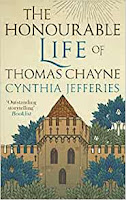
First published in 2001 for children, Cindy Jefferies found success with her Fame School series with Usborne Books, obtaining 22 foreign rights deals. Latterly writing fiction for adults as Cynthia Jefferies, her first title The Outrageous Fortune of Abel Morgan was published in 2018, followed a year later by The Honourable Life of Thomas Chayne, set during the English Civil Wars, followed in 2019. Both titles are now available in paperback.

I came to read Sarah Hall by way of a friend who recommended her. Hall is a multi award winner, including being shortlisted for the Man Booker twice so far. Surely she’ll win it one day. Why on earth hadn’t I come across her before? But I hadn’t, now I have and am eternally grateful to Claire, who put me right.

I like to support my local library, which is only a few yards away from my house. I love the randomness of what’s in and what’s out. The only Sarah Hall when I looked online was The Wolf Border, published in 2015, so that’s what I picked up. But I have lots more treats in store. She has now written six novels, and several collections of short stories. Apparently she started her writing career by publishing poetry in literary magazines. Of course she did. She’s the real deal, and I really shouldn’t be admitting to not knowing her work until now!

So to The Wolf Border. I love reading about wolves, and I do enjoy a good plot. When you add in wonderful descriptions of landscape, well researched human and wolf biology and superlative phrases I had to read again, either for the pure poetry, or for the wisdom within them … well! Finding everything in one novel is rare. They don’t come along every day. Unputdownable can also mean so plot-driven that you’re left gasping but ultimately unfulfilled. Literary can mean difficult. Not here.

Rachel is an expert on wolves. She lives on a reservation in Idaho, protecting the wolves in her care. She has a good team. She has a few friends, and brief affairs with men. Her upbringing in Cumbria was unusual, her mother not easy to love, or even to like. She has very little contact with mother or brother. Perhaps she is something of a lone wolf, but that’s too easy. Life isn’t that simple, and Hall writes real, complex characters, easy to believe in.

When Rachel goes back to Cumbria after several years away it is to visit her mother, who is dying, and to meet a landowner who has a plan to introduce wolves back into the UK. He has a vast estate, friends in high places, and the money to invest in the project. Rachel doesn’t think much of Thomas the earl, but the idea is intriguing, and the land reasonably suitable. The space the pair would have while in quarantine is generous, and eventual release into a huge area, though not as good as being totally wild, is close to the next best thing. There are too many deer on the estate and it is clear that the wolves would be self-sustaining and would improve the environment in several ways.

Hall doesn’t shy away from the complexities of making such a project happen. There would be opposition and encouragement both locally and more widely. The high salary Rachel is offered isn’t the thing that sways her. It’s the possibility of making it work. Yes, they would still be captive, but the amount of land they would have would enable them to live their own lives, naturally. Hunting their own food, and maybe, one day raising their own young. She takes the job, but has unwittingly brought something with her from Idaho which will have a profound effect on her life in England.

Thank you, Sarah Hall, for a thoroughly enjoyable and thought provoking novel. My next trip will be to the bookshop for your latest!

The Wolf Border is published by Faber.

Here is a Q&A with Cynthia (Cindy) Jefferies on her novel set during the Civil War, The Honourable Life of Thomas Chayne.


Monday, 4 October 2021

Guest review by Judith Allnatt: ENGLISH PASTORAL - AN INHERITANCE, by James Rebanks


"In a world trembling at the brink of climate disaster, this is both a timely and a hopeful book..."

Judith Allnatt writes short stories and novels for adults. Her novels have been variously shortlisted for the Portico Prize for Literature, the East Midlands Book Award and featured as a Radio 5 Live Book of the Month. Short stories have appeared in the Bridport Prize Anthology and the Commonwealth Short Story Awards, and have been broadcast on BBC Radio 4 and the World Service.

Judith’s latest novel, The Silk Factory, is an eerie story of love and memory drawing on both the Luddite weavers’ rebellions in the nineteenth century and a modern day haunting. She has lectured widely on Creative Writing for over two decades and is a Royal Literary Fund Fellow. She lives with her family in Northamptonshire and is working on her fifth novel. For more information and blog posts see Judith’s website.  Twitter: @judithallnatt

English Pastoral is both urgent in its call to arms for the planet and poetic in its lyrical description of life on the author’s farm in the Cumbrian fells.

The book is structured in three acts. The first concerns the traditional farming that he learnt from his grandfather: rotating crop and pasture, using manure to nourish the soil and harvesting once a year. These were the farming methods evolved over centuries that worked both with and for nature. Spilt grain helped birds survive through the winter and cutting hay once for fodder rather than frequent grass cutting for silage allowed a habitat to survive for ground nesting birds such as curlews.

The second act explains the pressures of a growing world population and the industrialisation of farming: the growing of monoculture crops and the widespread use of pesticides, literally weeding out biodiversity; the spiralling use of fertilizers on soil ever more compacted and degraded; the use of massive machines on huge fields stripped of ancient hedgerows. These are practices that work efficiently to maximise production, but this drive for ever-lower food prices leaves little room for wild things and the cost to the natural world and the climate goes largely unheeded.

The third act explores hope for the future - the equivalent of the ‘redemption’ frequently used at this point in the structure of fiction. It describes James Rebanks’ return to some traditional farming methods. He chooses Herdwick sheep for their hardiness to Cumbrian weather. Belted Galloway cattle are introduced that can stand wintering outside and don’t need to eat silage indoors. Thus at one stroke he removes both the need for multiple crops of monoculture grass and the practice of spreading the resulting slurry: an acidic form of muck that destroys soil quality rather than well-rotted manure, which builds it. 12,000 trees are planted on his land. With the help of the Eden Valley River Authority, river and beck are rerouted and transformed from straightened, dredged, draining channels to meandering curved watercourses, slowing their pace to help protect towns downstream that were previously devastated by floodwater from unprecedented levels of rain. As the river wanders, gravel is deposited and salmon and trout that need gravel shoals on which to spawn return. He documents the otters, hares and owls returning to his land, alongside the rare wildflowers in the meadows. He speaks with equal enthusiasm of micro-organisms and numbers of earthworms - indicators of healthy soil. And what of the curlews? Driven out during the years of losing their chicks to the harvester, they are starting to return along with the swallows and swifts that dive to snatch the flies above muck-nourished fields.

Hung along the narrative thread that follows the farm’s fortunes, are vignettes of farming life: sheep stranded on an island of grass in floodwater, his father’s manic delight in the five yearly gorse burning, a son’s pride in winning a silver shield for being ‘best tup handler’.

The book is beautifully written. Old phrases such as ‘leading in the hay’ are used naturally as a matter of course. (Surely an echo of the thousands of years preceding this mechanical age, when men led horse and cart from field to yard). The face of the fells, changing with weather, the hour and the season is brought alive by the close observation and choice images of the writer.

In a world trembling at the brink of climate disaster, this is both a timely and a hopeful book. James Rebanks demonstrates that his farm is now not just carbon neutral but carbon positive – it is storing more carbon than it creates. Whilst pragmatically recognising that chemical intervention has its place, he makes the case for using traditional methods wherever possible and for encouraging and cherishing farming that improves the land and stewards the wildlife upon it. He points out that big corporations hunt in rural corners for genes in stock or crops in order to breed animals and plants capable of surviving new challenges such as climate changes. Yet, with every small farmer swallowed up by large scale monoculture farming these opportunities narrow and treasure is lost.

Most of us live in towns and cities and have little close contact with the land that feeds us. We buy packaged food from supermarkets and don’t think much about where it comes from or how it is produced. This book turns our eyes in this unwonted direction. What we see is that we can’t afford to ignore issues of regeneration and stewardship any longer, and that what happens to our land has far-ranging consequences for what will happen to our planet.

English Pastoral is published by Penguin.

See also: Wilding, by Isabella Tree, reviewed by Linda Newbery   


Monday, 22 March 2021

THE INVENTION OF NATURE: the Adventures of Alexander von Humboldt, the Lost Hero of Science, by Andrea Wulf, reviewed by Linda Newbery


"Why isn't he as widely acknowledged as Charles Darwin as a key figure in our understanding of nature?"

Linda Newbery edits Writers Review. Her young adult novel Set in Stone was a Costa category winner; she has published widely for young readers, and is currently working on a new adult novel. Her non-fiction title This Book is Cruelty-Free: Animals and Us will be published in July by Pavilion Books.

What an amazing man Alexander von Humboldt was - one of those driven people who achieves enough to fill ten lives. Yet until I heard about Andrea Wulf's book when it won the Costa Biography prize in 2015, the name Humboldt meant little to me beyond the Humboldt current in the Pacific and the Humboldt penguin. In fact, he has more animals and plants named after him than anyone else – as well as the Mare Humboldtianum, an impact basin, or ‘sea’, on the moon. He was so influential that I’m astonished he isn't a household name, like Charles Darwin, and Wulf's subtitle reflects this: The Adventures of Alexander von Humboldt, the Lost Hero of Science. 

Born into a wealthy Prussian family in 1769, he loved collecting and labelling shells, insects and plants from an early age. His father, an army officer, died when Alexander was nine, and he was brought up by his rather distant mother, who sent him to study government and politics. Alexander rejected this planned career in favour of natural history, and became a tireless traveller, explorer, collector, writer, observer and interpreter of the natural world.

While still in his twenties he came to the realisation that nature forms ecosystems, such a key concept today. His term for this was Naturgemälde, in which – unlike other naturalists of his day, who focused on identifying, naming and categorising as if species lived in isolation – he saw that natural systems form a complex, interdependent web. Not only that, but as early as 1800 he foresaw that human intervention had the potential to disrupt the climate; he described "mankind's mishief ... which disturbs nature's order".  More than two hundred years later we're still waiting for this to be fully acknowledged by world leaders.

His earliest travels, in his twenties, were in Venezuela, where he climbed mountains and volcanoes, studied vegetation and made detailed notes on climate zones. From then on, he wrote and published copiously, starting with botany, progressing through his seven-volume Personal Narrative, which combined scientific study with travelogue. Through further travels in South America he observed the damaging effects of Spanish colonialism on indigenous peoples. He advised Thomas Jefferson on the likely effects of independence from Spain and how it might affect the United States; throughout his life he was an outspoken critic of slavery. His influence also set Simon Bolivar on his campaign to free south American from Spanish rule. Wulf points out his contradictions, though – while approving of revolution, he served for years as court chamberlain to the German King Friedrich Wilhelm IV. 

His view that nature calls for an emotional response alongside scientific interest  (he wrote like a poet, one reviewer said) inspired the Romantic poets – Wordsworth and Coleridge are known to have read his books, and Byron directly referred to Humboldt in Don Juan. And Charles Darwin had Humboldt’s Personal Narrative in his cabin on the Beagle, ­annotated with his own comments. Reading these, Wulf says, is like eavesdropping on a conversation between the two. For Darwin, Humboldt was such a key influence that he rather nervously sent the older man a copy of The Voyage of the Beagle, and was delighted when Humboldt replied with detailed appreciation. ‘Few things in my life have gratified me more,’ Darwin wrote; ‘even a young author cannot gorge such a mouthful of flattery.’ We’re so used to seeing Charles Darwin as the bearded, venerable grandfather of natural science that it’s intriguing to see him here, responding as any novice author would to praise from a much-admired elder.

Possibly, Humboldt’s ‘web of life’ idea is also behind James Lovelock’s Gaia hypothesis – that the Earth, as a whole, is a living thing, capable of regulating itself (if not destroyed by excesses of human interference). Certainly it was the impetus behind Man and Nature, by George Perkins Marsh, which elaborated on Humboldt’s idea that humans would have a disastrous effect on the natural world. Marsh even foresaw that animal agriculture and meat-eating would deplete natural resources, and that vegetarianism is far more sustainable. Henry David Thoreau’s Walden also owes much to Humboldt’s writings. and Wulf believes that Humboldt was the first to produce nature writing as we think of it now..

The energy and drive of this remarkable man lasted well into his eighties – when he died, at 89, he was still working on a massive, multi-volume project, Cosmos, which aimed to bring everything – animals, plants, geology, oceans and even the sun and stars into one consummate study.

If you’re interested in nature, exploration, the history of science and how we see ourselves in relation to the natural world, I’m sure you’ll enjoy this richly informative book as much as I have. Perhaps Humboldt’s ideas, revolutionary in their time, strike us now with a new and pertinent force. 

So why has he slipped from view? Why isn't he as widely acknowledged as Charles Darwin as a key figure in our understanding of nature? Wulf suggests that, firstly, he was writing at a time when generalism in science was being replaced by specialist disciplines; and secondly, that anti-German feeling in Britain and the USA began to play its part. Still, Wulf concludes that "Environmentalists, ecologists and nature writers today remain firmly founded in Humboldt's vision - although many have never heard of him. Nevertheless, Humboldt is their founding father."

The Invention of Nature is published by John Murray.

See also: Walden by Henry David Thoreau


Monday, 5 October 2020

Guest review by Tracey Mathias: THE OVERSTORY by Richard Powers


"A novel for the Anthropocene, for an age of mass extinction brought about by human action: it portrays Nature as we need to understand it now: not as stable and enduring but in a state of catastrophic change."

Tracey Mathias grew up in Cardiff but has lived for more than half her life in London. She has three grown-up daughters, and has been writing for children since they were small. She is writer in residence at the DaCapo Music Foundation, writing song lyrics and performance pieces, and is the author of the fantasy trilogy Assalay. Her latest book is Silence is Also a Lie (originally published as Night of the Party) – a Young Adult love story, mystery and political dystopia set in a near future England.
 
The Overstory deeply impressed and affected me on first reading: I have already reread it and imagine that I’ll return to it more than once in the future. It feels like a necessary book for our age, and one that opens up possibilities for what can be done with fiction. 

There are so many things to admire here. Powers’s prose is beautiful, precise and lyrical. He interweaves the stories of a large cast of characters with skill and poise: introducing them in a series of vivid biographical vignettes and then following them over a broad sweep of time from early years to late adulthood. But more than anything, I am struck by the ways that he imagines and writes the natural world. 

The trees and forests that dominate the novel are described with the kind of clarity and loveliness that comes from close observation. The ‘pinnate leaves’ of an ash tree ‘feather the light and make life feel softer than it is.’ The trunk of a redwood is ‘a triple wide door of darkness into the side of the night.’ In the ‘twilight-green’ air of an ancient forest ‘clicks and chatter disturb the cathedral hush.’ 

These descriptions are not static, either, but full of dynamic life. There’s a running theme about time and the relativity of time here. The novel’s computer genius (whose pioneering games act as analogies for so much else: codes branch; a bestselling game involves the competitive extraction of value from a virtual Earth) remembers a snippet of sci-fi. A race of aliens move so fast that ‘Earth seconds seem to them like years’ and humans ‘nothing but sculptures of immobile meat.’ By analogy, we must see trees in ‘tree time’ to understand them not as static, but as active, moving and purposeful beings, and the energy and vibrancy of Powers’s language does just this: a chestnut ‘spirals’ into the sky; trees in a forest ‘fight for scraps of light’; the roots of Douglas firs ‘run into each other underground.’ And Powers doesn’t only give us poetic description, but poetic science. The book is rich in fascinating botanical detail, especially in those passages written from the perspective of a plant scientist whose major interest is the social life of trees: the ways in which they communicate, co-operate and form communities. 

So narrative doesn’t just belong to humans: trees have their own stories of change and relationship. They’re also deeply entwined with human stories (the novel itself takes the form of a tree, imagining human life as roots, trunk, crown and seeds). Trees are emblems and instruments of human history, love, fate, tragedy, and there’s a hint of mystical connection, in the synchronous flourishing and declining of people and trees. 

But, crucially, this is also a relationship of tragedy and damage. The Overstory is a novel for the Anthropocene, for an age of mass extinction brought about by human action: it portrays Nature as we need to understand it now: not as stable and enduring but in a state of catastrophic change. The novel is elegiac, all its beauty threated with the awareness of what we have lost and stand to lose. Some of the most painful passages in Roots describe the blight that wiped out the great chestnut forests of the US east coast, and the main driver of the plot is the protest against the felling of virgin redwood forest on the West Coast. Powers offers no easy reassurance for the future. There is, one character reflects, a war between trees and humans ‘over the land and water and atmosphere. And she can hear, louder than the quaking leaves, which side will lose by winning.’ 

Beautiful, painful, urgent: this is an important book.

The Overstory is published by Vintage.

Monday, 4 November 2019

WILDING by Isabella Tree


"Essential, even exciting, reading for anyone interested in nature, wildlife, ecosystems and climate change." 

Linda Newbery is the editor of Writers Review. She has written widely for young readers and is currently completing a new adult novel.

'Until we understand what the land is, we are at odds with everything we touch.' Wendell Berry

What a fascinating book this is! It covers so much, overturning several preconceptions along the way, that I hardly know where to start. So I'll begin at the end, where Isabella Tree comments on the benefits of natural surroundings for mental health, and the sad fact that many people nowadays have little exposure - through choice or circumstance - to wild nature. Readers of this blog probably know that Robert Macfarlane and Jackie Morris were spurred to work together on The Lost Words - a beautiful book which won Jackie Morris a well-deserved Kate Greenaway Medal for illustration - by news that the Oxford Junior Dictionary was ditching such words as acorn, bluebell, wren and otter to make space for  terms deemed more relevant to today's world: celebrity, blog, broadband and suchlike. Macfarlane and Morris's widely-acclaimed collaboration is a timely and important book, and so in its different way is Wilding. 

Isabella Tree and her husband Charlie Burrell, inheriting his family estate of 3,500  acres, at first continued the arable and dairy farming already established there, but found that their hard-baked clay soil did not produce good yields. Could there be a way of letting their land fulfill its potential - not for commerce, but for wildlife? Inspired by a Dutch project on land earmarked for industry but then abandoned, they learned how the presence of grazing animals - greylag geese, then large herbivores - had produced surprising results; close grazing kept the water fringes clear and tree growth in check, providing habitat for a wealth of insects, birds and small mammals. It's often assumed that any fertile land, if left untended, will become mature woodland; but, as Isabella Tree points out, this notion overlooks the presence of grazing herbivores such as the ancient aurochs, tarpan and bison which preceded human intervention, later replaced by deer, domesticated cattle and pigs. Perhaps, she thinks, we have the wrong idea about ancient forests. She quotes Oliver Rackham: "To the medievals, a Forest was a place of deer, not of trees. If a Forest happened to be wooded it formed part of the wood-pasture tradition."

Wondering if this minimal-intervention approach would work with their own land, Isabella and Charlie sought grants from English Nature (now Natural England), the government's advisory body. Unlike most applicants for funding they had no clear plan for what was in effect an experiment: their plan was, over twenty-five years, to see what would happen if they fenced their land to make it deer-proof, a major expense, and introduced Longhorn cattle, fallow and later red deer, and Exmoor ponies. As in the Dutch project, they chose tough, sturdy animals that could fend and forage for themselves and withstand all weathers.

Copyright Knepp Wildland
Of course the Knepp project couldn't fully replicate natural ecosystems without including apex predators - lynxes or wolves - to keep the numbers of cattle, ponies and deer in check.The Dutch project, leaving weak and elderly animals to die from illness or starvation, had met with justifiable opposition; at Knepp, with the land crossed by footpaths, such a hands-off approach couldn't be justified on humane, aesthetic or even practical grounds. So the grazing animals are culled, and their meat sold. Apparently grass-fed beef is delicious, and pasture grazing is certainly the most environmentally efficient way of producing meat, although it's a luxury few can afford.

Copyright Knepp Wildland
The Knepp experiment, now sixteen years on, has produced inspiring results. Iconic species such as turtle dove, nightingale and purple emperor butterfly have moved in; beavers have been introduced, their dams creating marshy wetland which supports wading birds, amphibians and bog plants. The softening of water edges is so important for flood defences, another re-think: rather than funnelling water into hard-edged channels, it can effectively be dispersed and soaked up, to the benefit of pasture and wildlife. Another keystone creature is the humble earthworm, whose importance has been underestimated to the detriment of soil health.

Copyright Knepp Wildland
Few individuals will be able to replicate the Knepp experiment - Tree and Burrell owned a substantial swathe of land and were able to recruit expert help and funding. But I hope their findings will influence government and NGO policy on land management and conservation. Among many revelations, perhaps the most significant is that if we intervene less, nature can be trusted to restore itself. Whether there's time, in the face of climate breakdown, to attempt this on a wider scale, is impossible to know - we may be too far into our reckless uncontrolled global experiment with the world's climate and ecosystems.

I'd say that Wilding is essential, even exciting, reading for anyone interested in nature, wildlife, ecosystems and climate change - and I think most readers will find surprises and revelations to make them see the countryside, and our role in it, with fresh eyes. And I don't want to end without giving a flavour of the writing: although packed with information, comparisons and statistics, Wilding also has moments of lyrical joy, such as this description of a nightingale's song: "It throws the ear with unexpectedness ... florid trills, first rich and liquid, then mockingly guttural and discordant; now a sweet insistence of long, lugubrious piping; then bubbling chuckles and indrawn whistles; and then, suddenly, nothing - a suspended, teasing hiatus before the cascades and crescendos break forth again ... these pulsating strains issuing from tiny vocal chords belting out like organ pipes, throwing the music of the tropics into the English night air."

Wilding is published by Picador.

Find out more on the Knepp Wildland website.