Showing posts with label biography. Show all posts

Monday, 18 March 2024

Guest round-up by Paul Dowswell: HIGH TIMES AND LOW CULTURE, a random selection of rock biographies


"Writers Review usually concerns itself with the classier end of the literary spectrum but on this occasion I’m going to stride manfully into the murky world of the Rock biography ..." 

Paul Dowswell
writes historical fiction and is a frequent visitor to schools, both home and abroad, where he talks about his books and takes creative writing classes. His novels Eleven Eleven and Sektion 20 won the Historical Association Young Quills Award and Ausländer won the Hamelin Associazione Culturale Book Prize and the Trinity Schools Book Award. Recently he has become increasingly concerned about how deranged he looks in Zoom calls.

Writers Review usually concerns itself with the classier end of the literary spectrum but on this occasion I’m going to stride manfully into the murky world of the Rock biography. And not just any rock biography – this last month a friend passed on a random wodge of them when he was having a clear out and it’s these I’ll be writing about as well as mentioning some others by way of comparison. This latest batch have been of variable quality, but good or bad it’s still been fascinating to read them.


Undoubtedly, some rock biogs are terrible. Radio presenter Danny Baker once dismissed David Bowie’s ex-wife Angie’s account of their life together, Backstage Passes, by saying you could open any page and read out any sentence and it would be dreadful. I did just that and came up with ‘Trying to have a relationship with a coke freak is like trying to eat an aircraft carrier.’ But notwithstanding, some rock biogs can be hands-down magnificent. Bob Geldof’s post Live-Aid effort Is that it? brilliantly portrays his early life in the cold-water chill of post-war Ireland and remains interesting when fame kicks in. John Cooper Clarke’s biog I wanna be yours offers the reader a magical picture of childhood in post-war Manchester and only goes off the rails once he becomes famous and, simultaneously, a heroin addict. Here, his unhappy tales of chasing his next fix become dull and repetitive.
 

But for now, let’s get back to this month’s batch:

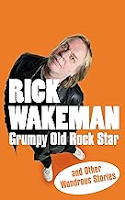
Rick Wakeman's music isn’t my thing but he seems like a genial soul so I've always warmed to him when I’ve seen him on the telly. His book generously credits his ghost writer – something that is not always the case in projects like these - and he quickly establishes his everybloke persona with chapter openers like ‘I love cars. I’ve had a few in my time…’. Alas, I found Grumpy Old Rock Star (Preface, 2009) hard work. On the printed page he comes over like a sozzled but harmless 'I'm mad, me' pub bore who might corner you at the bar. And, good God, his anecdotes are INTERMINABLE. His hearty pub-speak style does grate, and no cliché goes unused. Radio station switchboards ‘light up like a Christmas tree’ when swearing occurs on air, and Rick is living his life ‘on God’s green earth.’ Within are tales of Barry the Perv, Herr Schmitt and Tony ‘Greasy Wop’ Fernandez. Come on, Rick. It’s the 21st Century, not the ‘Hop off you Frogs’ 1980s.
 

Keith Emerson’s Pictures of an Exhibitionist (John Blake Publishing, 2004) is handicapped by the prog keyboard star’s clunky writing style. The book doesn’t credit a ghost writer but you would have thought his editor would have something to say about sentences like ‘From his casual shrug, could I be forgiven my suspicions that a game of deception was being played?’ It’s also rich in muso talk such as ‘By coincidence, Carl’s drum pattern happened to fit a left-handed ostinato figure I was working on…’ But before you know it he’s undermining his role as Prog’s own music professor by regaling us with tales of Emerson, Lake and Palmer sharing a roadside German prostitute.

For anyone who dislikes the prog-rock behemoths (as 1970s rock critics invariably described ELP) there’s plenty here to fuel their prejudice. ‘I’ve got this image of us creating a vast "sheet of sound" that defies conventional structures,’ writes Emerson. ‘There doesn’t appear to be one set time signature or a key structure but the total effect played by the three of us could be very prolific.’ Whimper fearfully and pray for the arrival of punk.
 

Lemmy’s White Line Fever (Simon and Schuster, 2002) is unexpectedly fascinating and he can certainly tell a tale. The Hawkwind and Motörhead bassist, who once said when asked for the secret of his success ‘Just keep going, like Attila the Hun’, is true to his word. Equipped with an iron constitution and an iron will, he burned through 40 years of Motörhead line-ups and died with his boots on a few short years after publication. You suspect, like The Alien, he had acid for blood. Despite his fearsome mien and even more fearsome consumption of amphetamine sulphate, he comes across as quite an old-fashioned and learned sort of chap. He even confesses that his greatest line in describing Motörhead to the world, ‘If we moved in next door your lawn would die,’ was actually nicked from American rock band The MC5. Unlike Rick Wakeman, Lemmy keeps his anecdotes short and to the point and is never less than entertaining. One former manager he describes as ‘a very interesting man… from an anthropological point of view. A complete ******* lunatic.’

Ginger Baker’s Hellraiser (John Blake, 2010) leaves you wondering how he lived so long. His parents’ generation would have called him a tearaway and he was undoubtedly mad, bad and dangerous to know. But among the tales of a decades-long smack habit, multiple infidelities and trying to set fellow band members hair on fire, you can’t help noticing that his daughter Nettie has done a really good job on the ghost writing. 

And to finish, two biogs written by a band accomplice and a journalist respectively, rather than the musicians and their ghost writers. Richard Cole’s Stairway to Heaven (Pocket Books, 1997) and Stephen Davis’s Hammer of the Gods (Pan Books, 2005), both about Led Zeppelin.

The band’s oft told tale reads like a Greek tragedy and by way of comparison, I’d say the best account of them all is undoubtedly Barney Hoskyns’s Trampled Underfoot, where artfully chosen and often quite contractionary quotes illuminate this cautionary tale. (Jimmy Page claims his drug use never affected his playing. The rest of the world disagree.) As a rule of thumb you can tell how crappy a Led Zeppelin biog writer is by the ease and frequency in which they resort to aerial metaphors to describe the ‘flight’ and ‘crash landing’ of the Leds. Hoskyns doesn’t do this and his is a sad and sorry tale which also leaves you in awe of their extraordinary talents and multi-faceted music.

So, what of these two aforementioned accounts? Richard Cole, who was the band’s road manager throughout their 12-year existence, tells a weary tale, from the stale, obvious title onwards. His is a book of paint-peelingly sordid revelations, made even more distasteful by Cole’s corrosive misogyny. If you have pearls, prepare to clutch them. It’s like eavesdropping on the Russian Mafia drunkenly guffawing about how badly they treat the local prostitutes. On one occasion, for example, Cole persuades a gaggle of thirteen and fourteen year old girls to join the group on their private plane at Los Angeles airport. When the plane unexpectedly takes off for New York, the girls become distressed when they realise how much trouble they’re going to get into with their parents, who they probably told they were going to a sleepover with school friends. What larks.


 Stephen Davis’s Hammer of the Gods is also a hair-raising expose of rock piggishness both within the group and their piratical road crew. Herein lurk tales of underage groupies, medieval brutality and Olympic-standard drug use.

But let's not end on such a negative note. Like Hoskyns, Davis loves the Leds. He even sings the praises of their underwhelming In Through the Out Door album, the last they made before their fearsome drummer, John ‘The Beast’ Bonham drank himself to death (48 vodkas, apparently…). Davis is an educated, erudite guide, quoting Primo Levi and snippets of Anglo-Saxon literature and while Cole’s book is a sordid swank along a very seedy avenue, Davis clearly revers his subjects, and finishes his book with a vivid and moving pilgrimage to John Bonham’s grave.

Monday, 22 March 2021

THE INVENTION OF NATURE: the Adventures of Alexander von Humboldt, the Lost Hero of Science, by Andrea Wulf, reviewed by Linda Newbery


"Why isn't he as widely acknowledged as Charles Darwin as a key figure in our understanding of nature?"

Linda Newbery edits Writers Review. Her young adult novel Set in Stone was a Costa category winner; she has published widely for young readers, and is currently working on a new adult novel. Her non-fiction title This Book is Cruelty-Free: Animals and Us will be published in July by Pavilion Books.

What an amazing man Alexander von Humboldt was - one of those driven people who achieves enough to fill ten lives. Yet until I heard about Andrea Wulf's book when it won the Costa Biography prize in 2015, the name Humboldt meant little to me beyond the Humboldt current in the Pacific and the Humboldt penguin. In fact, he has more animals and plants named after him than anyone else – as well as the Mare Humboldtianum, an impact basin, or ‘sea’, on the moon. He was so influential that I’m astonished he isn't a household name, like Charles Darwin, and Wulf's subtitle reflects this: The Adventures of Alexander von Humboldt, the Lost Hero of Science. 

Born into a wealthy Prussian family in 1769, he loved collecting and labelling shells, insects and plants from an early age. His father, an army officer, died when Alexander was nine, and he was brought up by his rather distant mother, who sent him to study government and politics. Alexander rejected this planned career in favour of natural history, and became a tireless traveller, explorer, collector, writer, observer and interpreter of the natural world.

While still in his twenties he came to the realisation that nature forms ecosystems, such a key concept today. His term for this was Naturgemälde, in which – unlike other naturalists of his day, who focused on identifying, naming and categorising as if species lived in isolation – he saw that natural systems form a complex, interdependent web. Not only that, but as early as 1800 he foresaw that human intervention had the potential to disrupt the climate; he described "mankind's mishief ... which disturbs nature's order".  More than two hundred years later we're still waiting for this to be fully acknowledged by world leaders.

His earliest travels, in his twenties, were in Venezuela, where he climbed mountains and volcanoes, studied vegetation and made detailed notes on climate zones. From then on, he wrote and published copiously, starting with botany, progressing through his seven-volume Personal Narrative, which combined scientific study with travelogue. Through further travels in South America he observed the damaging effects of Spanish colonialism on indigenous peoples. He advised Thomas Jefferson on the likely effects of independence from Spain and how it might affect the United States; throughout his life he was an outspoken critic of slavery. His influence also set Simon Bolivar on his campaign to free south American from Spanish rule. Wulf points out his contradictions, though – while approving of revolution, he served for years as court chamberlain to the German King Friedrich Wilhelm IV. 

His view that nature calls for an emotional response alongside scientific interest  (he wrote like a poet, one reviewer said) inspired the Romantic poets – Wordsworth and Coleridge are known to have read his books, and Byron directly referred to Humboldt in Don Juan. And Charles Darwin had Humboldt’s Personal Narrative in his cabin on the Beagle, ­annotated with his own comments. Reading these, Wulf says, is like eavesdropping on a conversation between the two. For Darwin, Humboldt was such a key influence that he rather nervously sent the older man a copy of The Voyage of the Beagle, and was delighted when Humboldt replied with detailed appreciation. ‘Few things in my life have gratified me more,’ Darwin wrote; ‘even a young author cannot gorge such a mouthful of flattery.’ We’re so used to seeing Charles Darwin as the bearded, venerable grandfather of natural science that it’s intriguing to see him here, responding as any novice author would to praise from a much-admired elder.

Possibly, Humboldt’s ‘web of life’ idea is also behind James Lovelock’s Gaia hypothesis – that the Earth, as a whole, is a living thing, capable of regulating itself (if not destroyed by excesses of human interference). Certainly it was the impetus behind Man and Nature, by George Perkins Marsh, which elaborated on Humboldt’s idea that humans would have a disastrous effect on the natural world. Marsh even foresaw that animal agriculture and meat-eating would deplete natural resources, and that vegetarianism is far more sustainable. Henry David Thoreau’s Walden also owes much to Humboldt’s writings. and Wulf believes that Humboldt was the first to produce nature writing as we think of it now..

The energy and drive of this remarkable man lasted well into his eighties – when he died, at 89, he was still working on a massive, multi-volume project, Cosmos, which aimed to bring everything – animals, plants, geology, oceans and even the sun and stars into one consummate study.

If you’re interested in nature, exploration, the history of science and how we see ourselves in relation to the natural world, I’m sure you’ll enjoy this richly informative book as much as I have. Perhaps Humboldt’s ideas, revolutionary in their time, strike us now with a new and pertinent force. 

So why has he slipped from view? Why isn't he as widely acknowledged as Charles Darwin as a key figure in our understanding of nature? Wulf suggests that, firstly, he was writing at a time when generalism in science was being replaced by specialist disciplines; and secondly, that anti-German feeling in Britain and the USA began to play its part. Still, Wulf concludes that "Environmentalists, ecologists and nature writers today remain firmly founded in Humboldt's vision - although many have never heard of him. Nevertheless, Humboldt is their founding father."

The Invention of Nature is published by John Murray.

See also: Walden by Henry David Thoreau


Monday, 6 April 2020

NOW ALL ROADS LEAD TO FRANCE by Matthew Hollis, reviewed by Celia Rees


"Matthew Hollis’s superb biography took me back to read the poetry with new eyes and introduced me to Thomas’s wonderful prose writing on nature and the English landscape."

Celia Rees is a leading writer for Young Adults with an international reputation. Her titles include Witch Child (shortlisted for the Guardian Children's Fiction Prize), Sorceress, (shortlisted for the Whitbread - now Costa - Children's Book Award), Pirates!, Sovay and Glass Town Wars.  The chance discovery of an old family cookery book has now taken her writing in a new and different direction. In 2012, she began researching and writing her first novel for adults, Miss Graham's Cold War Cookbook, to be published by HarperCollins in July, 2020.
Twitter: @CeliaRees

instagram: @celiarees1

I generally resist biographies of artists and writers. I don’t want details of their personal life to colour my view of their work. Edward Thomas is one of my favourite poets and, although I bought this book a while ago, it has been on my shelves unread. I’m very glad I put my prejudice aside. Matthew Hollis’s superb biography took me back to read the poetry with new eyes and introduced me to Thomas’s wonderful prose writing on nature and the English landscape.


The biography covers the usual details: Edward Thomas was born in Lambeth and educated in Battersea, then St Paul’s before attending Lincoln College, Oxford. Then the story begins to unfold... 

While still at Oxford, he married Helen Noble and soon had a family to support. He was determined to make his own way and to live by his pen. He reviewed for newspapers and periodicals, published essays, biographies and volumes on the countryside. As a reviewer, he was a familiar face among the Georgian poets and their younger rivals. He was a particular friend of the Welsh tramp poet, W.H. Davies and became great friends with a new comer to the London poetry circle: the American poet, Robert Frost. He was a respected, even feared poetry critic, famous for his blunt honesty, but he didn’t begin writing poetry himself until 1914. 

He was a restless man, moving his family often, finding it difficult to find a place to settle and write. Even when a home was established, Thomas found it hard to stay there, leaving his wife Helen and the children for weeks at a time. He was subject to recurring bouts of black depression, which had started when he was at Oxford. He was a difficult man – proud, prickly and moody. His great solace was walking, alone, or in the company of Frost, roaming the countryside, covering many miles in a day.

Paul Nash - Whittenham Clumps (Nash's paintings remind me of Thomas' poetry and vice-versa. The two men were fellow soldiers in the Artists' Rifles and friends. They shared a love of the countryside and a keen interest in bird watching.)
Both men were interested in a new kind of poetry, using the vernacular, echoing the cadences of everyday speech and song. Very different from the self conscious flourishes of their contemporaries the Georgian poets, much closer to the unadorned honesty that would follow later with the First World War poets, like Wilfred Owen and Siegfried Sassoon. In 1914, with Robert Frost’s encouragement, Thomas began to write verse of his own, initially under the name Edward Eastaway. He was reluctant to publish under his own name, unsure of the reception he would receive. 

All his poetry was written between November 1914 and his death in April 1915. It is an extraordinary body of work, containing some of the finest poems in the English language, but he had served a long apprenticeship as a critic, reviewer, essayist and inveterate observer and note taker of everything he saw and heard around him. He began to write poetry when he was ready to do so. ‘I’ll know my song well before I start singing” to quote a later poet, Bob Dylan. 

As with all great poets he captures a moment, a feeling but strikes a resonance beyond the words on the page, going on and on, rather like the amplified bird song in one of his most famous poems Adlestrop.

'And for that minute a blackbird sang 
Close by, and round him, mistier, 
Farther and farther, all the birds 
Of Oxfordshire and Gloucestershire. '

I came to Edward Thomas by way of Adlestrop in a Poetry Appreciation class on just such a June afternoon with the windows open and the blossom falling outside the classroom. My enduring love came later with As The Team’s Head-Brass. This is where I will leave the review. I’ll let the poem speak for itself, as poems always should. In a little under two years from writing this poem, Edward Thomas  was dead. Shot clean though the chest on a gun battery near Arras. 

As the team’s head-brass flashed out on the turn
The lovers disappeared into the wood.
I sat among the boughs of the fallen elm
That strewed an angle of the fallow, and
Watched the plough narrowing a yellow square
Of charlock. Every time the horses turned
Instead of treading me down, the ploughman leaned
Upon the handles to say or ask a word,
About the weather, next about the war.
Scraping the share he faced towards the wood,
And screwed along the furrow till the brass flashed
Once more.

The blizzard felled the elm whose crest
I sat in, by a woodpecker’s round hole,
The ploughman said. “When will they take it away?”
“When the war’s over.” So the talk began—
One minute and an interval of ten,
A minute more and the same interval.
“Have you been out?” “No.” “And don’t want
to, perhaps?”
“If I could only come back again, I should.
I could spare an arm. I shouldn’t want to lose
A leg. If I should lose my head, why, so,
I should want nothing more. . . . Have many gone
From here?” “Yes.” “Many lost?” “Yes, a good few.
Only two teams work on the farm this year.
One of my mates is dead. The second day
In France they killed him. It was back in March,
The very night of the blizzard, too. Now if
He had stayed here we should have moved the tree.”
“And I should not have sat here. Everything
Would have been different. For it would have been
Another world.” “Ay, and a better, though
If we could see all all might seem good.” Then
The lovers came out of the wood again:
The horses started and for the last time
I watched the clods crumble and topple over
After the ploughshare and the stumbling team.

Edward Thomas, May, 1916


The Menin Road - Paul Nash

Now All Roads lead to France is published by Penguin.

See also: In Parenthesis by David Jones, reviewed by Graeme Fife