Showing posts with label Paul Dowswell. Show all posts

Monday, 4 May 2026

Guest feature by Paul Dowswell: THE MANY-SPLENDOURED OBSCENITY OF VIZ


Paul Dowswell'
s journey from foolish youth to mithered old codger is near to its end. In between these two points he has written some books and hopes to write some more. His website can be found here.

The Inuit, famously, have over 40 words for snow. That’s nothing. Readers of Viz’s Profanisaurus, their “ever-expanding dictionary of contemporary profanity, euphemism and obscenity”, will know that the British have hundreds of words for the perineum. And there are probably just as many for assorted other nether regions and what you might be doing with them. And there are certainly scores more terms than the Bristol Stool Chart’s eight, for what might come out of your bottom.

Those who have never read it will probably regard Viz as an Olympic-standard wallow in schoolboy puerility. Well, I can’t argue with that. But it can also be very funny, and just as witty as anything the last 40 years has conjured up to amuse us. The Guardian ran a piece about Viz in 2021 and over 500 readers wrote in to share their favourite thing in it.

In its early ’90s peak it was selling almost as much as the Radio Times and TV Times. When I first started reading it in 1987, it seemed fantastically fresh. It spawned a host of short-lived imitators too, with titles such as Zit, Spit and Poot. They were equally obscene but they all lacked the spark of genuine invention and joie de vivre that Viz possessed in abundance. That’s not to say that Viz wasn’t also prone to alarming lapses of taste and judgement. But this piece is about the best things in Viz so I’m going to leave that can of worms unopened.

I could attempt to intellectualise its appeal and employ words like scatological, Rabelaisian, earthy, ribald – but in essence it was four young men who should have known better, trying to make each other laugh in a Newcastle pub with the most outrageously obscene ideas for comic strips they could think of.

Chris and Simon Donald, Simon Thorp and Graham Dury, and a rotating cast of contributors, certainly had a lot of them. And most of them were very funny. The initial idea – take the template of the Beano and the Dandy but have the characters you create doing bizarre and inappropriate things – was an instant success. The titles of the strips alone will give you the idea: ‘Buster Gonad and his unfeasibly large testicles’, ‘Sid the Sexist’, ‘The Fat Slags’, ‘Bertie Blunt, his parrot’s a c***’, ‘The Bottom Inspectors’, ‘Terry F***wit – the unintelligent cartoon character’.

More often than not, these strips were as one dimensional as their names would suggest. But occasionally, Viz would come up with something deeper and more disturbing. Victorian Dad, for example, featured a nightmarish modern-day parent with the mindset of a puritanical Victorian. He becomes sexually aroused by the sight of table legs and beats his son every day to remind him that life isn’t fair. Another character goes by the unlikely name of Fru T. Bunn. A baker by trade, Frubert Bunn, whose daughter is, of course, called Chelsea, is an extraordinarily vivid portrait of middle-aged male sexual frustration. He channels his sex drive into the creation of gingerbread sex dolls and most episodes end with him grievously injured in Beano-style bandages and Plaster of Paris.

In its heyday the writers often seemed to be vying with each other over who could scrape through the barrel and go right down to the Earth’s core. Dr Poo (Tom Baker era Dr Who searches in vain through time and space for a quiet, unoccupied lavatory where he can ‘go’.) Dr Poolittle (a Doolittle-like character suffers from constipation), Billy Bottom and his zany toilet pranks – go on, have a guess…

The similarity in style to the Beano and the Dandy even presented the characters talking directly to their audience. ‘Hello readers. Today I’m going to…’ Funniest of all, and nearest to the Beano in its lack of swearing and material of a sexual nature, was Johnny Fartpants (Tagline “There’s always a commotion going on in his trousers.”) Schoolboy Johnny even has a German pen pal called Hans Honkyhosen, who visits from time to time. On one occasion (best suspend your disbelief here...), as an April Fool prank, Johnny furtively ‘buries’ a fart in a cake mix his mother is preparing for a visit from the vicar. The fart then springs out when the vicar cuts the cake. (Of course it does…). Even if you are appalled by the subject matter I invite you to admire the sheer ‘leaping off the page’ gusto of the artwork. The episode takes a nightmarish turn when Johnny’s exasperated parents feed him quick drying cement disguised as porridge to clog up his alimentary canal and put an end to his ‘bottom pranks’.

 Viz’s fondness for mixing high art and science with low humour was also a frequent feature. One quiz tie-breaker invited readers to name their favourite noble gas. The comic strip The Bach that dogged in the night featured JS Bach taking a break from his cantatas to go dogging in a nearby forest, much to Mrs Bach’s displeasure. Max’s Plank featured the German atomic physicist Max Planck as a schoolboy, getting up to mischief with a magic plank.

More than anything, Viz loved a pun – evidenced here in a one-off 2003 strip by relatively new boys Barry Farmer and Lee Healey, and their terrifying creation Vidal Baboon:

r/Viz - Your stylist will be with you in a minute: Would you like a coffee while you walt? Vidal Baboon Yes please; SKRIEKE IRe KYM;y HAcK; X SKREEE SKRAAA Gaspl Y-Yes_ GRAAE vidal baboon That's very er, nice . Snip SKRIIKE

 One thing I quickly grew to love about Viz was their complete disregard for the bottom line (so to speak). They took enormous risks in offending both a potential readership and the advertisers that flocked to present their wares in their unexpectedly vast circulation publication. The Clown Chat Line spoof below is a perfect example of Viz having its cake and eating it too. At the time (early 1990s) the back pages of their comic, along with the UK’s downmarket tabloids, were festooned with real-life telephone sex lines, the advertising of which no doubt brought their publisher a substantial income.

25+ Clown Memes To Send In - Memebase - Funny Memes

 True, most of the Viz output was and remains cheerfully obscene, but they could also be admirably prescient. One long running character Timmy Timpson (appearing in Spoilt Bastard) is a hideous eight-year-old in a sailor suit whose adoring mother Cissy submits to his every whim. He has milkshake and Skittles for breakfast and habitually calls his poor mother a ‘fat old toilet’. The strip had the unsettling effect of making the reader wonder if they had ever behaved quite so appallingly, or indeed allowed their own child to do so. But one particular episode, shown below, from a 1997 edition of Viz, uncannily predicts the political landscape of 2026:

 And Viz could produce contemporary satire just as sharp as Private Eye. Here’s a strip featuring the vainglorious Luvvie Darling – a rather Daily Mail inspired caricature of those actor types – approaching a vanity publisher with his memoirs. I grew to detest vanity publishers while teaching creative writing classes and hearing stories about them from students, so there is much to relish in this depiction:

 And finally, I have to include one of Viz’s magnificent advertising spoofs, this one for a ‘Sexual Temperance Spoon’, designed to discourage unwanted amorous advances. Whoever came up with the slogan ‘The only spoon that stops stirring’ has earned my undying admiration. 

All illustrations reproduced by kind permission of Fulchester Industries/ Diamond Publishing.

Monday, 12 January 2026

Special feature by Paul Dowswell: THRILL POWER - in praise of 2000 AD


"Despite the plainly terrifying nature of some of the stories and characters, there was something  essentially benign about 2000 AD ..."

Paul Dowswell's journey from foolish youth to mithered old codger is near to its end. In between these two points he has written some books and hopes to write some more. His website can be found here. 

A 2000 AD cover from 1983. Here, the unfortunate Bizmo Klutz, who is already 80% bionic parts, falls into a radiation pit. His human remains dissolve, leaving his malfunctioning bionic frame to set out on a quest for human parts …

I have never liked the Superheroes of the Marvel or DC Comic world – Superman, Spiderman, the X-Men et al. I heartily agree with comic author Alan Moore who described this genre as ‘revenge fantasies of the impotent’, although I don’t think the phrase is his own. I can’t be doing with the endless Superhero movies either, although their huge popularity does suggest I’m in a minority. I always had a soft spot for the Beano, though. And graphic novels like Art Spiegelman’s Maus and Marjane Satrapi’s Persepolis.

I’ve been in ‘Swedish Death Cleaning’ mode these past few months – clearing out our overstuffed attic, and I was fascinated to find two boxes of a moth-eaten sci-fi comic I’d squirrelled away decades ago called 2000 AD. First published in the misty 1970s, by 1980 the comic had really hit its stride and was popular with secondary school kids. I was introduced to it in the early 1980s by my younger brother Alan and liked it so much I bought it every week for the next three or four years, despite being well into my 20s.

2000 AD is mostly famous for its flagship character Judge Dredd, a near-future Judge/Jury/Executioner tasked with keeping law and order in Mega-City-One, a huge and chaotic conurbation making up most of the east coast of the United States. Post nuclear war, and outside of a handful of other vast cities, the North American continent is now a howling hellscape known as The Cursed Earth. The vastly overcrowded cities aren’t much better and ‘The Judges’ are tasked with bringing judgement to law breakers. The comic strip has spawned two films you may be familiar with. The first, a 1995 effort with Sylvester Stalone in the title role, is breathtakingly dreadful. I’d rather be boiled alive than watch it again. Another go, in 2012, is much better, and Karl Urban plays Dredd in a manner more in keeping with the spirit of the comic book. Both films regularly pop up on Netflix and other platforms. If you can bear the graphic violence, the Karl Urban one – Dredd – is very watchable. In truth, both films were hobbled by the fact that the original character is so obviously based on Dirty Harry era Clint Eastwood, and by the time Dredd was popular enough to be made into a film, Eastwood was way too old to play him.

Typically pithy dialogue from the Judge Dredd story ‘The Apocalypse War’ where America goes to war with the 22nd Century version of the Soviet Union.  

Read again, forty years later, the Dredd stories remain the most engaging in the comic, not least the extraordinarily creepy tale of Judge Death and his three companions: Fire, Fear and Mortis – a parallel-world quartet of unnerving Judges whose mission in life is to wipe out all living things. One story ends with Judge Death captured inside of the mind of the Psychic Judge, Anderson (also featured in the illustration above), and both are then encased in a single plastic cocoon to prevent Death escaping – something to give any child nightmares.

D is for Death, Dark Judges and Democracy – Quaequam Blog!

2000 AD’s most terrifying baddies, the four Dark Judges.

But Dredd could also be funny and topical. Here below are a few frames from ‘High Society’, a story where low-life slum dwellers are relocated by Mega City One’s municipal housing department to a posh orbiting satellite for the ultra-wealthy. Another story pits two huge social housing blocks against each other in an all-out war. The buildings are named Carole Munro Block and Vince St Clair Block – the aliases Coronation Street’s Jack and Vera Duckworth adopt when they both surreptitiously sign up to a video dating agency in 1983. And I loved the story about Carl Heinz Pilchards-In-Tomato-Sauce Clayderman – a name inspired by the avant-garde composer Stockhausen and the French easy-listening pianist. At a classical music concert in Mega-City One, the composer turns on his audience and starts murdering them in a variety of ludicrous ways which coincide with his music. Judge Dredd, of course, is in attendance and intervenes…

One Judge Dredd episode from 1984 sees a high society orbital suburb occupied by rehoused slum dwellers from Mega-City One. 

Like its 1980s contemporary the music magazine Smash Hits, the comic was cleverly designed to make the reader feel like they were part of a secret society with its own insider slang. The editor was an alien from Betelgeuse called Tharg (of course he was) forever reassuring his readers their stories were charged with ‘thrill-power’. 2000 AD even invented its own pretend swearwords ‘Grud’, ‘Drokk’ and ‘Stomm’, like ‘Frak’ in Battle Star Galactica and ‘Pigging’ in Jack Rosenthal’s The Dustbinmen.

Reading again from a distance of 40 years it’s easy to see how many of the strips were borrowed from other sci-fi films and books. ‘Rogue Trooper’ for example, owes a debt to Blade Runner, as does ‘Robo-Hunter’, which also comes with a large dose of Sam Spade. ‘Mean Arena’ was clearly inspired by Rollerball. Inspiration also came from history. In ‘Nemesis the Warlock’ a strangely horse-like alien defends his fellow extra-terrestrials from Spanish Inquisition style human space explorers intent on genocide. The stories, illustrated in a detailed steam-punk style, also have more than an echo of the Nazi racial state, with its evil baddies banging on about ‘keeping pure’.

Plagiarism, or maybe it’s ‘homage’, also abounds in Alan Moore’s ‘DR and Quinch’ a cheeky lift from National Lampoon’s OC and Stiggs, itself a deplorable but amusing tale of two repellent high school students from the Eisenhower era who create Olympic standard mischief. Moore’s version is set in the far future and features two bizarre aliens getting up to malevolent high-jinx on their home planet.

Waldo ‘DR’ Dobbs and Quinch fall foul of Judge Thorkwung in the episode ‘DR and Quinch Go Straight’.

But my favourite story of all takes inspiration from E.T. and, incongruously, Boys from the Blackstuff. Running in 1983, ‘Skizz’ is another invention of Alan Moore and reading this again I still found it engaging and moving. Here an alien interpreter from some far-off planet’s diplomatic corps crash-lands in the West Midlands and is taken in by two kindly and unemployed Brummies, Roxy and Loz. They help him learn to speak English and adjust to life on Earth while also keeping him out of the clutches of a brutal South African policeman who bears a passing resemblance to PW Botha, who is working in league with the British military.

Stranded Interpreter Zhcchz (Skizz) is taken in by kindly Brummies Roxy and Loz. Uneasily adjusting to Earth food and atmosphere he vomits frequently, an event he thinks the Earthlings call ‘Flippi-Neck’. 

The copies I have were produced during the high tide of Thatcherism and fortunately 2000 AD was not on the radar of the Daily Mail. The insult ‘Woke’ was, of course, decades away from coinage, but they would have gone into orbit at the comic’s anti-establishment stance. Almost all the characters are either brutal representatives of a repressive state or men and women who have been done wrong by authority.

Like Viz, the quality of the artwork and stories was variable and sometimes you had to sift through a lot of dross to get to the gold. The weekly schedule put tremendous demands on the artists who often produced highly detailed work, so they were rotated to keep to the deadlines. But despite the plainly terrifying nature of some of the stories and characters, there was something essentially benign about 2000 AD. Occasionally a strip would feature editor Tharg and his office ‘droids’ – robot caricatures of the staff and freelancers – and in one story the office is infested by mice. The staff buy mousetraps in an effort to exterminate them but Tharg is having none of it. He opens a space portal, gets out his magic flute, and leads them across space to a planet entirely made of cheese. The snowflake!

2000 AD was formerly published by IPC Magazines Fleetway Publications and currently by Rebellion Developments

Monday, 18 March 2024

Guest round-up by Paul Dowswell: HIGH TIMES AND LOW CULTURE, a random selection of rock biographies


"Writers Review usually concerns itself with the classier end of the literary spectrum but on this occasion I’m going to stride manfully into the murky world of the Rock biography ..." 

Paul Dowswell
writes historical fiction and is a frequent visitor to schools, both home and abroad, where he talks about his books and takes creative writing classes. His novels Eleven Eleven and Sektion 20 won the Historical Association Young Quills Award and Ausländer won the Hamelin Associazione Culturale Book Prize and the Trinity Schools Book Award. Recently he has become increasingly concerned about how deranged he looks in Zoom calls.

Writers Review usually concerns itself with the classier end of the literary spectrum but on this occasion I’m going to stride manfully into the murky world of the Rock biography. And not just any rock biography – this last month a friend passed on a random wodge of them when he was having a clear out and it’s these I’ll be writing about as well as mentioning some others by way of comparison. This latest batch have been of variable quality, but good or bad it’s still been fascinating to read them.


Undoubtedly, some rock biogs are terrible. Radio presenter Danny Baker once dismissed David Bowie’s ex-wife Angie’s account of their life together, Backstage Passes, by saying you could open any page and read out any sentence and it would be dreadful. I did just that and came up with ‘Trying to have a relationship with a coke freak is like trying to eat an aircraft carrier.’ But notwithstanding, some rock biogs can be hands-down magnificent. Bob Geldof’s post Live-Aid effort Is that it? brilliantly portrays his early life in the cold-water chill of post-war Ireland and remains interesting when fame kicks in. John Cooper Clarke’s biog I wanna be yours offers the reader a magical picture of childhood in post-war Manchester and only goes off the rails once he becomes famous and, simultaneously, a heroin addict. Here, his unhappy tales of chasing his next fix become dull and repetitive.
 

But for now, let’s get back to this month’s batch:

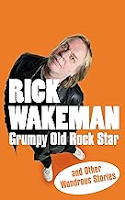
Rick Wakeman's music isn’t my thing but he seems like a genial soul so I've always warmed to him when I’ve seen him on the telly. His book generously credits his ghost writer – something that is not always the case in projects like these - and he quickly establishes his everybloke persona with chapter openers like ‘I love cars. I’ve had a few in my time…’. Alas, I found Grumpy Old Rock Star (Preface, 2009) hard work. On the printed page he comes over like a sozzled but harmless 'I'm mad, me' pub bore who might corner you at the bar. And, good God, his anecdotes are INTERMINABLE. His hearty pub-speak style does grate, and no cliché goes unused. Radio station switchboards ‘light up like a Christmas tree’ when swearing occurs on air, and Rick is living his life ‘on God’s green earth.’ Within are tales of Barry the Perv, Herr Schmitt and Tony ‘Greasy Wop’ Fernandez. Come on, Rick. It’s the 21st Century, not the ‘Hop off you Frogs’ 1980s.
 

Keith Emerson’s Pictures of an Exhibitionist (John Blake Publishing, 2004) is handicapped by the prog keyboard star’s clunky writing style. The book doesn’t credit a ghost writer but you would have thought his editor would have something to say about sentences like ‘From his casual shrug, could I be forgiven my suspicions that a game of deception was being played?’ It’s also rich in muso talk such as ‘By coincidence, Carl’s drum pattern happened to fit a left-handed ostinato figure I was working on…’ But before you know it he’s undermining his role as Prog’s own music professor by regaling us with tales of Emerson, Lake and Palmer sharing a roadside German prostitute.

For anyone who dislikes the prog-rock behemoths (as 1970s rock critics invariably described ELP) there’s plenty here to fuel their prejudice. ‘I’ve got this image of us creating a vast "sheet of sound" that defies conventional structures,’ writes Emerson. ‘There doesn’t appear to be one set time signature or a key structure but the total effect played by the three of us could be very prolific.’ Whimper fearfully and pray for the arrival of punk.
 

Lemmy’s White Line Fever (Simon and Schuster, 2002) is unexpectedly fascinating and he can certainly tell a tale. The Hawkwind and Motörhead bassist, who once said when asked for the secret of his success ‘Just keep going, like Attila the Hun’, is true to his word. Equipped with an iron constitution and an iron will, he burned through 40 years of Motörhead line-ups and died with his boots on a few short years after publication. You suspect, like The Alien, he had acid for blood. Despite his fearsome mien and even more fearsome consumption of amphetamine sulphate, he comes across as quite an old-fashioned and learned sort of chap. He even confesses that his greatest line in describing Motörhead to the world, ‘If we moved in next door your lawn would die,’ was actually nicked from American rock band The MC5. Unlike Rick Wakeman, Lemmy keeps his anecdotes short and to the point and is never less than entertaining. One former manager he describes as ‘a very interesting man… from an anthropological point of view. A complete ******* lunatic.’

Ginger Baker’s Hellraiser (John Blake, 2010) leaves you wondering how he lived so long. His parents’ generation would have called him a tearaway and he was undoubtedly mad, bad and dangerous to know. But among the tales of a decades-long smack habit, multiple infidelities and trying to set fellow band members hair on fire, you can’t help noticing that his daughter Nettie has done a really good job on the ghost writing. 

And to finish, two biogs written by a band accomplice and a journalist respectively, rather than the musicians and their ghost writers. Richard Cole’s Stairway to Heaven (Pocket Books, 1997) and Stephen Davis’s Hammer of the Gods (Pan Books, 2005), both about Led Zeppelin.

The band’s oft told tale reads like a Greek tragedy and by way of comparison, I’d say the best account of them all is undoubtedly Barney Hoskyns’s Trampled Underfoot, where artfully chosen and often quite contractionary quotes illuminate this cautionary tale. (Jimmy Page claims his drug use never affected his playing. The rest of the world disagree.) As a rule of thumb you can tell how crappy a Led Zeppelin biog writer is by the ease and frequency in which they resort to aerial metaphors to describe the ‘flight’ and ‘crash landing’ of the Leds. Hoskyns doesn’t do this and his is a sad and sorry tale which also leaves you in awe of their extraordinary talents and multi-faceted music.

So, what of these two aforementioned accounts? Richard Cole, who was the band’s road manager throughout their 12-year existence, tells a weary tale, from the stale, obvious title onwards. His is a book of paint-peelingly sordid revelations, made even more distasteful by Cole’s corrosive misogyny. If you have pearls, prepare to clutch them. It’s like eavesdropping on the Russian Mafia drunkenly guffawing about how badly they treat the local prostitutes. On one occasion, for example, Cole persuades a gaggle of thirteen and fourteen year old girls to join the group on their private plane at Los Angeles airport. When the plane unexpectedly takes off for New York, the girls become distressed when they realise how much trouble they’re going to get into with their parents, who they probably told they were going to a sleepover with school friends. What larks.


 Stephen Davis’s Hammer of the Gods is also a hair-raising expose of rock piggishness both within the group and their piratical road crew. Herein lurk tales of underage groupies, medieval brutality and Olympic-standard drug use.

But let's not end on such a negative note. Like Hoskyns, Davis loves the Leds. He even sings the praises of their underwhelming In Through the Out Door album, the last they made before their fearsome drummer, John ‘The Beast’ Bonham drank himself to death (48 vodkas, apparently…). Davis is an educated, erudite guide, quoting Primo Levi and snippets of Anglo-Saxon literature and while Cole’s book is a sordid swank along a very seedy avenue, Davis clearly revers his subjects, and finishes his book with a vivid and moving pilgrimage to John Bonham’s grave.

Monday, 3 January 2022

Awards Season! Part 3


Here's the third and final part of our virtual awards. Our contributors give a prize of their own choice and their own naming.  As usual, too, at this time of year, we give our grateful thanks to all the contributors who generously give their time, insights and enthusiasm to the blog. We couldn't keep going without you!

Paul Dowswell's prize for Book by an author I’ve just discovered goes to 
The Girl with the Louding Voice by Abi Daré.

I’m not an adventurous reader. My most recent good reads were Geoff Dyer’s Another Great Day at Sea, and David Mitchell’s The Thousand Autumns of Jacob de Zoet – both magnificently written and both entirely mainstream. But a good friend, who reads widely, recommended Daré’s book, and I bought it on a whim.

Narrator Adunni is a 14-year-old Nigerian girl, married off by her father to Morufu, an old man who, she tells us, looks like a goat. Adunni’s education comes to an abrupt end. She, wanting to become a teacher, is devastated. The book has the makings of a grim misery memoir but it is actually engaging, heartening and funny.

Daré brilliantly captures Adunni’s idiosyncratic Nigerian English, and I read on, transfixed as she pits her wit, intelligence and cunning against the terrible hand she has been given. Best of all, Daré conjures a world I’ve never imagined before – something all the best fiction should do.

Graeme Fife
: No prizes, but R C Sherriff's The Fortnight in September, an unexpected marvel, took me aback. Recommended by a dear friend and by an author whose output is dominated by that silly First World War play, it's beautifully observed, understated in its telling, acutely detailed and, albeit the story is, on the face of it, barely dramatic, it tells volumes about human relationships, how they are shaped, interact, develop, reveal themselves in strength and weakness. It's the work of an author who reflects deeply and strips away all flashiness of expression in an admirable quest for directness and truth. (Full review coming next week ... )

There are other books which have charmed and beguiled me this year. The novels of  J B Priestley richly deserved revisiting. Hadley Freeman's House of Glass is utterly bewitching and beautifully crafted. The story it tells not only compelling but necessary. Emily Wilson's translation of Homer's Odyssey is a tour de force.

Val McDermid: 
The McDermid Medallion for the book that made me cry more than once goes to Sarah Hall's Burntcoat. It’s an extraordinary narrative about love and art in a time of pandemic. It’s not our particular plague but it deals with the wrenching pain of loss, the divisive othering, the despair and the moments of hope we’ve all lived with these past months. But it’s also astonishingly uplifting, joyous even, not least because Sarah Hall writes of the physicality of love as well as its emotional impact. Her prose is engrossing -- dynamic, rich and authentically emotional. I read Burntcoat over two days, and I resented setting it aside to deal with the obligations of my own life. It moved me to tears and at the end, I felt as drained as if it had been a tale of grief and glories told by my best friend.

Ignaty Dyakov-Richmond
's award for A book I will keep on my desk and recommend to my clients over the next few years goes to How To Live by Professor Robert Thomas

At a time when we seemingly depend on pills and vaccines as never before, Professor Robert Thomas, a practising consultant oncologist and professor at the University of Cambridge, refreshingly reassures us that there is plenty we can do ourselves to sustain our health and wellbeing. With over 497 cited sources, it is still a very straightforward read and due to its structure can be used as a reference book too.

So many thoughts in the book resonate with me and provide answers to the current challenges we face: from lowered energy to the pressure on the NHS to the ever-increasing taxes we pay for healthcare, and to climate change. In the words of Professor Thomas, “The more I delve into the research from around the world, the more convinced I am of the influence of lifestyle over the genes we are born with."

Diamond Dystopian Award
, awarded by Jane Rogers for the best dystopian book of the year, goes to The Animals in That Country by Laura Jean Mckay (Scribe)

It’s already won a bunch of other prizes, including the Arthur C Clarke award, although I wouldn’t call it Sci Fi. Set in a very real Australia, it features a pandemic which causes humans to understand animal communication, a dignified dingo named Sue, and a foul-mouthed, alcoholic granny with no inhibitions. What the animals say is totally unexpected and often devastating – many humans are simply driven mad. But granny Jean and dingo Sue set off on the mother of all road trips to rescue Jean’s grand-daughter, and I defy anyone to put this book down unfinished. The tears in my eyes at the end were both of laughter and sorrow. The most original book I’ve read for years.

Linda Newbery
presents the Newbery Notable Award for Seasonal Uplift to The Midnight Library by Matt Haig. We've all wondered about the alternative lives we could have led - if only we had done something differently, or better. What if we had the chance to sample them, and live in them? It's an intriguing premise that's cleverly handled, as suicidal Nora finds herself in a library stacked with books that are portals to the infinite lives she might have lived. With a nod to It's a Wonderful Life in its focus on how small things in our lives can affect others, this is an ideal read for the turn of the year when we're all likely to be reflecting on what has, hasn't, and could have happened, and what lies in store. (See Julia Jarman's review.)

Sally Prue: The Glacier Award for the Slowest Book is presented to Nathaniel Hawthorne for 
The House of the Seven Gables.

Slowness in a book is not generally celebrated, but The House of the Seven Gables is a book so glacial, so majestically constipated, as to be mesmerising.

It begins as it means to go on, with a long (well, it seems long) description of the generations who lived in the house of seven gables (seven? Surely several of those must be otiose?) before the action (sorry, wrong word) begins.

I read this book years ago, and was very soon hypnotised by it. This means, sadly, that my memories are rather vague. There’s a death-dealing curse, and much gradual decay, and, best of all, surely the longest, slowest, and most incremental death-scene in the history of literature.

The House of the Seven Gables is gloriously ponderous, quite magnificently leaden.

And a simply extraordinary read.

Thanks to all those who've been so generous with their virtual awards! Normal service resumes next week - follow us for a great reading recommendation every Monday.

Saturday, 3 April 2021

Easter Saturday extra: guest feature by Paul Dowswell. RETURN TO SENDER - A PORTRAIT OF THE ARTIST AS A YOUNG CLOT


"Imagine my surprise when I was sacked at the end of the week..."

When there’s not a pandemic going on, Paul Dowswell writes historical fiction and is a frequent visitor to schools, both home and abroad, where he talks about his books and takes creative writing classes. His novels Eleven Eleven and Sektion 20 won the Historical Association Young Quills Award and Ausländer won the Hamelin Associazione Culturale Book Prize and the Trinity Schools Book Award. Recently he has become increasingly concerned about how deranged he looks in Zoom calls.

Readers of  Writers Review will no doubt be familiar with the joke about the rabbit who goes into the butchers and asks ‘Got any carrots?’ The butcher tells him he doesn’t sell carrots. But following four days of the same repeated request from the rabbit the butcher loses his temper and says ‘If you EVER ask me for carrots again, I’m going to nail your ears to the floor.’

The rabbit comes back the next days and says ‘Got any nails?’

The butcher looks perplexed and shakes his head.

‘Got any carrots?’ asks the rabbit.

Reader, as a young man, I was that rabbit.

And evidence of that rabbithood is everywhere in a bundle of my letters home from the age of 13 to 23, which I found whilst recently clearing out my mum’s house.

The early 70s found me incarcerated in a horrible little boarding school in the depths of Shropshire, where, unlike Byron at Harrow, I didn’t spend my pre-University years translating The Iliad from the original Greek into Latin. I was an academic mediocrity. I did write a lot of letters home though. And here, in defiance of the widely held view that texts and emails have destroyed the traditional art of letter writing, I present an extract from my letter home from November 27, 1972:

On Thursday there was the House Music competition. We came 4th. (Woe!) On a happy note I’ve had dioreaha (or however you spell it) recently.’

‘That’s nice, dear,’ I can hear my mum saying.

Having cocked up my A Levels I got into Goldsmiths’ in 1975 via the clearing system and read History – a subject I wasn’t terribly interested in at the time. Not a lot of work was done. On Nov 3, 1977 I wrote home ‘As for me, I’m ill at the moment – it’s sort of bronchitis and Flu and I don’t feel so good. However I’m taking good care of myself and getting lots of sleep.’

I obviously had no understanding of the laws of cause and effect, for in the very next paragraph I write: ‘John and Johnny P. (my brother and his best friend) came down this last weekend… we played a ridiculous game of spin the knife the low/high point of which was me having to take a paddle in the birdbath, John whipping himself around the garden, and Johnny having to squirt lemon juice down his throat (blaaaaghhh). We got utterly wrecked on Saturday night and all ended up sprawled on the floor playing I-spy and with Johnny P. drinking Italian plonk from his boot.’

I finished with the reassuring words ‘p.s. am taking approx. 5,000 pills a day so don’t worry.’

Other letters from university are full of ramblings about the travails of my rotten band. My dear dad, who hated rock music, wouldn’t have been remotely interested. ‘We did two gigs this week – One on Tuesday at a Psychology society Party at College + the other at some Greenwich rowing club on Friday. The psychology one was alright – only trouble was **** broke a lead, thus we balled up things a bit. The one on Friday was a disaster. **** broke a string and we lost the attention of what little audience we had.’

A pattern was emerging.

The band broke up shortly after, although **** is still a good pal. (Hence the *s.)

I graduated in 1978, and moved to a grisly bedsit in New Cross Gate. (‘Paul’s room is not so bad,’ wrote my girlfriend to my parents, ‘just a bit scabby – but there aren’t any cockroaches or rats.’) Eventually I found work at a market research company, where I collated surveys on fork-lift truck lubricating oil. Desperate to escape, and still not really having A CLUE what to do, I enrolled on a teacher training course back at Goldsmiths’ College. Nowadays, my respect for the teaching profession knows no bounds, but back in 1979 I wasn’t so sure. My course, I wrote to my mum, herself a teacher, ’… contains a million bossy girls/women all called SUSAN (no Sue, Suzie, Suzanne etc just SUSAN) who have been nursing a burning desire to teach since they lined their dollies up at the age of three and told them off for not doing their homework.‘

Mea Maxima Culpa, teacher chums. And friends called Susan.

The autumn of 1980 found me on the dole (again) and subject to the whims of the job centre, who sent me to Woolworths head office on Marylebone Road to act as a security guard in their impressive glass and marble foyer. ‘It’s crushingly boring beyond belief and only suitable for the lobotomised and those in a deep opium trance,’ I wrote home. ‘I try and keep myself amused by seeing which hurts the most when I bang my head on it, (Of Marble, Glass, Plaster and Plastic, Marble is by far the worst), and breathing on the main glass door and drawing Anarchy signs in the condensation.’

Imagine my surprise when I was sacked at the end of the week.

But other more exciting opportunities in the world of work were presenting themselves. One, in particular, promised a life-changing turn in the road. At 22/23 I was desperate to work for the BBC and understood the important thing was to get in, doing anything, and then apply for the more interesting jobs from the inside. With that in mind I wrote home in June 1981 ‘The BBC have been in touch. I had an interview yesterday for a job in the outside broadcasting dept – v. boring – costing transmissions via the G.P.O. (British Telecom)…’

With mounting excitement I relayed the news that ‘the bloke rang that afternoon and told me I didn’t get the job BUT………..

1. They were very impressed (repeated 9 times)

2. The job was ‘way below my capabilities anyway.’

3. He would be in touch with the right people and they would be looking out for a suitable post and I would hear from them shortly.’

40 years later, whenever the phone rings, I still hope that it’ll be them.


See also: I NEVER READ MY REVIEWS, by Paul


Monday, 4 January 2021

Reading ahead - New Year anticipation, part 3


Here's the third and final part of our Reading Ahead feature, and again we take the chance to thank all our contributors for supplying us with great reviews and recommendations all year round. This last part includes a number of titles due for publication this year, so - whatever tier we're in - none of us will be short of tempting books to read. Several of the titles mentioned here will feature on the blog in the coming months. 

Happy New Year reading!

Paul Dowswell: I’ve enjoyed retreating into music non-fiction during the pandemic. It’s a perfect comfort read for an anxious time. Rock writer and music magazine creator, David Hepworth, has been churning out a book a year since 2016’s 1971 – Never a Dull Moment. It’s a particular pleasure to read his work because his brilliant but defunct monthly music magazine The Word is greatly missed. From its marvellous title and fabulous cover shot of the Rolling Stones dressed in drag onwards, Overpaid, Oversexed and Over There - How a Few Brits with Bad Teeth Rocked America promises a fascinating journey through an era (1960s to 80s) when British bands dominated American popular music. His previous books have shown that Hepworth excels in the quirky anecdote, and being a publishing entrepreneur as well as a music fan, he is always able to present a perceptive insight into the business side of ‘show business’. I’m snapping this up as soon as it comes out in paperback.

Pippa Goodhart:
I bought a book for my daughter Mary that I’m longing to read myself. It’s The Other Bennet Sister by Janice Hadlow. Hadlow has taken middle Bennet daughter, Mary, from Jane Austen’s Pride And Prejudice, and imagined what happened to her after Austen’s novel finishes. Mary is the plain and serious sister amongst lively beauties, and she fails to find a man to marry within P&P, but this novel promises to see her ‘grow into herself’, and, yes, find love. Perfect, I hope, for some escapism during cold Brexit January.

​Talking of ‘hope’, a treat I’m very much looking forward to in March is Hope Adams (a.k.a. Adèle Geras)’s novel set in 1841 on a ship bound for Australia with 180 women convicts on board. I know that the seed of this story was planted by a quilt in the V&A Quilt Exhibition from a few years ago that I saw. I love real history woven into rich story! Reading Dangerous Women, I look forward to jumping aboard that convict ship!

Michelle Lovric
: I read up to my thighs during lockdown 1: when I put them in a pile, that’s where the books reached. I wasn’t surprised to hear Bloomsbury are doing well: my literature consumption definitely increased with Covid. Books on my looking-forward-to list: Susanna Clarke’s Piranesi, Dangerous Women by Hope Adams, a.k.a Adèle Geras of this parish; Casanoviana, including an account of 2019’s symposium – in a real room, with touchable international scholars – on the World’s Most Misunderstood Venetian. I discovered Donal Ryan’s The Spinning Heart recently, so now the rest of his oeuvre’s beside the bed. What else to do when you run out of Niall Williams and Sebastian Barry? (Hint, gentlemen!) For three wonderful years, I attended a poetry masterclass with Robert Vas Dias. Just arrived: his The Poetics of Still Life. For my own work, lately much taken up with puffins and millinery, I’m about to start Denise Dreher’s From the Neck Up.

Jane Rogers:
 This year I have been on the lookout for fiction about the Climate Emergency. Because it’s such a vital and overwhelming topic, I’m curious to see how other writers are dealing with it. And I should admit I’m hoping to write a climate novel myself.

In the interests of this research I’ve read Chris Beckett’s America City (recommended) and Jenny Offill’s Weather (well written, but doesn’t live up to the hype). I was delighted to hear a recent Open Book on Radio 4 devote a full programme to climate change fiction, or Cli-fi, as they are now calling it. It has become a sub-genre all of its own! Apparently there is lots in the pipe-line; I want to start with Carys Bray’s new novel, When the Lights Go Out, which is set in the near future, with floods outdoors and a collapsing marriage indoors. Carys writes beautifully - I loved her short story collection Sweet Home. And Diana McCaulay’s Daylight, Come, set in a fictional island closely resembling Jamaica, where she lives, in a future where the days are so hot everyone has to sleep in the day and work at night, sounds fascinating.

Adèle Geras
There’s much to look forward to in 2021, and these are the books I’m longing to read. First is Marika Cobbold’s On Hampstead Heath. I’m a big fan of this writer, and this will be published in April by Arcadia Books. It’s set in one of my favourite parts of London and concerns a journalist who invents a story, for the best possible reasons. Enticing.

Then there’s Caroline Lea’s The Metal Heart, which has a very striking cover. It’s a wartime love story set in a camp for Italian prisoners of war in Scotland. I suspect I will need tissues. Coming in April from Michael Joseph.

My last choice is Atomic Love, by US author Jennie Fields. (Michael Joseph) This is about a woman scientist working on the Manhattan project. I’ve read the first couple of pages and am drawn in already....

It’s going to be another good year for fiction.

Patricia Elliott
: I'm intrigued to read Stuart Turton's new second novel, The Devil and the Dark Water, set on board a cursed ship sailing to Amsterdam in the seventeenth century, a dangerous voyage even without the murder and mayhem I'm promised. His first, The Seven Deaths of Evelyn Hardcastle, was an artful, twisty riff on a detective story, with a fiendishly complicated plot: a game he played with the reader. Turton is not a beautiful stylist but his writing is energetic and vivid, with startling similes. Also recently published, I think I shall enjoy Edward Parnell's Ghostland, in which the author goes on a cathartic journey after family tragedy, revisiting books and places in Britain's most haunted countryside. To reread? Among other books and inspired by the magnificent television adaptation of Philip Pullman's His Dark Materials, now finishing its second series, The Subtle Knife, my favourite of the trilogy, last read 25 years ago. Jon Appleton: Echoes of adored, established writers have lured me to some recent independent publishing.

Jon Appleton: 
Echoes of adored, established writers have lured me to some recent independent publishing.

The Continuity Girl by Patrick Kincaid (Unbound) promises ‘A lost movie. An elusive monster. One last chance…’ It’s billed as a novel for fans of Jonathan Coe (whose work I adore). There’s a fanatical fan and an old film retrieved and the stage is set for a glorious homage and reckoning with the world today. I can’t wait!

 Penelope Lively’s clashes of the mores of past and present (Treasures of Time, Judgement Day) remain reading highlights. (They’re funny, too.) I predict Simon Edge’s historical fiction will be equally beguiling. Anyone for Edmund (Lightning Books) pokes fun at Westminster culture and celebrates the cult of a medieval saint. I’ve also ordered his A Right Royal Face-off, which contrasts Gainsborough’s high art with celebrity TV.

Another indie publisher whose work impresses me is Louise Walters Books. I love novellas and The Sweep of the Bay by Cath Barton evokes the brilliant film 45 Years. Louise has just released Helen Kitson’s Old Bones ­– I can’t resist a quarry-found corpse and the repressed secrets of spinsters. Could we have another Ruth Rendell in the making?

Sue Purkiss:
In the last few years, like many of us, I’ve become more and more concerned about our environment and what we’re doing to it. So in the New Year I shall look forward to reading more books about nature. One will be The Running Hare, by John Lewis-Stempel, which has been strongly recommended to me by my brother-in-law, who has a smallholding in Ireland. I’ve also heard good things about James Rebanks’ new book, English Pastoral: and I have my eye on Surfacing, by Kathleen Jamie, who writes about wild places with a poet’s perception, though this, like an earlier book, Sightlines, is prose. (Of the most elegant, spare and focused kind.)

I still have some excellent birthday books to look forward to as well – The Lying Life of Adults, by Elena Ferrante, and The Diary of a Young Naturalist, by Dara McAnulty.


Dara McAnulty's Diary of a Young Naturalist is reviewed here by Gill Lewis.


Susanna Clarke's Piranesi is reviewed here by Adèle Geras.


We will feature a Question and Answer with Hope Adams (Adèle Geras) to mark the publication of Dangerous Women.