Showing posts with label Ignaty Dyakov-Richmond. Show all posts

Monday, 14 March 2022

Guest review by Ignaty Dyakov-Richmond: FROM GAS STREET TO THE GANGES by Simon Wilcox


"This is not an ordinary local history book, albeit written by a professional journalist with a degree in History. This is more like The Thousand and One Nights ..."

Ignaty Dyakov-Richmond
wears several hats (apart from a deer-stalker and a faux-fur Russian hat). A Chartered Linguist, he has authored a series of unconventional Russian and ELT textbooks, which help students learn grammar and vocabulary through fun-to-read detective stories. They are now used at universities and schools all over the world, US, UK and France being the biggest markets. Ignaty is currently on the Management Committee of the Society of Authors, where he also chairs the Educational Writers Group.

In recent years, after he qualified as a life coach and Ayurvedic consultant, he has set up a health and wellbeing coaching practice in the Midlands. He works on a one-to-one basis, delivers talks and workshops and writes articles on a holistic approach to health, complementary therapies and coaching methods. More information can be found on www.lifesensei.uk or on Facebook https://www.facebook.com/lifesenseiuk/

In his spare time, he loves writing and reading short stories, walking, vegan cooking and a bit of DIY.

I must admit this wouldn’t be a book I would look for in bookstores; in fact, I wouldn’t seek to search books on this topic, not at this stage in my life. It was just that at a chance authors’ meet-up in a cafe I saw Simon Wilcox giving a copy of this book to someone else. I had finished conversing with a fellow writer and thus had a moment to look around and try to catch what others were talking about; that’s when I spotted the first words in the title, From Gas Street to the Ganges, and the cover. The cover did it for me: two pictures - one of warehouses along the canal and the other of a splendid, yet clearly vacant Oriental palace on a river bank. I knew then that I wanted to learn about the connection, the reason why these two pictures were placed next to each other.

This is not an ordinary local history book, albeit written by a professional journalist with a degree in History. This isn’t a Wikipedia-style collection of facts, albeit it has lots of facts and lots of references, methodically noted. This is more like The Thousand and One Nights - an easy-to-read collection of stories, stories which once happened but of which we might not have known all the details if not for the research coupled with the imagination and experience of the author. These stories always start in Birmingham and then take us on journeys to far-away countries. We meet protagonists, like James Chance of glass-manufacturer Chance Brothers, John Sumner of Typhoo Teas, or indeed Ron Wilcox, journalist and Simon’s father. We follow them to India, Sri Lanka, or Australia; we can almost see these places with their eyes, through the imaginative writing of Simon Wilcox. I find this is the best way to learn history - through personal history. Through emotions you might understand and remember the past better.

The book starts with a brief insight into Simon Wilcox’s biography, his childhood in Birmingham and then his escape into the open world, then coming back to see his birthplace decades later. I cannot deny that I was relieved to learn that I wasn’t the only one who hadn’t understood and who had disliked Birmingham. My wife, who lived in Harborne, Birmingham, when we met four years ago, says to everyone that one of my first questions on our first date was, ‘Why on Earth do you live in Birmingham? Let’s get out of here!’ I am glad that having now read Simon’s book I understand the place better and look forward to coming back there and exploring it further, checking on all those places I have now read about.

We then proceed to learn about various prominent people and buildings in the city and the connections they have with other countries within the Commonwealth. Each chapter is dedicated to one country or territory: from Sri Lanka, to India, to South Africa, to Gibraltar. I like how the author weaved in his father’s story and journey to Australia towards the end of the book, almost as if all the research he’d done led him to appreciate his family history more and got him back to his roots – a great circle starting from himself and then bringing him to the generation before him.

Was there anything of note to improve? Well, we all know that publishers these days have to cut down on everything to ensure that a book can still be priced attractively so I can only feel for the time-pressured editor as some paragraphs seemed disjointed from others which disrupted the flow of the text at times. There is only so much that even the most thorough author can notice in their own writing and that’s why publishing a book has always been a team effort. Yet overall, it is a solid work based on good research that mostly reads very smoothly and with ease.

I would also like to learn more about social history and lives of ordinary people in Birmingham and their families in far away lands, so perhaps the second tome would be great to have (no pressure!).

Overall, I liked From Gas Street to the Ganges very much and would definitely have it in mind later this year when the Midlands will be hosting the Commonwealth Games and I might be asked for reading recommendations.

Did I judge this book by its cover? To a degree perhaps, as every time I was ready to read from it, I would spend a few moments looking at the photos and feel how I was transported deep into the past and far into the distance, a good feeling. So yes, I am as partial to the cover as I am to the title, and yet there is so much more inside the book too which makes it a good and educating read.

From Gas Street to the Ganges is published by The History Press.

Monday, 3 January 2022

Awards Season! Part 3


Here's the third and final part of our virtual awards. Our contributors give a prize of their own choice and their own naming.  As usual, too, at this time of year, we give our grateful thanks to all the contributors who generously give their time, insights and enthusiasm to the blog. We couldn't keep going without you!

Paul Dowswell's prize for Book by an author I’ve just discovered goes to 
The Girl with the Louding Voice by Abi Daré.

I’m not an adventurous reader. My most recent good reads were Geoff Dyer’s Another Great Day at Sea, and David Mitchell’s The Thousand Autumns of Jacob de Zoet – both magnificently written and both entirely mainstream. But a good friend, who reads widely, recommended Daré’s book, and I bought it on a whim.

Narrator Adunni is a 14-year-old Nigerian girl, married off by her father to Morufu, an old man who, she tells us, looks like a goat. Adunni’s education comes to an abrupt end. She, wanting to become a teacher, is devastated. The book has the makings of a grim misery memoir but it is actually engaging, heartening and funny.

Daré brilliantly captures Adunni’s idiosyncratic Nigerian English, and I read on, transfixed as she pits her wit, intelligence and cunning against the terrible hand she has been given. Best of all, Daré conjures a world I’ve never imagined before – something all the best fiction should do.

Graeme Fife
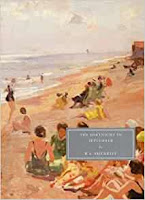
: No prizes, but R C Sherriff's The Fortnight in September, an unexpected marvel, took me aback. Recommended by a dear friend and by an author whose output is dominated by that silly First World War play, it's beautifully observed, understated in its telling, acutely detailed and, albeit the story is, on the face of it, barely dramatic, it tells volumes about human relationships, how they are shaped, interact, develop, reveal themselves in strength and weakness. It's the work of an author who reflects deeply and strips away all flashiness of expression in an admirable quest for directness and truth. (Full review coming next week ... )

There are other books which have charmed and beguiled me this year. The novels of  J B Priestley richly deserved revisiting. Hadley Freeman's House of Glass is utterly bewitching and beautifully crafted. The story it tells not only compelling but necessary. Emily Wilson's translation of Homer's Odyssey is a tour de force.

Val McDermid: 
The McDermid Medallion for the book that made me cry more than once goes to Sarah Hall's Burntcoat. It’s an extraordinary narrative about love and art in a time of pandemic. It’s not our particular plague but it deals with the wrenching pain of loss, the divisive othering, the despair and the moments of hope we’ve all lived with these past months. But it’s also astonishingly uplifting, joyous even, not least because Sarah Hall writes of the physicality of love as well as its emotional impact. Her prose is engrossing -- dynamic, rich and authentically emotional. I read Burntcoat over two days, and I resented setting it aside to deal with the obligations of my own life. It moved me to tears and at the end, I felt as drained as if it had been a tale of grief and glories told by my best friend.

Ignaty Dyakov-Richmond
's award for A book I will keep on my desk and recommend to my clients over the next few years goes to How To Live by Professor Robert Thomas

At a time when we seemingly depend on pills and vaccines as never before, Professor Robert Thomas, a practising consultant oncologist and professor at the University of Cambridge, refreshingly reassures us that there is plenty we can do ourselves to sustain our health and wellbeing. With over 497 cited sources, it is still a very straightforward read and due to its structure can be used as a reference book too.

So many thoughts in the book resonate with me and provide answers to the current challenges we face: from lowered energy to the pressure on the NHS to the ever-increasing taxes we pay for healthcare, and to climate change. In the words of Professor Thomas, “The more I delve into the research from around the world, the more convinced I am of the influence of lifestyle over the genes we are born with."

Diamond Dystopian Award
, awarded by Jane Rogers for the best dystopian book of the year, goes to The Animals in That Country by Laura Jean Mckay (Scribe)

It’s already won a bunch of other prizes, including the Arthur C Clarke award, although I wouldn’t call it Sci Fi. Set in a very real Australia, it features a pandemic which causes humans to understand animal communication, a dignified dingo named Sue, and a foul-mouthed, alcoholic granny with no inhibitions. What the animals say is totally unexpected and often devastating – many humans are simply driven mad. But granny Jean and dingo Sue set off on the mother of all road trips to rescue Jean’s grand-daughter, and I defy anyone to put this book down unfinished. The tears in my eyes at the end were both of laughter and sorrow. The most original book I’ve read for years.

Linda Newbery
presents the Newbery Notable Award for Seasonal Uplift to The Midnight Library by Matt Haig. We've all wondered about the alternative lives we could have led - if only we had done something differently, or better. What if we had the chance to sample them, and live in them? It's an intriguing premise that's cleverly handled, as suicidal Nora finds herself in a library stacked with books that are portals to the infinite lives she might have lived. With a nod to It's a Wonderful Life in its focus on how small things in our lives can affect others, this is an ideal read for the turn of the year when we're all likely to be reflecting on what has, hasn't, and could have happened, and what lies in store. (See Julia Jarman's review.)

Sally Prue: The Glacier Award for the Slowest Book is presented to Nathaniel Hawthorne for 
The House of the Seven Gables.

Slowness in a book is not generally celebrated, but The House of the Seven Gables is a book so glacial, so majestically constipated, as to be mesmerising.

It begins as it means to go on, with a long (well, it seems long) description of the generations who lived in the house of seven gables (seven? Surely several of those must be otiose?) before the action (sorry, wrong word) begins.

I read this book years ago, and was very soon hypnotised by it. This means, sadly, that my memories are rather vague. There’s a death-dealing curse, and much gradual decay, and, best of all, surely the longest, slowest, and most incremental death-scene in the history of literature.

The House of the Seven Gables is gloriously ponderous, quite magnificently leaden.

And a simply extraordinary read.

Thanks to all those who've been so generous with their virtual awards! Normal service resumes next week - follow us for a great reading recommendation every Monday.