Showing posts with label India. Show all posts

Monday, 9 February 2026

Guest feature by Jamila Gavin: the research and influences behind MY SOUL, A SHINING TREE, Nero Prize category winner


"I knew that many Indians (1.5 million) had volunteered for the First World War, and I wanted their unknown stories to be represented."

Jamila Gavin was born in the foothills of the Himalayas in Mussorie, India, in 1941. After the war, her family relocated to England where she spent the remainder of her childhood.

Those first experiences of life at that time, between two countries and cultures, became the main inspiration for much of Jamila's writing. She wanted to reflect the changing face of multicultural Britain, knowing the importance of every child being able to find their mirror image in books. Her first book, The Magic Orange Tree, was published in 1979, followed by numerous other short stories, collections and several novels including The Surya Trilogy (Egmont,) Coram Boy, (Egmont: winner of the Whitbread Children’s Prize 2000) and Blackberry Blue, (Random House.) She lives in Stroud. Find out more on her website.

'I have inherited two rich cultures which have run side by side throughout my life.'

Some books seem to leap, almost fully formed into the mind, with the characters waiting for you to notice them, name them, and build them into the narrative. Coram Boy started life like that, for which I researched on the hoof – so to speak – as the narrative took hold.

Although Coram Boy was fiction, it was set in a real period, with one or two historic characters, so research was essential. In any case, research is my main way of confirming that my plots work – and that it could have happened. This is especially the case with the so-called “historical” novel; you always take a chance, when writing fiction in the context of real history. There’s always someone who is bound to wag the finger, and say, “Aaah! That didn’t happen” or, “you got that wrong!” Then your whole book can lose its credibility. In any case, for me, to fully engage with the plot and the period, I need to satisfy myself that my scenario and characters were as thorough and as credible as could be in fiction.

My Soul a Shining Tree started life as a contribution to an anthology, Stories of WW1, commissioned by Tony Bradman. I knew that many Indians, (1.5 million) had volunteered for the First World War, and I wanted their unknown stories to be represented in this anthology. In researching, I came across Khudadad Khan, a British Indian soldier in the Regiment of the Duke of Connaught’s 129th Own Baluchis. It was his uniform that clinched it – especially the red trousers - my title was definitely going to be The Man in the Red Trousers. Everything else had to make that title viable.

The original short story, set in in WW1, involved a young ten-year old Belgian character, Lotte. Lotte lives with her family on a farm in the village of Gheluveldt in Flanders, where she encounters a man in red trousers.

But to make it a novel, as Tony Bradman later recommended, I needed to extend the scenario, which had started with Lotte and Khudadad Khan, to Ernst, an under-age German Cavalry hussar. I knew what I wanted Ernst’s character to be. However, to make sure his story was viable: I found myself seeking out a book I had heard of, by Robert Musil: The Confusions of Young Törless. This book confirmed what I knew was most likely to be the case in a German military boarding school where Ernst was sent: the bullying, the need to find a way to survive, and the friendships that developed. I also felt certain that the issues I had read about many years earlier in Tom Brown’s School Days, by Thomas Hughes, would also apply to Ernst in his school.

Finally, almost insisting on a voice too, was a walnut tree, which dictated the title. It became their shelter, and was also able to observe the characters and events into which they all got swept up. I even researched the walnut tree to be sure it could actually have grown in Flanders. The deeper I delved, the more I wanted to be sure of my facts, so I went to Gheluveldt, to see for myself its geography, and where there was highish ground – so essential to my story. The outcome was My Soul, a Shining Tree. The title is taken from a poem by Siegfried Sassoon, Tree and Sky – this poem and so many others by First World War poets were part of my emotional research.

My Soul, a Shining Tree is published by Farshore

Stories of WW1, where Khudadad Khan's story first appeared, is edited by Tony Bradman and published by Orchard. It includes stories by WR contributors Paul Dowswell, Adele Geras, Linda Newbery and Leslie Wilson.

Monday, 1 September 2025

BOOKSHOP FEATURE: Inside an Indian Indie Bookstore, by Venkatesh Swamy


"Just like its customers, a bookstore has its own personality and temperament ..."

Eureka! bookstore in New Delhi, the first specialist, independent, children's bookstore in India, was set up in April 2003 by Venkatesh Swamy and Swati Roy, two passionate book-lovers who felt that they should do something to get children and books together under one roof.

Eureka! believes in selecting and promoting good books for children. As an extension, Venky and Swati also co-founded and set up India's first children's literature festival Bookaroo that has travelled to 17 cities with 49 editions - they will celebrate their 50th festival in Shillong later this month. Here Venky writes about their experiences.

If one were asked to define a brick-and-mortar independent bookstore’s day in one word, that word would be unpredictable. But it is the unpredictability that is exciting in a world that is increasingly click-and-go. Our world’s adage is festina lente, a slowness that is at once charming and frustrating.

Twenty two years ago, when Swati and I set up Eureka!, the concept of a neighbourhood bookstore was unheard of in Delhi. Even rarer was one that sold only children’s books. As we muddled through, we read more books than we sold (later, we would sell more books than we read before the cycle started all over again), made friends, started in-store events and book clubs and also managed to launch Bookaroo, India’s first children’s literature festival (incidentally, it won the Festival of the Year prize at the London Book Fair’s International Excellence Awards in 2017).

It has been eventful and memorable. From relocating three times, to watching the rise of online selling, to closing down during Covid then opening up again, to influencers, we have seen it all. We have witnessed change - in readers’ tastes in books as well as an explosion of genres, authors, illustrators and design. A children’s book market that was dependent on imported books now has compelling writing in Indian languages and in English by Indian authors, Indian publishers exploring unexplored genres and stunning picture books. The shelves are full of interesting books. What is more interesting, however, is what happens inside the bookstore.

Sometimes, nothing happens. The doors open at 11 am and often the only people in the store are the staff till about 2pm, when you spot a customer - approaching very slowly – either alone or with a child. Instinctively, you want to drag her in by the arm but you don’t. The in-house joke is to observe a minute’s silence as the doors open and they walk in.

Then there are moments when the store is packed and you wonder why the customers cannot space out their visits. For many of our visitors, being at Eureka! is not just about buying a book and rushing away. We chat, we exchange news, we receive gifts, share heartbreaks and fears, discover common friends from the past and answer questions ranging from the future of reading, to 'how to get my child interested in books’, to why we don’t have an in-store coffee counter.

There is one question that makes us nervous and excited. Young man or young lady marches in confidently and asks: 'Remember me?'  Both of us know that they are from our past and have come back to visit the store after all those years. The saving grace is that Swati hardly ever forgets faces and names. So we sail through it and the walk down memory lane gives us a high that lasts for days. Another one that makes us smile wryly to ourselves is: 'You are still working here?' And there is the usual question that starts with, “You know, on Amazon …”

Being a children’s bookstore does not mean we haven’t thought about the parents who bring them in. The store has a couple of shelves dedicated just for them while their children browse away. The children are lovely as they haven’t developed ‘traits’ - yet. But the grown-ups are different.

There is the delightful customer and the irascible customer, there is the chatty customer and the Instagram-driven one, there is the ‘secret scanner’ (scans ISBNs to compare prices on online portals), the active discount-seeker and the customer who believes that he ought to endorse the store – and does it. Then there is the overachiever parent who wants their child to read a couple of levels ‘higher’ than his age.

A recent phenomenon that has us worried is the way children are being egged on to become published writers far too soon. It is not that they lack the talent, but we strongly believe that childhood should be a time for reading, not looking for publishers.

Just like its customers, a bookstore has its own personality and temperament. Eureka’s tends towards agreeable-ness while its temperament is more on the phlegmatic side. It may all sound unbusinesslike, but as bookstore people we wouldn’t want to do anything else. Business can continue to be unpredictable but, like the cobbler, we will stick to our last.


Swati Roy has been awarded the 2025 Snehlata Prize for Promoting a Lifelong Love for Reading in Children


Photographs: a visiting customer reads to her child; Petr Horacek, visiting writer and illustrator; storyteller Vatsala Zutshi; dog Nanu who visits every day; Venky and Swati

Monday, 14 March 2022

Guest review by Ignaty Dyakov-Richmond: FROM GAS STREET TO THE GANGES by Simon Wilcox


"This is not an ordinary local history book, albeit written by a professional journalist with a degree in History. This is more like The Thousand and One Nights ..."

Ignaty Dyakov-Richmond
wears several hats (apart from a deer-stalker and a faux-fur Russian hat). A Chartered Linguist, he has authored a series of unconventional Russian and ELT textbooks, which help students learn grammar and vocabulary through fun-to-read detective stories. They are now used at universities and schools all over the world, US, UK and France being the biggest markets. Ignaty is currently on the Management Committee of the Society of Authors, where he also chairs the Educational Writers Group.

In recent years, after he qualified as a life coach and Ayurvedic consultant, he has set up a health and wellbeing coaching practice in the Midlands. He works on a one-to-one basis, delivers talks and workshops and writes articles on a holistic approach to health, complementary therapies and coaching methods. More information can be found on www.lifesensei.uk or on Facebook https://www.facebook.com/lifesenseiuk/

In his spare time, he loves writing and reading short stories, walking, vegan cooking and a bit of DIY.

I must admit this wouldn’t be a book I would look for in bookstores; in fact, I wouldn’t seek to search books on this topic, not at this stage in my life. It was just that at a chance authors’ meet-up in a cafe I saw Simon Wilcox giving a copy of this book to someone else. I had finished conversing with a fellow writer and thus had a moment to look around and try to catch what others were talking about; that’s when I spotted the first words in the title, From Gas Street to the Ganges, and the cover. The cover did it for me: two pictures - one of warehouses along the canal and the other of a splendid, yet clearly vacant Oriental palace on a river bank. I knew then that I wanted to learn about the connection, the reason why these two pictures were placed next to each other.

This is not an ordinary local history book, albeit written by a professional journalist with a degree in History. This isn’t a Wikipedia-style collection of facts, albeit it has lots of facts and lots of references, methodically noted. This is more like The Thousand and One Nights - an easy-to-read collection of stories, stories which once happened but of which we might not have known all the details if not for the research coupled with the imagination and experience of the author. These stories always start in Birmingham and then take us on journeys to far-away countries. We meet protagonists, like James Chance of glass-manufacturer Chance Brothers, John Sumner of Typhoo Teas, or indeed Ron Wilcox, journalist and Simon’s father. We follow them to India, Sri Lanka, or Australia; we can almost see these places with their eyes, through the imaginative writing of Simon Wilcox. I find this is the best way to learn history - through personal history. Through emotions you might understand and remember the past better.

The book starts with a brief insight into Simon Wilcox’s biography, his childhood in Birmingham and then his escape into the open world, then coming back to see his birthplace decades later. I cannot deny that I was relieved to learn that I wasn’t the only one who hadn’t understood and who had disliked Birmingham. My wife, who lived in Harborne, Birmingham, when we met four years ago, says to everyone that one of my first questions on our first date was, ‘Why on Earth do you live in Birmingham? Let’s get out of here!’ I am glad that having now read Simon’s book I understand the place better and look forward to coming back there and exploring it further, checking on all those places I have now read about.

We then proceed to learn about various prominent people and buildings in the city and the connections they have with other countries within the Commonwealth. Each chapter is dedicated to one country or territory: from Sri Lanka, to India, to South Africa, to Gibraltar. I like how the author weaved in his father’s story and journey to Australia towards the end of the book, almost as if all the research he’d done led him to appreciate his family history more and got him back to his roots – a great circle starting from himself and then bringing him to the generation before him.

Was there anything of note to improve? Well, we all know that publishers these days have to cut down on everything to ensure that a book can still be priced attractively so I can only feel for the time-pressured editor as some paragraphs seemed disjointed from others which disrupted the flow of the text at times. There is only so much that even the most thorough author can notice in their own writing and that’s why publishing a book has always been a team effort. Yet overall, it is a solid work based on good research that mostly reads very smoothly and with ease.

I would also like to learn more about social history and lives of ordinary people in Birmingham and their families in far away lands, so perhaps the second tome would be great to have (no pressure!).

Overall, I liked From Gas Street to the Ganges very much and would definitely have it in mind later this year when the Midlands will be hosting the Commonwealth Games and I might be asked for reading recommendations.

Did I judge this book by its cover? To a degree perhaps, as every time I was ready to read from it, I would spend a few moments looking at the photos and feel how I was transported deep into the past and far into the distance, a good feeling. So yes, I am as partial to the cover as I am to the title, and yet there is so much more inside the book too which makes it a good and educating read.

From Gas Street to the Ganges is published by The History Press.

Monday, 19 April 2021

Guest review by C J Driver: THE MOTH AND THE MOUNTAIN by Ed Caesar


"This is a man who can't turn back, won't turn back, doesn't turn back ..."

Jonty Driver has kept himself busy in lockdown working with a local firm, Artwrite of Rye, to produce four booklets of his poems, some illustrated by himself, and a card, The Slave-Bell at Doornhoek, a poem and a painting. The booklets are: Image & Image, some old photographs & a dozen unrhymed sonnets; The Journey Back; The Chinese Poems, 1979-2020; and A Winter’s Day at Westonbirt & other poems. All are available from Artwrite. See more on Jonty's website.

I’d better start by mentioning that, though I didn’t teach him, Ed Caesar was a pupil at Wellington College when I was Master there. I admitted him to the school in 1993 as a non-fee-paying Foundationer because his father had been killed on active service with the Royal Navy in 1982. After taking a degree from Edinburgh, Ed has made a successful career for himself as a journalist and is now writing books too: the first, Two Hours, was about the marathon and the chances of someone’s breaking two hours to run it. This one is about an attempt in 1934 by a brave but largely deluded Englishman to be the first to climb to the top of Everest. 

“By any rational measure, he (Maurice Wilson) had not the tiniest chance of reaching the summit.” The third son of a Yorkshire family, he had fought through  the First World War, joining as a private and then being commissioned, and winning a Military Cross for his bravery. Recovered from his wounds, but still mentally damaged, he had left Bradford and emigrated to New Zealand. After various mishaps, marital and otherwise, he returned to the UK and then settled on a scheme to buy an aeroplane to fly, solo, to the lower slopes of Mount Everest, and then to climb the mountain, on his own. He didn’t know how to fly, and he had never climbed a mountain. But he does fly solo all the way to India in his Moth, and evades all efforts to stop him getting to the mountain. And he does set off to climb what no one has climbed before.

It is an extraordinary story, garnered from a variety of sources, including Wilson’s own diary and letters he wrote to a woman he was in love with (she was married to someone else). Ed Caesar is, I think, meticulously truthful; he doesn’t pretend to know what he can’t know and, when he guesses, he makes it clear that he is guessing. In the end, the story becomes somehow close to tragic: this is a man who can’t turn back, who won’t turn back, who doesn’t turn back, even when any rational being would realise he can’t survive. I found the book utterly absorbing, and I recommend it wholeheartedly.


The Moth and the Mountain is published by Viking

See also: Touching the Void by Joe Simpson


Monday, 4 February 2019

Guest review by Ann Turnbull: A STATE OF FREEDOM by Neel Mukherjee


Ann Turnbull has been writing stories for young people of all ages since 1974. Her most recent book is In That Time of Secrets, a Young Adult novel about the persecution of Catholics in 1605, set in the Black Country. Find out more at www.annturnbull.com

I was immediately drawn into this story by the beauty of the writing and by the dreamlike events of the first chapter, in which an American man of Indian birth and his young son wander, sightseeing, in the ruins of an ancient palace. They are tired. It’s been a long day, and they’ve been delayed by an accident: the death of a workman who has fallen from scaffolding. They encounter the unsettling presence of a man who may be a spirit, a ghost, or a warning.

The remaining chapters follow the interwoven stories of several people: a young man from London visiting his parents in Mumbai; two determined women - Renu, a cook, and Milly, a cleaner – both of them seeking freedom from poverty; Soni, whose anger and despair drive her to join a guerrilla group; Lakshman, a desperately poor man who trains a bear cub to dance and tries to earn a living from it; and his twin brother Ramlal who leaves home to find work as a labourer in the city.

The story takes you to the heart of their struggles. Soni’s father, having borrowed money at high interest and travelled miles with his desperately ill wife, finds himself lost and defeated in the overcrowded hospital as he is sent upstairs and down, and up again, only to be brushed aside without help once more: “Soni’s father turned away, came outside and sat down on the steps. Against his will, his mouth twisted, like a child’s; he couldn’t make it hold its shape; he failed to make his crying resemble a dignified adult’s.”

The young man from London sums up his work, “My design job in London was flexible. I worked for a progressive, thinking-outside-the-box class of trendy outfit …” This is about as far removed from the lives of the other people in the novel as one could get, and he is uncomfortably aware of the very different lives of his parents’ servants, Renu and Milly, who live in the nearby slum and work shifts at several houses. Their earnings are not for themselves, but for the better future they are determined to win for their dependents.

Milly escapes to a kind of freedom, while her friend Soni’s family is left in despair. But all the people in this story had hope at first. Once, “on a golden afternoon when the boys were eight or nine”, Lakshman’s brother Ramlal had shown him how to see the face of Shiva in the mountainous landscape near their home: “Of course, Lakshman could see – he could see the god’s beautiful, lotus-like eyes, more closed than open, and the mouth, almost smiling … there he was, the great god Shiva, his face imprinted on Nanda Devi, his abode. And there he, Lakshman, was, gazing on it, a wonder revealed to a boy, and all the air, all the light and all the days were his to do what he wanted.”

These stories combine to give a deep insight into the lives of the poor in India. I’d recommend reading the book twice. On a second reading you make the connections more easily, and the writing is so beautiful, varied and engaging that it’s a joy to re-read, to experience aspects of the story falling into place, and to admire the intricacy of its construction.

A State of Freedom is published by Vintage.

Monday, 17 September 2018

Guest review by Savita Kalhan: A FINE BALANCE by Rohinton Mistry


"A complex and tightly-woven tapestry of humanity at its best and at its worst."


Photo: Mal Woodford
Savita Kalhan was born in India, but has lived in the UK most of her life. She got the writing bug when she was teaching in the Middle East, where she lived for several years. Now living in North London, she runs a teen reading group at her local library in Finchley, and writes for children.

Her debut novel, The Long Weekend, published by Andersen Press, is a tense thriller about two boys who are abducted after school. Her new book, The Girl in the Broken Mirror was published in May by Troika Books. ‘This is an unflinching, multi-layered exposition of male privilege, male abuses of women, and the clash of cultures. With hard-hitting clarity it also shows how girls are silenced, made to feel ashamed of their bodies, ashamed of wrongs done to them. Ultimately this is a poignant personal story of a girl’s fight to rebuild and re-connect with herself and those who love her after a truly harrowing experience.’ Love Reading 4 Kids


Some stories stay with you forever; they leave an indelible mark on you, leave you wanting for more, for the story to never end, for the writer to never stop writing. A Fine Balance by Rohinton Mistry is such a book for me.

It was also the work that had the most profound effect on me and my understanding of the country of my birth, its customs, traditions and people.

Mistry did not start writing until after he had left India with a degree in Maths and Economics from the University of Mumbai. He emigrated to Canada to work in a bank. It was some years later that he decided to pursue a degree in English and Philosophy, and it was then that he started writing stories. He won the Hart House literary short story prize two years consecutively. Tales of Firozsha Baag was a collection of short stories set in an apartment block in modern day Mumbai. Then came Such a Long Journey, which was shortlisted for the Booker prize, and won many others. Later, after it was adopted as a University text in Mistry's old university, it was to come under attack by extremists and was withdrawn despite a huge outcry.

A Fine Balance is the book of his that I truly love. It stands the test of time. As a portrayal of life in Bombay in India during the 1970s, it is, for me, without comparison. I've lent out my hardback copy to friends, who, with the exception of one person, have absolutely loved it. The one exception's pronouncement on it was: 'Good melodrama' - which was tantamount to blasphemy in my eyes.

The sad fact of the matter is that the everyday lives of the characters may well have seemed like melodrama to him, as though the author had simply sensationalized the harshness of his characters' lives for the sole purpose of giving the reader something more than a portrayal of the humdrum nature of abject poverty. For all the harsh realism contained within its pages, and there is much, the novel is one of carefully, almost poetically, crafted prose, which forms a story that is memorable and harrowing. It is far removed from the magical realism of Salman Rushdie's work, also originally from Mumbai, yet there is something magical in each page of this book, and even the most minor character you stumble upon within its pages is treated to the magic of his penmanship.

A Fine Balance was shortlisted for the Booker prize, has won countless others, and even made it onto Oprah Winfrey's Book Club. It hasn't been to everyone's taste. Germaine Greer hated it and said it in no way resembled the India she had come to know after spending all of four months there. Others have criticized Mistry for appropriating a turbulent time in Indian politics to meet his own ends and the needs of his characters. Personally, I don't understand this criticism, unless such critics balk at the atrocities of those times coming under public scrutiny after such a long period. In A Fine Balance Mistry explores the inherent inequalities of the caste system, extreme poverty, high level corruption, and life during the turmoil of Indira Gandhi's Emergency, and the sterilization programme, and the 'Beautification' policies, which led to the forced removal of street-dwellers into indentured labour. His characters are drawn from many Indian communities including the Parsi, Hindu, Muslim communities; from Untouchables to Prime Minister, from beggars to thieves; but there are four central characters of different backgrounds and histories, and it is through their hearts and minds that the story is told.

It is a tale of a Parsi woman, Dina, two tailors and a student from the north, four disparate people whose lives, outlooks, preconceptions and prejudices are fundamentally changed over a period of time after their first meeting. Tragedy exists at the heart of each of their stories, it permeates each page, yet the resilience of their spirit sits right next to it, tempering it. 'You have to maintain a fine balance between hope and despair' - and quite simply, that is exactly what Rohinton Mistry does.

His work speaks to me as an Indian, but it is universal in scope and in its depiction of humanity. He is, above all, a writer who plunges you, heart and mind, deep into his stories, where you remain submerged until the final page has been turned and you come up, gasping for air.

'... his sentences poured out like perfect seams, holding the garment of his story together without drawing attention to the stitches' - this is a line spoken by one of Mistry's characters, and perhaps best describes the mastery and craft of Rohinton Mistry himself.

In A Fine Balance he has created a complex and tightly-woven tapestry of humanity at its best and at its worst. For me the book is a literary masterpiece. It is a story you will never forget. His most recent novel Family Matters was published in 2002, but I am sure that I am not alone when I say that I am still waiting for Mistry’s next story.

A Fine Balance is published by Faber.

Monday, 9 April 2018

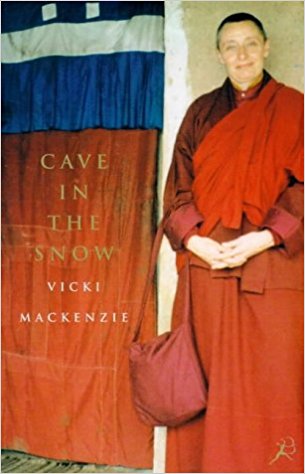
Guest review by Katherine Roberts - CAVE IN THE SNOW by Vicki Mackenzie


Katherine Roberts’ latest novel, Bone Music, invokes the spirit of the 13th century Mongolian steppes to tell the story of Genghis Khan’s rise to power… no Yetis, but it does have wolves! Published by Greystones Press.

In 1976, many years before Buddhism became trendy in the West, a fishmonger’s daughter from the East End of London retreated to a cave 13,200 feet up in the Himalayas, where she spent the next 12 years of her life meditating with only the wild creatures for company. Her name was Diane Perry, though today she is better known by her Buddhist name of Jetsunma Tenzin Palmo. Cave in the Snow  is the fascinating story of Diane’s life up until 1998, when the book was published, by which time she had emerged from her cave with her new name to embark upon a fierce schedule of talks across the world to fund her new project: building a nunnery for young Buddhist girls. Happily, the funds were raised, and the Dongyu Gatsal Ling Nunnery now exists in the Kangra Valley of northern India, close to the seat-in-exile of His Holiness the Dalai Lama.


Diane Perry’s lifelong quest for spiritual enlightenment resonates with me as an author. We spend months, sometimes years, in our metaphorical caves working on our writing projects with only our characters for company, and then emerge blinking into the world to talk about our published books. The book ‘called’ to me from a local charity shop bargain box, not because of its cover (which on my edition is strangely prosaic with its photograph of Tenzin Palmo, dressed in her Buddhist robes, standing beside what I think must be the Tibetan flag), but because of its evocative title coupled with the interesting blurb on the back. How could a woman raised in the East End of London in the aftermath of the Blitz survive alone in a cave in the Himalayas for so many years? Why did she feel the need to retreat there? And what did she discover during her long and lonely years of meditation?

In Tenzin Palmo’s own words, referring to a period when she worked at the Department of Employment to raise funds for her return to India prior to entering her cave: “I felt very sad - there were all these middle-aged guys saying ‘What have I done with my life?’ and young married people with mortgages, already trapped.” Authors also tend to view society like this, from the outside as detached observer rather than as part of the group, and it can be dangerous to look too long or too deeply at what actually matters in life. Shortly afterwards, Tenzin Palmo entered her cave, but not before carrying out a few essential renovations with the help of the locals to give it some proper walls and a door she could close against the elements and wolves. As she says in the book: “It was a very pukka cave.”

Tenzin Palmo did not write in her cave. She read her Buddhist texts and meditated in her box-bed, which was not big enough to allow her to lie down. She grew vegetables outside in the summer months, and - like St Francis of Assisi - was visited by the animals and birds of the mountains. She conversed with wolves, saw the prints of the elusive snow leopard outside her cave in the snow in the depths of winter, and also a huge footprint that may have belonged to the legendary Yeti. It seems she also survived possible breast cancer, and a serious eye infection. And, through all these hardships, she thrived.

It must have been a profound experience, and I kept wishing that Tenzin Palmo had written this book herself, rather than having to read her story secondhand. But Vicki Mackenzie has written a clear and faithful account based on her interviews with Tenzin Palmo, and part of the allure of a spiritual quest is the difficulty of capturing such a mystery in words. Perhaps the best any writer can hope to do is sketch down the bones, and leave it up to the individual reader to supply the flesh and the colour. If you are curious to know more, Jetsunma Tenzin Palmo is still teaching - see her website for details.

Cave in the Snow is published by Bloomsbury.

Wednesday, 27 July 2016

COMING HOME by SUE GEE....reviewed by Adèle Geras

(This post first appeared on the History Girls blog.) 


 "Sunlit India was always there, always behind their  lives." This sentence sums up  the story of Will and Flo Sutherland and their children, Bea and Freddie. 

Sue Gee's very autobiographical novel tells the story of a version of her own family. The paperback edition has an essay at the end about how she came to write it. After her father died,  she was listening to tape recordings  he had made, and the writing of the novel was something she felt she could now do. She says: "By 2009, I had reached the age of memoir.....the past was precious and important."

The reason I'm writing about Coming Home on the History Girls blog is because as well as being a novel about Gee's own life, it's also the other side of what happened when India became independent in 1947. We have read Midnight's Children and other novels about the end of the Raj, but even the wonderful Raj Quartet and Staying On by Paul Scott are still set in the sub-continent. Gee's book is firmly located in England. 

Flo and Will  fell madly in love  and married quickly. Then, torn away from the idyllic scenes of their courtship, they set sail for a small, grey island far away from the place which would  come to represent for them a kind of Paradise Lost. 

Children are born, the family goes through very hard times, and when I spoke to Sue Gee on the phone to ask her some additional questions, I told her I found it very sad. She agreed it was sad at times, but that wasn't of course the whole story.

There are two particular strands of the narrative which will test the tear ducts of the most hardened reader. First, we weep for Flo, who all her life has wanted to write. The book starts with her composing a last letter home to her parents before she leaves India. It is the only scene set there. She writes letters, diaries and also a novel about her younger self, wanting to convey the magic of what she feels was her own very romantic whirlwind romance. The disappointments attendant on this venture are heartbreaking. At one point, Flo has a breakdown. I don't want to spoil readers' enjoyment by giving too much away, but there are some things in this book which are  hard to read about.

Gee does something very clever in this novel. She tells the story of a  family coolly and dispassionately. It is the very opposite of hysterical and overheated writing, but all the more effective for that. The simplicity and directness and 'this happened and then that happened'  structure allow the writer to go from one character's story  to another, giving each of them his or her proper weight and distinctive set of preoccupations. She is brilliant at showing the impact of small domestic tragedies, or misunderstandings that occur when things are misheard, or not properly talked about: what Will would doubtless call 'getting the wrong end of the stick.'  

Perhaps the saddest part of the book relates to Freddie. He is sent away to boarding-school at what seems to us a ridiculously young age. Bea would have loved it there, but Freddie is miserable and Sue Gee's account is a worthy addition to the ranks of accounts of school misery. More than that, though, it shows how what we are now examining and prosecuting as child abuse was allowed to flourish. In part it arose from the horror that people had in those days of 'making a fuss' or being embarrassed. It sheds fascinating light on the subject.

Another thing that makes this novel exceptional is the way Gee creates for those who haven't lived through it, the very texture and taste and look of an entire historical epoch: from post-war austerity (and the winter of 1947!) to the 60s, by which time things were beginning to resemble the world we know today. She does it through detail: the songs sung at Sunday school, the clothes, the landscape, and the careful (though never overdone) descriptions of things like houses, streets, gardens, farms, cars, clothes and everything else that makes our lives what they are.  The Sutherlands also have a décor which I recognise from  many houses of ex-Colonials that I've been in: statues of elephants, a panther-skin on the floor and sundry other Indian knick knacks. There is a  poem by Will which appeared in the newspaper in India called  'Indian Refugees from Burma.' It's reproduced at the back of this edition and it's rather good, too.


Best of all, Gee captures exactly the turns of phrase of the people she's writing about. You can hear the conversations, catch the tone of voice on every page. The class distinctions are here and the slang and the chit chat bring to life a time that's long gone. Many of this blog's readers are young but anyone born in the 1940s will feel as though they've gone back to their own childhoods.

Lastly, I must mention the 'other side of the coin' aspect I spoke of before. Most of the  English men and women who came home from the Colonies after Independence were not evil monsters. They were often good, honest, well-intentioned people and, moreover, people who, through their work, and through living in India,  had come to love the country deeply and who carried that love in their hearts and their lives to the end of their days. Speaking as a Colonial child  myself, I understand this completely. Sue Gee's father returned to England in 1947. My own father was a Colonial till he died in 1972. Many men and women did their very best for a country they regarded as the best place they'd ever been in and Will and Flo Sutherland were two of those people.  This is what Sue Gee conveys so well: that here is a life, here are children and problems and everyday things, but once upon a time, there was an enchanted place of eye-searing colour and heat and beauty and that distant place has never been forgotten.

 I hope that many readers of this blog will read Coming Home. Gee could have written a memoir and chose not to.  This is because a memoir has a duty to be factually true. In a novel, Gee has been able to get inside four different heads and imagine much. That's what makes the difference. That's what makes it, I think, truer than a memoir would be.  I did ask Sue what her mother thought when she saw her own daughter being published where she had failed and the answer was: she was delighted. Well, of course she was. The novel shows, more than any other single thing, Flo's profound love for her children.  The Sutherlands are a fine family  and it's a marvellous book.