Showing posts with label Himalayas. Show all posts

Monday, 13 May 2024

Guest review by Graeme Fife: EVEREST 1953 by Mick Conefrey


"The final climb itself, a gripping story, loses none of its thrill"

Graeme Fife
is a regular reviewer here. He has written many plays, stories, features and talks for radio, stage plays and articles for newspapers and magazines, and is a regular contributor to BBC Radio 4's From Our Own Correspondent. He's the author of a string of books - children's stories, biography, works of history and fiction. His novel of the French Revolution, No Common Assassin, tells the story of Charlotte Corday. His latest publication, Memory's Ransom, is published by Conrad Press.

British rock climbers pioneered the craze for Alpine exploration in the early nineteenth century, followed by nationals of those countries which might have laid a more immediate claim to proprietorship of the great alpine peaks in their country. Perhaps it may be put down to a Victorian thrust for exploration and conquest riding the crest of imperial expansion. The often incomprehensible obsession with ice and adversity – the polar expeditions – ensued. They formed a part, we may say, of the similar preoccupation with heroic failure which began with the Charge of the Light Brigade, the spilling of blood on foreign sand, a calamity puffed by Sir Henry Newbolt’s jingoist doggerel, Invictus, and finally belittled by the heroic triumph of the Battle of Britain. The fascination of ice perhaps began with Cabot’s search for the North-West Passage and underpins the drive to ‘conquer’ Everest – named for a Surveyor General of India; local names were rejected because of native hesitation about allowing foreigners entry. The Tibetan name, Qomolangma, means Holy Mother, and it must be clarified, mountains are never conquered; they may be climbed but remain a challenge forthwith.

Edward Whymper laid the benchmark. An English illustrator, born in 1861, he was sent to the Pennine Alps to make drawings and, fascinated by the daunting sight of the Matterhorn ‘peak of the Meadows’ near Zermatt, a mighty wind-whipped, partly snowbound pyramid of rock, a giant of those mountains, he determined to climb it. At 5.30 am on 13th July 1865, he and four other Britons with two Zermatt guides set off from Chamonix, bivouacked overnight and, at dawn next day began their assault. At 1.40 pm, Whymper and another climber ‘skipped up the final slope’ to the summit. (The word had not yet been debased as a verb – Americans again.) Descending, one man, roped to three others, slipped: fatally, all fell.

The triumph is reckoned by some to mark the end of the Golden Age of Alpine first assaults. Whymper is honoured with a statue in Chamonix.

In the 1920s, the outstanding climber George Mallory led three expeditions on Everest, the first two times eschewing oxygen - considered infra dig, albeit they happily used stimulants and other drugs. Two failures preceded their final attempt in 1924 when the climbers did use oxygen to combat the debilitating effect of perilously thin air. Mallory and his companion may have reached the top; nobody knows. but both men died and Mallory’s body was not found until 1999. He is alleged to have answered the question ‘Why try to climb it?’ with ‘Because it’s there.’

From that final effort, somehow, the British thought of Everest as ‘their’mountain and Edmund Hillary, a bee-keeper from New Zealand, exceptional Himalyan climber, took part in several exploratory expeditions mounted by British teams from the 1930s on.

The Swiss mounted their own attempts – all dependent on permission from the Nepalese government - and, in 1952, came very close, even as the organisation of another British expedition team proceeded, headed by Colonel John Hunt, a first-rate mountaineer. Nepalese Sherpas were routinely called upon to act as guides, porters and support climbers; one, Tensing Norgay, an exceptional mountaineer, climbed with the Swiss and, warming to their amiable attitude, found the more militaristic hauteur of the British far from conducive. Luckily, Hunt was no martinet but that rare species among miltary men, a fine, sympathetic leader with none of that egotism characteristic of so many British officers. Tensing’s inclusion in the 1953 team was fortuitous. Not only did he prove himself a priceless asset as a climber but he bonded closely with the highly experienced Hillary, another ‘outsider’ like him, to form an indelible partnership.

The politics, tensions, rivalries, accommodations of assembling the team, martialling the complicated manner of approach, preparation and final assault – who was to be chosen? – are skilfully narrated, without bias, even the drama of getting the news to London for Coronation Day in 1953, itself a mini epic; all described with meticulous detail and understanding. The final climb itself, a gripping story, loses none of its thrill, the outcome being known.

As to the shabby behaviour and misreporting of clamouring newshounds after the climb, this forms a sorry footnote to a wonderful exploit, rightly celebrated as a British triumph, albeit the two men who stood on the top of the world had citizenship by right of inclusion as men of the colonial governance. No matter. Their achievement does not wait on partisan claim. They did something none else had ever done; their bravery and fortitude are for all humanity. If their success inevitably overshadows the work of their companions, without that superlative support they might have failed.

Everest 1953 is published by Oneworld.

 More reviews by Graeme:

A Telling of Stones by Neil Rackham


The Shapeless Unease by Samantha Harvey


One Day by David Nicholls

Monday, 5 August 2019

Two eerie tales: MR GODLEY'S PHANTOM by Mal Peet and THIN AIR by Michelle Paver, reviewed by Linda Newbery


'With both these novels, you'd better have uninterrupted time ahead before you begin.'


Linda Newbery has published widely for young readers and is now completing her second novel for adults. Her latest book is The Key to Flambards, which follows K M Peyton's classic Flambards quartet but is set in the present. 

I've admired Mal Peet's work since reading Tamar, a story of the Dutch resistance combined with a present-day mystery. Published for young adults, it won the Carnegie Medal, but is of equal interest to adults (must read it again.) Life: An Exploded Diagram, a coming-of-age novel set at the time of the Cuban Missile Crisis, was equally impressive. Mal Peet reminds me of Aidan Chambers in that his novels - intelligent, inventive, provocative - blur the boundary between young adult and adult fiction. At his death he had left three unpublished novels: The Murdstone Trilogy (which isn't a trilogy and wasn't intended to be); Beck, a young adult novel still in progress which was completed by Meg Rosoff; and this - a first draft with notes to himself for its revision.

It's a novella really, though generously spaced, illustrated by Ian Beck and handsomely produced in hardback (now in paperback too, with the striking cover shown below). As Daniel Hahn says in his Afterword: "It is many kinds of book rolled into one: a story about a man recovering from trauma, a historical novel, and even a police procedural." It's also a ghost story of a sort. The phantom of the title refers - partly, at least - to Mr Godley's pride and joy, his Rolls-Royce Phantom Three Sedance de Ville, with the bonnet mascot shown on the cover. It's this car that entices Martin Heath, a distinguished young war veteran suffering from what we'd now call PTSD, to take up a post as Mr Godley's chauffeur and handyman at a remote Devon mansion, Burra Hall.  

But there are other 'ghosts', too. The frail and elderly Mr Godley himself reminds Martin, horribly, of the pitiful sights he saw on entering Belsen: 'Martin had felt neither rage nor even revulsion. rather, it was like discovering that he had contracted an incurable disease; that, having inhaled the miasma of death, he could never be well again. That his heart might eat itself.' And Mr Godley in turn is haunted by his son Julian, who was killed in action less than a month before the 1918 Armistice, and of whom Martin seems to remind him.

This might sound unbearably grim, but in Mal Peet's hands it isn't - at least, not all the time. Peet has an expertly light touch that enables him to indicate horrors without ever overdoing the pathos or telling us how to react. Martin's recovery is aided by the willingness of servant girl Annie to engage in regular and vigorous sex, and there's humorous observation: Godley's laugh is "four dry, chickeny sounds" and Martin, assessing Annie's appeal on first meeting her, notes that "it was difficult to judge the attractiveness of a woman eating cabbage." There are unexpected turns, and then more, with light relief provided in the viewpoints of Detective Inspector Sheepstone and DS Panter, called in to investigate the old man's disappearance. But towards the end, reading Mr Godley's years-old journal which is presented in a plausibly crabbed and not easily legible hand, the emotional power was such that I felt I was prying into the private anguish of a real person.

The title, subtitle, and many things in the story don't yield all their meanings at once. As with all Mal Peet's work, it's a novel that will repay re-reading.

Like him, Michelle Paver first made her name by writing for young readers; she's best known for her award-winning Chronicles of Ancient Darkness series. I was gripped by Dark Matter, with its high Arctic setting, so was eager to read Thin Air, which takes us to the Himalayas in the mid 1930s in the company of an expedition attempting to reach the summit of Kangchenjunga. They're following the path of a failed attempt made thirty years previously; five mountaineers of that party were killed, as documented in a published account by leader Sir Edmund Lyell.

From the moment when narrator Dr Stephen Pearce meets the only living survivor of that expedition, the omens are unsettling. Dogged by guilt over a broken engagement and constantly needled by taunts from his brother Kits, a more accomplished climber, Stephen soon realises that he's not the only one alert to forebodings; the 'coolies' on whom the party depend for the conveying of supplies to Base Camp and on upward have many superstitions of their own, partly to do with the demands of the mountain gods but also connected to the presence of an uneasy spirit. When these 'coolies' find an old rucksack, identified as the property of a climber from Lyell's expedition whose body was never discovered, Stephen is assailed by mounting feelings of dread. His scientific background only makes his hallucinations the more worrying: "... even if I'm wildly mistaken about everything, about what I saw on the Crag and now here at the crevasse - even if  it's all simply the result of oxygen deficiency - how does that help? The idea that altitude is giving me waking nightmares, that thin air is altering my very perceptions and deceiving my own mind into betraying me ... I find that horrifying. It's a kind of possession." And the dog Cedric who's adopted the party acts as a barometer, frequently disappearing when the atmosphere darkens.

As bickering breaks out among the group and individuals suffer from frostbite and worse, we're all too aware of the dangers that must be confronted before the summit is reached. But the real horror in the story comes from the cleverly contrived realisation of the fate suffered by the owner of the rucksack - and how the truth about the Lyell expedition has been concealed.  

Michelle Paver excels at taking us with her characters into extreme conditions. I simply couldn't put this book down; it's a ghost story for which I'll willingly suspend disbelief, full of tension and thoroughly convincing on the details of terrain, the lure and terrors of the mountains, bodily frailty and survival. With both these novels, you'd better have uninterrupted time ahead before you begin.

Mr Godley's Phantom - an infection of evil is published by David Fickling Books
Thin Air - a Ghost Story is published by Orion

(Pictured: Mal Peet, and the new paperback cover for Mr Godley's Phantom, published 1st August; Michelle Paver and her latest novel, Wakenhyrst.)


Monday, 9 April 2018

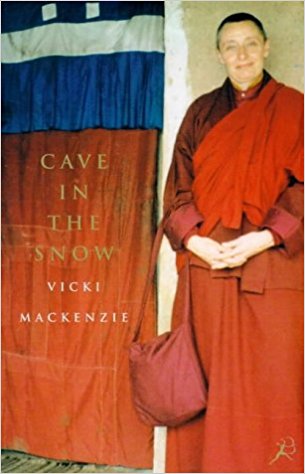
Guest review by Katherine Roberts - CAVE IN THE SNOW by Vicki Mackenzie


Katherine Roberts’ latest novel, Bone Music, invokes the spirit of the 13th century Mongolian steppes to tell the story of Genghis Khan’s rise to power… no Yetis, but it does have wolves! Published by Greystones Press.

In 1976, many years before Buddhism became trendy in the West, a fishmonger’s daughter from the East End of London retreated to a cave 13,200 feet up in the Himalayas, where she spent the next 12 years of her life meditating with only the wild creatures for company. Her name was Diane Perry, though today she is better known by her Buddhist name of Jetsunma Tenzin Palmo. Cave in the Snow  is the fascinating story of Diane’s life up until 1998, when the book was published, by which time she had emerged from her cave with her new name to embark upon a fierce schedule of talks across the world to fund her new project: building a nunnery for young Buddhist girls. Happily, the funds were raised, and the Dongyu Gatsal Ling Nunnery now exists in the Kangra Valley of northern India, close to the seat-in-exile of His Holiness the Dalai Lama.


Diane Perry’s lifelong quest for spiritual enlightenment resonates with me as an author. We spend months, sometimes years, in our metaphorical caves working on our writing projects with only our characters for company, and then emerge blinking into the world to talk about our published books. The book ‘called’ to me from a local charity shop bargain box, not because of its cover (which on my edition is strangely prosaic with its photograph of Tenzin Palmo, dressed in her Buddhist robes, standing beside what I think must be the Tibetan flag), but because of its evocative title coupled with the interesting blurb on the back. How could a woman raised in the East End of London in the aftermath of the Blitz survive alone in a cave in the Himalayas for so many years? Why did she feel the need to retreat there? And what did she discover during her long and lonely years of meditation?

In Tenzin Palmo’s own words, referring to a period when she worked at the Department of Employment to raise funds for her return to India prior to entering her cave: “I felt very sad - there were all these middle-aged guys saying ‘What have I done with my life?’ and young married people with mortgages, already trapped.” Authors also tend to view society like this, from the outside as detached observer rather than as part of the group, and it can be dangerous to look too long or too deeply at what actually matters in life. Shortly afterwards, Tenzin Palmo entered her cave, but not before carrying out a few essential renovations with the help of the locals to give it some proper walls and a door she could close against the elements and wolves. As she says in the book: “It was a very pukka cave.”

Tenzin Palmo did not write in her cave. She read her Buddhist texts and meditated in her box-bed, which was not big enough to allow her to lie down. She grew vegetables outside in the summer months, and - like St Francis of Assisi - was visited by the animals and birds of the mountains. She conversed with wolves, saw the prints of the elusive snow leopard outside her cave in the snow in the depths of winter, and also a huge footprint that may have belonged to the legendary Yeti. It seems she also survived possible breast cancer, and a serious eye infection. And, through all these hardships, she thrived.

It must have been a profound experience, and I kept wishing that Tenzin Palmo had written this book herself, rather than having to read her story secondhand. But Vicki Mackenzie has written a clear and faithful account based on her interviews with Tenzin Palmo, and part of the allure of a spiritual quest is the difficulty of capturing such a mystery in words. Perhaps the best any writer can hope to do is sketch down the bones, and leave it up to the individual reader to supply the flesh and the colour. If you are curious to know more, Jetsunma Tenzin Palmo is still teaching - see her website for details.

Cave in the Snow is published by Bloomsbury.