Showing posts with label crime. Show all posts

Monday, 12 October 2026

Guest review by Dennis Hamley: EARTH TO EARTH by John Cornwell


"The author had to revisit it and write a new conclusion, which survived an attempt by Ted Hughes to have the book pulped ..."

Dennis Hamley
read English at Jesus College, Cambridge, and has a PhD from Leicester. After teaching, lecturing and acting as County English Advisor for Hertfordshire, he retired to write full-time. He has written widely for children and young adults; one of his best-known books, The War and Freddy, was shortlisted for the Smarties Prize. His recent adult novel, The Second Person from Porlock, is a fantasy riff on the chaotic life of Samuel Taylor Coleridge; with Writers Review Publishing he has reissued Spirit of the Place. He lives in Oxford with his wife Kay, an artist.

Earth to Earth
 is a true crime classic revisited. 

This extraordinary book was first published in 1982. It concerned an event in 1975. This event has reverberated through fifty years, causing renewed arguments and accusations, so much so that the author had to revisit it and write a new conclusion, which survived an attempt by Ted Hughes to have the book pulped.

The scene is Devon, in the strip of land which runs through the gap between Exmoor and Dartmoor. Near the village of Winkleigh is a farm, West Chapple. In 1975 it was farmed by the three Luxton siblings: Frances, born in 1908, Robert John (usually known as Robbie), born in 1911 and Alan, born in 1921.Their father, also Robert John, died in 1939 and Wilmot, his wife, in 1949.

On September 23rd, 1975, all three siblings, Robbie, Frances and Alan, were found dead. Each had been shot in the head with a shotgun. Bone, brain and blood had spread over the ground. Robbie had strange wounds on his face, Frances had a broken leg. The three doors and entrances were locked from the inside.

John Cornwell is a fellow emeritus of Jesus College, Cambridge. He is a working investigative journalist with a wide range of non-fiction books, including Coleridge, Poet and Revolutionary, which is how I encountered him when I was writing The Second Person from Porlock. His editor at Penguin Books read about the tragedy at West Chapple and asked John if he thought it was worth investigating. Well, John agreed and this extraordinary book was the result.

Though the Luxton family had farmed West Chapple for several generations, hardly any of their neighbours ever saw them. When they did, they observed strange eccentricity. Frances went to the village shop to buy a single shoelace, Robbie docked a labourer’s wages for picking one orchard apple.

Robbie did all the work on the farm, following the traditional practices of his overbearing father. New farming methods were ignored. The only labourer, Fred Lyne, was paid partly in money but mainly in produce, enough to keep him alive. He was sacked just a week before the killings. The only power on the farm was supplied by a waterwheel. West Chapple was locked into the early nineteenth century.

Robbie forbade marriage. Nobody was to leave his farm. Both Frances and Alan attempted relationships. Robbie squashed them all. They were virtual prisoners. This drove Alan mad, partly illustrated when he wandered around dressed only in a sack as a sort of loincloth.

So John started his investigation, which can be read as both a speculative crime reconstruction and a riveting novel. What had brought the three to this slaughter? Was it a suicide pact? Had one of the siblings murdered the other two and then ended their own life? The inquest came to no satisfactory conclusion.

John interviewed other branches of the Luxton family, of which there were several, and found examples of class, snobbery, envy and contempt, suggestions of madness and murder, and put them together in a first edition of Earth to Earth in 1982. But there was trouble before the publication. So many questions. Possibilities of libel, slander. A family curse? Legal opinion sought. At last the book was published and won the Crime Writers Gold Dagger award.

But still the arguments raged. The poet Ted Hughes, a near neighbour, joined in, opposing any new edition. His accusation was that the book had ruined the Satow brothers, who lived in a manor house, Westacott, and ran it as a sort of B&B. On the contrary, said the brothers. The notoriety brought by the book had increased their business hugely. Hughes suggested seeking the truth through a Ouija board, but Gabrielle, John’s Catholic wife, objected.

And so here is the new 2026 edition. Everything finally sorted? Probably not: this is a story which could still plague generations to come.

Meanwhile, here is the most compulsive, thrilling page-turner I have read for years.

Earth to Earth is published by Riverrun. 

Read a Q&A with Dennis on Spirit of the Place.


Monday, 26 January 2026

Guest review by Nicki Thornton: THE IMPOSSIBLE THING by Belinda Bauer


"The Impossible Thing is more than just a perfectly plotted thriller, it’s a masterpiece of storytelling."

Nicki Thornton
is a bestselling children’s author who has recently published her first crime novel for adults. Little Bookshop of Murders is about Keera Munroe, who tries to escape her shady past by opening a bookshop in an idyllic village. But when Keera argues with a customer who then dies in mysterious circumstances, she’s forced not only to try to find out what really happened, but to confront the fact that even the loveliest places can be hiding the darkest secrets.

Little Bookshop of Murders is inspired by Nicki's twenty years of working in and with bookshops – perfect places for solving crime!

The Impossible Thing was my favourite read of 2025. Many of my favourite writers are those who use crime fiction to comment on times past and present and Belinda Bauer is one of the best, writing with so much humanity and dealing with big and tricky subjects with a nice line in humour as well as a mystery plot.

A break-in in the present day plunges two unlikely heroes into the historical, unexpectedly murky, obsessive, and very lucrative world of oology, or egg collecting.

I was delighted to see that one of the unlikely heroes is the return of one of my favourites of her previous characters, Patrick. Belinda Bauer won the Theakston Old Peculier Crime Novel of the Year with Rubbernecker, another absolute cracker of a story and one I’m always recommending, where a young autistic man, Patrick, signs up for an anatomy class examining a corpse to determine cause of death. Smart but socially inept, Patrick suspects murder. I was thrilled to see Patrick featuring again.

Told in a dual-timeline, The Impossible Thing starts in the 1920s when egg-collecting was both legal and huge. Obsessed and fanatical rival collectors were in desperate competition to have a rare egg to show-off.

The historical timeline doesn’t focus so much on the collectors, but on a group of Yorkshire farmers discovering they have new source of wealth – in all the nests beneath their cliff-top farms. One family is desperate to be part of this new business of egg-collecting, but they have a farm atop a totally inaccessible cliff.

Tiny, brave and always hungry, Celie Sheppard risks her life going over a cliff no one else will dare. She discovers a near mythical red egg, the Impossible Thing. Celie’s bravery changes the fortune of her entire family and everyone connected to her.

A greedy collector knows a red egg is going to be laid every year, and over time will form into an incredible collection, because a nesting guillemot will return to the same cliff nest every year. Each mother lays eggs with distinctive markings so they know which egg is theirs. Of course, if they're collected, none will ever hatch. Every year each chick will be killed. I particularly love that Belinda Bauer weaves the consequences for the birds into her narrative and shows how birds are also innocent victims of greed and ego.

From the wild cliffs to stuffy gentlemen’s clubs in London to council estates, protected woodland nests and the hidden back rooms of a natural history museum, the story loops between the timelines and what happened to those rarest of rare eggs. Patrick and his friend are unwittingly drawn into the now underground, present-day world of egg collecting and all its hidden dangers.

Belinda Bauer triumphantly weaves both timelines together. Crime, mystery, family drama, romance, tragedy, characters you wish you could stay with and the consequences of wildlife trafficking, all is delivered in an enthralling way as the dots are connected as things get increasingly thrilling. I did not want the book to end.

The Impossible Thing is more than just a perfectly plotted thriller, it’s a masterpiece of storytelling. I’m really hoping it will win a lot of awards this year. I encourage everyone to seek out and read it.

The Impossible Thing is published by Bantam.

Nicki Thornton's Little Bookshop of Murders is published by Chimneys Publishing.

Monday, 26 May 2025

Guest review by David Breakell: DEATH AT THE SIGN OF THE ROOK by Kate Atkinson


"Only a writer of Atkinson's skill could pull this off without straining credibility to breaking point."

David Breakell, formerly a practising lawyer in the City of London, writes historical fiction. His novel The Alchemist of Genoa was published in March this year - find out more on his website.

Great fictional detectives have dysfunctional personal lives. Or at least that's how it seems: Sherlock Holmes, Philip Marlowe, Inspector Laidlaw - just add your favourites to the list. And Kate Atkinson's sardonic ex-cop turned private eye, Jackson Brodie, is a great detective. Not 'great' for his brilliant deductive reasoning or his observational powers, or even that he (usually) gets his man, if not the girl. Rather that his humanity, fallibility, dark humour - and the sheer train wreck of his life - grab our minds and hearts and never let go.

If you've read any of Atkinson’s novels, then you won't need much arm-twisting to read this one, the sixth to feature Jackson Brodie. Just as there are spy fiction writers and then there's John Le Carre so, in this reviewer's mind at least, there are crime writers and then there's Kate Atkinson.

Jackson Brodie trails his personal history like a long-life shopping bag and he's instrumental in unravelling the truth behind the crimes, but he's not a permanent presence in the novel. DC Reggie Chase, the rookie police detective last seen in “Big Sky”, is given equal billing this time. Reggie is a warm-hearted young woman who’s clever - but not always wise - beyond her years.

It seems that Atkinson has decided to have fun with this latest novel in the series. She places her focus on the other main characters. And what a menagerie they make: the battleaxe - or just plain batty - dowager marchioness and her graceless offspring; the solitary vicar who has lost his only child, then his faith and now his voice; and the young army officer, invalided out with only one leg and yet to find an alternative purpose in life.

Written like that, it might not sound as if humour was the intention. But Atkinson sets these characters against a background straight out of Agatha Christie: a crumbling stately home, a missing Old Master or two, a killer on the run, a snowstorm in which three of the main characters get separately stranded, and the unloved novels of a whodunit writer, whose creaking plots mirror the real-life crimes.

Atkinson ramps up the comedy by pitching her real-life characters against pretend ones, a troupe of might-have-been actors who are contracted to perform in a Murder Mystery evening at the stately home. No-one, except perhaps Jackson, seems able to separate the stage villains from the real ones. The action hurtles at an ever-increasing pace towards near-farce and the bodies, dead or just acting, mount up.

The Christie parody is of course intentional: only a writer of Atkinson's skill could pull this off without straining credibility to breaking point. In the meantime, her trademark one-liners propel the reader along. Talking to the heirs of a deceased old lady who describe her death as 'peaceful', Jackson muses, "He had seen a lot of dead people, and he wouldn't call them peaceful. He would call them dead." When it comes to the Pet Service at the local parish church, Lady Milton "made a point of not taking her own dogs. It might have given them ideas."

Atkinson also has the uncanny ability to take an everyday observation and turn it on its head. Contemplating the gravestones in his churchyard, the vicar reflects that plague victims "had never tasted coffee. Or tea for that matter. Or potatoes. The list of deprivations in the Middle Ages was a long one." The invalided soldier with his too-stiff-upper-lip parents believes that "if you spent too long trying to look on the bright side, you became dazzled and couldn't see anything properly.”

So, how does this compare with other Jackson Brodie novels? Much as I enjoyed it, I doubt it will rank with her very best. Admittedly, "When Will There Be Good News?" was a pretty hard act to follow, with one of the most jaw-dropping opening chapters I've ever read. The book had the power to make you both laugh and cry, many times. The bereft vicar apart, this latest novel is weighted more towards comedy: and indeed, I laughed, but I would have liked more of the emotional tug of its predecessors…

In the same way as Graham Greene described some of his own oeuvre, “Death at the Sign of the Rook” could perhaps be classed as an 'entertainment' rather than a novel. But I'll take a Kate Atkinson 'entertainment' over someone else's magnum opus, any day.

Death at the Sign of the Rook is published by Penguin.

David Breakell's The Alchemist of Genoa is published by Dower House Books.


See also: Nicola Morgan's review of Kate Atkinson's A God in Ruins.

Monday, 22 July 2024

EIGHTH BIRTHDAY SPECIAL FEATURE: guest Simon Mason on THE BROKEN SHORE and TRUTH by Peter Temple


"As rich, grim and sprawling as Dostoevsky, taking in multitudes, a swarming cast of characters, murder, politics, money and horror ..."

Simon Mason is a writer of fiction. At first he wrote books for adults, then books for children, which grew up at roughly the same rate as his own children, and now he is back writing books for adults again.

His latest books are crime thrillers featuring a mismatched pair of detectives in Oxford. The first, A Killing in November (shortlisted for the Golden Dagger) was a Sunday Times crime book of the month, and so was the second, The Broken Afternoon. The third, Lost and Never Found, was long-listed for the Theakston’s Old Peculier Crime Novel of the Year Award. 

He has pursued a parallel career as a publisher. From 2012 to 2018 he was Managing Director of the children’s publisher, David Fickling Books, where he worked with many wonderful writers, including Philip Pullman, whose book of essays Daemon Voices (2016), he edited.

Arriving on the scene late (he was fifty when his first book was published), Peter Temple was instantly a writer of thoroughly expert literary thrillers, stylish, intelligent, humorous and dark. Words were important to him, his sprightly, stylish prose reminiscent of Chandler, but funnier (‘Gerry gave me the look chefs reserve for three-day-old fish’). The real world was important too; a former journalist, he knew how things work – newspapers, information-gathering agencies, politics – and also how the past lives in the present: ‘the past had suckers, it attached itself to everything.’ His characters, like those of Dickens, are vivid animations, distinguished by the marks of their individuality; his speciality was in damaged men. Scene-setting is always vivid and deeply felt, in particular of Temple’s adored-abhorred Melbourne, with its industrial lots, big-business office complexes, weatherboard slums and gated mansions. And all these literary virtues combine in his two last, loosely connected novels, The Broken Shore (2005) and Truth (2009), which outgrew his chosen genre.

The Broken Shore won the CWA Gold Dagger but is altogether meatier and more highly wrought than the average crime novel, a study in evil, a hard look at Australia and a moving portrait of a damaged, somehow-surviving man.

Melbourne detective Joe Cashin has been shunted to undemanding duties in remote Cromarty, his hometown, as he convalesces from a near-fatal attack which killed his partner. He would like to be free to pursue the Quixotic renovation of his old family farm, to walk his dogs, to reflect on what Cromarty has become – a coastal town half dead industry, half new holiday homes – but the local ‘squire’, last bastion of Cromarty’s former industrial wealth, is found murdered in his mansion, apparently killed for his watch, which, a few days later, a couple of Aboriginal kids are caught trying to sell. It seems a straightforward case. It isn’t.

Temple’s love of language is evident in the urgent, evocative writing which strips away inessentials. What’s left are shrewd, concentrated descriptions (‘wicked-eyed gulls’, ‘the beach tightly muscled’) and bursts of dialogue which capture the sounds, moods and evasions of taciturn Australian men who live in danger. Australia itself is a broken shore, a blasted heath of ruins, a desolate place for desolate characters. Damage has been done by the violence of hardscrabble poverty, privileged wealth and deep-rooted racism. Where is the soul of Australia now? In Cashin? In Dove, Cashin’s down-trodden Aboriginal partner? Or in Dave the Swaggie, a ‘ghost’, an ‘alien’ (‘did Dave ever have an earthly identity?). Story-lines, as likely to be personal as investigative, spiral outwards and continue to proliferate even at the end. Though its virtues are literary, its plot grips like a thriller. Its immediate focus is crime but its deeper enquiry is into human nature. It asks Who are we now, and by what appalling path did we get here?

Truth is as rich, grim and sprawling as Dostoevsky, taking in multitudes, a swarming cast of characters, murder, politics, money and horror. It all happens around Stephen Villani, Head of Homicide in Melbourne, that ‘ghostly’ city of foul deeds. After a cameo role in The Broken Shore, Villani here takes centre stage, conducting investigations into two separate murders, separating acrimoniously from his wife, having a lust-charged affair with an eye-catching television journalist, trying to find his runaway daughter, worrying that a certain event in his past is going to return to destroy him. He flirts recklessly with danger, not only in his violent encounters on the street but in the swanky living rooms of politicians courting him for higher office, and in his childhood home in the hills, where his ex-combat father is refusing to evacuate in the face of rapidly spreading fires.

It is, among other things, a novel of memories, Villani conjuring up a city built of his own experiences, reflecting on what it has all meant, struggling to recall things buried too deep, things that lie ‘just beyond the breakers, in the deep water, in the dark, slippery, moving kelp of the mind.’ His project is to understand – or at least to get into view the unintelligible: ‘There was a meaning here. There was something speaking to them and they did not know the language.’ Temple’s own language is extraordinary: demotic, urgent, elusive, it demands concentration and delivers constant shocks of the new. He avoids explanation like the plague. He loves to ramify, can’t resist an extra layer, a wounding complication. Huge numbers of people appear and disappear, many of them suspect, and the investigation leads not towards their crimes but into their lives. It progresses crabwise, slow and opaque. In retrospect the solutions are simple, we have simply been hustled past them onto other fascinating things. It is an extraordinary achievement.

The Broken Shore and Truth are published by Riverrun.

See also Linda Newbery's review of Daemon Voices by Philip Pullman


Monday, 1 May 2023

THE LAST REMAINS by Elly Griffiths, reviewed by Adèle Geras


"If you have never read these books, then start right now ..."

Adèle Geras has written many books for children and young adults and six novels for adults, the latest of which (under the pseudonym Hope Adams) is Dangerous Women, published by Michael Joseph. She lives in Cambridge.

One of the best presents I was given for my birthday this year was a copy of Elly Griffiths' latest Dr Ruth Galloway mystery. My friend Wendy Cope gave it to me ... we've been reading about Ruth and her companions alongside one another since The Crossing Places, which was the book that launched the series in 2009. For sixteen years, at the rate of almost a book a year, we've lived with Ruth and followed her life and her adventures. We've got to know her lover, Harry Nelson, a married policeman who heads a team of men and women who are all fully rounded characters. If you love the Ruth Galloway books, you belong to a kind of gang.

Appropriately, a book called The Last Remains is the final book about this particular detective and her friends. I was therefore almost bereft when I came to the end of the story. I live in hope that some years further down the line, there will be a case which brings everyone back one more time ....but till then, Elly Griffiths has created a glorious collection of stories about one of the most likeable of detectives.

From the start, Ruth was more like a normal person than most detectives. She was, for one thing, not thin. She describes herself as needing to lose weight, though this aspect, which made me warm to her, is less important as the books go on. Throughout the series, her relationship with Harry Nelson is the spine that holds the narrative together, gives it an emotional core absent from many other books, and provides a continuity that makes Griffiths' fans go back again and again to see how those two are getting on. I know Elly a little and every time I meet her I beg her to make things end well for our hero and heroine. I'm saying nothing about what happens. You will have to read the book. Of course the fact that the top policeman has a distinguished archaeologist to help him, makes the answers to the mysteries much more interesting. Their adventures take them in all kinds of unexpected directions, and there's a thread of magic, worlds beyond our own, the slightly supernatural which runs through the books. Cathbad, Ruth's friend who is a Druid, carries most of the weight of these themes in the novels and he's one of her most attractive creations. Mystery surrounds him even in the midst of the most prosaic situations.

Because we've lived with these characters for so long, we have followed a great many stories through recent history. Cathbad almost died of Covid. Ruth has a daughter with Nelson, and we watch Kate grow into a young person who reflects well on the way her mother has brought her up. Nelson's family also help in Kate's development and are present in her life. A situation which could have become very fraught has always (even through many ups and downs, some of them very dramatic) been managed in a way that's both civilised and plausible.

The stories are set in Norfolk and bring that county most beautifully to life. Ruth lives in one of three cottages on a salt marsh and we are always made aware of what every location looks like. Griffiths never over -describes, but can paint a scene in very few sentences so that we feel we are there. Her dialogue is pitch perfect. It never sounds artificial, but as though real people are talking. She's very good at animals and I have grown especially fond of Ruth's cat Flint. Cathbad's dog (called Thing) is a bull terrier of impeccable character but I have to confess to being one of those people who have a 'thing' about that breed. My bad. Thing is totally lovely in every respect.

In The Last Remains, the body of a young woman is found behind the boarded-up wall of what used to be a café back in the day. Suspicion falls on a group of students and their charismatic and creepy tutor who used to frequent the café long ago. Cathbad, who was then called Michael Malone, was one of their number. What does he know? How involved was he? When he goes missing, there's a possibility that he may have something to hide. Alongside all this, Ruth's University is about to axe the Department of Archaeology. A colleague of hers has something surprising to tell her. Nelson's wife, Michelle, who had been living apart from her husband, has returned to Norfolk. There's an awful lot going on and it's miraculous that Griffiths manages to keep all the balls in the air so brilliantly. Also, there's a reference in this novel to events that happened in the other books, so that you're reminded as you read of all that you've read before. The solution is elegant with a really poignant and unexpected revelation towards the end of the book.

I will now go and catch up with other novels by Griffiths that I haven't read yet. And yes, she has written many other novels. She's one of the most prolific writers of mysteries at work today.

Goodbye, Ruth and co. Reading about you for all these years was a real treat and I hope that one day, you might return. I want to see what Kate becomes. I want to see Ruth and Nelson as grandparents. I want more....

If you have never read these books, then start right now. You won't regret it.

The Last Remains is published by Quercus.

See also Elly Griffiths' The Postscript Murders, reviewed by Rachel Ward.  


Monday, 20 March 2023

Guest review by Rachel Ward: THE SECOND STRANGER by Martin Griffin


"If you are looking for a page-turning thriller to get lost in, then look no further."

Rachel Ward
writes adult crime and thrillers. Her first psychological thriller, Safe With You, was published in 2022, and her second, The Girl Who Vanished, will be out in May. She also writes a cosy crime series, The Supermarket Mysteries, the first of which, The Missing Checkout Girl Mystery regularly features in the cosy crime charts. She is currently working on the fourth book in the series. Rachel lives in Bath, and posts daily photos on Twitter from her early morning walks, as well as occasional paintings. Find her on Twitter: @RachelWardbooks


The tagline ‘One Detective. One Murderer. But which is which?’ neatly sums up the book, except there is so much more going on.

The setting is a country house hotel in the Scottish Highlands with extensive grounds, which Remie Yorke is getting ready to close for the end of the season and leave for good. On her last night, Storm Ezra hits, the snow piles up and the phone lines go down. An injured man knocks at the door, claiming to be a police officer, PC Don Gaines, who was transporting a prisoner from a nearby prison when the vehicle was in an accident. Remie lets him in, but while he is doing security checks of the building, a second stranger appears. His name, apparently, is Don Gaines.

The idea of guests and staff vacating a hotel at the end of the season, ensuring that a large building is almost empty was very atmospheric and a good set up. Add in a fearsome snowstorm and a stranger turning up and I was hooked. By the time I got to the second stranger, I was agog.

I listened to the audiobook, ably narrated by Tamsin Kennard, while I was painting. It kept me thoroughly entertained for several sessions. This book has all the key elements you need including a remote location cut off from the outside world, a small cast of characters who you can’t trust further than you can throw them, a protagonist with a troubled past, and twists and turns aplenty.

If you are looking for a page-turning thriller to get lost in, then look no further. I can’t wait to see what Griffin writes next.

The Second Stranger is published by Sphere.

Monday, 30 May 2022

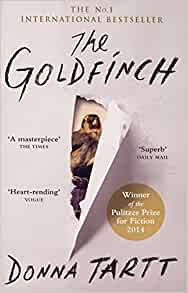
THE GOLDFINCH by Donna Tartt, reviewed by Linda Newbery


"Donna Tartt is a simply wonderful writer: I was captivated by her descriptions of art, the deft characterisations of even the most minor characters, the setting of scene, the insights and honesty."

Linda Newbery edits Writers Review. Best known for fiction for children and young adults, with titles including the Costa Category winner Set in Stone, she has also published one novel for adults, Quarter Past Two on a Wednesday Afternoon, and is currently working on another. Her latest title, This Book is Cruelty Free: Animals and Us, is a guide to compassionate living for teenagers and adults.

I didn't rush to read The Goldfinch, having given up on Donna Tartt's The Little Friend after reading about a third. Although that's something I rarely do, I was finding it a chore rather than a pleasure; hence my delay in reading this. Now, though, nine years after publication, I've completed it and am full of admiration.

My reading was hybrid: part reading, part listening to the audio version (wonderfully read by David Pittu). At more than 770 pages it's a brick of a book, too heavy to carry on buses and trains, and this tactic made the length seem less daunting, though before long I was absorbed and by the end felt the sense of loss at finishing that great books can leave you with, and a need to return to several episodes for a second reading.  

Aged thirteen, Theo Decker survives an explosion that kills his mother and dominates his life from then on. Minutes before the catastrophe, the pair had been admiring The Goldfinch, a painting by the Dutch artist Carel Fabritius, in a New York gallery. In the confusion that follows, the boy tries to help a dying man and a strange, intense bond is formed between them, one that will dictate the course of the adult Theo's life. This elderly man, Welty, a furniture restorer, asks of Theo two things: to take the goldfinch painting, and to go to his shop with a warning for his colleague. Welty's charge, a girl a little younger than Theo, is also badly injured in the explosion, and the two will form a close attachment.

The painting's totemic significance stays with us to the end, prompting meditations on the meaning of art, the power of communication, and the sense of loss. Fabritius was himself killed in a gunpowder explosion at the age of 32, and The Goldfinch (Het puttertje in Dutch) may have been in his workshop at the time. It's a small trompe l'oeil painting showing a beautiful but pitiable finch chained by one leg to a wall-mounted box: kept as a pet or ornament, suffering, unable to escape. That Fabritius painted it in the year of his death adds poignancy. In real life it's safely in the Mauritshuis in The Hague, but in Tartt's novel the painting is taken by Theo who for various reasons keeps it, the secrecy weighing heavy on him: "How had I ever thought I would keep it hidden? I'd meant to deal with the painting for years, get it back where it belonged, and yet somehow I had kept on and on finding reasons not to. To think of it wrapped and sealed uptown make me feel self-erased, blanked-out, as if burying it away had only increased its power and given it a more vital and terrible form. Somehow, even shrouded and entombed in the storage locker, it had worked itself free and into some fraudulent public narrative, a radiance that glowed in the mind of the world."

Theo's father having deserted the family, Theo is for a while looked after by the wealthy parents of a school acquaintance, later being claimed when his father reappears and takes him to a haphazard life in Las Vegas. Here he meets Boris, a Ukrainian boy used to fending for himself, until circumstances force a return to New York. Home and employment are provided by the kindly, self-contained James Hobart (Hobie), Welty's business partner, who introduces Theo to the techniques of furniture restoration. The love with which Hobie practises his craft is touching: "Hobie lived and wafted like some great sea mammal in his own mild atmosphere, the dark brown of tea-stains and tobacco, where every clock in the house said something different, and time didn't actually correspond to the standard measure but instead meandered along at its own sedate tick-tock, obeying the pace of his antique-crowded back-water ... In blameless quiet, he buried himself in his work, steam-bending veneers or hand-threading table legs with a chisel, and his happy absorption floated up from the workshop and diffused through the house with the warmth of a wood-burning stove in winter ... " We sense that lasting security, and mutual love with Pippa, the damaged girl, could be Theo's future, were it not for his involvement in dubious sale deals and the re-emergence of Boris with a revelation that leads him into serious crime. 

It's partly a coming-of-age story, partly a crime thriller, and I admit that the convolutions of the latter plot lost me somewhat; I'd struggle to explain in detail who was who and exactly what happened. But, beyond being concerned for the fate of Theo and the painting, this wasn't what interested me most. Donna Tartt is a simply wonderful writer: I was captivated by her descriptions of art, the deft characterisations of even the most minor characters, the setting of scene, the insights and honesty, in this narrative supposedly written by Theo himself. I marked several passages that particularly struck me, but really could have noted something on almost every page - an indication of a brilliant novel. Surely if I return now to The Little Friend I'll find the same qualities there.

The Goldfinch is published by Little, Brown


Monday, 9 May 2022

Guest review by Sally Nicholls: RISK, ODDS AGAINST and more - the novels of Dick Francis


"It's a long time since I've been so thoroughly swallowed by a novel ..."
 
Sally Nicholls
is the author of nineteen books for big children, little children and teenagers. Her novels have been shortlisted for (and won!) numerous awards, including the Waterstones Children's Book Prize, the Costa Book Award, the Guardian Children's Book Prize and the Carnegie Medal. Her work includes Ways to Live Forever, Things a Bright Girl Can Do and The Button Book. She lives in Liverpool with her husband and two children.

In the corner of my mother’s bookcase, looking rather incongruous next to field guides to birds and plants and illustrated hardbacks on British history, sit a small collection of red-jacketed paperback thrillers. My mother is not a natural thriller-reader. She likes autobiographies, books about religion, fiction about good people being decent to each other. But the thrillers, all by the same author, have sat on her shelves my entire life, surviving innumerable clear outs. Their red spines are as familiar to me as the battered Shirley Hughes books I read to my children.

Home for half term, looking for something to read, I pick one off the shelf.

Risk by Dick Francis.

Six hours later, I put down the book, somewhat stunned. What just happened? It’s a long time since I’ve been so thoroughly swallowed by a novel. I feel breathless, as though, like the jockey hero of Risk, I’ve been chloroformed, kidnapped, bundled off in a Red Cross ambulance minutes after winning the Cheltenham Gold Cup on a rank outsider. Captive to the yellowing pages, I am addicted. I want more.

I go on social media to rave about my new discovery, and am greeted with delight. One person tells me Dick Francis is the reason she became a writer. Several talk about finding him in the unbookish houses they grew up in. They all agree how readable he is. ‘I read one when I was pregnant,’ someone else says. ‘I was sort of alarmed by how addictive it was. Felt like snorting cocaine. I wondered if I read another if I would be forever condemned to reading nothing but his books.’

I am not at all surprised by this. Writers are snobs about bad writing, but they respect anyone who does a job well. Dick Francis is what George Orwell called a ‘good bad writer’. His books are mid-twentieth-century thrillers in the American vein; they are by no stretch of the imagination literature. But they are very, very good at what they do. He has the sort of simple style it is incredibly hard to emulate. He is emotionally sound, and quietly humorous. He is the only three-time winner of the Edgar, and one of only two writers to win both the Edgar and the Golden Dagger for the same novel, Whip Hand. (The other was John Le Carre for The Spy Who Came in From the Cold.)

Over the next few weeks, I read seven more Dick Francis thrillers in quick succession: Odds Against, Whip Hand, Come to Grief, In the Frame, Nerve, Reflex and Straight. These are all recommendations by friends on social media, and any would make a good starting point to his work, though it should be noted that Odds Against, Whip Hand and Come to Grief are a mini-series about Sid Halley, Francis’ most popular hero. You may prefer to read them in order, though you don’t really have to.

The books are very similar. Francis’ heroes are all basically the same person; practical, intelligent men of about thirty, physically resilient, emotionally reticent, frequently wounded (literally and metaphorically) and splendidly moral. When Philip Nore takes a bribe to lose a horse race in Reflex I am genuinely shocked, though he quickly comes to his senses. They all also have broadly the same plot. The men, who are generally jockeys, stumble upon evil and are compelled to do something about it. They use their wits to investigate, despite the clearly increasing danger. At some point, about two-thirds of the way through, they are set upon by rent-a-thugs and attacked or kidnapped. They are hurt. (As an ex-jockey himself, Francis wrote with great authority about pain, though never gratuitously). Their loved ones beg them to rest, but they struggle on, breaking their chains, outsmarting their enemies, and, in one memorable finale, winning a major horse-race for the sheer joy of forcing the villain to congratulate them on live television.

These wounded heroes are part of Francis’ appeal. They may be steely-eyed under pressure, but they come with well-realised neuroses and insecurities. They don’t just walk away from their wounds, they carry them with them for the remainder of the book, and sometimes into the next one. When one ends up trapped in his car after a car crash, we get a meticulous description of how he is cut out. Francis (or apparently usually his wife) does his research. Another joy of the books lies in the details of the worlds he writes about, be they horse racing, painting, photography or the rare gem trade. I’ve never been to a horse race in my life. But his knowledge makes me interested. He cares, so so do I.

The emotional honesty is perhaps why Francis has so many female fans. He writes women well; be they spinster headmistresses who outmanoeuvre thugs, or junior editors with an eye for genius. There aren’t many seventies thriller-writers who would give Sid a cheerful, untidy PhD student as a love interest. And never once are the women ‘fridged’, raped or hurt. If a villain wants to get to a Francis hero, he does the decent thing and bops him on the head, ties him up, shoves him into his car, and duffs him up in a deserved stable yard somewhere. There is romance, but no on-stage sex and no swearing, apparently because Francis didn’t want to upset the Queen Mother, who was a fan.

Rumours abound that Francis’ wife actually wrote the books. He left school at sixteen, she was a publishers’ reader with a university degree. I’m not so sure. The books are extremely competently written, but they are also intensely male. Francis himself said “I am Richard, Mary was Mary, and Dick Francis was the two of us together.” Their son described them as ‘Siamese twins joined at the pencil.’ Some sort of collaboration seems most likely.

For me as a writer, something good always comes from falling nose-first into a book or a series. I’m certain I wouldn’t have written Things a Bright Girl Can Do and A Chase in Time (at least not in quite the same way) if I hadn’t fallen so hard for Peter Wimsey and Harriet Vane. I’m not sure what will come out of all these racing thrillers, but I’m certain something will. I’m looking forward to finding out what.

Dick Francis' novels are published by Penguin.

Sally Nicholls' Things a Bright Girl Can Do is included in this round-up of suffragette fiction for younger readers and adults.


Monday, 14 February 2022

Guest review by Rachel Ward: THE POSTSCRIPT MURDERS by Elly Griffiths


"A light-hearted read in the vein of Richard Osman’s The Thursday Murder Club or S.J.Bennett’s The Windsor Knot."

Rachel Ward
has written five thrillers for young adults, the first of which, Numbers, was shortlisted for the Waterstones Children's Book Prize. Her novels for adults, The Cost of Living, Dead Stock and Expiry Date (Sandstone Press) are cosy crime stories set in and around a supermarket. Rachel lives in Bath where she also paints and takes photographs. Twitter: @RachelWardbooks Facebook: Rachel Ward Art

When ninety-year-old Peggy Smith is found dead in her armchair by the window in a care home by the sea, her death is put down to natural causes, but her carer, Natalka, suspects foul play. For Peggy was a ‘murder consultant’ who plotted deaths for authors and had told Natalka that someone was following her. Natalka investigates, helped by Peggy’s friends, eighty-year-old former BBC Radio 3 presenter, Edwin, and ex-monk turned coffee barista, Benedict, and also local police detective D.S. Harbinder Kaur. The case takes them through the murky world of publishing and to further deaths before the truth is finally revealed.

This is a light-hearted read in the vein of Richard Osman’s The Thursday Murder Club or S. J. Bennett’s The Windsor Knot. The action keeps coming with surprising twists and turns. For this reader, there are rather delicious references to the crime-writing world. What marks this book out from others in the cosy crime genre is the fine and complex characterisation. Griffiths makes you really care about Natalka, Edwin, Benedict and Harbinder. We learn about their, in some cases unusual, backgrounds and history and enjoy their friendships developing. The plot may stretch credibility a little (which I didn’t mind at all) but the relationships between the main characters are utterly believable.

This is the second book to feature D.S. Harbinder Kaur. I don’t think it matters that I am coming to them out of sequence and I’m looking forward to reading the first one, The Stranger Diaries.

The Postscript Murders is published by Quercus.

Rachel Ward's Ant and Bea books are reviewed here by Savita Kalhan.


The Windsor Knot  by S J Bennett is reviewed here by Penny Dolan.


Monday, 11 October 2021

Guest review by Doug Johnstone: THE NIGHT ALWAYS COMES by Willy Vlautin


"Even as a writer in a similar genre I couldn’t predict how Vlautin would end this beautiful but excruciating tale. But when it comes, the ending is just perfect."


aAuthor photo by Duncan McGlynn
Photograph by Duncan McGlynn
Doug Johnstone is the author of thirteen novels, most recently The Great Silence. His previous book, The Big Chill was longlisted for the Theakston Crime Novel of the Year. Several of his books have been bestsellers and three, A Dark Matter, Breakers and The Jump, were shortlisted for the McIlvanney Prize for Scottish Crime Novel of the Year. He’s taught creative writing and been writer in residence at various institutions over the last two decades including festivals, libraries, universities, schools, prisons and a funeral directors.

Doug is a Royal Literary Fund Consultant Fellow and works as a mentor and manuscript assessor for many organisations, including The Literary Consultancy, Scottish Book Trust and New Writing North. He’s been an arts journalist for over twenty years and has also written many short stories and screenplays. He is a songwriter and musician with six albums and three EPs released, and plays drums for the Fun Lovin’ Crime Writers, a band of crime writers. He’s also co-founder of the Scotland Writers Football Club.

Willy Vlautin is something of a hidden gem of American fiction. He is occasionally blessed (and maybe cursed) by that phrase ‘a writer’s writer’, but that might give the wrong impression of him as someone who is showy and flamboyant in his writing style. Nothing could be further from the truth – Vlautin’s novels contain the cleanest and clearest prose around, simple yet devastatingly effective. He brings to mind the words of Orwell, that good writing should be like a windowpane. It feels as if you can see straight through Willy’s words to the story, the characters and the pain he puts them through.

The Night Always Comes is Vlautin’s sixth novel. His previous outings have all been heartfelt examinations of the dark underbelly of the American dream – stories that look at the downtrodden and hard-done-by people at the bottom of that country’s society, and how they cope with the hardships that their situations throw at them. This latest book sees him finessing this formula masterfully, while also marrying it to a breathless thriller plot that feels like it owes a debt to the classic American noir canon.

The beating heart of the book is Lynette, a thirty-year-old with a troubled past, currently working three jobs, living with her mother and caring for her older brother who has learning difficulties. The book is set in Portland in the recent past, as the city is being rapidly gentrified, pricing people like Lynette out of the housing market and forcing them out of the city.

Lynette’s plans to scrape together enough cash to buy the house she rents are scuppered when her mother gets cold feet. Because of her dubious history, Lynette has no credit rating and needs her mother on board. She is left trying to claw back money that she’s owed from various less than savoury people, taking her on a long dark night of the soul as she travels across the changing city getting deeper and deeper into trouble.

The whole book takes place over two nights, as Lynette is forced to make hard decisions, then is forced to deal with the consequences of those decisions. One of her jobs is as a part-time sex-worker, and when she asks a rich returning client for a loan, his disgusted reaction forces her to take matters into her own hands for once. From there it’s a classic noir trajectory, as the momentum of her actions becomes impossible to resist.

From the opening few pages this is a heart-in-the-mouth read, both in terms of the action and the depth of empathy that Vlautin conjures up for Lynette. It’s impossible not to care about what happens to her even as she makes terrible mistakes, and even as a writer in a similar genre I couldn’t predict how Vlautin would end this beautiful but excruciating tale. But when it comes, the ending is just perfect.

The framing of Lynette’s story against the backdrop of rampant commercialism and consumerism in a modern American city allows Vlautin some social commentary, but it’s handled deftly and never polemical, always in service of his story.

This is a short novel, but one that takes structural and stylistic risks too. There are elements here that go against the standard creative writing lessons, things that shouldn’t work but just do because of Vlautin’s care and attention to the words on the page. There’s a large section of Lynette’s backstory inserted later on, not something I usually care for but it works brilliantly here. Then there is a lengthy discussion near the end between Lynette and her mother that by rights should bore the reader at a time when action is required, but which actually becomes a profound treatise on how we live our lives and relate to others.

As a writer, it can become harder to be blown away by others’ work when you can see the nuts and bolts of what they’re doing. But sometimes a book is just so good that you’re blown away. This is just such a book.

The Night Always Comes is published by Faber.

Doug Johnstone's  A Dark Matter was the choice of our birthday guest Val McDermid. Read her review here.


Monday, 26 July 2021

Fifth Anniversary special guest: VAL McDERMID and A DARK MATTER by Doug Johnstone


"The set-up sounded like a delicious prospect ... And so it proved. It had me at the first line."

Val McDermid
has sold over 17 million books to date across the globe and has been translated into more than 40 languages. She is perhaps best known for her Wire in the Blood series, featuring clinical psychologist Dr Tony Hill and DCI Carol Jordan, which was adapted for television starring Robson Green and Hermione Norris. Her most recent TV series Traces aired in a BBC1 primetime slot in January of this year, and a second series is currently in production, as is ITV’s adaptation of Karen Pirie, based on Val’s cold case detective of the same name.

1979, the beginning of a new series for Val, featuring journalist Allie Burns, is published on 19th August. She has also published Resistance, a graphic novelisation of her critically acclaimed radio drama, illustrated by Kathryn Briggs, this May.

Val was chair of the Wellcome Book Prize in 2017 and has served as a judge for both the Women’s Prize for Fiction and the 2018 Man Booker Prize. She is the recipient of six honorary doctorates and is an Honorary Fellow of St Hilda’s College, Oxford. She is Visiting Professor in the Centre of Irish and Scottish Studies at the University of Otago in New Zealand. She is an experienced broadcaster and much sought-after columnist and commentator across print media.

Val is also lead vocalist with The Fun Lovin' Crime Writers, possibly the only band made up of crime writers ever to play at Glastonbury!   

McDermid fans - what's your favourite title? Tell us in the comments!

When I first heard about Doug Johnstone’s proposed trilogy of novels about three generations of women running a funeral home and a private eye agency, I couldn’t wait to read it. I’ve long been an admirer of his spare and insightful prose, and the set-up sounded like a delicious prospect.

And so it proved. It had me at the first line: ‘Her Dad took much longer to burn than she expected.’ Not, it turns out, the aftermath of a murder, but the garden funeral pyre of undertaker Jim Skelf.

A Dark Matter has its origins in the six months Johnstone spend as writer in residence in a funeral home in Edinburgh, where this book is set. He spoke to as wide a range of employees and employers as possible, and that gives the book its authenticity and authority. There’s nothing gruesome or voyeuristic here; but we never doubt that he knows what he’s talking about. It’s dark, it’s funny, it’s emotionally intelligent and it’s a page-turner too.

The triple-stranded plot revolves around the three women of the Skelf family. (‘Skelf’ is a Scots word that means either a thin splinter of wood or a troublesome person.) Dorothy, the matriarch, is a transplant from California who married Jim, the owner of the long-established family business. A healthy 70-year-old, she deals with her grief and stress behind her attic drum kit or on her yoga mat.

For her daughter Jenny, Jim’s death feels very close to the final straw. She’s lost her job as a journalist and her marriage imploded afer she discovered husband Craig was cheating on her. She can’t afford the rent so she has no choice but to move back home and take over her dad’s role in the business, nursing her bitterness to keep it warm.

The youngest Skelf woman is Hannah, 20 years old, studying quantum physics at Edinburgh University, in a lesbian relationship with Indy who works in the funeral home. Bright and sparky, her light has been dimmed by her grandfather’s death.

Of course, in fiction, a death in the family always opens the door on secrets and lies. Jim’s ashes are barely cold when Dorothy is stricken by the discovery that her late husband had been making secret payments to another woman for years. It’s hard to resist the conclusion that her happy marriage was nothing more than an edifice, but she’s determined to get to the truth.

Jenny meanwhile has taken on what appears at first to be a straightforward PI case of establishing adultery, an investigation that has painful undertones every step of the way.

And Hannah’s grief is made all the sharper when her best friend disappears. As she tries to unravel what happened to Mel, she finds a shocking trail of dark revelations.

The three narrative strands are expertly woven, building tension that never lets up on a journey of discovery that’s as much about three women learning about themselves and each other. The dynamic between the three generations is all too credible and never sentimental. Few male authors write women really well, but Doug Johnstone has created three very different but credible female characters who all resonated with me in their very different ways.

The final plum in the pudding for me is the setting. This is not the Edinburgh the tourist sees – it’s a living variegated city and Doug Johnstone opens doors and windows on a capital we don’t always see. He’s a writer whose books always have a strong sense of place, but never more than in this trilogy. The good news is that the second book in the series, The Big Chill, is already out, and the third, The Great Silence, will be published in August 2021.

A Dark Matter is published by Orenda Books.


Monday, 16 December 2019

Guest review by Susan Price: THE THIRD POLICEMAN by Flann O'Brien


"Blends a keen sense of wonder and beauty, with poetry, comedy, horror and despair. I don’t think there is another book like it." 

Susan Price has written everything from picture book texts to ‘cross-over’ novels like The Sterkarm Handshake, which won the Guardian Children’s Fiction Award but is read by teenagers and adults alike. Her book The Ghost Drum won the Carnegie Medal. She is one of the bloggers at Authors Electric. Susan Price’s website is here.

“Not everybody knows how I killed old Phillip Mathers, smashing his jaw in with my spade; but first it is better to speak of my friendship with John Divney because it was he who first knocked old Mathers down by giving him a great blow in the neck with a special bicycle-pump which he manufactured himself out of a hollow iron bar. Divney was a strong civil man but he was lazy and idle-minded. He was personally responsible for the whole idea in the first place. It was he who told me to bring my spade. He was the one who gave the orders on the occasion and also the explanations when they were called for.

"I was born a long time ago…”

That’s the opening of The Third Policeman,  and it contains a psychology of psychopathy. The cool, unemotional account of a violent murder. The ranking of murder as equal in importance to the manufacture of a bicycle-pump, and the instant shifting of blame.

Flann O’ Brien is known as a ‘comic writer.’ This is a ‘comic novel.’ It’s also a masterpiece.

It is very funny — and also bizarre, poetic and despairing. It’s sinister. This is sinister, eerie, unsettling comedy.

I first read The Third Policeman thirty years ago, and on re-reading, I find I remembered the comic scenes most: the atomic theory, as applied to bicycles and Irish roads; the men who are more than 75% bicycle; the delicate legal matter of deciding, when a man who is predominately bicycle, commits a murder, which should be hung? The man or the bicycle?

I remembered the book as much more light-hearted than, on re-reading, it actually is. Scathingly funny, yes. Comic in the sense of ‘holding human nature up to ridicule.’ In its inventiveness and originality, it's even playful. But light-hearted? No.

On second-reading, I still laughed at the scenes set in the police station — O’Brien’s inventiveness and verbal audacity is second to none — but was more struck by the poetry of many passages, and how frightening much of it is. I’ve read whole ghost stories that don’t manage to convey such a sense of menace and ill-omen, as, in a few lines, O’Brien does.

The prose is beautiful. O'Brien could move, with ease and perfect rhythm, often in the same passage, from the cant of the pub, to officialise, to poetry.

As I read, certain images kept coming into my mind, all drawn from ‘The Cabinet of Dr. Caligari,’ with its strange, skewed perspectives.

“As I came round the bend of the road an extraordinary spectacle was presented to me. About a hundred yards away on the left-hand side was a house which astonished me. It looked as if it were painted like an advertisement on a board on the roadside and indeed very poorly painted. It looked completely false and unconvincing. It did not seem to have any depth or breadth and looked as if it would not deceive a child… What bewildered me was the sure knowledge deeply rooted in my mind that this was the house I was searching for… I had never seen with my eyes ever in my life before anything so unnatural and appalling and my gaze faltered about the thing uncomprehendingly as if at least one of the customary dimensions was missing, leaving no meaning in the remainder. The appearance of the house was the greatest surprise I had encountered since I had seen the old man in the chair and I felt afraid of it.”

'My gaze faltered about the thing...' What a phrase.

This sense of nothing being as it should be, of indeterminate dread, pervades the book — and is part of the very narration, with its cool, detached, measured descriptions of terrors and shocks.

The nameless narrator, who tells us he can’t remember his own name, is an orphan and, due to an accident, has a wooden leg. He has inherited a fortune, but by the time he is adult and returns to his farm, the money has been squandered by the caretaker, John Divney.

Both the narrator and Divney are keen to replenish the fortune — Divney so he can marry, and the narrator so he can publish a book on the scientist, De Selby, with whom he has become obsessed.

Asides and footnotes on De Selby make up a substantial part of the book, adding both to its oddness and its cool, detached manner. Among De Selby’s theories is the notion that darkness is a contaminating vapour which emanates from holes in the earth, and contributes to disease because we inhale it. This was once a genuinely held theory of the nature of darkness, before it was established that darkness is an absence of light, rather than a thing in itself.

De Selby also argues that if we angle enough mirrors, to give enough successive reflections of ourselves, we could look into our past. He claims, by setting up many mirrors, to have glimpsed himself at the age of eleven. Many of his theories seem to be twisted, or over-literal understandings of relativity or quantum theory, while their twisting of time and space relate to the literally twisted perspective in the description of the book’s world.

In pursuit of fortune, the narrator and Divney murder an old man, Mathers. Divney makes off with the cash-box, which he hides, saying they must spend none of the money until suspicion has died down.

Eventually, Divney reveals that he has hidden the box in Mather’s house. They go together, one night, to the deserted half-ruinous murder house, and while Divney waits outside, the narrator goes in to fetch the box. From this moment on, the book, already strange, becomes increasingly bizarre. The narrator climbs through a window:-

“I clambered through the opening and found myself, not at once in a room, but crawling along the deepest window-ledge I have ever seen. When I reached the floor and jumped noisily down upon it, the open window seemed very far away and much too small to have admitted me.”

He discovers that the cash-box has gone. And then:—

“I heard a cough behind me, soft, and natural yet more disturbing than any sound that could come upon the human ear. That I did not die of fright was due to two things, the fact that my senses were already disarranged and also that…the cough seemed to bring with it some more awful alteration in everything, just as if it had held the universe standstill for an instant…”

The narrator then takes tea with the old man he has murdered.

I don’t want to spoil the book by detailing the narrator’s adventures after that. Suffice to say that he meets with two enormous policemen, Sergeant Pluck and Constable MacCruiskeen, and also with his own soul. We learn about MacCruiskeen’s mind-boggling hobbies, and even more about De Selby’s experiments. We meet the brotherhood of one-legged men, visit Eternity and, eventually, meet the third policeman, Sergeant Fox.

If the book has a message, I understand it to be that Evil is self-centred, self-aggrandising, futile and barren. And, possibly, that to be such a person is its own punishment, though they will never understand that.

In fact, a lack of understanding is one of the book’s themes. The narrator obsessively studies the works of De Selby, trying to understand them — but his understanding of the world around him seems to dwindle as his knowledge of De Selby increases.

The Third Policeman is a book that blends a keen sense of wonder and beauty, with poetry, comedy, horror and despair. I don’t think there is another book like it — except those others by Flann O’Brien, whose real name was Brian O'Nolan.

His first novel, At-Swim-Two-Birds (also a must-read) was published, and acclaimed, in 1939.

The Third Policeman was his second novel, and it was turned down. It wasn’t published until 1967, after the author’s death, when it was recognised for the wonderful piece of writing it is.

I wonder if, these days, any conventional publisher would accept it at all?

The Third Policeman is published by Dalkey Archive Press