Showing posts with label Dennis Hamley. Show all posts

Monday, 12 October 2026

Guest review by Dennis Hamley: EARTH TO EARTH by John Cornwell


"The author had to revisit it and write a new conclusion, which survived an attempt by Ted Hughes to have the book pulped ..."

Dennis Hamley
read English at Jesus College, Cambridge, and has a PhD from Leicester. After teaching, lecturing and acting as County English Advisor for Hertfordshire, he retired to write full-time. He has written widely for children and young adults; one of his best-known books, The War and Freddy, was shortlisted for the Smarties Prize. His recent adult novel, The Second Person from Porlock, is a fantasy riff on the chaotic life of Samuel Taylor Coleridge; with Writers Review Publishing he has reissued Spirit of the Place. He lives in Oxford with his wife Kay, an artist.

Earth to Earth
 is a true crime classic revisited. 

This extraordinary book was first published in 1982. It concerned an event in 1975. This event has reverberated through fifty years, causing renewed arguments and accusations, so much so that the author had to revisit it and write a new conclusion, which survived an attempt by Ted Hughes to have the book pulped.

The scene is Devon, in the strip of land which runs through the gap between Exmoor and Dartmoor. Near the village of Winkleigh is a farm, West Chapple. In 1975 it was farmed by the three Luxton siblings: Frances, born in 1908, Robert John (usually known as Robbie), born in 1911 and Alan, born in 1921.Their father, also Robert John, died in 1939 and Wilmot, his wife, in 1949.

On September 23rd, 1975, all three siblings, Robbie, Frances and Alan, were found dead. Each had been shot in the head with a shotgun. Bone, brain and blood had spread over the ground. Robbie had strange wounds on his face, Frances had a broken leg. The three doors and entrances were locked from the inside.

John Cornwell is a fellow emeritus of Jesus College, Cambridge. He is a working investigative journalist with a wide range of non-fiction books, including Coleridge, Poet and Revolutionary, which is how I encountered him when I was writing The Second Person from Porlock. His editor at Penguin Books read about the tragedy at West Chapple and asked John if he thought it was worth investigating. Well, John agreed and this extraordinary book was the result.

Though the Luxton family had farmed West Chapple for several generations, hardly any of their neighbours ever saw them. When they did, they observed strange eccentricity. Frances went to the village shop to buy a single shoelace, Robbie docked a labourer’s wages for picking one orchard apple.

Robbie did all the work on the farm, following the traditional practices of his overbearing father. New farming methods were ignored. The only labourer, Fred Lyne, was paid partly in money but mainly in produce, enough to keep him alive. He was sacked just a week before the killings. The only power on the farm was supplied by a waterwheel. West Chapple was locked into the early nineteenth century.

Robbie forbade marriage. Nobody was to leave his farm. Both Frances and Alan attempted relationships. Robbie squashed them all. They were virtual prisoners. This drove Alan mad, partly illustrated when he wandered around dressed only in a sack as a sort of loincloth.

So John started his investigation, which can be read as both a speculative crime reconstruction and a riveting novel. What had brought the three to this slaughter? Was it a suicide pact? Had one of the siblings murdered the other two and then ended their own life? The inquest came to no satisfactory conclusion.

John interviewed other branches of the Luxton family, of which there were several, and found examples of class, snobbery, envy and contempt, suggestions of madness and murder, and put them together in a first edition of Earth to Earth in 1982. But there was trouble before the publication. So many questions. Possibilities of libel, slander. A family curse? Legal opinion sought. At last the book was published and won the Crime Writers Gold Dagger award.

But still the arguments raged. The poet Ted Hughes, a near neighbour, joined in, opposing any new edition. His accusation was that the book had ruined the Satow brothers, who lived in a manor house, Westacott, and ran it as a sort of B&B. On the contrary, said the brothers. The notoriety brought by the book had increased their business hugely. Hughes suggested seeking the truth through a Ouija board, but Gabrielle, John’s Catholic wife, objected.

And so here is the new 2026 edition. Everything finally sorted? Probably not: this is a story which could still plague generations to come.

Meanwhile, here is the most compulsive, thrilling page-turner I have read for years.

Earth to Earth is published by Riverrun. 

Read a Q&A with Dennis on Spirit of the Place.


Monday, 11 May 2026

Special feature Q&A: Dennis Hamley talks about SPIRIT OF THE PLACE


"The cat is, in some ways, the most significant character in the book ... the cause of Fowler’s greatest sin and the subject of a failed poem. His final guise explains the whole story."

Dennis Hamley's first novel, Pageants of Despair, was published in 1974. He read English at Jesus College, Cambridge, and has a PhD from Leicester. After teaching, lecturing and acting as County English Advisor for Hertfordshire, he retired to write full-time. He has written widely for children and young adults; one of his best-known books, The War and Freddy, was shortlisted for the Smarties Prize. His recent adult novel, The Second Person from Porlock, is a fantasy riff on the chaotic life of Samuel Taylor Coleridge and was published in 2021. He lives in Oxford with his wife Kay, an artist.

Spirit of the Place is now reissued by Writers Review Publishing. First published in 1995, the novel was described by Philip Pullman as "a marvellous story, put together with great ingenuity. Dennis Hamley seems to have got right inside the eighteenth century (one of my own favourite places to visit), heroic couplets and all. It made me want to go out at once and build a Grotto in the garden."

Dennis lives in Oxford with his wife Kay, an artist. Here he answers questions from Linda Newbery.

LN: Congratulations on the reissue of this marvellous novel! I loved it on reading it soon after its first publication, by Scholastic, and am delighted to see it reissued as the fifth title from Writers Review Publishing. It struck me as very different from anything of yours I'd read before. What was the sparking point?

Dennis Hamley: I remember the first tiny inklings of the novel. We (my first wife and I) lived at the time in Hertford. Three miles away, in Amwell, on the outskirts of Ware, was John Scott’s grotto, built in the eighteenth century. Scott owned Amwell House. Once it was part of a great estate, now it is built over and the grotto exists almost by accident. Scott was a Quaker and a poet. His anti-war poem shows both qualities:

    I hate that drum’s discordant sound
    Parading round and round and round.
    To thoughtless youth it pleasure yields
    And lures from cities and from fields.


His grotto, open to the public on Saturdays in summer, is a magical place. A gatehouse, underground passages with walls lined with quartzes, glass, and shells which shine eerily in the light of your torch or your ancestors’ lanterns. You emerge into the daylight feeling that you have experienced a marvel.

Well, I did, anyway, and knew I must write a story about a grotto. And, as there seemed a connection between grottoes and poetry, I had to have a poet to go with it. Thus Nicholas Fowler was born. I saw him in eighteenth-century gentleman’s costume, a small figure, green jacket, blue waistcoat, beige breeches and hose encasing withered legs, walking across his estate, supported by a gold-topped cane.

The great poet Alexander Pope built a grotto in his garden in Twickenham and wrote a poem about it. So my Nicholas Fowler must do the same.

    What secrets are exposed by human toil?
    What great new work replaces sullen soil?
    A thing of beauty forms for all of time.
    Its epithet is clear. It is sublime.


LN: The novel uses a split structure. Can you explain about that?

DH: I think this came to mind as a necessity even as I emerged from Scott’s Grotto. Here was I, standing in the twentieth-century having just had an eighteenth-century experience. The centuries had to be merged.

Fowler is the novel’s main character. The poetry he writes is eighteenth-century in style. I am imitating the heroic couplets of Pope, Dryden and a host of lesser poets.

Spirit is a time-slip novel and present-day characters are equally significant. Chief among them is Lindsey Lovelock, a university student. Lyndsey has chosen Nicholas Fowler as the subject for the long study she must write for her degree in Philosophy and Literature.The ‘Now’ part of the novel is seen though her eyes. She comes to consciousness in hospital but with temporary amnesia, injuries she can’t explain, and with Kath Welland, a detective-sergeant to pull the extraordinary truth out of her. For Lindsey’s boyfriend Rod is in police custody, accused of breaking and entering Coswold, a mansion house once Nicholas Fowler’s home, now owned by the University and let out to a big pharma company doing secret research. Rod, a science student, longs to know what that research is: something to do with genetics. His garbled evidence suggests that he doesn't need the police, but a psychiatrist.

LN: The novel deals with big subjects. Can you explain how you made thematic use of them?

DH: Well, first of all there’s Jack, Lindsey’s microcephalic brother. He is the reason Lindsey is a home student, going to the university just up the road because she and her mother are his sole careers.

Quite apart from that, great changes are coming to our world. The implications of the human genome project, the dawn of cyberspace and AI might (or might not) seal humanity’s mastery of nature. But in the eighteenth century Man was seen, as Fowler puts it, ‘God’s viceroy on Earth’, whose purpose was to improve on nature, discover its laws, find the great principles and driving force of His power. In effect, these aims are the same.

Fowler doesn’t see himself merely as a poet. He is a scientist. He learned from Priestley, who discovered oxygen, how to build a friction machine which can trap a strange power, enough to make a needle swing seemingly of its own volition. The first hint of electricity. A vision vouchsafed to humanity by God himself? Yes, thinks Fowler. This new hubris will have grave consequences for him.

LN: Class distinctions are very important in the ‘then’ chapters.

DH: Yes. The concept of The Great Chain of Being was at the centre of the class system. As Fowler puts it:

    For in this panoramic scheme
    Each actor’s purpose long has been
    Ordained in mighty plan .
    Green frond to insect, fish to cat,
    Ascending rungs in stairways that
    Lead up to God through Man


Fowler is a gentleman. ‘I am a man of substance, a Master of Arts of the University of Cambridge, a member of the Church established and shall succeed to my father’s estate.' A very precise definition, but in the Great Chain of Being nowhere near the aristocracy. As Sir Charles Witherpole, an angry neighbour, says, ‘This is not Blenheim or Woburn. These are the modest estates of Squires, not Dukes.’ Which puts him in his place

Several rungs below on the class ladder is Mr Perry, clerk of works and a salaried man responsible to Mr Landskip Peters, an avatar of Mr Capability Brown. Perry and Fowler are at constant loggerheads.

In Coswold’s kitchen are four characters far below Fowler and even Perry. The cook, Mrs Mundy; Mr Grainger, a handyman and general factotum for the estate; Verity, a serving girl; and the boy, unnamed until the very end. And the cat.

LN: Yes, you made very clever use of that cat – an endearing and important character.

DH: The cat is, in some ways, the most significant character in the book. He appears in different guises throughout, in both ‘Then’ and ‘Now’. He is a sagacious creature with a mind of his own. He is the boy’s only friend. He is the cause of Fowler’s greatest sin and the subject of a failed poem. His final guise explains the whole story.

LN: Nicholas Fowler is very convincing as an 18th Century poet - i.e. you are! Did writing Nicholas's poems come easily to you?

DH: I’m not a poet. But I love capturing the feel of real poets. I suppose you could call it pastiche. Well, yes. But I think it’s something more. I love writing it anyway. Once, I managed about ten lines of T S Eliot’s Fifth Quartet. And once I wrote a Shakespearian play for students to act, The Tragicall Historie of Dogmaticus, Prince of Academe, his fall. I put it about that it was a lost Shakespeare play recently discovered and to my amazement some people believed me! Sadly I don’t have a copy, but I can remember whole chunks still.

LN: Can you tell us about Lindsey's brother and the treatment he receives? I was particularly interested in that, as one of my late uncles was very much involved with Conductive Education as a trustee and fundraiser. Again, you made clever thematic use of this character to link past and present.

DH: Well, Jack, Lindsey’s brother, is microcephalic. He is the reason Lindsey is a home student. In the prelims, I thank the Morrissey family, who live near Galway in Ireland. Their son was microcephalic and though it was a long time ago that we met I shall never forget him. Later on, I met a family whose child had cerebral palsy. It was then that I learnt about ‘Pathways to the Brain’, Conductive Education and the Peto Institute. This was important to the novel because it defines Lindsey’s professional purpose in life.

LN: What was it like returning to your earlier novel to revise it?

DH: It was wonderful. I had already looked at it again twelve years ago, when I brought out a hardback limited edition, 100 copies numbered and signed. It was not a very good idea because I’ve got fifty left!  When I came to look at Spirit again I realised I had a difficult task. First of all, there’s a fair bit about computers, nineties technology and speculation about future social media. So I had to bring the technology up to date. That wasn’t as hard a task as I had feared. Then I thought about the novel’s structure. It had been written in alternating chapters. I felt that this wasn’t really suitable. So I divided the book into separate parts. Part 1 –‘Then’, two chapters. Part 2, - ‘Now’, two chapters. I think it makes the story move better and connects the separate themes more clearly. The last chapter deals with Fowler and his end. But when I did the limited edition, I wrote a postscript showing what had happened to Lindsey and Rod. Not good enough I thought now, so I lengthened it and, I think, provided a real ‘sense of an ending.’ Yes, how I enjoyed writing Spirit of the Place. And now I can enjoy it again, somewhat rewritten and radically reorganized.

LN: Thank you, Dennis. I hope this revised reissue will give enjoyment to many new readers.

Spirit of the Place is published by Writers Review Publishing


and reviews by Dennis: Possession by A S Byatt


Monday, 27 April 2026

WRITERS REVIEW PUBLISHING marks its first birthday


Great reissues and new fiction - more on the way this year!

Our new venture, an author publishing collaborative, launched last April with titles by Judith Allnatt, Mary Hoffman and Linda Newbery. Since then we've announced the publication of Sheena Wilkinson's Miss McVey Takes Charge and most recently Dennis Hamley's intriguing Spirit of the Place. 

We're very proud of our small but excellent list, which will soon see the addition of a sixth title: Sue Purkiss's first novel for adults, An Ordinary War, based on her father's experiences as prisoner of war in Poland. Christina Hardyment plans to join us with her next Alyce Chaucer mystery novel, and Linda Newbery's The Hide will appear in October. 

Coming soon on the blog - a piece by Dennis on the inspirations behind Spirit of the Place.

Find out more about our authors and their books on our website. 

See also:


Monday, 8 September 2025

Guest review by Dennis Hamley: POSSESSION, a Romance, by A S Byatt


"Possession is my favourite-ever novel. I re-read it once every three years and each time I find even more in it."

Dennis Hamley's first novel, Pageants of Despair, was published in 1974. He read English at Jesus College, Cambridge, and has a PhD from Leicester. After teaching, lecturing and acting as County English Advisor for Hertfordshire, he retired to write full-time. He has written widely for children and young adults; one of his best-known books, The War and Freddy, was shortlisted for the Smarties Prize. His recent adult novel, The Second Person from Porlock, is a fantasy riff on the chaotic life of Samuel Taylor Coleridge and was published in 2021. His highly-acclaimed novel Spirit of the Place will be reissued by Writers Review Publishing later this year. He lives in Oxford with his wife Kay, an artist.

I personally owe a lot to this wonderful novel. It inspired my own Spirit of the Place, of which a reviewer said, ‘It reads like a starter pack for Possession.’ Was this a put-down or praise? I chose praise, because, though not intentionally, that’s what, in effect, it is. I remember back in 1990, when the opinions of the Booker panel were televised before the winner was announced, someone from the Cambridge English Faculty dismissed Possession because, he opined, any of his colleagues could have written the poetry Byatt writes on behalf of the novel’s two fictional poets. I remember thinking, ‘No you couldn’t, mate.’ Because this book is extraordinary, unique, a mighty tour de force.

Roland Michell is a humble research student writing a paper on the Victorian poet Randolph Henry Ash. He is subservient to the demanding Professor Blackadder of Prince Albert College, London and frightened by Professor Mortimer Cropper, an American who covets memorabilia for his definitive Randolph Ash Institute at his American university and will stop at nothing to get hold of it. He is the nearest in the novel to an evil character and brings an element of Dark Academe to the story, which also involves the razor-sharp Professor Leonora Stern, also from America, and Beatrice Nest, whose interest is mainly in Christabel La Motte’s friend Blanche Glover.

Roland makes an intriguing discovery in the London Library. In the mid-nineteenth century Crabb Robinson held breakfasts to which the great and the good in literature were invited. Roland discovers a letter from Randolph Ash, a poet who stands as a splendid avatar for Robert Browning and Tennyson, to a ‘Dear Madam,’ who he had obviously just met at one of Crabb’s breakfasts. Who is this mysterious recipient?

A fascinating correspondence develops between them. The ‘Dear Madam’ is also a poet, Christabel LaMotte, whose verse has elements of Christina Rossetti as well as Sara Coleridge in her domestic verse, Emily Dickinson with her frequent use of breathless dashes and Elizabeth Barrett Browning, whose actual elopement parallels the fictional version still to come.

The novel concerns three love affairs. One, in the nineteenth century; is between Ash and Christabel. The present-day understated, slow burning romance is between Roland and Maud Bailey, a descendant of LaMotte and head of the Women’s Studies department at the University of Lincoln. Oddly, there was no university at Lincoln when Possession was published, but there is now. A clear example of fiction turning into reality. The third is the relationship, hinted to be lesbian, between Christabel and Blanche Glover in their cottage by the Thames. Christabel writes her poems, Blanche paints her pictures. Ash walks in, Christabel leaves and Blanche drowns herself. Shades of Virginia Woolf.

For me, Byatt’s poetry is the greatest of the many triumphs of this novel. Far from being mere pastiche, it illuminates the already three-dimensional characters.

First a sample of Ash in his poem Ask to Embla, part of a narrative, but also a declaration of love.

They say that women change: ‘tis so: but you
Are ever constant in your changefulness,
Like that still thread of falling river, one
From source to last embrace in the still pool
Ever renewed and ever moving on
From first not last a myriad water-drops
And you – I love you for it – are the force
That moves and holds the form.


There is irony here, because Christabel and Ash are travelling through Yorkshire as man and wife. However, Ash is sending letters home to Ellen, his real wife, telling her all about it, including their visit to Whitby, as if he is alone. An attitude which reflects Robert Browning’s misogyny:

Man’s love is of man’s life a thing apart.
‘Tis woman’s whole existence.


Kathleen Jones called her biography of Christina Rossetti Learning Not to be First and that sums it up perfectly. For LaMotte, Christina Rossetti, Elizabeth Barrett Browning, Sara Coleridge and Emily Dickinson, poetry was a private, even domestic, art, as were Blanche Glover’s paintings. In a letter to Ash, Christabel writes, I have it in my mind to write an epic – or if not an epic… a great mythical poem – and how can a poor breathless woman with no staying power confess such an ambition to the author of the Ragnarok?

Ironically, she does just that, about Melusine, the snake goddess, a powerful narrative and a fierce competitor for Ash's Swammerdam and Mummy Possest, both of which appear in the book and are akin to Browning's dramatic monologues.

But Christabel has other preoccupations. Her short-lived affair with Ash is over, by mutual agreement, though their love stays on. This poem of longing may be meant as a consequence.

I press my palms on
Window’s white cross
Is that your dark form
Beyond the glass?

How do they come who haunt us
In gown or plumey hat
Or white marbling nakedness
Frozen --- is it –- That?

Their remembrances haunt us
A trick of a wrist
Loved then -– automatic –-
Caught at and kist

The emotion is obvious. Christabel is laying herself bare. But she is only a character in a book . The underlying voice is Byatt’s. The comparison is with Emily Dickinson, dashes and all.

Christabel, half Breton, is with her cousin in Brittany. She brings with her a consequence, unexpected but inevitable, of her affair with Ash. She is pregnant with a daughter, who will carry the family on to generations close to our own. And now the story reaches its climax, tense, fast-moving, sometimes very funny, sometimes shocking. It culminates with Cropper, Roland, Maud, Leonora and all the others involved in the struggle gathered together at night in a shrieking storm and opening up Ash’s grave – for what? Suffice it to say that the solution involves possession of a copyright and there can be only one winner. An echo of the real-life event when Dante Gabriel Rossetti opened the grave of Lizzie Siddall to recover his poems which, in a thoughtless fit of emotion, he had buried with her.

So the story is over. Roland Michell and Maud Bailey can now realise and consummate their love and Roland can take up the proper job he has been offered, albeit at a university in Amsterdam.

There is a short, bitter-sweet, ironic epilogue. Ash meets a little girl and they start talking. There is a consequence.. Ash comes off worse from it.. No more, one might say, than he deserves.

Possession is my favourite-ever novel. I re-read it once every three years and each time I find even more in it.

PS A film of Possession starring Gwyneth Paltrow and Jeremy Northam was made in 2002. To my surprise I found it on Youtube and we watched it last night, Half-expecting a travesty I was pleasantly surprised. There were no poems and the part of Roland Michell was played by an American whose name escapes me but is pretty good. Every scene meshed in with my private internal film as I read the book. It's an excellent adaptation. The bitter-sweet epilogue is beautifully handled. I was well satisfied at the end and I recommend it as a quick way to to experience the book and prepare you for the infinitely more absorbing real thing.

Possession is published by Vintage Classics.

It's been published in many other editions and with many different covers - here's a selection.


Monday, 23 June 2025

Guest review by Dennis Hamley: THE PROOF OF MY INNOCENCE by Jonathan Coe


"A superb book. You’ll have to work hard at it. But the rewards are intensely satisfying." 

Dennis Hamley's first novel, Pageants of Despair, was published in 1974. He read English at Jesus College, Cambridge, and has a PhD from Leicester. After teaching, lecturing and acting as County English Advisor for Hertfordshire, he retired to write full-time. He has written widely for children and young adults; one of his best-known books, The War and Freddy, was shortlisted for the Smarties Prize. His recent adult novel, The Second Person from Porlock, is a fantasy riff on the chaotic life of Samuel Taylor Coleridge and was published in 2021. His highly-acclaimed novel Spirit of the Place will be reissued by Writers Review Publishing later this year. He lives in Oxford with his wife Kay, an artist.

Yes, Jonathan Coe is indeed a brilliant author. Acerbic about society and especially its politics, profound understanding of human, especially sexual, relationships, sometimes a bit of cosy crime, very funny – no wonder Bob Mortimer, himself a cosy crime author, says ‘My comfort read is anything by Jonathan Coe.’ But I think The Proof of my Innocence is anything but comfortable. Funny but alarming.

How many of us have been irritated by that persistent cry of 'See it, say it, sorted' which assaults our ears on train journeys? Well, it certainly annoys the first character, as yet unidentified, who we meet in the short, intriguing prologue. But the book has three parts. Guess what each of the three parts is called. A typical Coe joke. So why is Proof different in kind from its predecessors?

Phyl has come down from university. The only job she can find is preparing sushi at Heathrow airport. Back home, her mother Joanna, vicar of a small parish, is expecting an old university friend to call in on his way to a conference. Christopher Swann writes a much-read left-wing political blog and the conference he is bound for is the first of a group which calls itself British TrueCon. He knows he will not be welcome. He brings with him Rashida, his adopted daughter. She and Phyl will later make a formidable partnership.

Christopher and Joanna first met at St Stephen’s College, Cambridge, to which all the main characters went. I presume that the fictional St Stephen’s is based on Trinity College, the college of treachery, to which Burgess, Maclean and Philby went and of which Blunt was a fellow. Coe was at Trinity himself so he knows what he is talking about. The implication seems to me to be that the TrueCon gathering is not just a Reform-lite party conference but something sinister, treacherous and dangerous. Emeric Coutts, fellow of St Stephens, is the eminence grise. He runs salons in the college for like-minded students. This reminds me of the Apostles, a real subversive Cambridge secret society. When a Coutts salon is over and students leave, a few stay behind and disappear with Coutts into an adjoining room in which, presumably, really secret - and dangerous - discussions ensue.

These people are not playing politics. They are murderous. During the Truecon conference, Swann is murdered. Or is he? The strange ending of the book suggests otherwise. It parallels an odd incident on the notorious Fish Hill, three miles east of Evesham, during Swann’s drive to the conference. If the ending is ‘true’, perhaps he never got there.

The story continues teasingly obliquely. Odd footfalls in the memory. What is the significance of the old ballad, Oh you have been poisoned, oh Randall my son? Who has poisoned him? His sweetheart. What will he leave her? A rope from hell to hang her.

A Rope from Hell. The title of a novel by Peter Cockerill, a famous writer who commits suicide. Or does he? Somebody does. The trouble is, we can never be sure who we are talking to. Nothing is ever what it seems. This tightly constructed novel seemingly moves with the inconsequentiality of dream. Or nightmare.

As a final joke, the story begins on the first day of Liz Truss’s doomed premiership and ends on the day of its ignominious conclusion.
 
A superb book. You’ll have to work hard at it. But the rewards are intensely satisfying. The clue is in the title.

The Proof of my Innocence is published by Viking.

See also Dennis's feature on his novel The Second Person from Porlock.


Monday, 25 September 2023

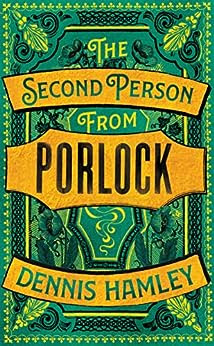
Guest feature by Dennis Hamley: THE SECOND PERSON FROM PORLOCK


"Each character, real or imaginary, had their own quest and I accompanied them on their journeys though the uneasy England of 1824. And I like to think I helped them find their destinations and their fulfilment."

Dennis Hamley has been writing for an unconscionably long time. His first book was published in 1962. Since then he's written more books than he can count, including The War and Freddy, Hare’s Choice, Spirit of the Place, Out of the Mouths of Babes, the six novels in the sequence of medieval mysteries The Long Journey of Joslin de Lay, Ellen’s People and Divided Loyalties. He says: "It's wonderful to see my Coleridge project in print at last, and published by Fairlight Books, based in Oxford where I live.  It came about when, after leaving hospital, I was visited by an ex-student of mine on the Oxford Creative Writing Diploma course - Louise Boland, a very good writer who had decided to set up as a small independent publisher specialising in literary fiction. That gave me the impetus to resurrect the project I'd been working on for years."

My interest in Samuel Taylor Coleridge merged into near-obsession at Cambridge, when my supervisor set our tutorial group an essay on STC’s theory of the imagination. This was in STC’s own college, Jesus. I loved this assignment, spent hours over it, found my understanding of literature changed utterly and received the supervisor’s comment ‘A noble effort’. Pleasing, but he omitted to say if it was actually any good. In 2002 a publisher, David Fickling, suggested I might write a novel about STC. So I did. It took me two years and he rejected it. And he was right. Incompetent and unreadable. So I got on with other things. But the resolve to write a proper novel about STC wouldn’t leave me. It took fifteen years for me to work out how to do it.

In 1972, a book called It’s a Don’s Life by Freddie Brittain, one-time fellow of Jesus (not to be confused with Mary Beard’s book) was published by Heinemann. Freddie mentioned a strange inscription in the first edition of Kubla Khan in the Old Library:

The writer of the above had much better have kept his sleeping thoughts to himself, for they are, if possible, worse than his waking ones.

It sounds damning. But perhaps it wasn’t. I needed someone to examine it closely. Who? A sizar, working as a library clerk, as had STC, perhaps?

My original failed novel depended on a what if? When in Sicily in 1804, Coleridge had a mysterious relationship with an opera singer, Anna-Cecilia Bertozzi. In 1808 he suddenly writes about her in his notebooks: ‘… her sincere vehemence of her attachment to me…Heaven forfend that I should call it Love.’

Back home, STC was in platonic love with Sara Hutchinson, the sister of Wordsworth’s wife, Mary. He called her ‘Asra’, to distinguish her from the other Saras, wife and daughter. And now, just in time, he sees ‘the heavenly vision’ of Asra’s face, ‘the guardian angel’ who saves him from the final temptation . I couldn’t resist thinking, ‘Yeah, right!’ What if STC had, unbeknown to him, left a son in Sicily and that son comes to England to find him?

So I had three main characters: one, STC, real; two fictional, George Scrivener, undergraduate who finds the Kubla inscription and works out its true significance, and Samuele Gambino, putative son in search of the truth. For George, an aspiring poet, the wish is that STC might be his mentor. Samuele needs to square his mother’s vision of genius with his teacher Mr Calvert’s of an opium-sodden wretch.

Perhaps the word ‘riff’ best describes what I was attempting. All facts would be accurate, but STC didn’t live by mere facts. We meet him with the line:

Samuel Taylor Coleridge had seen a ghost.

He was lodging with Dr Gilman and his wife on a sort of extended rehab. The ghost first appeares in Highgate High Street and then haunts him. Is this revenant the Second Person from Porlock? George Scrivener works out that there couldn’t even have been a first.

Mixing fictional and real characters is a risk worth taking. Samuele’s guide in his quest is Charles Lamb, who tells him who to visit and provides letters of introduction. So Samuele meetsTom Poole, STC’s friend in Nether Stowey, Wordsworth, Southey and, most important, STC’s brilliant daughter, Sara.

Once I had a structure in my mind, actually writing the book came relatively easily. Each character, real or imaginary, had their own quest and I accompanied them on their journeys though the uneasy England of 1824. And I like to think I helped them find their destinations and their fulfilment.

The Second Person from Porlock is published by Fairlight.  

‘With no discernible sleight of hand this master storyteller, with effortless assurance and prodigious skill, weaves his mighty spell and conjures before our very eyes all we will ever need to know about the most famous lines of poetry that English ever produced.’ — Robert Lipscombe, author of The Salamander Tree and The English Project


Monday, 26 November 2018

Guest review by Dennis Hamley: EILEEN by Ottessa Moshfegh, ELMET by Fiona Mozley and EVERYTHING UNDER by Daisy Johnson


Dennis Hamley has been writing for an unconscionably long time. His first book was published in 1962. Since then he has written more books than he can count, including The War and Freddy, Hare’s Choice, Spirit of the Place, Out of the Mouths of Babes, the six novels in the sequence of medieval mysteries The Long Journey of Joslin de Lay, Ellen’s People and Divided Loyalties. He now writes mainly as an independent author, with his own imprint, Joslin Books. The Joslin de Lay sequence is about to be republished in paperback.

He is at present writing, with painful slowness, a novel which has found a different publisher, The Second Person from Porlock, a sort of riff on the life of Samuel Taylor Coleridge.


Writers in Oxford, of which I am a member, have an annual Not the Booker evening in which members of the panel each introduce a shortlisted novel, comment on, praise or traduce it, estimate its chances and then rush home to put on the TV and find out if they were right. I’ve been on the panel for the last three years. I’ve been wrong for all of them.

For this review I had intended to deal only with Elmet by Fiona Mozley, about which I spoke - enthusiastically favourably, to the evident annoyance of some among the audience – last year. This year I introduced Daisy Johnson’s Everything Under. However Elmet was still reverberating round my mind when I started to write this review. And this made me think back to 2016, when my book was Ottessa Moshfegh’s Eileen. Suddenly all three seemed to mesh together.

The book choices panel members make are entirely arbitrary: it’s first come, first served so there was no suggestion that I was looking for a pattern. But suddenly, I was finding unexpected connections, common themes, similar relationships in these novels. God knows I’m not suggesting any form of plagiarism: here are three astonishingly original works offering experiences uniquely different from anything I have read before, written by authors who, I believe, can truly be called brilliant. I even began to wonder if I had accidentally hit upon a new genre. 


First of all, Eileen. Eileen is the narrator and she tells us straight away what the novel is about. ‘This is the story about how I disappeared.’ She lives in New England, in a town so featureless that it is referred to throughout as ‘X-ville’. She has a deranged alcoholic ex-cop father who fears that even the slightest noise means a hoodlum is about to burst in. Eileen works days in a young boys’ prison and spends her nights driving aimlessly, except for shoplifting, round X-ville in her father’s old Dodge. She secretly lusts after a prison guard, a passion which eats her up but of which he is completely unaware. And she pulls no punches about herself: this is a novel about self-loathing.

The first part of this novel is set in 1964 when Eileen is in about as dreadful and repellent a situation as you could imagine. Yet this is superb writing: magnificently controlled and with a relieving level of black humour. And soon we gather that it is reminiscence, because as she writes she is now in her seventies and somehow has attained everything she could possibly dream of – wealth, a place in an elite society and a significant hint of personal history in that she never knew what good food was until she met her second husband. A disappearance indeed - and we are hustled on towards it with the knowledge that the main narrative takes place within one week.

So how does this peripeteia come about? A new counsellor, Rebecca, comes to the correctional facility. She is beautiful, confident, everything Eileen is not. Eileen is soon completely infatuated with her. This is not returned, but as a result, Eileen is drawn into a crime which compels her disappearance. An action which to say the least, is morally disputable leads to her abandoning the Dodge on the high road behind her with a compromising item left on board. She hitch-hikes to New York and whatever strange events she will undoubtedly meet there.

So the theme shows a horribly dysfunctional family situation between extremely disturbed people leading to an ambiguous escape. 


Enter Elmet. Fiona Mozley’s first novel drew much praise but much criticism as well. I felt it undeservedly ended up as the ugly duckling of the 1917 shortlist. The setting is about as far removed from X-ville as you can get. Elmet was the last of the old Celtic kingdoms, finally conquered by the Angles in the 7th century. It stretched across Yorkshire, from the Calder Valley eastwards to Selby. Ted Hughes lived in it, at Lumb Bank, near Hebden Bridge, and wrote a cycle of poems about it in his Remains of Elmet. For centuries it had the reputation of being a refuge of lawlessness, crime and outrage, where normal rules did not apply. In Mozley’s Elmet it still has. A wild land which plays by its own rules.

Fiona Mozley’s unsettling, gothic and very noir novel is set in the present day. Yet it still seems to be acted out in the Middle Ages, even though Elmet’s eastern boundary is the East Coast main line, which becomes the symbol of escape (quick complaint – the Pendolino, the tilting train, only runs on the West Coast main line because of the curves round Shap, and never on the much straighter ex-LNER route. I do wish authors would get railway facts straight). Once again, a dysfunctional family tries to survive, by twisting reality to its own ends. Cathy and Daniel are brother and sister looking after their Daddy, cossetting him, cutting his hair and seeing he is comfortable, not out of fear but fierce caring love. ‘Daddy’ though, is entirely the wrong title for this fearful, strong law unto himself. He is a bare-knuckle boxer, part of an underground sport controlled by rapacious landowners. Because he is the best of all local fighters, they use him as a sort of gambling cash cow.

But Daddy and his family are playing a dangerous game hidden just beneath Elmet law – which is a sort of home-made shariah controlled by the landowners. The family lives in a house Daddy built with filched materials on ground which was not his. They live a primitive life very close to nature, of foraging and hunting. For the long periods when Daddy is away fighting, Cathy and Danny have to fend for themselves, which they do effectively. Cathy, the elder is a strong character who takes charge and Danny accepts her authority.

But this arrangement is frail. Daddy is not the fighting pawn that the landowners hope he is. He has broken the tyranny of their private legal system and the relationship must break as result. There is a conclusion of harsh, even appalling, certainly tragic, violence which, in retrospect, is inevitable from the outset of the novel. And as a result, the frail equilibrium on which the lives of Danny and Cathy has been based is broken irretrievably.

So, is the conclusion nihilistic or a sign of hope? Unlike as in Eileen, there is no suggestion of a more contented life as a result. Danny is making his escape from Elmet alone. He is looking for Cathy, who has disappeared. His only way out is the railway. Has she gone north or south? He makes a guess and starts the long trek along the tracks towards York. Another dysfunctional family, another unlooked for but inevitable crisis and another ambiguous escape. 


And so to Daisy Johnson’s Everything Under. I have to say that in the end, although I found it the most challenging of the three to read, I also found it the most satisfying, although for a large part of the novel, especially at the beginning, I didn’t know what the hell was going on. I had already picked up from the pre-publicity that it was a retelling of Oedipus Rex but for at least half of her novel I was thinking ‘well, you could have fooled me.’ But by about page 100 I was suddenly clear about it. It is a sort of transgender version and I realised what it was that had obscured it for me.

This novel is a stylistic tour-de-force. I love the word ‘liminal’ but I don’t think I completely knew what it meant until I read Everything Under. The setting, as it is with the other two novels, is more or less identifiable. It is near Oxford, partly on the Isis, partly on the canal. Everybody lives on boats and, as the main character is a lexicographer working on a dictionary, it must be somewhere within commuting distance of OUP. But there’s never going to be an Everything Under tour of the city and its surrounding waterways. Once again, we have a separate ‘other’ reality in which normal rules do not apply.

Even so, Everything Under is a brilliant title. To me the whole distillation of reality was somehow misty, elusive, as if all seen from ‘under water’. Actuality was, as it were, refracted. Meanings, events, and motivations were presented obliquely: the reader constantly has to work hard. Many might not have the patience. But those who have will get a really rewarding experience. The novel’s idiom is flowing and seductive and yet it is needle-sharp in transmitting the significance of actions and consequences and I found it almost mesmerising.

Gretel works as a lexicographer because her early life with her mother on board a houseboat was close, exclusive and led to the development of a private language, with words such as ‘harpiedoodle’ and ‘effing’. Is lexicography a connection with the ‘real’ world? Certainly it’s almost the only feature of the novel which is not liminal. But her mother disappears and Gretel spends years looking for her, until she receives information that she has been found and goes to check. Yes, this has been a dysfunctional relationship, but the full extent of this dysfunction only appears gradually and there is still a long way to go.

Meanwhile other characters not so much drift as materialise into the story, for example Margot, who later resurfaces as Marcus, Charlie, Fiona the transgender medium who, like Tiresias, ‘old man with wrinkled dugs’ in the play by Sophocles, gives a terrible warning. They seem to appear and disappear in a strange dance, into which the underlying Oedipus retelling – which in the end is complete and satisfying in the sense that we recognise how well, though strangely, it has worked – is fulfilled.

And below it all lurks the ‘bonak’, a mythical entity – spirit or monster? - which lurks under water and is responsible, so they say, for all the misfortunes which befall the river and canal folk. Although at the end it appears to have been caught, cooked and eaten and its gamey flesh seems to be rather enjoyed.

The salient Sophoclean features – the abandonment, the patricide and the incestuous sex – appear almost incidentally, almost, as in Horatio’s words, ‘casual slaughters’, and this is of a piece with the ruling liminality. But as I closed the book I felt that I had read something with a wonderful structure, a real sense of form, because, though the story could reach out beyond itself with further consequences, they were not part of it. There was no more to say. I had a real feeling of completeness.

I was pleased that, at the end of our Booker evening, the audience decided that Everything Under was the book they most wanted to read. Nothing to do with my presentation. It’s just that, of these three remarkable books which share strangely similar themes and structures, this was, to me, the best and I feel sad that it did not win the 2018 Man Booker prize.

Eileen is published by Vintage.
Elmet is published by John Murray.
Everything Under is published by Vintage.