Showing posts with label childhood. Show all posts

Monday, 24 May 2021

Guest review by Lesli Wilson: FROM SPARE OOM TO WAR DROBE by Katherine Langrish


"Imagine revisiting a magical place you loved as a child, a place that engrossed you so much that you had to revisit it again and again..."

Lesli Wilson is the author of two novels for adults and two for young adults. Last Train from Kummersdorf was shortlisted for the Guardian Children's Fiction Prize and the Branford Boase Award; Saving Rafael was nominated for the Carnegie Medal and Highly Commended for the Southern Schools Book Award. Both deal with Nazi Germany. Lesli Wilson is half German, was brought up bilingual, and has spent considerable amounts of time in Germany. She is currently working on a novel for adults, set in the very early nineteenth century.

It is a very risky business to write about such a much-loved children's book series (to say nothing of films, but I like the books way better) as C.S. Lewis's Narnia books. I used to think I was the only child who ever walked hopefully into wardrobes (I chose my grandmother's rather small one, which did, however, have a moth-bally fur coat in it). Of course I wasn't alone. Katherine Langrish was one, for a start. I should think many thousands of kids did. Langrish also wrote her own Narnia stories, based on the stories that Jewel the Unicorn tells Eustace and Jill in the dying days of that world. She was trying to create more magic, but discovered that the hard work of writing made that difficult. This is a different way in, and whether she recreated the magic for herself, she certainly succeeds for the reader of her book.

Imagine revisiting a magical place you loved as a child, a place that engrossed you so much that you had to revisit it again and again, and even when you went back as an adult the enchantment still gripped you, almost in spite of yourself. Now imagine that you go there with a guide, a guide who has always found it as exciting and enchanting as you did, who is able, not just to walk you back along those old paths of thrilled delight and sadness, mountains, forests, seascapes, but who has extra information you didn't have when you went there - but whose information increases your understanding without threatening to spoil the magic; explains without explaining away.That's how I felt when I was reading From Spare Oom to War Drobe.

Langrish shows us the roots of many of the stories' motifs. The green serpent-witch who abducts Prince Rilian is rooted in the Lindwurm dragons of Norse (and Germanic, incidentally) legend and North of England folk songs, but also in the 'Dame of the fine green kirtle' in a Scottish fairy tale. Aslan's How, in Prince Caspian, so much resembles a Neolithic passage-grave in Ireland, that Langrish reckons Lewis must have known of it, if he didn't visit it (Lewis being a Northern Irishman, born in Belfast). Langrish is well-versed in a wide range of folk tale, this being the theme of her Seven Miles of Steel Thistles blog, and the author of a previous book about myth and legend. In addition, she supplies the answer to something that has puzzled me for about 60 years: why it is important, in writing King Peter's challenge to King Miraz (Prince Caspian) to put an h in abhominable (ab homin in Latin, inhuman) Though maybe, I think, it is all too human to murder for a crown.

None of this destroys the wonder of the books. That it doesn't is partly due to Lewis's artistry; he used these themes and images and set them to work in his own story, in his own way. But what we learn from Spare Oom to War Drobe is how no story, of any kind, exists in a vaccuum. All of us who write are swimming in the sea of motif and poetry that has been washing around in the human psyche since language began and the first stories were told; before that, probably, for in the basement of the psyche, as in Jung's dream of descending there, which is recounted in the introduction to this book, there are images and moving objects that stem from pre-verbal times. I am not strictly speaking a Jungian, but I'm quite sure there is such a thing as the collective unconscious.

Langrish even refers to The Waste Land, in terms of the rich infiltration of other writings into Narnia. I would reference the Four Quartets myself, because that poem enchanted me from a very young age, when my parents got the record of Eliot reading it. But there's nothing self-consciously post-modern about Narnia.

We are also reminded of the genuine sadness that infuses the books, particularly when Digory, in The Magician's Nephew, asks Aslan for 'something that will cure Mother', and Aslan's answer is 'Grief is great.' Lewis lost his mother as a boy; when I read The Magician's Nephew, it wasn't very long after I had been taken to say goodbye to my mother in hospital, lying on the pillow, weak and white-faced, like the mother in that book. Luckily, my mother, like Mrs Kirke, did not die after all, but the resonance went to my heart; there are terrible things that adults, with the best will in the world, cannot protect children from. Children need books that boldly acknowledge the pain of that.

Of course the books have aspects that are repellent to modern readers. Langrish doesn't feel that the book is misogynistic, as some have claimed, pointing out that the initiative is often taken by female characters, in particular Lucy, but also the resourceful and skilful Jill. The portrayal of the Calormenes, however, is loathsome, and Langrish as an adult is repelled by it. As for the demonisation of progressive schools, pacifism, vegetarianism, and the glorification of corporal punishment as a means of developing character – well, it was a different age.

But I so agree with Langrish about the dreadful ending of The Last Battle. I read that book with a sense of mounting outrage – though now, reading her account of it, I can see the link between the confusion of truth and falsehood there and what we see going on in our own times. Like her, I hated the idea of a Narnia that was expanding, and the constant travel to a bigger Narnia – what was the point if you couldn't linger? And though I know more about neo-Platonism now than I did, I still think it has been far better described by Plato himself and theologians like the Quaker Isaac Penington. But I also disliked the way in which Aslan morphed into the He who was ubiquitous in church services. Langrish was a child brought up in conventional Christianity, but for her also Narnia was never an allegory of the Gospels. What she does point out is the disturbing parallel between the use of lies to gain power in that final book and the issues that trouble us nowadays.

I referred to the Four Quartets earlier; in its last stanzas Eliot writes that the end of all our exploring should be to arrive where we started and know that place for the first time. Reading this book took me back to the children in the apple tree, to the child I once was, (lying on my stomach and eating apples,like Polly in the attic, in The Magician's Nephew) and yes, it has helped me to understand so much more about that place than I did when I first went there.

 From Spare Oom to War Drobe: Travels in Narnia with my nine year-old self is published by Darton, Longman and Todd.

Katherine Langrish's Seven Miles of Steel Thistles is reviewed on this blog by Penny Dolan.


Monday, 10 May 2021

Guest review by Claire Cox: AN AWFULLY BIG ADVENTURE by Beryl Bainbridge


"It’s Bainbridge’s unrivalled ability to conjure this period of history, the scarred city of Liverpool, its social attitudes, its deeply traumatized, impoverished citizens, with such unerring detail and dark humour that makes this novel a dynamic and memorable read."

Born in Hong Kong, Claire Cox now lives and works in Oxfordshire. She has an M.A. in Creative Writing from Oxford Brookes University, where she won the Blackwell’s Prize for best student. She’s currently a part-time research student at Royal Holloway, studying poetry and disaster. Her poems have appeared in magazines, including
Ink Sweat & Tears, Magma, Lighthouse and Butcher’s Dog. She’s co-founder of ignitonpress, based at Oxford Brookes University’s Poetry Centre, and is an editor there. One of three winners of Primers: Volume Five (Nine Arches Press, 2020), Claire has also won the Alastair Reid Pamphlet Prize with A Book of Days (Wigtown Festival Company, 2020). She was project poet for the Clean Seas Odyssey voyage, 2018, investigating marine plastic pollution. Her article ‘Mourning the Present: Towards a Quantum Elegy’ was published in Exclamat!ion: An Interdisciplinary Journal (Volume 4, 2020).

Set in post-war Liverpool, this sharply-observed novel follows the intrigues of a down-at-heel repertory theatre company in the lead up to their Christmas production of Peter Pan. Told through the eyes of Stella, the teenage assistant stage manager, Bainbridge cleverly counterpoints Stella’s feisty naivety with the seedy sexual misconduct that’s rife within the troupe, and which unfolds with tragic consequences. Stella, brought up in a boarding house by her concerned Uncle Vernon and Aunt Lily, is finally confronted by her own troubled childhood in unexpected and devastating ways.

In a counterpoint to the plot, the whereabouts of Stella’s absent mother is intriguingly handled, as is the fraught mother-daughter relationship. Here, Bainbridge sows the seeds of an underplayed, but deeply emotional element in what is, otherwise, a searingly unsentimental portrayal of humanity’s pettinesses and vanity.

The cast of characters is extensive and deftly drawn. Banbridge has a knack of picking exactly the right telling details to describe her creations in a way that gives them substance and vibrancy. Even the incidental characters offer a richness of texture and serve to underscore the impoverished, slightly sinister mood of the novel, from the young woman wearing a man’s jacket over ‘a gaudy satin slip streaked at the hem with blood’, and the ‘boy with ringworm throwing stones at a cat on a wall’, to the chap in a duffle coat ‘who wore a monocle and flashed a sardonic smile as though he were a member of the SS’.

The description of Stella’s decision to take an impromptu bath sums up Banbridge’s thoroughness in evoking this period of history, one imbued, more likely than not, by her own experiences of post-war Liverpool: paraffin from the chandler’s shop has to be fetched for the stove, which in turn needs to be lugged up two flights of stairs to the bathroom, and a blanket nailed to the window. The view from the bathroom smacks of veritas: ‘a bombed house with the wallpaper hanging in shreds from the chimney-breast’. This description is followed, of course, by another darkly appropriate observation, as here in the back alley ‘sometimes women, no better than they ought to be, lured men into the ruined shadows.’

This acute sense of place continues elsewhere in the novel with finely drawn glimpses of the cityscape. Again, in these descriptions nothing is unsullied. Even symbols of hope or redemption become tarnished: ‘the unfinished transept of the rose-pink cathedral smudged the high white sky.’ These moments work as a backdrop, offering a distant perspective against which the busy entanglements of the protagonists play out. In this respect, Bainbridge is creating a drama within a drama; the performance is one of our foolish mistakes set against the stark scenery of a ravaged world. And the further her plot develops, the more apparent becomes the inexorability of fate, the consequences of tainted actions across the generations that are the life-blood of the Greek tragedies of Aeschylus and Sophocles. As with these ancient stories, the costs are inescapable and unflinchingly told.

Ultimately, though, it’s Bainbridge’s unrivalled ability to conjure this period of history, the scarred city of Liverpool, its social attitudes, its deeply traumatized, impoverished citizens, with such unerring detail and dark humour that makes this novel a dynamic and memorable read.

An Awfully Big Adventure is published by Abacus.


Monday, 26 April 2021

Guest review by Jon Appleton: LONELY CASTLE IN THE MIRROR by Mizuki Tsujimura, translated by Philip Gabriel


"Originally published in Japan in 2017 where it won prizes and became a bestseller. Its prize-worthiness isn’t in question as you read..."

Jon Appleton
is a freelance writer and editor based in London.


A number of reviewers of this parish have connections to the children’s book world but we don’t generally review books for young readers here. Today I’m reviewing a novel about children.

Lonely Castle in the Mirror was originally published in Japan in 2017 where it won prizes and became a bestseller. Its prize-worthiness isn’t in question as you read but perhaps it’s only when you reach the poignant Publisher’s Note, written for the English-language translation, at the very end that its popularity is explained.

The story is told mostly from the perspective of Year 8 student Kokoro, whom we learn early is bullied so relentlessly at school that she stops going, even finding herself unable to begin again at the new school her sympathetic parents and former teacher have found her. She is confined to spending the hours of 9 to 5 each weekday alone trapped in her bedroom.

That is until a strange effect in her bedroom mirror transports her to another dimension, into a many-roomed castle where she meets six other children – of course there are seven children altogether; all the tropes of traditional tales were here – who have also found formal education untenable. They are set a year-long challenge by the sinister girl in a wolf mask who calls herself the Wolf Queen.

‘You are all lost Little Red Riding Hoods,’ the Wolf Queen said. ‘From now until next March, you will need to search for the key that will unlock the Wishing Room. The person who finds it will have the right to enter and their wish will be granted.’

But this privilege comes at the expense of others’ ambition and safety. And in other ways, too, the world of the castle is no more kind or democratic than life in the classroom. There are rules to obey – and rules that unexpectedly change – and soon routines form. The children can enter and leave the castle as long as they do so within the hours of 9 to 5. But they can’t abandon the tensions and rivalries of adolescence. You might think they’ve forfeited one classroom for another.

Allusions to children’s literature abound – from Hans Christian Andersen to anime, via Harry Potter and The Chronicles of Narnia – which give the story a kind of timelessness, but this is not a dreamy, reflective novel. Each chapter spans a month in the characters’ year-long challenge and I felt propelled through the story by a kind of bruising inertia. However, its intricate plotting and attention to detail give the novel a necessary tenderness too. The depiction of Japanese society, its culture and philosophies add huge interest for those of us reading the attentive translation.

A new novel that reminded me of I’m the King of the Castle by Susan Hill and Penelope Farmer’s A Castle of Bone, Lonely Castle in the Sky will no doubt conjure other novels in readers’ mind but will be memorable for its own unsettling power.

Lonely Castle in the Mirror is published by Doubleday.

Jon is a regular reviewer here with a knack for finding great new reads as well as older publications you may have missed. Here are more of his pieces:


Memorial by Bryan Washington

Shuggie Bain by Douglas Stewart

The Dutch House by Ann Patchett

The Biscuit Factory Girls by Elsie Mason

An Honest Man by Ben Fergusson

Clock Dance by Anne Tyler

Carnivore by Jonathan Lyon

Commonwealth by Ann Patchett

- and Jon's own novel, Ready to Love, is reviewed here by Sophie Masson:


Monday, 18 January 2021

Guest review by Jon Appleton: SHUGGIE BAIN by Douglas Stewart


"This is a book full of heart ..."

Jon Appleton is a freelance writer and editor based in London.

‘She’d looked as happy as he could ever remember, and he was surprised how this hurt. It was all for the red-headed man. He had done what Shuggie had been unable to do.’

These devastating lines come halfway through Douglas Stewart’s debut novel, the deserved winner of the 2020 Booker Prize. ‘He’ is Agnes Bain’s youngest child, Hugh, known as Shuggie after his father.

The ‘red-headed man’ is Eugene, a self-interested, lonely widower who courts Shuggie’s mother Agnes and who is yet another person – specifically, a man – who ruins her. First there was her father, years earlier, who bitterly came to regret indulging his daughter, as do both her husbands. Yet Agnes’s beauty is compelling and irresistible; it also seems inviolable, enduring even when the demon drink impairs her capacity for everyday living, and in spite of the heckles and put-downs from the neighbourhood gossips on the bleak housing estate flanked on one side by the abandoned colliery and marshland on the other. In Thatcher’s 1980s Glasgow, Agnes is constantly condemned for daring to have pride in circumstances which are patently denigrating.

Shuggie, needing beauty himself, is fuelled by Agnes’s vitality. But it’s a thin fuel; one character observes of the boy at eight: ‘he had grown taller but he had also sunk somehow, like bread dough stretched much too thin. She could see he had slid deeper into himself and become more watchful and guarded. He was nearly eight now, and often he could seem so much older.’

Both Agnes and Shuggie accept the need to be normal in order to fit in but neither can manage it – mother and son form an unspoken pact to stay together even when everyone else abandons them. Agnes’s parents die, the husbands detach themselves (Agnes left her first husband but he soon stopped contact with his children; Shug Bain moves the family out of town and leaves them there), her elder children leave – first Catherine, who escapes to South Africa with her new husband, then finally Leek can endure no more and makes his own life in another part of town. But Shuggie remains. He would do anything for her.

Despite the title, Shuggie Bain is more Agnes’s story. Or perhaps there’s more to say of her because Shuggie, who is six at the beginning and in his mid-teens at the end, sees much but understands or concedes very little, remaining ‘watchful and guarded’. He keeps his precocity, and his sexuality, close to his chest, and is a quiet but potent presence in this story. In a strange way, the reader is protected from enduring an impossibly harrowing narrative.

Douglas Stuart writes with a light, lyrical touch that is not without humour. He includes a smattering of Glasgow dialect but there’s a power that transcends word choice and placement. This is a book full of heart. For all that the Scottish literary world is rightfully proud of Stuart’s achievement, he has spent most of his adult life in America and it felt like a sweeping American novel rather than a British one. Or perhaps it’s an ex-pat’s novel, addressing what’s been left behind but also carried with him.

I also think it’s like a prequel – the making of the man – because only at the very end, in the final paragraph, does Shuggie feel safe enough to outwardly display his real self. Shuggie Bain is apparently autobiographical, but it is fiction. I left it wondering where Shuggie is now, feeling hopeful.

Shuggie Bain is published by Picador.

See more reviews by Jon:

The Dutch House by Ann Patchett


An Honest Man by Ben Fergusson

Clock Dance by Anne Tyler

Carnivore by Jonathan Lyon

Commonwealth by Ann Patchett


Monday, 30 November 2020

Guest review by Cindy Jefferies: LANNY by Max Porter


"A story that seems as if it has uncurled from some unknown place ..."

First published in 2001 for children, Cindy Jefferies found success with her Fame School series with Usborne Books, obtaining 22 foreign rights deals. Latterly writing fiction for adults as Cynthia Jefferies, her first title The Outrageous Fortune of Abel Morgan was published in November 2018. Her second title The Honourable Life of Thomas Chayne, set during the English Civil Wars, was published last year and is now in paperback.

Lanny is a young boy, a newcomer in an ancient village that has been through many changes over the centuries. It is something of a dormitory for his father, who works in finance in London.. It has the usual cross hatching of residents, with all their habits, likings and suspicions. The village is also home to Dead Papa Toothwort, the ancient something or someone that has woken from a long sleep. He inhabits what he choses, from the gnarling of an old gate to a rusty ring pull and can make mischief, cause mayhem, if he chooses.

The story is of a short period during Lanny’s life in the village. His conversations with the elderly, once famous artist known as Mad Pete are masterfully drawn in words by Porter, small perfect sketches of their burgeoning friendship. Lanny is an unusual boy, with a deep connection to some things that others don’t see as important, or even sensible. I particularly liked his message put in a plastic bag and buried with the seed potatoes, to be revealed when they are harvested. How I would love to receive such a message!

Dead Papa Toothwort likes to listen to what is being said in the village. He lurks, and the phrases he hears are scattered in italics, bending and slithering around the page, as if drifting from letterboxes, chimneys or from the bus queue. He is not entirely, or even mostly, nice, but then he has seen a lot over the centuries.

What happens is shocking, but also seems inevitable, and Dead Papa Toothwort holds a mirror up to the three people who love Lanny the most. Is he restrained in his actions by perhaps the only adult who understands at least something of him?

This is a beautiful book. I hesitate to call it a novel, although of course it is, in both senses of the word. It is a crafted thing, and also a story that seems as if it has uncurled from some unknown place. It is a small gem of 210 pages which has won a place on my shelf to be talked about, lent, and read again. In my opinion, one can’t say fairer than that. And if you get a chance to hear Max Porter read from Lanny, don’t miss it. You won’t regret it for a moment.

Lanny is published by Faber.

See also Max Porter's Grief is the Thing with Feathers, reviewed by Miriam Moss

Monday, 22 July 2019

THIRD ANNIVERSARY POST No.1 by guest Jill Paton Walsh: SCENES FROM A CHILDHOOD by Jon Fosse, translated by Damion Searls

Photograph by Julia Hedgecoe

"What an extraordinary writer Jon Fosse is!"

Jill Paton Walsh has been a professional author since 1966.  She has written for children of many ages, from toddlers to teenagers,  has written five literary novels and more recently four detective stories with her own detective. She has also been pursuing the cast of characters in Dorothy L Sayers' famous Lord Peter Wimsey stories into their later adult lives.

She has lectured extensively about children's literature, predominantly in the United States, where her children's books have won several major prizes.  In the UK one of her adult novels, Knowledge of Angels, was a near miss for the 1994 Man Booker prize. 

She is that odd person – an Oxford graduate happily resident in Cambridge.  


My grand-daughter Catherine has grown up in Australia, so I have not seen very much of her during her childhood. She was rather sporty and talkative and not much interested in reading. Now she is in England for her gap year, and is visiting me regularly in Cambridge. Of course she has changed in many ways, but the most striking to me is that for her Heffer’s is the central sanctum of the city.

She is suddenly reading voraciously and buying books with all her spare cash.

With the excuse that she wants to know what I think of this author and that, she is controlling my own reading, concentrating on titles like Normal People by Sally Rooney, which I managed to read half way through… but at 82 I quickly found that teenaged sex was not fascinating for me.

However, she recently demanded that I read a book by a writer I must confess I had never heard of - Scenes from a Childhood  by Jon Fosse, translated from Norwegian by Damian Searles, and published by Fitzcarraldo Editions.

This is a collection of short stories of a strange and fragmented kind. When Catherine mentioned it to me I thought first of Schumann, and then inaccurately of Chekhov. But I was quickly very intrigued by the copy Catherine bought for me.

Jon Fosse is, as one begins to read his stories, almost impossibly artless. The scenes from childhood are raw fragments of recollection, about as coherent as fragments of china lying broken on a floor. They are not arranged, nor threaded together at all - not in any sense I at first recognised as narrated - almost literally artless. Everything is in the present tense. It is not of course particularly original to write in the present tense - nor to write a narrative imitating strains of thought - that goes back at least as far as Dorothy Richardson. I have attempted narrative in the continuous present myself, hoping to capture the immediacy of experience, and awareness of the physical context in every remembered event of one’s life.

But I have never before encountered a work of literature in which total realism, including realistic representation of the fragmented nature of recollection is being carefully employed. It is not even evident if the fragments of disconnected events are in any kind of order. It is like looking at a jigsaw puzzle with the pieces laid out helter-skelter on a table, none of them yet fitted together.

Very gradually a broken picture emerges of growing up in Norway - of family and friends, and any episode in which the narrator hurt himself and bled. That sounds harrowing, and it is - but it casts a deep light of joy on fragments of remembered moments of happiness. It is completely convincing, in the way it might be if someone were telling you what happened when they fell in the river, or broke a limb or some other traumatic or puzzling event, recalled, not understood, and recounted without any art or interpretation at all. Now and then what is remembered, is a later memory of an earlier one, still unvarnished, and unstructured.

Of course there is in a way a narrative voice; and this narrator conveys with startling and moving clarity the experience of not understanding the adult world around him.

This book ought to be depressing, so bleak and without order is the narrative; but in fact it is exhilarating to be reminded what the world is really like to innocent eyes, when the pieces don’t fit together, and understanding is not yet achieved.

Of course one result of reading the book is to feel that meaning and understanding are undercut, they are shown to be a construct. What we truly experience is not coherence…. and the fragmented pieces are mesmerising….

What an extraordinary writer Jon Fosse is! I did not expect, at my age to be offered a new view of the world, nor to find, at last, a common vision with my grand-daughter.

Scenes from a Childhood, translated by Damion Searls, is published by Fitzcarraldo Editions.


Monday, 28 January 2019

Independent Bookseller feature No.4: Rachel Phipps of THE WOODSTOCK BOOKSHOP chooses FAMILY LEXICON by Natalia Ginzburg


"I was hooked from the first page, not just engrossed but totally in love with the book in a way that rarely happens."

  • Rachel Phipps: My first job was at a bookshop, the tiny and wonderful Walrus Books in Burford, run by Katherine Watson who was possibly the best-read person I have ever met. She knew everything, it seemed to me. She had a shelf that she called ‘Ladies’ Light Reading’ that was very popular with the ladies of Burford, and a large poetry section. I worked there during my holidays when I was at school and longed to have a similar shop one day. After my English degree – during which I became slightly better read but still not in Katherine Watson’s league - I worked at Sandoe’s in London, then at Penguin, had periods as a teacher and proof reader and, six children later, opened The Woodstock Bookshop in 2008 (Katherine sadly died just after I opened the shop so she never saw it but I hope she might have approved). We held regular readings in Woodstock for the first few years, and started the annual Woodstock Poetry Festival seven years ago which has featured most of the best poets now writing in Britain. For a full account of the shop and our talks, have a look at our website.
I first came across Family Lexicon when it was published by nyrb editions in 2017 in a translation by Jenny McPhee. I was hooked from the first page, not just engrossed but totally in love with the book in a way that rarely happens. I read it slowly, unwilling for it to end, wanting to stay in that world for as long as possible. When I finished it I turned back to the first page and started again. Partly I loved it because the father in it reminded me of my own father, who died far too young at the age I am now, over thirty years ago. He, too, shouted and bullied and loved and was loved, was a larger than life person who demanded the impossible from those around him but was adored by his children. I also loved the book because of the author's voice. I felt I could listen to her for a very long time.

Family Lexicon is autobiography written as a novel. As Ginzburg says in her Preface, 'Even though the story is real, I think one should read it as if it were a novel, and therefore not demand of it any more or less than a novel can offer.' She wrote the book in the early 1960s when she was living in London, far from her family. She had already written several novels by the time it was published in 1963 and it was a huge success, selling half a million copies and winning the Strega, Italy's most important literary prize. It is the story of her family and her upbringing, written in very colloquial Italian, catching a vanished world.

''My parents had five children. We now live in different cities, some of us in foreign countries, and we don't write to each other often. When we do meet up we can be indifferent or distracted. But for us it takes just one word. It takes one word, one sentence, one of the old ones from our childhood, heard and repeated countless times. All it takes is for one of us to say 'We haven't come to Bergamo on a military campaign', or 'Sulphuric acid stinks of fart', and we immediately fall back into our old relationships, our childhood, our youth, all inextricably linked to those words and phrases. If my siblings and I were to find ourselves in a dark cave or among millions of people, just one of those phrases or words would immediately allow us to recognise each other. Those phrases are our Latin, the dictionary of our past, they're like Egyptian or Assyro-Babylonian hieroglyphics, evidence of a vital core that has ceased to exist but that lives on in its texts, saved from the fury of the waters, the corrosion of time. Those phrases are the basis of our family unity and will persist as long as we are in the world, re-created and revived in disparate places on the earth whenever one of us says, 'Most eminent Signor Lipmann', and we immediately hear my father's impatient voice ringing in our ears: 'Enough of that story! I've heard it far too many times already!''

The voice in which she tells the story is very distinctive, at first almost the voice of the young child she is at the start of the novel but then changing gradually as she moves through the years and grows older. Natalia herself remains largely unknown, but her parents and brothers and sisters, theirs friends, her husband, all the vanished people of a world that no longer exists, are vividly alive through their words and her memories of them. It is a love song to family, to the people who make us and are special because they are our people. It is very funny at times and very sad at others, and I have urged everyone who comes in to the shop to read it – as I now urge you.

Family Lexicon is published by Daunt Books.

Monday, 12 March 2018

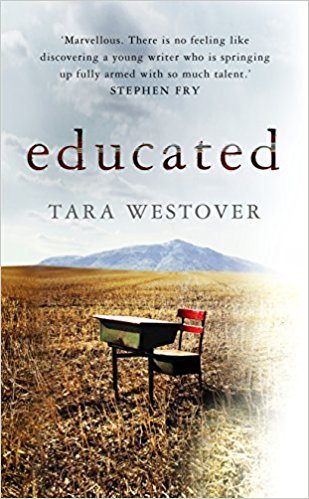
EDUCATED reviewed by Adele Geras


Adele Geras has written many books for children and young adults and six novels for adults, the latest of which is Love or Nearest Offer, published by Quercus in paperback. She’s working on a historical novel for adults. She lives in Cambridge.

The cover of Tara Westover's Educated  is striking. The passage quoted on the back of the book tells you something of what this memoir is about: the author's journey from Idaho to a PhD from Cambridge, a path strewn with astonishing descriptions of life in her extraordinary family. It also demonstrates some of the power of Westover's writing style: plain, sinewy and elegant, all at once. 

You couldn't make it up... that's what people say when what they've read or seen takes them aback to such an extent that they find it an effort to (in another popular form of words) get their heads round it.

I read Educated about two months ago and I'm still thinking about it. It's been universally praised. I predict that it will be on every shortlist it can possibly be on. It will be passed from one friend to another and anyone who reads it will come away moved, touched, horrified and above all knocked sideways by Westover's gift for telling her story in such a powerful and resonant way. She writes most beautifully, with a gift for conveying at the same time the terrible, violent, abusive things that attended her childhood and family life and at the same time, the tenacity of the bonds she feels binding her to her parents and siblings.

She sees them clearly as they are: a man and a woman adhering to a Survivalist Mormon belief so powerful and paranoid that the children are unregistered with school or any other government agency and have spent their entire lives working in their father's scrapyard (with no Health or Safety supervision) or, in the case of the girls, helping with their mother's herbal remedies for family and neighbours. Westover's mother is a self-taught midwife and in thrall to her narcissistic and overbearing husband. Some of her siblings are more sympathetic than others, and one brother is a brutal abuser. The physical harm described in the book is startling and deeply shocking. If this were fiction (you couldn't make it up) your editor would say: you can't put that in your novel. No one would believe it. But it did happen to Westover and how she escaped her family and gained a brilliant PhD from Cambridge University can be seen as an (again, scarcely believable) happy ending.

But Cambridge is not unalloyed bliss. Tara Westover has suffered greatly and hasn't been in contact with most of her family for years.

I finished this book full of admiration for its courageous and hugely talented writer and I hope very much that she finds happiness in her life from now on. I can't wait to read her next book, whatever it turns out to be, and I can safely say that if you start reading Educated, you will not be able to put it down. And you certainly won't be able to forget it.

Educated is published by Hutchinson.

Monday, 26 February 2018

Guest review by Nicola Davies: GROWING PAINS: MAKING SENSE OF CHILDHOOD: A PSYCHIATRIST'S STORY, by Dr Mike Shooter


"For me, and I think for others who write for children, perhaps the greatest inspiration in Growing Pains is in the power and value of story itself."


Nicola Davies is the author of more than 50 books for children, fiction, non fiction and poetry. Her work has been published in more than 10 different languages and has won major awards in the UK, US, France, Italy and Germany. Nicola trained as a zoologist and her work focuses on nature and human relationships with the natural world. She has been a senior lecturer in Creative Writing, and now regularly runs workshops for children and adults to help them find their voices as writers and advocates for nature. She was the first recipient of the SLA’s award for Outstanding Contribution to Children’s Non Fiction in 2017 and in 2018 has four picture books longlisted for the Kate Greenaway Award.

Mike Shooter has been helping children and young people through every kind of crisis, from the ordinary wear and tear of family life, to some of the most horrific experiences that human beings can endure, for all of the four decades of his professional life.But this book, drawn directly from his difficult and demanding clinical practice, is not the voice of the arrogant practitioner handing down pills and judgment from a place of safety: Mike Shooter has battled against depression, and knows about mental health problems from the bottom up. This personal experience, plus a healthy scepticism about received wisdom, has informed his work and made him into an extraordinary listener. Listening to what children say about their lives has been the heart and soul of his work. The stories that he has heard and the insights he’s gained, are retold in Growing Pains with a clarity and honesty that is moving and powerful. It is also at times disturbing - not always because of the nature and magnitude of the mental health problems, but because of their mismanagement through poor practice in the NHS and society as a whole. Dr Shooter isn’t a sensationalist, but he doesn't mince words about the fact that the UK has one of the poorest records of child and adolescent mental health in the developed world: a culture increasing focussed on a narrow vision of success and a health service run by and for bean counters.

These are, of course, not all stories with happy endings, but they are inspiring at many levels. First there’s the ability of humans to heal, not just themselves but their relationships: adolescents apparently hell bent of a path of self destruction find better ways to express anger and frustration; parents and children living like enemies in a war zone build bonds of love and support. Then there’s the way that children can make brave and powerful decisions about their lives, their bodies and even their own deaths, when adults include them in all conversations, even the most difficult.

For me, and I think for others who write for children, perhaps the greatest inspiration in Growing Pains is in the power and value of story itself. Symbols and metaphors help children and young people to understand their own lives: the disturbed adolescent finds the root of his unhappiness when the broken heart of a Russian doll reminds him of his dead twin; the little boy who acknowledges the loss of his father and the fact that life goes on through the way the snowflakes settle in snow globe. Growing Pains has re-inspired me to go on trying to write stories that reflect children’s real experience in all its difficulty and to find the comfort and magic that can lie in the heart of the most traumatic situations

Growing Pains is published by Hodder and Stoughton.

Monday, 21 August 2017

Guest review by Ann Turnbull: BLACK COUNTRY by Liz Berry


Ann Turnbull writes stories for young people of all ages. Her young adult novel No Shame, No Fear was shortlisted for both the Guardian and Whitbread awards. Since the 1970s Ann has lived a mere twenty miles or so north-west of the Black Country, so its accent is familiar – but her own accent remains stubbornly south-east London.

I came upon Liz Berry’s work by chance while writing a historical novel set in the Black Country. I was searching online for a book about the local dialect, and among the phrase books was Liz Berry’s book of poems. Poetry sounded like a more enjoyable way of getting the feel of the dialect so, by a happy chance, I bought that instead.

In the end, hardly any dialect found its way into my novel, but this book awakened in me a renewed interest and enthusiasm for poetry. I became immersed in these poems, loved them, and read them over and over again.

Black Country is a celebration of the region – its people, their work, their landscape and history. Like Liz Berry, I believe that the voices of ordinary people – those strong, resonant voices – should be celebrated. They carry, as folk songs do, the stories of working people’s lives and history. So here are the canals (‘cuts’), nail-making and chain-making industries, pits, pubs, food – and here is the authentic voice of the people:

“bibble, fittle, tay, wum,
vowels ferrous as nails, consonants
you could lick the coal from.”

There’s the world of work:

“Nailing was wenches’ werk.
Give a girl of eight an anvil and a little ommer
and by God er’d swing it,
batter the glowing iron into tidy spikes…”

And, when work was done, there were the pigeons beloved of colliers

“whose onds grew soft as feathers
just to touch you, cradle you from egg
through each jeth-defying tumble.”

There are sensual, lyrical poems about love and sex, funny poems, dark ghostly tales, poems based on family letters and stories. This is a collection of great variety – of ideas, and of styles and rhythms, with depths and subtleties that become apparent on re-reading. There is a beautiful precision in the use of language. On Christmas Eve the Black Country is ‘tinselled by sleet’ which ‘fattens and softens to snow’; a teacher ‘unhooked a high window on a stuffy day/and heard the room’s breath’; pigeons fly ‘jimmucking the breeze’.

The collection carries throughout the theme of a girl growing up and leaving home, and the imagery of birds is used to describe her awakening to adult life, love, sensuality and eventual flight:

“then an exultation of larks filled the clouds
and, in my mother’s voice, chorused:
Tek flight, chick, goo far fer the winter.”

What I love most about this collection is the warmth and tenderness that lies at the heart of all its variety. My own favourite section is the last, in which the poet returns to her childhood – in particular to her father who, the summer before she started school,

“…made me a boat of words
and pushed us off from the jetty into the Sea of Talk.”

This poem ends:

“Bab, little wench, dow forget this place,
its babble never caught by ink or book,
fer on land, school is singin’ its siren song
and oysters clem their lips upon pearls in the muck…”


Liz Berry was born in the Black Country and now lives in Birmingham. Black Country, her debut collection, was published by Chatto & Windus in 2014, and has received many awards, including the Somerset Maugham Award, the Geoffrey Faber Memorial Award, and the Forward Prize for Best First Collection 2014.

Wednesday, 27 July 2016

COMING HOME by SUE GEE....reviewed by Adèle Geras

(This post first appeared on the History Girls blog.) 


 "Sunlit India was always there, always behind their  lives." This sentence sums up  the story of Will and Flo Sutherland and their children, Bea and Freddie. 

Sue Gee's very autobiographical novel tells the story of a version of her own family. The paperback edition has an essay at the end about how she came to write it. After her father died,  she was listening to tape recordings  he had made, and the writing of the novel was something she felt she could now do. She says: "By 2009, I had reached the age of memoir.....the past was precious and important."

The reason I'm writing about Coming Home on the History Girls blog is because as well as being a novel about Gee's own life, it's also the other side of what happened when India became independent in 1947. We have read Midnight's Children and other novels about the end of the Raj, but even the wonderful Raj Quartet and Staying On by Paul Scott are still set in the sub-continent. Gee's book is firmly located in England. 

Flo and Will  fell madly in love  and married quickly. Then, torn away from the idyllic scenes of their courtship, they set sail for a small, grey island far away from the place which would  come to represent for them a kind of Paradise Lost. 

Children are born, the family goes through very hard times, and when I spoke to Sue Gee on the phone to ask her some additional questions, I told her I found it very sad. She agreed it was sad at times, but that wasn't of course the whole story.

There are two particular strands of the narrative which will test the tear ducts of the most hardened reader. First, we weep for Flo, who all her life has wanted to write. The book starts with her composing a last letter home to her parents before she leaves India. It is the only scene set there. She writes letters, diaries and also a novel about her younger self, wanting to convey the magic of what she feels was her own very romantic whirlwind romance. The disappointments attendant on this venture are heartbreaking. At one point, Flo has a breakdown. I don't want to spoil readers' enjoyment by giving too much away, but there are some things in this book which are  hard to read about.

Gee does something very clever in this novel. She tells the story of a  family coolly and dispassionately. It is the very opposite of hysterical and overheated writing, but all the more effective for that. The simplicity and directness and 'this happened and then that happened'  structure allow the writer to go from one character's story  to another, giving each of them his or her proper weight and distinctive set of preoccupations. She is brilliant at showing the impact of small domestic tragedies, or misunderstandings that occur when things are misheard, or not properly talked about: what Will would doubtless call 'getting the wrong end of the stick.'  

Perhaps the saddest part of the book relates to Freddie. He is sent away to boarding-school at what seems to us a ridiculously young age. Bea would have loved it there, but Freddie is miserable and Sue Gee's account is a worthy addition to the ranks of accounts of school misery. More than that, though, it shows how what we are now examining and prosecuting as child abuse was allowed to flourish. In part it arose from the horror that people had in those days of 'making a fuss' or being embarrassed. It sheds fascinating light on the subject.

Another thing that makes this novel exceptional is the way Gee creates for those who haven't lived through it, the very texture and taste and look of an entire historical epoch: from post-war austerity (and the winter of 1947!) to the 60s, by which time things were beginning to resemble the world we know today. She does it through detail: the songs sung at Sunday school, the clothes, the landscape, and the careful (though never overdone) descriptions of things like houses, streets, gardens, farms, cars, clothes and everything else that makes our lives what they are.  The Sutherlands also have a décor which I recognise from  many houses of ex-Colonials that I've been in: statues of elephants, a panther-skin on the floor and sundry other Indian knick knacks. There is a  poem by Will which appeared in the newspaper in India called  'Indian Refugees from Burma.' It's reproduced at the back of this edition and it's rather good, too.


Best of all, Gee captures exactly the turns of phrase of the people she's writing about. You can hear the conversations, catch the tone of voice on every page. The class distinctions are here and the slang and the chit chat bring to life a time that's long gone. Many of this blog's readers are young but anyone born in the 1940s will feel as though they've gone back to their own childhoods.

Lastly, I must mention the 'other side of the coin' aspect I spoke of before. Most of the  English men and women who came home from the Colonies after Independence were not evil monsters. They were often good, honest, well-intentioned people and, moreover, people who, through their work, and through living in India,  had come to love the country deeply and who carried that love in their hearts and their lives to the end of their days. Speaking as a Colonial child  myself, I understand this completely. Sue Gee's father returned to England in 1947. My own father was a Colonial till he died in 1972. Many men and women did their very best for a country they regarded as the best place they'd ever been in and Will and Flo Sutherland were two of those people.  This is what Sue Gee conveys so well: that here is a life, here are children and problems and everyday things, but once upon a time, there was an enchanted place of eye-searing colour and heat and beauty and that distant place has never been forgotten.

 I hope that many readers of this blog will read Coming Home. Gee could have written a memoir and chose not to.  This is because a memoir has a duty to be factually true. In a novel, Gee has been able to get inside four different heads and imagine much. That's what makes the difference. That's what makes it, I think, truer than a memoir would be.  I did ask Sue what her mother thought when she saw her own daughter being published where she had failed and the answer was: she was delighted. Well, of course she was. The novel shows, more than any other single thing, Flo's profound love for her children.  The Sutherlands are a fine family  and it's a marvellous book.