Showing posts with label USA. Show all posts

Monday, 16 August 2021

Guest review by Jane Russ: TO KILL A MOCKINGBIRD by Harper Lee, revisited


 "The descendants of Bob Ewell were to be found at the Capitol on January 6th..."

Jane Russ
is writer and series editor for the
UK Nature series of books from Graffeg publishing. The books are not only about the physiology of the animal or bird but about myth, legend, art and literature too. Jane's sixth book, The Native Pony Book, came out in July and joins her others about hares, foxes, owls, red squirrels and robins in this very successful series.

 I asked if I could review an old book, something well loved and read by millions. A book that most readers would know but which has come sharply into focus since 25 May 2020: the day George Floyd was murdered in Minneapolis.

I first read To Kill a Mockingbird at school in about 1967 when I was fifteen. The story gripped me and, I am ashamed to admit, I still have my original (stolen) school copy beside me as I write! I was older than the narrator Scout Finch but not so much older that the antics of her day to day life failed to resonated with me, in all their glorious detail.

It was another fifty years before I read it again. I have occasionally been disappointed on re-reading a book I loved the first time around: not so with this one. This second reading threw up all the touch points of my own lived experience and I found I loved it even more. I was shocked by the nuance I missed originally, but what fifteen-year-old knows about nuance? Then I read it a third time in February this year; to see if there were things I had forgotten that could help me understand the horrors going on in America today. Not just the George Floyd murder but the insurrection too.

The novel at its simplest is a tale of two children growing up in the deeply segregated world of Maycomb, Alabama in the mid-1930s. The narrator is a young adult looking back on her childhood. Scout is six when the story begins and her elder brother Jem is ten. Their mother died four years before and Scout and Jem are devoted to their father Atticus, the town’s attorney. Atticus believes in never talking down to children and always answering every question: helping them to understand the world around them. The mother figure in the story is Calpurnia, the black cook/housekeeper, who loves the children as her own and has high standards of behaviour, which Scout and Jem work diligently to ignore. The third child we come to know and love is Dill, who comes every summer to stay with his aunt in the house next door. A fatherless, slightly old-fashioned, only child from Meridian, Mississippi, Dill is the catalyst the other two need for all that follows.

Written with a flowing natural style that effortlessly draws you into Scout’s world, it deals with major issues of the day in a clear gritty way and it is also very funny. In the final storyline, it seems perfectly natural that Scout, dressed as a ham, should be walking home in the dark with Jem after a school event. The ham plays an important role in the end-game. In fact, it could be said that without the ham she would be dead.

Whilst encircled by sharply-observed descriptions of their neighbours and Dill’s obsession with trying to get the recluse Boo Radley to come out of his house, the book has at its core Atticus’ defence of a black man accused of raping a white woman. Bob Ewell, a poor white farmer living with his large brood of children in virtual destitution on the outskirts of the town, accuses his black neighbour Tom Robinson of raping his eldest daughter Mayella. By the time the trial starts, Atticus has already saved Tom from a lynching by a crowd of men who turn up at the jail where he is being held. Scout, Jem and Dill sneak out at night and arrive just before the men. Scout unknowingly defuses the anger in the men when she spots the father of a classmate and speaks to him about his son. Her innocence and kindness prompt Mr. Cunningham to tell the other men to go home. This scene is the start of Scout’s understanding that nothing is fair for black people. (NB: The book was written only five years after the well-publicised lynching of teenager Emmett Till in 1955.)

Bob Ewell, in the eyes of the town is the lowest of the low but inherent racism tops even this and Tom Robinson in the ‘court’ of Maycomb is guilty before the trial starts. The judge sets Atticus to defend Tom as he knows Atticus to be an honest man who will not just put on a show of defence but the real thing; that is exactly what Atticus does. Scout, Jem and Dill, unbeknownst to Atticus, watch the whole trial from the ‘coloured gallery’, where they are brought to the front, known as they are to be Calpurnia’s charges and Atticus’ children. One thing that shocks white sensibilities at the trial is that Tom admits he felt sorry for Mayella being forced to look after her many siblings and her unpleasant father when her mother dies. In a segregated world how dare a black man have the temerity to feel sorry for a white man; even a Ewell. Even though it becomes obvious that Tom was physically incapable of giving Mayella the beating she received (he has a withered arm) the jury, after a very long deliberation, still finds him guilty.

As the story progresses there are things we discover and consider. This is where reading this book as an adult gives you a different perspective; the lessons are the same, just in sharper focus.

Prejudice of all kinds, be it based on religion, skin colour, age or anything else, is abhorrent.

This is something left for the reader to infer from the many characters in the book. As Miss Maudie says “Sometimes the Bible in the hand of one man is worse than a whisky bottle in the hand of (another)... There are just some kind of men who're so busy worrying about the next world they've never learned to live in this one, and you can look down the street and see the results.”

Atticus, when discussing the court-room verdict, says to Jem. “The older you grow the more of it you’ll see. The one place where a man ought to get a square deal is in a court-room, be he any colour of the rainbow, but people have a way of carrying their resentments right into a jury box. As you grow older, you’ll see white men cheat black men every day of your life, but let me tell you something and don’t you forget it – whenever a white man does that to a black man, no matter who he is, how rich he is, or how fine a family he comes from, that white man is trash.’

The majority of people are good at heart. As Scout says to Atticus after realising that Arthur Radley saved her. “Atticus, he was real nice." "Most people are, Scout, when you finally see them.”

There are so many things to take from this book. Not least the realisation that although laws may change, attitudes passed from generation to generation of people needing to find a scapegoat for their own failings, will be hard to change. The end of the Civil War and the American government’s inability to deal with the problem of how to integrate slaves into society, is a harvest still being reaped to this day. ‘Forty Acres and A Mule’ for liberated slaves, meant that someone somewhere, felt aggrieved that they were not included, particularly poor whites. The descendants of Bob Ewell were to be found at the Capitol on January 6th and it is no coincidence that the Confederate flag was much in evidence on that day.

To Kill a Mockingbird is an easy read, just right for a teenage mind needing a story that pulls you along but it is of course so much more than that. I hope I have inspired you to get back to it and give it another viewing; you will not be disappointed.

To Kill a Mockingbird is published by Cornerstone.


By Jane Russ:


Monday, 12 April 2021

Guest review by Simon Edge: SQUEEZE ME by Carl Hiaasen


"In normal circumstances the whole thing would be cartoonishly implausible, but the tragedy of our times is that it’s never been more believable."

Simon Edge
is the author of four novels. His fifth, The End of the World is Flat, is out from Lightning Books in August


Were it not for the farcical Florida recount in the 2000 Presidential election, I might never have begun my love affair with the novels of Carl Hiaasen.

Back then, an election that hung on whether voters had successfully punched out all the cardboard from a perforated ballot, or left some of it still dangling, was the most absurd that US politics had ever got. I remember Hiaasen, interviewed on Radio 4, explaining that this might seem weird to the rest of the world, but it was normal for the nuthouse that was the Sunshine State.

He was the Miami Herald journalist who reinvented himself writing angry comedy thrillers about Florida, channelling his fury at the destruction of the Everglades into satirical tales of venality and corruption. As a rule, the crooks’ greed is only surpassed by their rampaging imbecility, and a Hiaasen hero – usually some kind of crime-busting Crocodile Dundee – is on hand to ensure the villains get a horrific comeuppance, often with the help of some of the fiercer creatures from Florida’s vanishing wilderness.

After I heard him on the radio I started binge-reading Hiaasen, and he’s an influence on some of my own dafter plots. But it’s been a while, so it was a joy to complete a personal full circle in the wake of another presidential election with a strong Florida angle.

Squeeze Me opens at a fundraising ball on the billionaire island enclave of Palm Beach, where a rich Republican widow – and fawning devotee of her near neighbour, the 45th President – goes missing. When her body turns up buried in concrete, a blameless Honduran immigrant called Diego Beltrán is arrested. The President – referred to throughout the novel by his secret-service codename the Mastodon – whips up his supporters by turning ‘No More Diegos’ into a racist campaign slogan.

The Crocodile Dundee here is a tough-but-hot ex-con wildlife handler called Angie Armstrong. Teaming up with an honest local cop and an agent on the Mastodon’s detail, she establishes that no human killed the widow. Unfortunately that won’t help Diego, whom the President and his chanting supporters require to be guilty. Angie is determined to get him released.

There’s also the ongoing problem of an infestation of man-eating Burmese pythons – the titular squeezers – in the Palm Beach area. The one-eyed eco-warrior ‘Skink’, an old Hiaasen favourite, may or may not have a hand in it.

All the maestro’s usual ingredients are here: merciless satire on ignorant, filthy-rich incomers to Florida; a parade of inept crooks and hoodlums offing each other through bovine incompetence; heroic champions of decency and justice with more sympathy for the animal and reptile population than the ever-swelling human one; and a gloriously chaotic climax in which greed, vanity and preening arrogance get their just deserts.

The added zing here comes with the Trump connection. The President and First Lady are not just an off-stage presence but central characters: he with monstrously rolling gut, a daily regime of laxatives and a dependence on erectile treatments; she with granite indifference to everything but her hunky secret-service lover.

A good deal of the plot takes place in Casa Bellicosa, a thinly disguised Mar-a-Lago, which is the scene of an unforgettable set-piece showdown featuring super-sized pythons tripping on acid and a malfunctioning tanning bed. It’s Hiaasen at his absurd, grotesque best.

In normal circumstances the whole thing would be cartoonishly implausible, but the tragedy of our times is that it’s never been more believable. If we’ve learned nothing else from the past few years, we can at least all agree that the best satire is documentary.

On that score, Hiaasen and Trump are a match made in heaven.


Squeeze Me is published by Sphere


Monday, 7 September 2020

Guest review by John Bowers: THE ROOM WHERE IT HAPPENED by John Bolton


"This is a President truly addicted to chaos ... ”

After attending state school in Grimsby, John Bowers was called to the Bar in 1979 and took silk in 1998. He has practised primarily in employment law and human rights. He has written or been the co-author of fourteen books on employment law. He has been Principal of Brasenose College Oxford since 2015. He also sits as a Deputy High Court Judge.

John Bolton is a polarising but significant figure. One suspects he could achieve an argument in a paper bag. He is a significant player in the Trump Circus because he was originally lauded by him as a great cold warrior who would make America’s enemies quake (having seen him as a regular commentator on Fox News). Gradually in office, Bolton became disillusioned with surely the most eccentric if not dangerous Commander in Chief in US history. He lasted as National Security Advisor only from 2018 to 2019. He resigned but the President, who is not one to allow people to leave with dignity, claimed that he had dismissed him, ostensibly for being too much of a war-monger. 

A great feature of the book is Bolton’s ability to contrast this Administration with that of George W Bush, where he held the post of US Ambassador to the UN; he had also served Bush Senior and Reagan. Unlike them, this is a President who has no sense of history, does not read much and does little to prepare for significant summit meetings. One does not sleep easily with him as Leader of the Free World. 

The book is the first insider’s account of Trump’s love in with the North Korean dictator. Trump adored a letter written apparently by Kim Jong Un. In fact it was Bolton says written by his underlings “as if the letter had been written by Pavlovians who knew exactly how to touch the nerves enhancing Trump’s self esteem”. Trump clearly wanted to meet Kim for the photo-op but did not read his briefings and was bested by Kim even though Kim had less cards to play and a smaller nuclear button (as Trump had once pointed out). This is at one with a disturbing kow-towing to other dictators or authoritarian figures whether they be Putin, Xi or Erdogan.

Trump’s ignorance as revealed by Bolton is truly extraordinary. As examples he thought Finland was part of Russia and he had no idea that the UK was a nuclear power. It is Trump’s attitude to Russia which is the most troubling, perplexing and difficult to explain. It is hard to understand why he would want to ensure that all but interpreters were absent from a meeting he insisted be held with Putin. As Bolton says “I was not looking forward to leaving him in a room alone with Trump”. Trump’s desire to see everything in terms of his own interest, especially his desire for re election but also commercial, is very worrying.

Bolton’s description of a meeting with President Xi Jinping of China is a classic. Xi read arduously note cards hashed out in advance while Trump ad libbed “with no one on the US side knowing what he would say from one minute to the next”. Xi ingratiated himself with Trump by saying he looked forward to working with him for another six years, at which point Trump said people were saying the two-term limit on presidents should be repealed for him. Trump then asked Xi to help him win the next election by alluding to China’s economic capability to affect the ongoing campaigns. Of course relations have now taken a turn for the worse with mutual allegations now filling the air.

The book also covers in detail the coup to topple Maduro in Venezuela which never quite happened. Iran, the Taliban, G7 meetings and getting Europeans to pay more for their defence are other themes which run through the work. Bolton provides some rare insights such as that he recalls that “Perhaps uniquely in presidential history, Trump engendered controversy over attendance at funerals” in particular those of Barbara Bush and John McCain, with whom he continued his petty squabble well after his death.

Bolton also sheds some light into the naked and ruthless media management of the Trump team. For example, he rushed out a statement on Saudi Arabia because this will “divert from Ivanka” who had been accused of using her personal e mail for government business.

This is a President truly “addicted to chaos” as the book blurb states. This is a truly dysfunctional White House and it is difficult to see why any rational person would want to work there. The book richly demonstrates how the daily tweets get in the way of developing rational foreign policy. 

The Democrats wanted to call Bolton to appear in the impeachment process. He does not quite deal with why he did not agree to testify and instead saved up his revelations for this no doubt lucrative book although he does aim probably merited criticism at the way the process was handled.

Bolton has few good words to say about anyone and has contempt for the idea that Trump was originally surrounded by an “axis of adults”. He takes aim at the inadequacies as he saw them of Mattis, Pompeo and Tillerson and is scathing about Nicky Haley, the Ambassador to the UN.

Bolton has a racy style and his insight into foreign policy in the past is illuminating. His overall verdict on Trump is “he second-guessed people’s motives, saw conspiracies behind rocks and remained stunningly uninformed on how to run the White House, let alone the federal government”. It is hard not to agree and the evidence is clearly presented in the book’s 577 pages.

The Room Where It Happened is published by Simon and Schuster.

See also: John Bowers' review of Tribes by David Lammy.

Monday, 14 May 2018

Guest review by Anne Cassidy: IDAHO by Emily Ruskovich


Anne Cassidy writes crime fiction for teenagers. She has published over forty novels for young adults. She writes dark crime fiction and is best known for Looking for JJ which was shortlisted for the Carnegie medal. Moth Girls was published by Hot Key in 2016 and concerns the disappearance of two twelve year old girls. Her new novel No Virgin describes the aftermath of a rape.

Idaho is a startling first novel which centres on a family tragedy. In it we are told the story of Wade and Jenny and their daughters June and May. The tragedy is the explosion at the heart of the story and the writer circles around it for the rest of the book. We begin to understand the events through the eyes of a number of characters mainly those of Ann, the second wife of Wade.

Ann has a pressing interest in the events of that day and it is her discoveries and interpretations that lead to the reader’s understanding of what happened and crucially why. And yet it is only a subjective solution for this is no classic crime novel. It is a story of a family in crisis, of a man who has a chance to live again, of a woman trying to understand the actions that brought it all about.

Mostly though this is the story of family life. Wade and Jenny, a young couple expecting a baby, have to live out a winter marooned in the snowy mountain. Two young sisters June and May play together until June is too old to play with dolls and May’s grief for the loss of her playmate is beautifully and painfully realised. Wade has early stage dementia just as his father had; though the loss of memory brings a kind of relief as he no longer knows what happened to his family.

The tragedy touches many people’s lives; William and Beth who comfort the husband afterwards; Tom Clark, who paints images of the missing daughter as she gets older year by year; Eliot, the boy who lost his leg falling through a dock. We also touch on the guilt of the perpetrator, the self-flagellation of a person who cannot accept any forgiveness.

The writing is assured and poetic and the characters are presented with a tender touch. There is no one in this book that the writer does not care about.

Idaho is published by Vintage.


Monday, 12 March 2018

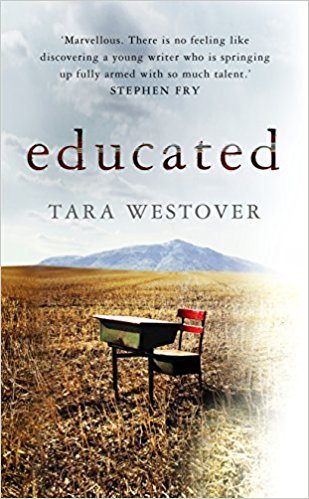
EDUCATED reviewed by Adele Geras


Adele Geras has written many books for children and young adults and six novels for adults, the latest of which is Love or Nearest Offer, published by Quercus in paperback. She’s working on a historical novel for adults. She lives in Cambridge.

The cover of Tara Westover's Educated  is striking. The passage quoted on the back of the book tells you something of what this memoir is about: the author's journey from Idaho to a PhD from Cambridge, a path strewn with astonishing descriptions of life in her extraordinary family. It also demonstrates some of the power of Westover's writing style: plain, sinewy and elegant, all at once. 

You couldn't make it up... that's what people say when what they've read or seen takes them aback to such an extent that they find it an effort to (in another popular form of words) get their heads round it.

I read Educated about two months ago and I'm still thinking about it. It's been universally praised. I predict that it will be on every shortlist it can possibly be on. It will be passed from one friend to another and anyone who reads it will come away moved, touched, horrified and above all knocked sideways by Westover's gift for telling her story in such a powerful and resonant way. She writes most beautifully, with a gift for conveying at the same time the terrible, violent, abusive things that attended her childhood and family life and at the same time, the tenacity of the bonds she feels binding her to her parents and siblings.

She sees them clearly as they are: a man and a woman adhering to a Survivalist Mormon belief so powerful and paranoid that the children are unregistered with school or any other government agency and have spent their entire lives working in their father's scrapyard (with no Health or Safety supervision) or, in the case of the girls, helping with their mother's herbal remedies for family and neighbours. Westover's mother is a self-taught midwife and in thrall to her narcissistic and overbearing husband. Some of her siblings are more sympathetic than others, and one brother is a brutal abuser. The physical harm described in the book is startling and deeply shocking. If this were fiction (you couldn't make it up) your editor would say: you can't put that in your novel. No one would believe it. But it did happen to Westover and how she escaped her family and gained a brilliant PhD from Cambridge University can be seen as an (again, scarcely believable) happy ending.

But Cambridge is not unalloyed bliss. Tara Westover has suffered greatly and hasn't been in contact with most of her family for years.

I finished this book full of admiration for its courageous and hugely talented writer and I hope very much that she finds happiness in her life from now on. I can't wait to read her next book, whatever it turns out to be, and I can safely say that if you start reading Educated, you will not be able to put it down. And you certainly won't be able to forget it.

Educated is published by Hutchinson.

Sunday, 27 November 2016

Guest review by Berlie Doherty: THE SECRET LIFE OF BEES by Sue Monk Kidd