Showing posts with label wildlife. Show all posts

Monday, 26 January 2026

Guest review by Nicki Thornton: THE IMPOSSIBLE THING by Belinda Bauer


"The Impossible Thing is more than just a perfectly plotted thriller, it’s a masterpiece of storytelling."

Nicki Thornton
is a bestselling children’s author who has recently published her first crime novel for adults. Little Bookshop of Murders is about Keera Munroe, who tries to escape her shady past by opening a bookshop in an idyllic village. But when Keera argues with a customer who then dies in mysterious circumstances, she’s forced not only to try to find out what really happened, but to confront the fact that even the loveliest places can be hiding the darkest secrets.

Little Bookshop of Murders is inspired by Nicki's twenty years of working in and with bookshops – perfect places for solving crime!

The Impossible Thing was my favourite read of 2025. Many of my favourite writers are those who use crime fiction to comment on times past and present and Belinda Bauer is one of the best, writing with so much humanity and dealing with big and tricky subjects with a nice line in humour as well as a mystery plot.

A break-in in the present day plunges two unlikely heroes into the historical, unexpectedly murky, obsessive, and very lucrative world of oology, or egg collecting.

I was delighted to see that one of the unlikely heroes is the return of one of my favourites of her previous characters, Patrick. Belinda Bauer won the Theakston Old Peculier Crime Novel of the Year with Rubbernecker, another absolute cracker of a story and one I’m always recommending, where a young autistic man, Patrick, signs up for an anatomy class examining a corpse to determine cause of death. Smart but socially inept, Patrick suspects murder. I was thrilled to see Patrick featuring again.

Told in a dual-timeline, The Impossible Thing starts in the 1920s when egg-collecting was both legal and huge. Obsessed and fanatical rival collectors were in desperate competition to have a rare egg to show-off.

The historical timeline doesn’t focus so much on the collectors, but on a group of Yorkshire farmers discovering they have new source of wealth – in all the nests beneath their cliff-top farms. One family is desperate to be part of this new business of egg-collecting, but they have a farm atop a totally inaccessible cliff.

Tiny, brave and always hungry, Celie Sheppard risks her life going over a cliff no one else will dare. She discovers a near mythical red egg, the Impossible Thing. Celie’s bravery changes the fortune of her entire family and everyone connected to her.

A greedy collector knows a red egg is going to be laid every year, and over time will form into an incredible collection, because a nesting guillemot will return to the same cliff nest every year. Each mother lays eggs with distinctive markings so they know which egg is theirs. Of course, if they're collected, none will ever hatch. Every year each chick will be killed. I particularly love that Belinda Bauer weaves the consequences for the birds into her narrative and shows how birds are also innocent victims of greed and ego.

From the wild cliffs to stuffy gentlemen’s clubs in London to council estates, protected woodland nests and the hidden back rooms of a natural history museum, the story loops between the timelines and what happened to those rarest of rare eggs. Patrick and his friend are unwittingly drawn into the now underground, present-day world of egg collecting and all its hidden dangers.

Belinda Bauer triumphantly weaves both timelines together. Crime, mystery, family drama, romance, tragedy, characters you wish you could stay with and the consequences of wildlife trafficking, all is delivered in an enthralling way as the dots are connected as things get increasingly thrilling. I did not want the book to end.

The Impossible Thing is more than just a perfectly plotted thriller, it’s a masterpiece of storytelling. I’m really hoping it will win a lot of awards this year. I encourage everyone to seek out and read it.

The Impossible Thing is published by Bantam.

Nicki Thornton's Little Bookshop of Murders is published by Chimneys Publishing.

Monday, 30 June 2025

LOST ANIMALS, DISAPPEARING WORLDS - STORIES OF EXTINCTIONS by Barbara Allen, reviewed by Linda Newbery


"Allen says that she wrote this book 'accompanied by many tears', but warns that it is too easy to judge the generations that came before us, while our own shows equal carelessness."

Linda Newbery
edits Writers Review. Her latest novel for adults is The One True Thing.
Mention extinction, and the first animals that come to most people's minds will be dinosaurs, followed by the iconic dodo, woolly mammoth and sabre-toothed tiger. Barbara Allen's book ranges more widely, taking in a number of creatures I (and probably you) had never heard of, and moving closer to the present day, to species whose demise is most definitely down to human activity. Inevitably a sad compilation, it's informative and engaging too, largely thanks to the author's device of giving a 'voice' to a member of each vanished species. Most famous of these is 'Lonesome George', the Pinta Island tortoise who died in 2012 at about a hundred and ten years old - like other animals here he was an 'endling', the poignant term for a lone survivor destined to die unmated and as the last recorded individual of its species.

In the opening, Barbara Allen, a minister in the Uniting Church in Australia, speculates about why she's included some animals rather than others - for example two of those I've just mentioned, the woolly mammoth and sabre-toothed tiger, don't appear here. "What I do know," she acknowledges, "is that no book, with one exception, can contain stories about every extinct species; the only volume that can, and does, cradle those sad tales close to its heart, its core, is Earth." 

The concept of extinction was first used in 1796 by the French naturalist Georges Cuvier, who spoke of animals living in "a world previous to ours". The religious establishment was affronted by this, just as it was sixty years later by the publication of Darwin's On the Origin of Species. We now know that extinctions are caused both by cataclysmic events such as asteroid strikes or volcanic eruptions and by more gradual changes such as pollution, competition for food or shelter, and habitat loss. But how can we know when a species truly is extinct? The IUCN (International Union for the Conservation of Nature) is the global authority, categorising a species as extinct if no sightings have been reported for fifty years - though there are sometimes comebacks from 'Lazarus' species such as the coelacanth, which until 1938 had been known only as a fossil. But it's sobering to note that 41% of amphibians, 27 per cent of mammals and 13% of birds are currently threatened with extinction. More optimistically, the IUCN's Green List analyses conservation efforts and their impact on species recovery.

Allen also writes about 'de-extinction' or 'resurrection science', and how this could be done through cloning and genetic engineering; but she examines the ethics of this, how feasibly it can be done, the effects on other species if, say, mammoths were reintroduced to the Arctic tundra, and whether hubris might result in humans thinking that by 'tinkering' they could do better than nature. And, as she points out, "If we think we can 'replace' a species, then apathy may set in, making us less inclined to protect others."

In the midst of the sixth mass extinction, or Holocene extinction, many of us experience the ecological grief referred to by the American conservationist Aldo Leopold when he wrote of the 'world of wounds' experienced by those who care and learn about the natural world. Allen wonders how best to 'memorialise' the lost creatures, recognising that each led its individual life and was not just a representative of its species. She describes the huge 'Lost Birds' sculptures of Todd McGrain: the passenger pigeon, the Carolina parakeet, the great auk, the heath hen and the Labrador duck, each sculpture positioned, where possible, at the site where the last known individual was shot or sighted. As McGrain says, "at those places haunted by what is missing". Some of the creatures in this book are illustrated with drawings, others by sad photographs of an animal alive or preserved: Qi Qi, the world's only captive Yangtze river dolphin; the Xerces blue butterfly; a stuffed ivory-billed woodpecker; a solitary Quagga in a cage in London Zoo.

Allen's own approach is to give an individual of each species a character and allow it to 'speak' to us, in tones of outrage, resignation, boastfulness or accusation. The Dodo, for example, introduces itself: "What a stupid name! Sets me up as a thing of ridicule; if one is not accorded respect, it is easier to kill ... some individuals in the past and in the present have found it had to believe that I was real, that I was not a made-up character for Alice's Adventures in Wonderland. I wonder when children realize that I was factual, real, rather than a creature of legend or fantasy? But fantasy doesn't exist and now neither do we." The Spectacled Cormorant, which inhabited Bering Island, complains that "Less than a century after we had been 'discovered', we were extinct" - thanks to its short wings and lack of suspicion of humans.

It's hard to comprehend how the once so numerous passenger pigeon could have been allowed to become extinct. The acclaimed bird artist John James Audubon wrote in the 1930s that when a flock passed over "the light of noonday was obscured as by an eclipse". (The book's cover shows a version of his painting of these pigeons, with the birds as blank silhouettes.) A flight of the massed birds could take three days to pass. Of course, they consumed grain and damaged trees and were not beloved by farmers, so they were shot in their thousands, sometimes as part of organised competitions. Forest depletion also led to a reduction in their numbers; efforts to save them came too late. The last known bird, Martha, died in 1914 at Cincinatti Zoo. 

Allen says that she wrote this book "accompanied by many tears". but warns that it is too easy to judge the generations that came before us, while our own shows equal carelessness. The penultimate chapter has the Bramble Cay Melomys, a rodent inhabitant of Papua New Guinea, lamenting as the tides rise higher that humans destroyed it: "not face to face but, rather, through greed, or ignorance, or indifference ... or apathy". Snails, small rodents and amphibians don't attract the attention given to polar bears or snow leopards, but their loss is just as significant as that of the bigger, more iconic species.

It could be argued that the fate of most species on Earth is to become extinct in time, but human activity has produced a current rate of loss estimated to be between 100 and 1000 times the rate of natural background extinction. Allen's book doesn't include any British species, but the recent State of Nature report found that an alarming one in six species, including the once-familiar water voles, hazel dormice and turtle doves, are at risk because of farming activity, pesticide use and habitat loss.

"May we endeavour," Allen concludes, "to add as few names and pages as possible to this book of extinction." Amen to that.

Lost Animals, Disappearing Worlds is published by Reaktion Books


Sightlines by Kathleen Jamie, reviewed by Sue Purkiss


Sarn Helen, a Journey through Wales, Past, Present and Future, by Tom Bullough, reviewed by Alison Layland

Monday, 20 January 2025

Guest review by Laura Parker: THE PLACE OF TIDES by James Rebanks


"This experience has caused Rebanks to dig much deeper as a writer. His enforced time out has him reaching for greater profundity while maintaining a simple, thoughtful style."

Photograph: Kitty Parker
Laura Parker
is the author of no books (yet), but she is working on one about drystone walls, and has written a growing collection of articles published by Country Life magazine. Her work covers animals and the art and history of the countryside. She has also been published in Little Toller’s
The Clearing, an online journal in which writers explore and celebrate the landscape we live in, as well as in Scottish Field and Scottish daily The Courier. Find out more on Laura's website.

James Rebanks made his name with two books: one about his life as a shepherd in Cumbria (A Shepherd’s Life) and the other on the changing face of agriculture over three generations (English Pastoral). So he was right to warn his 150,000 X-followers that his next book would be different.

The Place of Tides takes him to Fjaerøy, a Norwegian island just below the Arctic Circle where he sheds his modern existence: no internet, barely any phone, limited power, no running water. For seventy days.

It is his account of ten weeks spent in the company of Anna, a woman of seventy determined to continue an age-old way of existence that she herself took up only later in life. Anna harvests down from eider ducks, gathering a material used for centuries for luxurious warmth, and continuing a tradition which has provided a living for the women of this fishing community since Viking times. It is a way of life that is dying out, not just because of cheaper and more abundant alternatives, but because the ducks themselves are getting scarcer.

Highlighting the fine balance between human intervention and nature, the ‘duck women’ build shelters for the birds as they come ashore to lay their eggs, and protect them from predators such as sea eagles and mink (the latter introduced by humans). In earning the trust of the ducks, their protectors take their reward at the end of the season by gathering the down the birds use to line the nests.

Rebanks discovers there is more to his stay than deploying his farming skills through raking seaweed or repairing shelters. Bewildered, he struggles to contain his impatience as the two women (Anna has brought a friend, Imogen) settle down indoors to knit for their first two weeks on the island. Rebanks is left unmoored, reflecting on the frenetic existence he has left behind, along with his wife and four children. He resolves to be a better husband and father. There are still eight weeks to go.

So far, so satisfying to a nature book reader: being taken to a remote frontier world, guided to closely examine a new habitat – there are many intricate observations of the wildlife and weather on the island – and to be made aware of a diminishing natural resource.

Unexpectedly, it is the deepening human relationships that become the heart of this book. Anna turns out to be different from Rebanks’s first arresting sight of her, a tiny but fierce ‘half-wild’ woman standing proud on the shoreline. She is older, frailer, at first unable to work. Constantly trying to be respectful of her world, Rebanks is frequently unsure how to proceed, a Gulliver in a strange land.

“I had sensed I ought to make myself much smaller, working to their commands, relinquishing responsibility.”

He realises, for the first time in his life, that he is in a place entirely run by women. By ‘paying attention’, he begins to see how men treat women, and he cringes. He also learns a great deal from Anna’s attitude to her work.

“Rarely have I seen anyone so absorbed in each living moment .. This way of living demanded a loss of self, a surrendering to the rocks, rain, wind and tides.”

Amid the poignancy – this is Anna’s last season – there are lessons for him, and for us.

“In this radically pared-back life she had found peace and meaning. She was the waves, the light, and the terns rising and falling on the bay. She was the guardian of this place … powerless against the scale of the natural forces at work and against the issues affecting the oceans, yet fierce in her determination to try.”

This experience has caused Rebanks to dig much deeper as a writer. His enforced time out has him reaching for greater profundity while maintaining a simple, thoughtful style.

Rebanks and the women leave the island with a harvest amounting to 2kg of down, which must then be painstakingly cleaned. It is barely enough to make two quilts. But both he and his readers have gleaned so much more about our threatened world.

The Place of Tides is published by Allen Lane.

See also: James Rebanks' English Pastoral reviewed by Judith Allnatt


Monday, 16 September 2024

Guest review by Nick Manns: H IS FOR HAWK by Helen Macdonald


"The notion of ‘looking’ is a key term in this book, and a suitable one for someone on a quest."

Nick Manns
taught English in comprehensive schools in south London and the Midlands for 20 years. He is the author of four novels for young adults, including Control Shift and Dead Negative, and is a founder and director of Dyslexia Lifeline, a company based at De Montfort University, Leicester.

'Grief has no distance,’ wrote Joan Didion in The Year of Magical Thinking. ‘It comes in waves, paroxysms, sudden apprehensions that weaken the knees and blind the eyes and obliterate the dailiness of life.’ The ‘dailiness of life’ is that touching trust in stability; of everything in its place and all being right with the world.

With Didion that confidence crashed when her husband dropped dead one evening from a heart attack and she spent months trying to navigate a changed reality. With Helen Macdonald, her old world finished with a phone call: when her mother told her that her father, apparently recovering from a trivial injury to his arm, had suddenly died. His heart had stopped.

Whereas Didion struggled to believe John Gregory Dunne was really dead (she needed to be alone,' she wrote, ‘so that he could come back’), Macdonald describes her grief in Biblical terms: ‘the rain fell and the waters rose and I struggled to keep my head above them’. Worse still, this was a world that was indifferent to her suffering: ‘planes still landed, cars still drove, people still shopped’ and ‘nothing made any sense at all.’ She finds herself in Auden land, where the misery of the bereaved cannot be assuaged: clocks can’t be stopped; catastrophes are always someone else’s problem. Icarus drops into the water and no-one notices.

The likeness to Didion isn’t limited to a shared experience. As the American author believed (at some level) that her husband was still around (heading towards the front door), so Macdonald holds a similar fantasy about her father, except that she wasn’t hanging around for the doorbell to chime or for the phone to ring.

Although most readers (who aren’t writing book reviews) will probably pass by incidental details, a pleasure of this book is in the hints and clues that Macdonald builds into the narrative. Early on, whilst walking the blasted heath of the Brecklands – the broken lands – of Norfolk, in search of goshawks, she comments: ‘The goshawk is the birdwatcher’s dark grail.’ They’re rare and hard to see. And she adds, ‘Looking for goshawks is like looking for grace: it comes, but not often.’

Of course, the notion of the ‘grail’ is often the focus in stories of chivalry – of a search for something precious in the Christian tradition. The journey to attain the grail (or achieve some worthwhile end) may be uncertain and perilous. In Macdonald’s case, like Sir Gawain, she must find her own way and use her own resources. The ‘broken lands’ of East Anglia are as good a place to start as any.

Throughout – and running as a parallel narrative – she shares with us the tale of another traveller, who went before, and we realise that finding the grail or receiving grace isn’t a given. Although there are no maps to this terra incognita and no guarantees, in good medieval tradition, she takes guidance from those who had asked the important questions and knew the likely trail. For Freud and Klein, the grail for each of us is authenticity and this is earned through self-knowledge.

In the early days, after the fateful call from her mother, Macdonald had groped her way out of ‘madness’ by connecting with the certainties of her childhood. She says: ‘When you are broken, you run. But you don’t always run away. Sometimes, helplessly, you run towards’. She recalls that years before, when working in a falconry centre, an injured goshawk had been brought in for assessment. The bird was not seriously harmed and they took her outside and then, like a magic trick (or something out of Philip Pullman), ‘She opened her wings and in a second was gone. She disappeared over a hedge slant-wise into nothing. It was as if she’d found a rent in the damp Gloucestershire air and slipped through it.’

Years later, following her father’s death, and after a series of dreams about hawks, she drove to Scotland, to meet an Irishman, who would hand over a young female goshawk. Although she had been advised against this project (‘Hiding to nothing,’ comments her friend), she was by this time an experienced falconer and disregarded the note of caution. And yet. The travelling box is opened and the bird ‘came out like a Victorian melodrama: a sort of madwoman in the attack.’

Her training of the incongruously named ‘Mabel’ dominates the rest of the book. We’re educated in the process of feeding the young bird and how Macdonald painstakingly built trust. This is a creature that is given ‘roughly torn day-old chicks’ and bits of rabbit. She’s also a creature straight from the menagerie of Ted Hughes: ‘I see it all; I own all this world and more.’

The notion of ‘looking’ is a key term in this book, and a suitable one for someone on a quest. As a child Macdonald describes herself as a ‘watcher’ who would climb the hill behind her home, crawl under a rhododendron bush and ‘look down on the world below.’ This habit of quiet observation is reinforced by her companionship with her father, who worked as a press photographer and transmitted the need for patience.

At one point Macdonald recounts a dream in which she looks down on a Second World War bombsite and sees a boy amidst the rubble. He turns and she sees it is a figure of her father as a child, who points to an approaching aircraft. She later reflects: ‘I’ve come to realise that we were watching the same things: or at least the things that history conspires to make the same. Since the dawn of military aviation, birds of prey had been thought of as warplanes made flesh…Hawks fly and hunt and kill: aircraft do the same.’ She concludes: ‘I must have inherited being a birdwatcher from Dad.’

There’s also something of the photographer in the exactness of her metaphors: long-tailed tits in a willow were like ‘animated cotton buds’; the feathers down the front of the young goshawk are the colour of ‘sunned newsprint.’ She describes fieldfares as ‘netting the sky …like a 16th century sleeve sewn with pearls.’

To understand Mabel, to train her so that they can become a hunting partnership, she reads widely and returns to the work of T. H. White. She had read The Goshawk as a child, and as then, so now, she is disturbed by the cruelty meted out by White in his attempt to make his wild bird biddable. This cruelty contrasts with her own sensitivity and kindness to the young bird in her care.

For Macdonald, ‘running towards’ the source of her feelings, enabled her to get in touch with important elements of her childhood: she was able to make sense of her life by inspecting her past. White’s past included neglect at home and physical abuse at boarding school: a history in which the school sanctioned the punishment of younger children by older pupils. As a gay adult he tried to ‘pass’ as a straight man (with upper class pretensions.) His repeated attempts to form relationships with women were predictable failures. Macdonald sees his efforts to train ‘Gos’ as an (unconscious) desire to tame the ‘wild’ parts of himself. She writes: ‘White found himself in a strange, locked battle with a bird that was all the things he longed for but had always fought against.’

Whereas White’s training methods would today elicit a call to the RSPCA, Macdonald is able to empathise with Mabel: she’s a ‘baby’ who could be ‘happy’ or ‘contented’. She doesn’t have to control this creature but to collaborate with it: she isn’t conflicted in her role. White was both stern schoolmaster and wild child: both roles which would be depicted in his children’s novel of Arthurian adventure, The Sword in the Stone.

White never resolved the different parts of himself: the relationship with Gos (spoiler alert) ends tragically: the hawk escaped. Macdonald notes that he remained alone all his life. At the end of her book, Macdonald can symbolically ‘let go’ of Mabel (the hawk spends several months in an aviary so that she can moult) and Macdonald emerges from crushing grief: she ‘lets go’ of her father.

This ending takes us back to the start of the book: she notes that Melanie Klein had commented that children deal with states of mind akin to mourning and that adults return to this emotional world whenever grief is experienced. Macdonald tells us that as a child she comforted herself that White’s Gos wasn’t really dead, he was ‘out there’ in the woods and she had wanted to go and ‘bring him back’. As an adult, she had wanted to ‘slip through that rent in the air’ and fly her hawk to find her lost father.

In the early days of training Mabel, Macdonald had riffed on lines by John Keats: ‘My arm aches and a damp tiredness grips my heart’. The poet had been meditating on the beguiling charms of a nearby nightingale, a ‘deceiving elf’, who might help him escape ‘the weariness, the fever and the fret’ of life. At the very end of her book, Macdonald fully returns to the human world: she recognises that goshawks are ‘things of death and blood and gore’. The world we inhabit is shared – but separate. She concludes, ‘Hands are for other human hands to hold. They should not be reserved exclusively as perches for hawks.’

H is for Hawk is published by Vintage.

See Nick's previous reviews:

The Antidote: Happiness for People who can't stand Positive Thinking by Oliver Burkmann


The Darker the Night, the Brighter the Stars by Paul Broks


Monday, 2 May 2022

Guest review by Linda Sargent: 12 BIRDS TO SAVE YOUR LIFE - NATURE'S LESSONS IN HAPPINESS by Charlie Corbett


"Rediscovering his connection to the natural world through reacquainting himself with birds, their habitats and song."

Linda Sargent is a writer who works as a publisher’s reader (David Fickling Books since 2002). She has published short stories and articles and her first novel, Paper Wings, appeared in 2010; she is also the author of Words and Wings, a training guide to creative reminiscence work, available as a free download from her website. She is currently working, along with Joe Brady and Leo Marcell, on Tosh's Island, a middle grade graphic novel based on her childhood.

The line, “Grief finds its good way home” from Elizabeth Jennings' poem Into the Hour, is especially apt for this book, I think. The cliché of coming to terms with loss has always felt inadequate and often inappropriate to me, but “finding its good way home”, yes, that’s more like it. And this diary/essay form account that Charlie Corbett uses to chart the ten years following the death of his mother does feel so much like this kind of journey and one that most people are likely to recognise. Charlie’s mother was in her mid sixties when she was diagnosed with a brain tumour, which the author says at first, although a shock to the family, they all imagined it would be dealt with, sorted out and their mother would continue to be their centre, as he describes, “the glue that held our family together”. That this would no longer be the case seemed unimaginable and when she died there was inevitable fracture and despair, one which sent the author into dark times and which he admits never fully disappear. For him this “way home” involved rediscovering his connection to the natural world through reacquainting himself with birds, their habitats and song.

Although he chooses twelve birds to focus on, during the chapters he also includes many others, presenting a full picture of his relationship with nature as a whole and a reminder of things that he knew were important to him, but that he’d forgotten or neglected to remember over time. As well as the perhaps more obvious candidates like the skylark, the robin and the wren, there are other less predictable birds such as the magpie and the seemingly ordinary house sparrow (sadly like so many not so ordinary and common these days). And although every chapter begins with one bird, it soon broadens out into reflection and reminiscence, as he recalls earlier associations and memories of family life and the way in which he, his father and his siblings have to begin to live with their new reality. At the end of every chapter he gives a brief and nicely personal factual guide to his chosen bird and finally he includes what he calls a Gazetteer – A year in the life of birds, detailing what to look and listen for where and when. It is, as he says, a very personal account and is not meant to instruct, but rather to invite the reader to join him on his journey and in doing so to maybe find it easier to approach loss and grief in their life and find solace in the natural world which is fundamental to us all.

12 Birds to Save your Life is published by Penguin.

More reviews by Linda Sargent:

The Orchardist by Amanda Coplin   

The Buried Giant  by Kazuo Ishiguro 


Linda wheeling away into Blenheim Park


Monday, 8 November 2021

Guest review by Tina Jackson: FEATHERHOOD by Charlie Gilmour


"A beautiful book about the nature of what is wild, and what can and cannot be tamed; about nature and nurture and how the two can co-exist."


Tina Jackson is a writer and journalist, and the author of the novel The Beloved Children (Fahrenheit Press), a short fiction collection Stories from the Chicken Foot House (Markosia) and a book of non-fiction about working class women and the struggle for the vote in her hometown, Leeds. See more on Tina's website.

In tales of enchantment, the arrival of a talking animal always has a particular significance, taking the person who encounters it – invariably someone in need of its counsel – over the boundary of what is usual and into the realms of the extraordinary. And while Charlie Gilmour’s Featherhood is not fiction, folk, or fairy tale, and Benzene - the magpie whose presence in his life provoked this telling - only ever speaks in crow, it tells a real-life transformation tale that casts an extraordinary spell.

Featherhood weaves life writing and nature writing to tell the story of how a gentle and troubled person was helped to make sense of his relationship with his absent father, and to prepare for becoming a father to his own child, by the presence in his life of a baby magpie. As Benzene, who Gilmour initially expects will not survive, thrives, she becomes fiercely attached to Gilmour and his partner Yana, and they to her. Nothing, in the wake of this profound inter-species connection, will ever be the same, and the wild bird is an agent of healing and chaos in equal measure.

Writing in luminous, clear prose, Charlie conjures a cast of human and avian characters no less fantastical or compelling for being real, and relates how he is taught by the magpie that he can also look after a human child and be a good and loving parent.

His biological father Heathcote Williams is the trickster in the tale: a slippery figure whose identities switched seamlessly between poet, magician, anarchist, absentee father and a person whose entire existence reads as a play of smoke and mirrors and leaves a trail of hurt, pain and abandoned relationships, such as the one with his son, in his wake. The twin threads of the story are the unfolding tale of Gilmour’s relationship with Benzene and his attempts to unravel the mystery of why his complex, charismatic father was unable to have anything but a fragmented relationship with his son. The book is shot through with down to earth humour, too, with the antics of the bird an obvious highlight and the succinct dismissal of Heathcote Williams’ mercurial behaviour by Gilmour’s staunch, loving, stepfather. ‘What a wanker,’ he sums him up, with this reader cheering him from a ringside seat.

This is a beautiful book about the nature of what is wild, and what can and cannot be tamed; about nature and nurture and how the two can co-exist; about what can and cannot be known; about families and how the past does not have to repeat into the present, and about the transformative power not just of love, but of care. It’s a story about being open to possibility and accepting responsibility – for the fierce demands of a bird that stashes meat in Gilmour’s hair and for the human baby who arrives after Gilmour has learned that he isn’t fated to repeat the example of his own father. It’s a story about understanding something that is other, whether that’s a creature of another species or a human being who behaves in ways that are less comprehensible than those of a wild creature. It’s a story of reconciliation with the past and accepting the numinous encounters that lead to becoming. Above all, Featherhood is an exceptional, beautiful and wonderfully told story about how to create a stable nest, and feather it with love, compassion and understanding. It may not be fiction, but it really is a magical tale.

Featherhood is published by Weidenfeld and Nicholson.

Tina Jackson's The Beloved Children is reviewed here by Yvonne Coppard.


Monday, 4 October 2021

Guest review by Judith Allnatt: ENGLISH PASTORAL - AN INHERITANCE, by James Rebanks


"In a world trembling at the brink of climate disaster, this is both a timely and a hopeful book..."

Judith Allnatt writes short stories and novels for adults. Her novels have been variously shortlisted for the Portico Prize for Literature, the East Midlands Book Award and featured as a Radio 5 Live Book of the Month. Short stories have appeared in the Bridport Prize Anthology and the Commonwealth Short Story Awards, and have been broadcast on BBC Radio 4 and the World Service.

Judith’s latest novel, The Silk Factory, is an eerie story of love and memory drawing on both the Luddite weavers’ rebellions in the nineteenth century and a modern day haunting. She has lectured widely on Creative Writing for over two decades and is a Royal Literary Fund Fellow. She lives with her family in Northamptonshire and is working on her fifth novel. For more information and blog posts see Judith’s website.  Twitter: @judithallnatt

English Pastoral is both urgent in its call to arms for the planet and poetic in its lyrical description of life on the author’s farm in the Cumbrian fells.

The book is structured in three acts. The first concerns the traditional farming that he learnt from his grandfather: rotating crop and pasture, using manure to nourish the soil and harvesting once a year. These were the farming methods evolved over centuries that worked both with and for nature. Spilt grain helped birds survive through the winter and cutting hay once for fodder rather than frequent grass cutting for silage allowed a habitat to survive for ground nesting birds such as curlews.

The second act explains the pressures of a growing world population and the industrialisation of farming: the growing of monoculture crops and the widespread use of pesticides, literally weeding out biodiversity; the spiralling use of fertilizers on soil ever more compacted and degraded; the use of massive machines on huge fields stripped of ancient hedgerows. These are practices that work efficiently to maximise production, but this drive for ever-lower food prices leaves little room for wild things and the cost to the natural world and the climate goes largely unheeded.

The third act explores hope for the future - the equivalent of the ‘redemption’ frequently used at this point in the structure of fiction. It describes James Rebanks’ return to some traditional farming methods. He chooses Herdwick sheep for their hardiness to Cumbrian weather. Belted Galloway cattle are introduced that can stand wintering outside and don’t need to eat silage indoors. Thus at one stroke he removes both the need for multiple crops of monoculture grass and the practice of spreading the resulting slurry: an acidic form of muck that destroys soil quality rather than well-rotted manure, which builds it. 12,000 trees are planted on his land. With the help of the Eden Valley River Authority, river and beck are rerouted and transformed from straightened, dredged, draining channels to meandering curved watercourses, slowing their pace to help protect towns downstream that were previously devastated by floodwater from unprecedented levels of rain. As the river wanders, gravel is deposited and salmon and trout that need gravel shoals on which to spawn return. He documents the otters, hares and owls returning to his land, alongside the rare wildflowers in the meadows. He speaks with equal enthusiasm of micro-organisms and numbers of earthworms - indicators of healthy soil. And what of the curlews? Driven out during the years of losing their chicks to the harvester, they are starting to return along with the swallows and swifts that dive to snatch the flies above muck-nourished fields.

Hung along the narrative thread that follows the farm’s fortunes, are vignettes of farming life: sheep stranded on an island of grass in floodwater, his father’s manic delight in the five yearly gorse burning, a son’s pride in winning a silver shield for being ‘best tup handler’.

The book is beautifully written. Old phrases such as ‘leading in the hay’ are used naturally as a matter of course. (Surely an echo of the thousands of years preceding this mechanical age, when men led horse and cart from field to yard). The face of the fells, changing with weather, the hour and the season is brought alive by the close observation and choice images of the writer.

In a world trembling at the brink of climate disaster, this is both a timely and a hopeful book. James Rebanks demonstrates that his farm is now not just carbon neutral but carbon positive – it is storing more carbon than it creates. Whilst pragmatically recognising that chemical intervention has its place, he makes the case for using traditional methods wherever possible and for encouraging and cherishing farming that improves the land and stewards the wildlife upon it. He points out that big corporations hunt in rural corners for genes in stock or crops in order to breed animals and plants capable of surviving new challenges such as climate changes. Yet, with every small farmer swallowed up by large scale monoculture farming these opportunities narrow and treasure is lost.

Most of us live in towns and cities and have little close contact with the land that feeds us. We buy packaged food from supermarkets and don’t think much about where it comes from or how it is produced. This book turns our eyes in this unwonted direction. What we see is that we can’t afford to ignore issues of regeneration and stewardship any longer, and that what happens to our land has far-ranging consequences for what will happen to our planet.

English Pastoral is published by Penguin.

See also: Wilding, by Isabella Tree, reviewed by Linda Newbery   


Monday, 15 June 2020

Guest review by Elen Caldecott: HIDDEN NATURE by Alys Fowler


"It is the story of someone yearning for adventure, yearning for the feeling of being alive and active, but doing so within five miles of their own home."

Elen Caldecott is a writer for young people. She also teaches creative writing in university and community settings. Her latest book, The Short Knife, is an historical drama set during the collapse of the Roman Empire in Britain. It will be published in July 2020 by Andersen Press.

I had decided to write about Hidden Nature before Covid and our state of suspended animation which came with it. But, on re-reading it for this blog, I was struck by its relevance, especially as lockdown lifts and we take small steps towards imagining what normal life might be.

Is this memoir, Alys Fowler writes of her decision to paddle Birmingham’s canal-ways in an inflatable dinghy. She does this in small bursts, over evenings and weekends, catching the bus, or cycling to the next stage of the journey. It is the story of someone yearning for adventure, yearning for the feeling of being alive and active, but doing so within five miles of their own home. It is a memoir in which the plants and animals of the canals and towpaths are companions and friends. They offer reassurance and familiarity to Fowler at a time in her own life when she is coming to terms with her own ‘hidden nature’ as she questions, and finally acts upon, her own sexuality. She emerges from her own state of suspended animation and she does so by meticulous exploration of her own back yard.

I was initially drawn to the memoir as Birmingham is close to my heart. I was an undergraduate there an eternity ago. Local lore had it that Birmingham has more canals than Venice and, while I was a student, many of the canals were undergoing gentrification, acquiring bars and restaurants where there had formally been abandoned warehouses and small-scale industries.

Fowler, who many will know as a gardening writer for broadsheet newspapers, took me on a tour of those familiar paths, but also gave me an education. She is so knowledgeable about the plants and wildlife she sees, and she shares this knowledge in the way friends might share gossip. Buddleia, for example, gets its own few pages. It was, Fowler tells us, an ornamental introduction to the UK that broke free of its garden confines after the Second World War. The urban bomb-sites replicated the exposed limestone of its natural habitat, and the slipstreams of railway embankments encouraged its dispersal until it became ubiquitous. She passes so many of these common, weed-ish, plants as she paddles her dinghy – first ineptly, later with a bit more ept – and she has something wonderful to tell us about each one.

Meanwhile, in the background, her life is quietly imploding. We hear about her husband, his long-term illness and the vicissitudes of caring for him. We hear about the worry of work and moving to a new city. We hear about a growing friendship with someone who will come to be crucial. But none of these threads are the point of this book. Rather, the book shows rather than tells us how the natural world can help to make the Big Problems of Life become a little smaller, a little more manageable.

There is a degree of tension in her descriptions of the people she meets, as opposed to the non-human canal life. Many of the people fishing, barbecuing, smoking, lollygagging about in the liminal spaces of the city waterways, are drawn with a very broad brush. There are some assumptions made about their lives, which aren’t really justified by the brief conversations she reports having with them. But, when Fowler speaks about the joy, the peace and the wisdom to be had by looking for small adventures, close to home, this book is superb.

Hidden Nature is published by Hodder and Stoughton.

Sunday, 19 April 2020

Lockdown Sunday extra: NATURE CURE by Richard Mabey


"In these days of coronavirus lockdown and climate emergency, the finding of solace in the natural world is ever more significant."


Linda Newbery edits Writers Review. She has published widely for young readers and is currently working on a new adult novel.

A version of this review first appeared on Normblog in 2006 as part of a Writer's Choice feature hosted by the late Professor Norman Geras.

A chance hearing of Radio 4’s Book of the Week first alerted me to this wise and compelling account of Mabey’s decline into depression, and re-emergence. This was in 2005, but in these days of coronavirus lockdown and climate emergency, the finding of solace in the natural world is ever more significant for those of us lucky enough to have gardens, parks or countryside at hand.

Mabey’s book strikes many chords with me, from page 2 where he describes the finding of a grounded swift. I had the same rare experience when one of my cats somehow caught one and brought it indoors through the cat-flap. Handling the bewildered but unharmed bird, I saw the perfection of its aeronautical design – strong, swept-back wings, wide gape, tough eyelids with bristly lashes. Like Mabey, I realised that the only way to return it to the air was to launch it like a paper aeroplane, and watched in amazed delight as it skimmed the grass before soaring high to rejoin the flock. (NOTE: since writing this piece I have learned that this isn't advisable as it could risk injuring the bird. Better to see if there's a wild bird sanctuary near you that can examine and release the swift.)

Swifts, epitomising English summer with their screaming flight, hold a special significance for Mabey, echoing Ted Hughes for whom their return each May proved that “the globe’s still working”. So it was a sure sign of the depression he’d sunk into that he lay in bed too lethargic to turn his head while the swifts whizzed and shrieked outside his window. Many writers will recognise the odd, bereft feeling of completing a book. For Mabey the work had been a massive one, Flora Britannica*, and the sense of loss was compounded by the death of his mother from Parkinson’s disease, through which he and his sister had shared the nursing.

His home for most of his life had been in his parents’ house in the Chilterns. There, he owned a piece of woodland, from which he banned the local hunt (hurrah!) while encouraging neighbours to wander and collect wood. Debilitated and purposeless in his illness, he was encouraged by friends – and a new lover - to resume his absorption in the natural world and in writing, the twin passions which had always sustained him. Acknowledging that he’d never really “fledged”, and that the process of maturation demanded a move, he decamped with three cats to the Norfolk Breckland, as lodgers in an isolated seventeenth-century farmhouse. Here, through a solitary but cathartic winter, he finds new bearings and rediscovers his connection with the land. He examines maps, he ponders over interesting names, he reflects on the shaping of the landscape by human intervention and the enclosure of the commons, he becomes fascinated by “westing” – what seems an instinctive alignment of buildings and field boundaries towards the setting sun.

This isn’t only the story, though, of Mabey’s illness and recovery. There are frequent digressions – into the effects of the Enclosures Act on Norfolk life and landscape, glaciation and land-forms, language and folklore, flora and fauna. The Northamptonshire poet John Clare, like the swifts, is present throughout. Mabey feels a strong affinity with Clare, “ecological minstrel”, not only because of Clare’s mental illness and shared habitats, including the same Northampton hospital, but for Clare’s deep empathy with wild creatures and his skill in capturing their “jizz” (the concise term used by birdwatchers).

He found little solace in mainstream environmentalism, seeing it as merely utilitarian, "based on enlightened self-interest: we want a healthy, unpolluted, species-rich ecosystem because our material future depends on it,” while we assume “the right, or the duty, to determine every other species’ share, too.” (Has he seen a change, I wonder, since publication of this book in 2005? Extinction Rebellion, Friends of the Earth and Greenpeace value the planet and its ecosystems for themselves, not solely for the benefits they bring to us. According to the organisation EcocideLaw, drawing on the work of the late Polly Higgins, "Ecocide is a crime against the Earth itself, not just against humans.")

Mabey sees our connection to the natural world as essential to our spiritual and physical well-being. In the worst slumps of depression, he had become, like the grounded swift, “the incomprehensible creature adrift in some insubstantial medium, out of kilter with the rest of creation. It didn’t occur to me at the time, but maybe that is the way our whole species is moving.” To read Nature Cure, at least, is to slow that progress. As well as the honesty of Mabey’s self-revelation and the range of his knowledge, it’s the quality of his prose – the Ruskin-like attentiveness to shifts of light, patterns of growth, and behaviour of even the most common bird - that makes this book so memorable.

Nature Cure is published by Vintage.

* Flora Britannica is another of my treasures, joined now by Birds Britannica (by Mark Crocker and Richard Mabey) which similarly combines natural history, folklore and anecdote.

See also The Salt Path by Raynor Winn, reviewed by Sue Purkiss

The Outrun by Amy Liptrott, reviewed by Paula Knight

Walden by Henry David Thoreau, reviewed by Linda Newbery

Sightlines by Kathleen Jamie, reviewed by Sue Purkiss

Corduroy by Adrian Bell, reviewed by Andrew Fusek Peters

Wilding by Isabella Tree, reviewed by Linda Newbery

Natural Selection: a Year in the Garden by Dan Pearson, reviewed by Linda Newbery

Monday, 2 March 2020

Guest review by Sue Purkiss: SIGHTLINES by Kathleen Jamie


"... the reader is right there with her, feeling the force of a wind strong enough to knock you over, seeing how gannets glint against a storm cloud, shocked at the speed with which killer whales slice through the water."

Sue Purkiss writes for children and young people. She has been a Royal Literary Fellow at Exeter and Bristol Universities, and has also taught English and worked with young offenders. Her latest novel for children, Jack Fortune and the Search for the Hidden Valley, is an adventure story set in the Himalayas at the end of the 18th century, featuring plant hunters, a sacred mountain – and its mysterious guardian! For more information, see Sue's website. She also has her own literary review blog, A Fool on a Hill (where this review first appeared), and is a contributor to The History Girls.

A couple of months ago, I mentioned to a friend that I was about to go on a course on nature writing (at Ty Newydd – I wrote about this on my blog). She chuckled, and said, “Oh, but nature writing’s so boring, isn’t it?”

I was taken aback and lost for words. Now, I would say to her: but what do you even mean by nature writing? How could it be ‘boring’ to read about something which I know she loves, just as I do? How could she not be interested in reading about what gives life to us, and makes our planet apparently unique - and how it is under profound threat?

Or perhaps I’d just give her this book by Kathleen Jamie and say, “Just give this a try. Go on – do.”

Kathleen was one of the tutors on the Ty Newydd course. I had heard of her before, but though I’d given this book to a couple of other people as a present, I hadn’t actually read it myself. I’ve just remedied this, and have found it completely engrossing – and therapeutic. It’s autumn, which is a beautiful season but has at its heart the fading of things – the fading of light, the falling of leaves, the gradual death of flowers. Of course it’s not all bad – there are birds that arrive as well as those that depart, and there are already buds on the bare branches. But still – it’s a season when it’s easy to succumb to a generalised feeling of sadness. And there are one or two things going on in the outside world which are also just a tad worrying.

So there have been mornings when I’ve woken up feeling gloomy. But as soon as I begin to read a chapter of Sightlines, I am taken into another place - and what a relief that is. That is perhaps a cliché: certainly, it’s my stock, easy answer when someone asks me what I like about reading: “A book can take you into another world…” But in this case, it really feels true. The book is a collection of essays. In most of them, Kathleen travels to Scottish islands, though there’s also one where she goes to a Norwegian museum and reflects on whale skeletons (in other essays, she writes about encounters with living whales); another where she decides she needs to see inside the body, not just outside, and examines pathogens under a microscope; another where she recalls an archaeology dig, from which the discovery of the ancient skeleton of a young girl lingers in her mind.

Wherever she goes, she is supremely attentive. She looks, she listens, she tastes, she touches, she thinks, she explores, she reflects. And she does this so effectively that the reader is right there with her, feeling the force of a wind strong enough to knock you over, seeing how gannets glint against a storm cloud, shocked at the speed with which killer whales slice through the water.

But she doesn’t simply describe what she sees. She muses, considers, makes analogies, asks questions. The reader follows not just her physical journeys, but the path her thoughts take. At the back of it all is an awareness of transience. As she says in the book’s final paragraph: "There are myths and fragments which suggest that the sea that we were flying over was once land. Once upon a time, and not so long ago, it was a forest with trees, but the sea rose and covered it over. The wind and sea. Everything else is provisional. A wing’s beat and it’s gone."

(She is flying in a helicopter as she leaves a remote, storm-swept island, where she had found a dead swan, describing its outstretched wing as a full metre of gleaming quartz-white, a white cascade: the swan’s wing, the wind, the helicopter flight – they all link into a chain of thought.)

Boring? Not remotely.

Sightlines is published by Sort Of Books.

See also: The Salt Path by Raynor Winn, reviewed by Sue Purkiss

A Telling of Stones by Neil Rackham, reviewed by Graeme Fife

The Outrun by Amy Liptrot, reviewed by Paula Knight

Monday, 2 December 2019

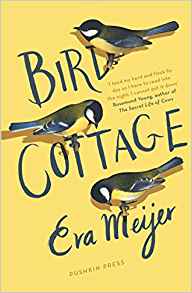
Guest review by Daniel Hahn: BIRD COTTAGE by Eva Meijer, translated by Antoinette Fawcett


"As much as anything, this is a book about communication and about relationships ... the reader feels a real warmth and joy emanating from the curious friendships that are its heart."

Daniel Hahn is a writer, editor and translator. "One way or another, most of my work involves books. I write them, translate them, edit them and review them. Quite a lot of what I do has a particular focus either on international writing / translation or on children's literature." A former chair of the Translators Association and the Society of Authors, as well as national programme director of the British Centre for Literary Translation and trustee for the Society of Authors, he has worked with a number of other organisations working with literature, literacy and free expression, including English PEN, The Children's Bookshow and Modern Poetry in Translation. In 2017 he established a new prize for debut literary translation - the TA First Translation Prize. More on Daniel's website.

Bird Cottage is based on the life of a real person, and a very unlikely life it was. But the novel itself feels somehow unlikely, too, not least because it took a Dutch writer to discover the story and evolve it into this excellent novel, to be beautifully translated by a woman in the north of England, and a copy of the published translation sent to me at home in East Sussex . . . just down the road from where the real story took place. Until Bird Cottage (originally Het Vogelhuis) popped through my letterbox, I had never even heard of Gwendolen Howard.

Len – as she was known – was born at the end of the nineteenth century, she had an Edwardian childhood in Wales, then moved to London to be a professional violinist. Becoming restless in her early forties, she gave up this career to retire to a cottage in Sussex, where she lived for four decades, with her windows kept always open to let the birds in. Birds were her passion, and she built a life to be shared with them – they had the run of her cottage at all times, and she befriended them, named them, studied them, and wrote about them. As a musician, she could differentiate between their songs, writing them down in musical notation.

Author and translator create two voices for the book: the main narrative thread, giving us Len’s telling of her life in the first person (novelist Meijer’s attempt to make sense of a person through a narrative), and short interspersed pieces of what are ostensibly Len’s own ornithological writings, focusing on one particular favourite of hers, a great tit called Star.

Bird Cottage examines the great turning point in Len’s life – what led to it, and its consequences – as she decides to rebel against social expectation and withdraw almost entirely from human society, from the inadequacies of human relationships and of human linguistic communication. (Worrying at these limitations is both a natural and a stressful thing for a novelist to engage with.) Along with her isolation, she attains a kind of emotional detachment from what is happening elsewhere – the death of members on her family, even the consequences of war.

Meijer herself is a writer about animals (a new non-fiction study of animal communication, Animal Languages, is also just out in English), and one of the things that interests her is Len’s place in the professional ornithological world. Her published work was best-selling, and widely translated, but dismissed by the scientific community, not only because she was inadequately qualified, and a woman besides (though this, too), but because her methodology was outside the prevailing scientific fashion. Her observational research involved watching birds close-up in something not too different from their natural habitat, rather than laboratory observation – at the time, the common practice was behaviourist study in lab conditions. Her desire to observe birds in the most natural, unconfined environment possible blurs the boundaries of her world and theirs, which in turn narrows the focus of Meijer’s story to one of the most extraordinary intimacy.

So this is a true story, which relies on the historical evidence that exists for Len Howard’s unusual life (the line separating fact and fiction here is a fuzzy one, of course); but there’s much more to it than just the curiosity value. This is not a piece of documentary but a novel, driven by some beautiful writing and by appealingly believable characters. The careful characterisation applies not least to the birds themselves, several of which (of whom?) recur as Len comes to know them well. As much as anything, this is a book about communication and about relationships, and – surprising though this may be – the reader feels a real warmth and joy emanating from the curious friendships that are its heart.

A post-script: when you’ve read the book (and you should), read Antoinette Fawcett’s fascinating piece in Asymptote about the lengths she to which she went to produce the translation.

Bird Cottage is published by Pushkin Press.

Monday, 4 November 2019

WILDING by Isabella Tree


"Essential, even exciting, reading for anyone interested in nature, wildlife, ecosystems and climate change." 

Linda Newbery is the editor of Writers Review. She has written widely for young readers and is currently completing a new adult novel.

'Until we understand what the land is, we are at odds with everything we touch.' Wendell Berry

What a fascinating book this is! It covers so much, overturning several preconceptions along the way, that I hardly know where to start. So I'll begin at the end, where Isabella Tree comments on the benefits of natural surroundings for mental health, and the sad fact that many people nowadays have little exposure - through choice or circumstance - to wild nature. Readers of this blog probably know that Robert Macfarlane and Jackie Morris were spurred to work together on The Lost Words - a beautiful book which won Jackie Morris a well-deserved Kate Greenaway Medal for illustration - by news that the Oxford Junior Dictionary was ditching such words as acorn, bluebell, wren and otter to make space for  terms deemed more relevant to today's world: celebrity, blog, broadband and suchlike. Macfarlane and Morris's widely-acclaimed collaboration is a timely and important book, and so in its different way is Wilding. 

Isabella Tree and her husband Charlie Burrell, inheriting his family estate of 3,500  acres, at first continued the arable and dairy farming already established there, but found that their hard-baked clay soil did not produce good yields. Could there be a way of letting their land fulfill its potential - not for commerce, but for wildlife? Inspired by a Dutch project on land earmarked for industry but then abandoned, they learned how the presence of grazing animals - greylag geese, then large herbivores - had produced surprising results; close grazing kept the water fringes clear and tree growth in check, providing habitat for a wealth of insects, birds and small mammals. It's often assumed that any fertile land, if left untended, will become mature woodland; but, as Isabella Tree points out, this notion overlooks the presence of grazing herbivores such as the ancient aurochs, tarpan and bison which preceded human intervention, later replaced by deer, domesticated cattle and pigs. Perhaps, she thinks, we have the wrong idea about ancient forests. She quotes Oliver Rackham: "To the medievals, a Forest was a place of deer, not of trees. If a Forest happened to be wooded it formed part of the wood-pasture tradition."

Wondering if this minimal-intervention approach would work with their own land, Isabella and Charlie sought grants from English Nature (now Natural England), the government's advisory body. Unlike most applicants for funding they had no clear plan for what was in effect an experiment: their plan was, over twenty-five years, to see what would happen if they fenced their land to make it deer-proof, a major expense, and introduced Longhorn cattle, fallow and later red deer, and Exmoor ponies. As in the Dutch project, they chose tough, sturdy animals that could fend and forage for themselves and withstand all weathers.

Copyright Knepp Wildland
Of course the Knepp project couldn't fully replicate natural ecosystems without including apex predators - lynxes or wolves - to keep the numbers of cattle, ponies and deer in check.The Dutch project, leaving weak and elderly animals to die from illness or starvation, had met with justifiable opposition; at Knepp, with the land crossed by footpaths, such a hands-off approach couldn't be justified on humane, aesthetic or even practical grounds. So the grazing animals are culled, and their meat sold. Apparently grass-fed beef is delicious, and pasture grazing is certainly the most environmentally efficient way of producing meat, although it's a luxury few can afford.

Copyright Knepp Wildland
The Knepp experiment, now sixteen years on, has produced inspiring results. Iconic species such as turtle dove, nightingale and purple emperor butterfly have moved in; beavers have been introduced, their dams creating marshy wetland which supports wading birds, amphibians and bog plants. The softening of water edges is so important for flood defences, another re-think: rather than funnelling water into hard-edged channels, it can effectively be dispersed and soaked up, to the benefit of pasture and wildlife. Another keystone creature is the humble earthworm, whose importance has been underestimated to the detriment of soil health.

Copyright Knepp Wildland
Few individuals will be able to replicate the Knepp experiment - Tree and Burrell owned a substantial swathe of land and were able to recruit expert help and funding. But I hope their findings will influence government and NGO policy on land management and conservation. Among many revelations, perhaps the most significant is that if we intervene less, nature can be trusted to restore itself. Whether there's time, in the face of climate breakdown, to attempt this on a wider scale, is impossible to know - we may be too far into our reckless uncontrolled global experiment with the world's climate and ecosystems.

I'd say that Wilding is essential, even exciting, reading for anyone interested in nature, wildlife, ecosystems and climate change - and I think most readers will find surprises and revelations to make them see the countryside, and our role in it, with fresh eyes. And I don't want to end without giving a flavour of the writing: although packed with information, comparisons and statistics, Wilding also has moments of lyrical joy, such as this description of a nightingale's song: "It throws the ear with unexpectedness ... florid trills, first rich and liquid, then mockingly guttural and discordant; now a sweet insistence of long, lugubrious piping; then bubbling chuckles and indrawn whistles; and then, suddenly, nothing - a suspended, teasing hiatus before the cascades and crescendos break forth again ... these pulsating strains issuing from tiny vocal chords belting out like organ pipes, throwing the music of the tropics into the English night air."

Wilding is published by Picador.

Find out more on the Knepp Wildland website.