What's on our reading piles? New publications, old favourites to return to, neglected classics, authors we've sampled and intend to read more fully? Here are the choices by ourselves and guests - including some new faces. A big thank you, as ever, to our many contributors - this wouldn't happen without them. We hope you'll find something to entice you here - and don't miss part 2 on New Year's Eve!
 Stephanie Butland:
 I was lucky enough to read an early copy of
The Confessions Of Frannie Langton, by Sara Collins, which comes out in April 2019, and it was one of the highlights of my reading year. A dark and beautifully written tale of murder, slavery, sugar and opium, it’s also a historical novel that feels painfully relevant to our times. I felt as though I held my breath through most of it. Gloriously good.
Philip Womack: I'm
most looking forward to continuing my way through Anthony Powell's
A Dance to the Music of Time - I've reached volume 5, and have been savouring it, coming to love its slow, perceptive movements. Ben Schott's P G Wodehouse homage,
Jeeves and the King of Clubs, looks like it will prove a treat over Christmas. On the children’s side, I’m excited about Alison Moore’s
Sunny and the Ghosts, about a boy whose parents buy an antiques shop full of spectral presences. And, as ever, like a warm bath I’m returning to my eternal dip in Samuel Pepys’s diaries, which I’ve been reading, on and off, for almost 15 years.
Linda Sargent: Dreams of the Good Life by Richard Mabey has been on my to-be-read pile for some time and it’s not through any lack of enthusiasm that it’s still there, quite the contrary. I’m an admirer of both Mabey’s writings and also the subject of this book, Flora Thompson. I first read her
Lark Rise to Candleford in the early seventies while studying Economic History at the University of Sussex and was immediately captivated. Despite being set in the nineteenth century, the rural Oxfordshire life she describes and the stories she tells, strongly resonated with my own background as the child of a farm worker in mid twentieth century Kent, as did her ambition to be a writer (although in my case that is still a work in progress...). It’s a book I’m savouring, for me part of the pleasure of this pile.

Adele Geras: I’m going to start 2019 by reading
The Wych Elm, the latest novel by Tana French. I’ve loved many of her previous Dublin-set thrillers, especially
Faithful Place and
Broken Harbour but have deliberately avoided finding out about this one, which is meant to be somewhat different. I’ll begin as soon as I’ve finished
Lethal White by Robert Galbraith (J K Rowling) which is my Big Christmas Treat Read!
Yvonne Coppard: For 2019, I’m returning to
If on a Winter's Night a Traveller by Italo Calvino, first read some years ago. It defies categorisation: a combination of narrative sequence and a journey into the reader’s own consciousness, intellect and experience. This time I will read more slowly, and uninterrupted; maybe I’ll finally understand what’s going on.
As a fan of Khaled Hosseini, I’m also keen to read his beautiful but devastating
Sea Prayer, inspired by the death of a three-year-old Syrian refugee, Alan Kurdi.
Graeme Fife: I’ve come to many authors late but, stoutly rejecting any sense of embarrassment about it, I rejoice, rather, in the discovery. James Baldwin’s
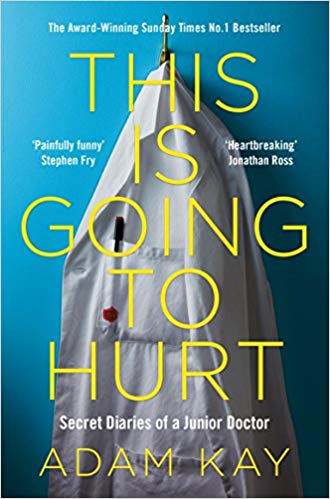
Go Tell it on the Mountain, the autobiographical novel about his coming to maturity in Harlem, grappling with a difficult relationship with his preacher father, introduced me to new riches in American fiction. Adam Kay’s
This is Going to Hurt…? Essential reading, I’d say. Scalpel in one hand, tickle stick in the other and huge compassion and humanity between. I’d not be without Seamus Heaney’s
100 Poems, a posthumous collection made by his family. Ah, but doesn’t his fine-tuned observation and framing speak for us all in our searching and contradictions.
 Celia Rees
: I very much admired Kate Atkinson’s
Life After Life and
A God in Ruins and I’ve been saving
Transcription as a special treat for the New Year. Female spies, Second World War and the post war period, all subjects and themes close to my heart. I’ve already reserved it for a post on Writers Review.
Pebbles on the Beach, by Clarence Ellis, was first published in 1954 and is now reissued with an introduction from Robert Macfarlane. I’ve collected pebbles since I was a small child, so pounced on it when I saw it in the wonderful South Kensington Books. I’m really looking forward to reading it and applying my new knowledge on beach and shore side. Another on my list of New Year Intended Reading is Deborah Robertson’s
Declutter - the get real guide to creating calm from chaos. That could present something of a challenge…


 Sue Purkiss:
 I'm looking forward to reading Elly Griffiths' new book,
Stranger Diaries. I'm a big fan of her Ruth Galloway series, and this has had great reviews, so I'm sure it's a treat in store.
And I intend to revisit an author I haven't read for many, many years - A J Cronin. He wrote hard-hitting books which often dealt with poverty and inequality in the 1930s, and I'd be interested to see if I still find them as impressive as I did when I first came across them.
 Sally Prue:
 My reading is haphazard and serendipitous, and the classics I haven't yet read are the ones I've been putting-off for half a century, so in some ways it's easier to say what I won't be reading (Proust and Anthony Powell are strong contenders, here). But Zola's
Germinal was amazing, so perhaps some more of
Les Rougon-Macquart if I happen to come across anything; and of course there's nothing quite as comforting as nestling down with a good old Trollope.
 Caroline Pitcher:
 My mind keeps returning to a novel I read earlier this year,
Sugar Money by Jane Harris. Based on a true story, it is told in lilting, rhythmic Creole by young Lucien from Martinique in 1765. He hero-worships his elder brother Emile and insists on joining him on a mission to smuggle back slaves from English owners on Grenada and return them to French friars. The vicious rivalry between slave-owning nations had not really occurred to me before reading this novel. Jane Harris has written a rollicking adventure with a touching sibling relationship, told in Lucian’s charming voice. All this serves to highlight the grisly cruelty and violence of the slave trade.
All my life, over and over again, the same scene, repeating in my mind.

 Katherine Langrish:
 Among the books I'm looking forward to (re-)reading this Christmas is Ursula LeGuin's novel
The Lathe of Heaven which I loved as a teenager. It doesn't seem to get the same attention as
The Dispossessed and
The Left Hand of Darkness (all such wonderful titles) but is just as brilliant. Quiet George Orr is too terrified to sleep because he believes his dreams change reality. When his initially sceptical shrink discovers this is true and starts manipulating George's powers for the good of humankind, things get really serious. Original, poignant, often funny, the book is a magnificent exploration of unintended consequences and the dangers of uncontrolled power.

K M Lockwood: I admit I do judge a book by its cover. When I saw Lucy
Rose’s artwork for The Familiars
written by Stacey Halls, I knew I coveted it. I pleaded and received a review
copy. A glance reveals a noose, a fox, parchment and plumes. Inside, you find women,
witchcraft and Pendle Hill. My sort of book - due out in February.
Help the Witch is
a short story collection from Tom Cox published by Unbound and illustrated by
Joe Mclaren. It too looks dark and imbued with foklore – but far more modern.
Interesting to compare and contrast.
Paul Magrs: There are two reading projects that I must return to when 2019 begins. I am reading Blockbusters – one for each year since my birth. I began with Mario Puzo’s
The Godfather from 1969 and I’ve been having an amazing, eye-opening time. I’ve been through
Love Story and
Jaws and I’m as far as 1977. Judith Guest’s
Ordinary People is next.
My other project is tackling the Beach House Books – i.e. the accumulation of heaps of novels everywhere in our house, overspilling into the Beach House. I’m putting myself on a book-buying ban once again, and I’m hiding from the world all January.
Anne Fine: I suddenly realised that neither of my daughters was living in this country while Posy Simmonds was doing her cartoons for the Guardian. Everyone’s coming for Christmas, so I’ve bought both daughters her superb collection,
Literary Life Revisited. Posy is unbelievably clever. She’s put her finger on every aspect of the writing trade. You recognise
everyone in every frame, and all of the situations and dilemmas.
And the greatest joy is that these books are so (comparatively) heavy that, though both my daughters will devour them during the holiday, at least one is likely to abandon her copy before the flight home. So that’ll be me in the New Year, steeped in delicious, genius Posy. I can’t WAIT.