Showing posts with label humour. Show all posts

Monday, 4 May 2026

Guest feature by Paul Dowswell: THE MANY-SPLENDOURED OBSCENITY OF VIZ


Paul Dowswell'
s journey from foolish youth to mithered old codger is near to its end. In between these two points he has written some books and hopes to write some more. His website can be found here.

The Inuit, famously, have over 40 words for snow. That’s nothing. Readers of Viz’s Profanisaurus, their “ever-expanding dictionary of contemporary profanity, euphemism and obscenity”, will know that the British have hundreds of words for the perineum. And there are probably just as many for assorted other nether regions and what you might be doing with them. And there are certainly scores more terms than the Bristol Stool Chart’s eight, for what might come out of your bottom.

Those who have never read it will probably regard Viz as an Olympic-standard wallow in schoolboy puerility. Well, I can’t argue with that. But it can also be very funny, and just as witty as anything the last 40 years has conjured up to amuse us. The Guardian ran a piece about Viz in 2021 and over 500 readers wrote in to share their favourite thing in it.

In its early ’90s peak it was selling almost as much as the Radio Times and TV Times. When I first started reading it in 1987, it seemed fantastically fresh. It spawned a host of short-lived imitators too, with titles such as Zit, Spit and Poot. They were equally obscene but they all lacked the spark of genuine invention and joie de vivre that Viz possessed in abundance. That’s not to say that Viz wasn’t also prone to alarming lapses of taste and judgement. But this piece is about the best things in Viz so I’m going to leave that can of worms unopened.

I could attempt to intellectualise its appeal and employ words like scatological, Rabelaisian, earthy, ribald – but in essence it was four young men who should have known better, trying to make each other laugh in a Newcastle pub with the most outrageously obscene ideas for comic strips they could think of.

Chris and Simon Donald, Simon Thorp and Graham Dury, and a rotating cast of contributors, certainly had a lot of them. And most of them were very funny. The initial idea – take the template of the Beano and the Dandy but have the characters you create doing bizarre and inappropriate things – was an instant success. The titles of the strips alone will give you the idea: ‘Buster Gonad and his unfeasibly large testicles’, ‘Sid the Sexist’, ‘The Fat Slags’, ‘Bertie Blunt, his parrot’s a c***’, ‘The Bottom Inspectors’, ‘Terry F***wit – the unintelligent cartoon character’.

More often than not, these strips were as one dimensional as their names would suggest. But occasionally, Viz would come up with something deeper and more disturbing. Victorian Dad, for example, featured a nightmarish modern-day parent with the mindset of a puritanical Victorian. He becomes sexually aroused by the sight of table legs and beats his son every day to remind him that life isn’t fair. Another character goes by the unlikely name of Fru T. Bunn. A baker by trade, Frubert Bunn, whose daughter is, of course, called Chelsea, is an extraordinarily vivid portrait of middle-aged male sexual frustration. He channels his sex drive into the creation of gingerbread sex dolls and most episodes end with him grievously injured in Beano-style bandages and Plaster of Paris.

In its heyday the writers often seemed to be vying with each other over who could scrape through the barrel and go right down to the Earth’s core. Dr Poo (Tom Baker era Dr Who searches in vain through time and space for a quiet, unoccupied lavatory where he can ‘go’.) Dr Poolittle (a Doolittle-like character suffers from constipation), Billy Bottom and his zany toilet pranks – go on, have a guess…

The similarity in style to the Beano and the Dandy even presented the characters talking directly to their audience. ‘Hello readers. Today I’m going to…’ Funniest of all, and nearest to the Beano in its lack of swearing and material of a sexual nature, was Johnny Fartpants (Tagline “There’s always a commotion going on in his trousers.”) Schoolboy Johnny even has a German pen pal called Hans Honkyhosen, who visits from time to time. On one occasion (best suspend your disbelief here...), as an April Fool prank, Johnny furtively ‘buries’ a fart in a cake mix his mother is preparing for a visit from the vicar. The fart then springs out when the vicar cuts the cake. (Of course it does…). Even if you are appalled by the subject matter I invite you to admire the sheer ‘leaping off the page’ gusto of the artwork. The episode takes a nightmarish turn when Johnny’s exasperated parents feed him quick drying cement disguised as porridge to clog up his alimentary canal and put an end to his ‘bottom pranks’.

 Viz’s fondness for mixing high art and science with low humour was also a frequent feature. One quiz tie-breaker invited readers to name their favourite noble gas. The comic strip The Bach that dogged in the night featured JS Bach taking a break from his cantatas to go dogging in a nearby forest, much to Mrs Bach’s displeasure. Max’s Plank featured the German atomic physicist Max Planck as a schoolboy, getting up to mischief with a magic plank.

More than anything, Viz loved a pun – evidenced here in a one-off 2003 strip by relatively new boys Barry Farmer and Lee Healey, and their terrifying creation Vidal Baboon:

r/Viz - Your stylist will be with you in a minute: Would you like a coffee while you walt? Vidal Baboon Yes please; SKRIEKE IRe KYM;y HAcK; X SKREEE SKRAAA Gaspl Y-Yes_ GRAAE vidal baboon That's very er, nice . Snip SKRIIKE

 One thing I quickly grew to love about Viz was their complete disregard for the bottom line (so to speak). They took enormous risks in offending both a potential readership and the advertisers that flocked to present their wares in their unexpectedly vast circulation publication. The Clown Chat Line spoof below is a perfect example of Viz having its cake and eating it too. At the time (early 1990s) the back pages of their comic, along with the UK’s downmarket tabloids, were festooned with real-life telephone sex lines, the advertising of which no doubt brought their publisher a substantial income.

25+ Clown Memes To Send In - Memebase - Funny Memes

 True, most of the Viz output was and remains cheerfully obscene, but they could also be admirably prescient. One long running character Timmy Timpson (appearing in Spoilt Bastard) is a hideous eight-year-old in a sailor suit whose adoring mother Cissy submits to his every whim. He has milkshake and Skittles for breakfast and habitually calls his poor mother a ‘fat old toilet’. The strip had the unsettling effect of making the reader wonder if they had ever behaved quite so appallingly, or indeed allowed their own child to do so. But one particular episode, shown below, from a 1997 edition of Viz, uncannily predicts the political landscape of 2026:

 And Viz could produce contemporary satire just as sharp as Private Eye. Here’s a strip featuring the vainglorious Luvvie Darling – a rather Daily Mail inspired caricature of those actor types – approaching a vanity publisher with his memoirs. I grew to detest vanity publishers while teaching creative writing classes and hearing stories about them from students, so there is much to relish in this depiction:

 And finally, I have to include one of Viz’s magnificent advertising spoofs, this one for a ‘Sexual Temperance Spoon’, designed to discourage unwanted amorous advances. Whoever came up with the slogan ‘The only spoon that stops stirring’ has earned my undying admiration. 

All illustrations reproduced by kind permission of Fulchester Industries/ Diamond Publishing.

Monday, 16 March 2026

Guest review by Jane Rogers: THE MATCHBOX GIRL by Alice Jolly


"As with all the best historical fiction, Jolly has written a novel which is only too relevant to our times ... "

Jane Rogers has written ten novels, including The Testament of Jessie Lamb, Man-Booker longlisted and winner of the Arthur C Clarke Award 2012. Other works include Mr Wroe's Virgins (which she dramatised as a BBC drama series), and Promised Lands (Writers' Guild Best Fiction Award). Jane also writes short stories, radio drama and adaptations, and has taught writing to a wide range of students.

Her latest collection of climate-themed short stories, Fire-Ready, is out now in paperback; five of the stories were read on BBC Radio 4's Book at Bedtime in March 2026. For a review by Lesley Glaister, and a Q&A with Jane, see below. For more information, see Jane's website.

This is an extraordinarily ambitious novel, set in Vienna before and during World War 2, and based on real events.

In Vienna in 1934 there’s a progressive residential centre for children with learning difficulties, children who today would be termed neurodivergent. The director is kindly, humane scientist Dr A (the real life Asperger). Our heroine and narrator, Adelheid, is a mute 12 year old inpatient. She has an unusual mind, the kind of mind Dr A is researching in order to better understand and teach children like her.

Instead of speaking, Adelheid writes things down; her passion for the truth, her intelligence, and her eagle-eyed attention to detail, make her a valuable assistant to Dr A, and over time she progresses from patient to member of staff. These qualities also make her a brilliantly unbiassed chronicler of the Nazis’ growing power and influence over Viennese life. Initially, like everyone else, she’s thrilled by the pomp and pageantry, the marching and singing.

But gradually she notices that certain staff members are disappearing – fleeing to America, or simply vanishing overnight. Jewish people. She observes that Dr A is being put under increasing pressure to turn his patients into ‘useful’ citizens. And that those who are unlikely to ever be ‘useful’ are being transferred to the sinister Am Spiegelgrund, a new children’s hospital where visitors are not permitted, and children are never heard of again.

This is a truly heart-breaking coming of age story, as naïve, truth-seeking Adelheid gradually comes to understand not only the extent of Nazi wickedness, but also to recognise the necessity – for people like Dr A – of playing along with it, in order to retain any agency at all. It is a bitterly accurate portrayal of the way in which fascist thinking can creep into people’s lives, and how, without in any way subscribing to antisemitism or child euthanasia, bystanders can become complicit. As with all the best historical fiction, Jolly has written a novel which is only too relevant to our times.

The subject matter is tragic, but mercifully this novel is not only uplifting, but often comic, thanks to Adelheid’s eccentric and original narrating voice. Here’s a taster:

‘I begin this Story on the day of 25 July 1934, a moment well known in the History of my Country of Austria. Personally, I do not remember that Day for the same reasons as do others. The World is so Extremely Busy, many things Happening all at once. (Adelheid – Do not go off down a Tram Track. Stick to the Facts.) The point is that on this day here is Adelheid Brunner (twelve years old) and she is arriving at the World-Famous Weiner Kinderklinik or Vienna Children’s Hospital. She has in her pocket Franz Joseph, who is named after a Habsburg Emperor, but is a Rat.’

The Matchbox Girl is published by Bloomsbury.

Jane Rogers' Fire-Ready reviewed by Lesley Glaister.

A Q&A with Jane about Fire-Ready.


Monday, 1 December 2025

Guest review by Tania Pettet: THE WOMAN WHO WENT TO BED FOR A YEAR by Sue Townsend


"She has always been a master of voice — from Adrian Mole to The Queen and I, she writes with a kind of democratic empathy that sees everyone’s absurdities without cruelty."

Tania Pettet is a lifelong writer and observer of people. A background in nursing honed her gift for listening, while her writing explores the emotional, historical, and sometimes fantastical threads that connect lives. She writes poetry and prose inspired by memory, landscape, and the quiet stories that shape us.

Her debut novel, 11 Warten Way - a dual-timeline family saga set between wartime Italy and postwar Britain - is rooted in the true story of her grandparents. It explores how love, loss, and resilience define who we become.

Find her on Instagram: @tpwordhug

"Sometimes doing nothing is the only thing left to do.”

I grew up reading Adrian Mole; he and I were the same age. Townsend’s wit, warmth, and eye for human folly shaped how I saw the world, and her humour became a kind of companion. When I was fourteen, a car accident left me hospitalised for weeks, and books became my refuge. I read both Sue Townsend and J.R.R. Tolkien during that time — two very different worlds, yet each offering escape and perspective in their own way. Even then, I understood that Townsend’s laughter was never cruel — it was the laughter of someone who knew how pain and absurdity often live side by side.

At first glance, The Woman Who Went to Bed for a Year is a deceptively simple story. A woman, overwhelmed by her family’s chaos and her own unacknowledged needs, opts out of it all. But Townsend’s genius lies in her ability to make this small domestic rebellion into a mirror of modern life. Eva’s bed becomes both a refuge and a battleground — a place where she reclaims the boundaries that motherhood, marriage, and habit have eroded.

What’s remarkable, especially in hindsight, is that this was Townsend’s final novel before her death in 2014. It reads like a valedictory work — still funny, still irreverent, but laced with melancholy. Beneath the wit lies a weariness that feels utterly authentic. Townsend, whose own health struggles were well known, writes about collapse not as weakness but as a form of truth-telling. When Eva says no, she is not refusing the world so much as demanding to exist within it differently.

Townsend’s prose is plain but piercing. She has always been a master of voice — from Adrian Mole to The Queen and I, she writes with a kind of democratic empathy that sees everyone’s absurdities without cruelty. Here, she turns that same eye on middle age, marriage, and mental overload. Even her caricatures — the pompous husband, the self-absorbed twins, the sanctimonious neighbours — are given enough shading to feel real.

One of my favourite characters is the window cleaner, Alexander. His gentle friendship with Eva becomes a quiet thread of humanity running through the story. Their conversations are often simple, sometimes awkward, but full of kindness. In Alexander, Townsend gives us an ordinary man who listens — truly listens — and through that act, offers Eva a kind of salvation. The stillness between them, often so understated it could be missed, becomes one of the most tender elements of the novel.

What lingers most, though, is the loneliness. Eva’s retreat draws attention from journalists and strangers, yet no one truly listens. In one sense, she becomes a minor celebrity for doing nothing; in another, she becomes a ghost in her own home. Townsend captures this paradox with tenderness — how modern life can make connection look busy while feeling empty.

There’s also a strong undercurrent of social critique. Townsend skewers the cult of productivity long before it became a buzzword. The novel asks what happens when a woman stops performing usefulness — when she steps out of her designated roles as mother, wife, and domestic anchor. The result is chaos, of course, but also clarity.

The Woman Who Went to Bed for a Year may masquerade as a domestic comedy, but it’s really an elegy — for women’s unseen labour, for middle-aged dreams deferred, and perhaps for the author herself. It’s a novel that begins with exhaustion and ends with a quiet kind of freedom.

Townsend’s voice remains singular: funny, humane, and unflinchingly observant. In Eva Beaver, she created not a heroine but an everywoman — someone who, by finally doing nothing, exposes everything that’s wrong with how we live.

The Woman Who Went to Bed for a Year is published by Michael Joseph (hardback) and Penguin (paperback).


Tania's 11 Warten Way is published by Terreni Press.


Monday, 17 March 2025

Guest review by Penny Dolan: SMALL BOMB AT DIMPERLEY by Lissa Evans


"A novel that cheers the heart. She writes with a wry sense of the comedy and tragedy of life ..."

Penny Dolan works as a children’s storyteller and writer. Her last novel for older children, A Boy Called Mouse, was nominated for the Young Quills Historical Fiction Award, and she is currently completing a companion book. She posts on The History Girls, on An Awfully Big Blog Adventure and can be found on Twitter @PennyDolan1.

Lissa Evans’ Small Bomb at Dimperley is a novel that cheers the heart. She writes with a wry sense of the comedy and tragedy of life, and with a sympathy for her characters, no matter how flawed they prove themselves to be.

I had loved her previous three novels, set between 1918 & 1945: Old Baggage, Crooked Heart and V for Victory. Written with a joyful sense of humour and an awareness of the absurd in life, it is clear that Evans is familiar with these decades. Her earlier historical novel, Their Finest Hour and a Half, is about a young female copy-writer drafted into the Ministry of Information to add a woman’s perspective, and was later made into a film.

This recent novel, Small Bomb at Dimperley, begins in 1945 and deals with a society used to war, to hardship and to bravely making the best (or the most) of it. Now that the Peace has been announced, people are faced by a different world. Do they look to the past, or the future?

The main focus, the fictional Dimperley House, is an almost symbolic place from the past: an Elizabethan manor house in the Buckinghamshire countryside. Past generations had adorned the exterior with architectural whims and stacked the inside with curiosities, including an unseen ghost in a passageway.

Dimperley withstood bombing by passing aircraft, the roughness of army requisitioning and practical neglect as a war-time mother-and-baby home. The house has survived the war, but how, under a new Labour government, will it survive the peace?

Evans fills her novel – and Dimperley - with a rich collection of characters. The imperious Dowager Lady Irene Vere-Thisset has remained in occupation, along with her brother Uncle Alaric, a reclusive archivist and Cedric, her brain-damaged middle son. Also resident is Lady Barbara, the Dowager’s bullied daughter-in-law, along with a few devoted and less devoted servants, an old horse in the stables and the Dowager’s yappy dogs. Adding to the air of irritation are Kitty and Priss, Barbara’s rebellious teenage daughters, appalled by Dimperly’s deprivations after the plenty of childhood years spent in California.

And then it happens: a telegram brings news from the Far East. Handsome Felix, the adored son and heir, was missing but is now definitely dead. Consequently, Valentine, the youngest son, who has served the war years as a lowly army Corporal, is summoned home to become, unwillingly, lord of the manor. He has to face what Felix’s death has brought: a large and long-avoided inheritance tax demand and a storm of financial troubles.

How will the awkward, injured Valentine, known at school as ‘Thicko’ Thisset, manage to deal with all the debts and responsibilities and paperwork? How can he make the money needed to deal with the crisis? Who should he marry for money – and should he? And of course, there are the complications of Felix’s personal legacy.

Dimperley is, at heart, an almost traditionally romantic novel: by chance, dull Uncle Alaric has employed a capable young woman, Mrs Zena Baxter, to assist him in writing his history of the house. For Zena, and her determined two-year-old daughter Allison, Dimperley is a magical place. Zena, who grew up in grim circumstances, is determined to help the house and grounds survive. The novel is as much Zena’s story as it is of the Vere-Thisset family; gently reminding the reader that history belongs to us all. Eventually, when all the alarms and subterfuges are over, the expected ending comes as a satisfying pleasure.

The plot within Small Bomb at Dimperley stretches way beyond the manor gates, offering the reader a wide cast of characters: moneyed middle-classes, salesmen, shopkeepers and delivery drivers; women at home and church fetes, men in pubs and clubs, all the remains of the old class-bound society all struggling to seize a place in this new era.

I felt, as the story grew, that the author was gently honouring the many ordinary people who endured the war years on the home front: those who were ordered about, sometimes with ignorance, and forced to accept all manner of official regulations without being recognised in return. Now, in 1945, as the nation’s public life moves on, their quiet sufferings are ignored and invisible.

But not here, within Lissa Evan’s lovely book. I do recommend this novel: a perfect mix of nostalgia, poignancy, written with humour and for today’s audience. Although the ‘quiet’ might depend on how easily you laugh aloud.

Here is one of the many smaller moments, as Barbara takes the injured Valentine out in the car.

The whole road surface as far as the East Lodge was in a dreadful state and Valentine jammed his good hand against the roof to keep level, as they lurched between the potholes. His sister-in-law steered with immense concentration, her knuckles white, her gaze rigid.

‘When did you learn to drive?’

‘When the chauffeur left. It was just before Dunkirk, I think, and he told everyone he was joining the marines, and then it turned out he was driving a tea van around an airbase in Cheadle.’


Additional News. Doubleday have just published Lissa Evans’ ‘Picnic on Craggy Island: The Surreal Joys of Producing Father Ted’, a slim hardback based on her diary notes and memories as a producer on that famous comedy tv series. It would be interesting to read this alongside episodes of the Father Ted  TV series still available on Youtube or other platforms. Lissa Evans’s novels for children include Wed Wabbit and Wished.

Small Bomb at Dimperley is published by Doubleday

Lissa Evans' Old Baggage is reviewed here by Pippa Goodhart

More of Penny's choices:

Lessons in Chemistry by Bonnie Garmus

The Secrets of Wishtide by Kate Saunders

Seven Miles of Steel Thistles by Katherine Langrish

Monday, 8 January 2024

SPECIAL FEATURE: Q & A with Julia Jarman about her novel THE WIDOWS' WINE CLUB


"It’s hard to define ‘voice’ but you can’t get going without it, and when I found my writing-for-adults voice it was a joy, like talking to a friend."

Julia Jarman, a regular contributor to Writers Review, has been writing children’s books for forty years, and still is. Cheeky Chick is her latest picture book. Recently, though, she turned her hand to ‘golden years’ women’s fiction and The Widows' Wine Club was the happy result. 

Linda: The starting premise of your novel is a brilliant one, with instant appeal. Were you always aware of how the novel would end for each of the three characters?

Julia: You told me it was a brilliant premise, Linda, when I first mooted the idea. I wasn’t so sure. I had a title in mind, I think, Widows In Love, and saw it as a rom-com. Three widowed women looking for love. It was as vague as that. I didn’t have specific outcomes in mind. I wrote the first draft to find out. You and other friends had begun writing for adults, after several years of successfully writing for children. I wondered ‘Can I?’ – as I like a new challenge - and you said firmly, ‘Yes you can!’

Linda: Did you find it equally easy to engage with each of the three main viewpoint characters? I know that the novel has been several years in the making – how have they developed during this time?

Julia: It has been a very long time in the making! I got the idea soon after my husband died in 2009 and thought of it as ‘Peter’s last gift to me’ but also felt guilty for exploiting the situation. It felt like an invasion of privacy, his privacy, our privacy, and that feeling may have held me up. But Peter had always encouraged my writing and said ‘use anything you like’ when I’d expressed similar reservations in the past. Sweary Viv was the first character who arrived in my head, probably because she is most like me, but I’ve also got a prim and proper side – believe it or not! – and was downright Puritanical in my youth, so I easily identified with Janet and knew where she was coming from. Zelda turned up, and aware of the ‘appropriation’ issue, because she’s mixed race and I am not, I hesitated, but she soon felt very real and insisted on staying and I loved her, so I thoroughly researched to find out as much as I could about her circumstances and carried on writing. All three developed over time. I discovered them as they discovered themselves, becoming more complex, acquiring ‘layers’ as I wrote and re-wrote, drawing on memory, research and imagination.

Linda: I especially like the Pitmen Painters scene. Is this an exhibition that has particular resonance for you?

Julia: Yes! Like Viv, the first I heard of it was when I went to see Lee Hall’s play, Pitmen Painters. It said, it enacted, what I believed, that human beings are makers, that we are more alive, more ourselves, more human when we create. That is what one of the characters says in the play. When he is working down the pit for the bosses he is not truly alive, not truly himself, but when he draws or paints, when he is depicting his reality, expressing his truth, he is. When I eventually stepped into the gallery to see the exhibition I felt I’d entered a holy place, embodying that truth.

I should also say that my father was a coal miner, briefly, three days and that was enough for him. He was put down the pit when he was fourteen and felt that a life in the mines would kill him, spiritually if not physically, though he wouldn’t have put it like that. He thought that no one should have to do that, and I felt that I was connecting with him.

AdèleTell us a little about the journey the manuscript took on the way to becoming the book it is today.

Julia: It had a lot of rejections, mostly nice rejections, but nonetheless disheartening. It first went out with the title A Second Summer, to fourteen mainstream publishers of women’s fiction, at the beginning of 2021. Some didn’t respond. Most did, complimenting me on ’wonderfully drawn characters’ ‘the balance of humour and depth’, ‘captivating style’ etc, but then came the ‘but not for me’ for a variety of reasons. Caroline, my agent concluded that it didn’t have the ‘SOH, the stand-out hook’ essential for commercial fiction and there was no point in sending it out again till it did. I was a bit nonplussed as I thought the SOH was the basic premise. Three women hit hard by grief, are looking for love. Will they find it? But I licked my wounds, re-read and re-wrote it, bearing in mind the feedback I’d had from editors and lay-readers. Several said they were confused by the to and fro-ing between the three characters, so I tried to put that right. I also strengthened a thread with an unpleasant minor character, making her more unpleasant, adding plot twists. I sent it out to more readers, including Georgia Bowers, librarian i/c of women’s fiction at Bedford libraries (and a writer herself), asking her to be ruthless in her criticism. Would she buy it for the library? She got back saying yes she would, but not with that title. She suggested The Widows’ Wine Club which I now think is its SOH.

In June 2022 my agent sent The Widows’ Wine Club out to nine smaller publishers of commercial fiction, and I got eight more rejections. Then came an expression of interest from Boldwood Books, a brand new publisher, only three years old. Editor Sarah Ritherdon had ‘thoroughly enjoyed’ my novel but had lots of doubts. It was hard to launch debut authors, she said. My 35 years as a children’s author counted for nothing. She asked my agent, ‘Had Julia got famous friends who would plug her book? Could Julia write more books? Quickly!’ Boldwood didn’t take one-offs. They only did multiple-book deals and their marketing plan required second and third books only months after the first. Gulp. The Widows’ Wine Club had taken me at least ten years. Could I write the next in ten months? Yes, said my friends – and I have!

AdèleHow many drafts did you go through? (I think the answer might be inspiring to other writers.)

Julia: Umpteen. I lost count. Ten at least, and I do a lot of re-writing as I write.

AdèleIs any character in the novel based on a real person? I’m assuming all three widows have bits of you in their DNA!

Julia: Assumption correct about use of my own DNA! I’ve said quite a lot about this to Linda. As to the ‘real person’ question, I’m going to hide behind the standard disclaimer ‘any resemblance to actual persons, living or dead, is purely coincidental’. I’ll risk saying that some of the characters are composites of people I’ve met, but sorry - that’s as far as I’m going!

Celia: This is your first novel for adults – when and why did you decide to write for an adult audience? How difficult did you find it to make the move from a writing career that was well established to this very different and challenging market?

Julia: I think the story dictates the audience, so when I have a story in my head I ask myself, consciously or unconsciously, is this a picture book for under-5s, a chapter book for 8-12 or a book for teens? This story was clearly for adults. The difficulty was finding the time to write it as I was very committed to the world of children’s literature and that for me included a lot of school visits. I was finding it hard to find uninterrupted time to write longer fiction for children, and was veering more and more towards picture books, which I love writing, when Covid changed all our lives. Suddenly I had time on my hands and a story in my head, partly written, for adults. I fished out my widows.

Writing for adults is, I think, easier than writing for children, which is why so many writers going the other way, or having a ‘go’ for their first book, come a cropper. They think – heaven knows why – that it must be easier. It isn’t. When you are writing for children you have to be aware that you’re writing for an intelligent audience, probably more intelligent than you the writer, but your readers haven’t had as much experience as you. They don’t know lots of stuff that you know, so you have to impart information and explain concepts in a non-patronising way that respects their intelligence. By comparison when you write for adults, you can assume their experience is much the same as yours. It’s therefore easier to find your ‘voice’ as a writer for adults. It’s hard to define ‘voice’ but you can’t get going without it, and when I found my writing-for-adults voice it was a joy, like talking to a friend.

Celia: The Widows' Wine Club is bittersweet in the truest sense. How hard was it to find the right balance between humour and pathos?

Julia: I didn’t think about this. I just told it how it was, being as true as I could to my experience and that of other widows I’d spoken to. I am I think, unconsciously funny. I come across as funny even when I’m crying inside . I’m not sure why this is, but looking back I think I’ve always made people laugh. A testimonial I like said, ‘People laugh a lot in Julia’s company and if they don’t, she does. She is serious but splendidly without solemnity.’ If that was the verdict on my books I would be happy.

Celia: Your widows are an attractive and likeable group who will appeal to many readers. I understand that you're working on a sequel. Will there be more after that?

Julia: I’ve just delivered the sequel which has a new main character, Libby Allgood. I’m hoping that readers will love Libby as much as they love Viv, Janet and Zelda, and not be disappointed by this change of focus. Reviews have made it clear that readers want the sequel to tell them more about the three Muscateers, and it will, a bit. But they will have to wait for the third book to learn a lot more about all four when I take them on another adventure.

The Widows' Wine Club is published by Boldwood. Widows on the Wine Path will be published on 3rd April.


Monday, 23 October 2023

Guest review by Graeme Fife: CULTURAL AMNESIA by Clive James


"James is a wonder: the breadth, the stretch of his curiosity, the range of his cultural interest both in ideas and literature is extravagant, the depth of his knowledge profound..."

Graeme Fife is a regular reviewer here. He has written many plays, stories, features and talks for radio, stage plays and articles for newspapers and magazines, and is a regular contributor to BBC Radio 4's From Our Own Correspondent. He's the author of a string of books - children's stories, biography, works of history and fiction. His novel of the French Revolution, No Common Assassin, tells the story of Charlotte Corday.

Where to start…? The fecundity of knowledge, the extent of learning, the restless fever of curiosity to discover more…it makes one feel like a lazybones, a mere beginner…

Introducing another acerbic comic song at the height of his celebrity, the late Tom Lehrer* said: ‘Some people make you realise how little you’ve achieved. It’s a sobering fact that when Mozart was my age, he had been dead for three years.’

I received this book as a gift but it is a gift in itself. James is a wonder: the breadth, the stretch of his curiosity, the range of his cultural interest both in ideas and literature is extravagant, the depth of his knowledge profound, add to this his wit and style and you hold in your hands the remarkable gathering of a lifetime’s inquiry into the human mind and heart.

The book comprises vignettes, some in quite extended essays, of individuals whose life and work has either enriched or compromised their existence. For the most part the men and women whom James remembers and speaks of, he recalls with affection and praise. Not always – he is not averse to censure and sees through cant or failed promise and I need not enumerate those whom he castigates. By and large, the censure they get they most obviously deserve. ‘Like his boss, (Goebbels) was able and industrious. He didn’t miss a trick. All he missed was the point.’

For some of the people celebrated in the pages of this totally compelling book, their legacy is an example, a very demanding example, of fortitude and integrity. Sophie Scholl (to whom the book is, in part, dedicated) was condemned by the Nazis for conducting a fearless pamphlet campaign against their venomous autocracy with her brother and friends, members of the White Rose resistance group. ‘Finally,’ she told the court, ‘someone has to make a start. We only said and wrote what many people think, they just don’t dare to express it.’

As Edward Gibbon (cited here by James in a separate chapter) said of life under the Emperors: ‘To resist was fatal and it was impossible to fly.’ The Gestapo offered Sophie Scholl respite if she recanted. She refused and the executioner, who in a small pity, took her first having allowed the condemned to smoke a last cigarette together, said that he had never seen anyone die so bravely. As James reports: ‘She just glanced up at the steel, put her head down and she was gone. Is that you? No, and it isn’t me, either.’ She was barely twenty-two.

Alongside the frankly solemn, even reverential, there is joyous mockery. His story of Albert Camus gives opportunity for a lively digression on the dumb bigotry of autocrats, their aversion to what Shakespeare’s King John calls ‘that idiot laughter’ and it’s a riotous comic gem: I cried with laughter. It’s evidence of the cool style of the man, his ecstasies of humour, so to put it. Nor does James the raconteur ever fail in wit, though his asides are never acidic, always gentle. In a captivating digression on the choice of book titles, he writes: ‘(T. S.) Eliot's own idea of a terrific title was Ara vos prec, a sure-fire hit with any bookshop browser who spoke medieval Provençal.’

In the portrait of Diaghilev (‘Why should I waste my imagination on myself?’) he riffs on the contrast between the exquisite structure of the work with the hopeless disarray of the life’. Of Auden: ‘The man whose lyrics were showpieces of carpentry – try to imagine a poem more accurately built than The Fall of Rome – kept a kitchen that could have doubled as a research facility for biological warfare….(he) lived long enough for me to see his tie. I thought it had been presented to him by Jackson Pollock until I realised that it was a plain tie plus food.’

Of Heda Margolius Kovály – heard of her? Nor I … look her up, read on – ‘If the world can’t be ruled by the values that come naturally to a woman like her, how can it be worth living in?’ There were, on the other side, apparatchiks and I won’t name them but what emerges from James is an urgent sense that he has thought deeply about these people and their contribution to our culture, thought very hard indeed and is, therefore, to be relied on. Yeats, he acknowledges had some pretty batty ideas about mystic inspiration, the spiritualist claptrap which vitiates much of his early work, but he eventually saw through it and his magnificent later poetry confirms how ‘art was, for him a system of solid knowledge by far transcending his own fads.’ That is the triumph of his intellect and his allegiance to the deeper requirements of the work. This book is peppered through with such gemlike insights into the matter of artistic creation, social idea and action, the driving force of human courage in the face of adversity, such as the ‘misuse of language linked to fraudulent politics’. It’s generous, unfailing in honesty and an absolute delight. As I say: a gift in and of itself. With astonishing skill James combines penetrating enquiry with an aphoristic style, a happy blend which has a particular attraction: the steady unpeeling of reputation, deserved or not, with sudden explosions of mirth and brilliant turn of laconic phrase..

Cultural Amnesia is published by Picador.

*Updated following the death of Tom Lehrer in July 2025.

More of Graeme's choices:

A Telling of Stones by Neil Rackham

At the Existentialist Cafe: Freedom, Being and Apricot Cocktails by Sarah Bakewell

The Piano Tuner by Daniel Mason

An interview with Graeme about No Common Assassin, his novel of the French Revolution

Monday, 3 October 2022

Guest review by Fran Hill: AND AWAY ... BOB MORTIMER, THE AUTOBIOGRAPHY


"He self-effacingly champions the underdog, perhaps because he himself has always felt a little underdoggy, if I’m reading him correctly."

Fran Hill is a humour writer and retired English teacher from Leamington Spa. Her funny teacher-memoir Miss, What Does Incomprehensible Mean? was published by SPCK Publishing in 2020. Her first full-length novel Cuckoo in the Nest is about sibling rivalry in a foster care situation and will be released by Legend Press in March 2023.

I could start this review with ‘You know, Bob Mortimer of Big Night Out and Shooting Stars with Vic Reeves in the 1990s.’ You know.

But that would be disingenuous. Mortimer wasn’t on my radar until his coy but hilarious monologues on the BBC’s Would I Lie to You and appearances on Gone Fishing with Paul Whitehouse. When the autobiography came out in 2021, I impulse-clicked on ‘Order Now’ before I could check my bank balance.

I’ve caught up on those earlier shows now, thanks to Youtube. Some elements are so surreal, I’m left bewildered, but Shooting Stars grew on me. What improvisational genius!

If you saw the first episode of Gone Fishing in 2018, you’ll recall that it starts with Mortimer and Whitehouse bonding over potentially fatal heart conditions and consequent re-evaluations of life’s meaning.

And Away begins similarly in October 2015 when Bob is 56, his life ‘trundling along like a podgy golden retriever being dragged along the pavement by an indifferent owner’. He’s about to embark on a UK tour with comedy partner Reeves to celebrate 30 years in the business. But sudden chest pains propel him to a cardiologist. Tests show that up to 98 per cent of Mortimer’s arteries are blocked. Without urgent surgery, he is in immediate danger. The tour is on hold.

After that first dramatic chapter, the second flashes back to Mortimer’s Middlesborough childhood, and Part 1 of the autobiography is structured like this: a chapter about his slow recuperation from heart surgery, interspersed with coming-of-age stories, including the death of his father in a car crash when Bob is 8, the development of Bob’s shy personality after this, and his early law career. The book is pacy: Mortimer is handy with cliff hangers.

Part 2 recounts his accidental arrival into comedy. A friend invites the lonely, recently love-spurned Mortimer to a comedy night at the Goldsmiths Tavern in New Cross, London, where he encounters Vic Reeves Big Night Out. He says, ‘I felt like I had seen the past, the present and the future of comedy.’ Weeks later, Reeves invites Mortimer onto the stage to play a bit part and the seeds of their farcical double act are sown.

In Part 3, Mortimer tells us about Shooting Stars, the surrealist and bizarre game show that found fame in the early 1990s, with 72 episodes over 8 series and with celebrity guests, some clearly less comfortable with the nonsense than others. Regulars included Ulrika Johnson, Matt Lucas, and Mark Lamarr.

Mortimer also describes his failures. For example, an attempt at proper, scripted TV acting teaches him that his talent is in improvisation: ‘It seems that maybe the one context where I can actually act is where there isn’t any script – just good, old-fashioned storytelling.’

The final sections include detail about Gone Fishing and necessary lifestyle changes since his heart surgery. He also honours key players in his life: his wife Lisa, mum Eunice, and his comedy partner, Vic Reeves. His portrayal of his mother throughout is affectionate and funny: he includes a list of things she taught him, including ‘How to tell if a melon is ripe’ and ‘A blanket beneath you is worth two above’.

He adds similar tips of his own, including 'Keep the filters clean in all your appliances’ and ‘Tired of pie, tired of life.’

Mortimer’s essential kindness and gentleness thread through the book. His degree was in Welfare Law and he self-effacingly champions the underdog, perhaps because he himself has always felt a little underdoggy, if I’m reading him correctly.

Mortimer plays with our minds a little. Watch out for the Would I Lie to You chapters in which he mirrors the show’s format by relating a series of incidents, one of which is complete fantasy. It’s fun guessing.

Similarly, a final final chapter, placed after the chapter entitled The End, is about his favourite music including an obsession with Joni Mitchell.

Right. That’s the review done. Back to Youtube.

And Away is published by Gallery UK.

Cuckoo in the Nest will be published by Legend Press.

Monday, 4 July 2022

Guest review by Sue Clark: REASONS TO BE CHEERFUL by Nina Stibbe


"Humour is as hard – some would say harder – to pin down on the page than so-called serious stuff ... That’s why, when comedy works, it is such a joy."

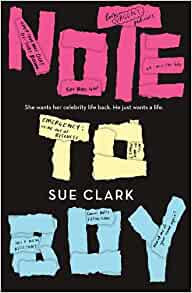
Sue Clark’s comic fiction, Note to Boy, was published in 2020 and received a PenCraft Award for Literary Excellence. She’s been a writer virtually all her professional life. Before her first novel, she was a comedy scriptwriter for BBC radio and TV, as well a journalist, copywriter, PR and jill-of-all-writing-trades. Note to Boy has been described as ‘both funny and tragic’, ‘warm, funny and life-enhancing,’ and just plain ‘terrific.’ She’s currently working on her second novel, another comic creation. Find more on her website and on Twitter: @SueClarkAuthor

I love all kinds of comedic writing – novels, plays, films, TV shows, stand-up routines – bring them on! However, one thing I can never get my head around is why comedy is so often dismissed as a lesser art. As anyone who’s ever tried writing it will confirm, humour is as hard – some would say harder – to pin down on the page than so-called serious stuff. I know. I’ve spent a lot of my time trying! That’s why, when comedy works, it is such a joy.

In Reasons To Be Cheerful, Nina Stibbe manages the extraordinary feat of writing a comic novel that makes you laugh, while reflecting quite deep thoughts about what it meant to grow up in the English provinces in the 1980s. I’m aware, as I write this, that all views on books are subjective, and those on humorous books particularly personal. What tickles my funny bone, may bring yours out in a nasty rash. You may not agree but, for me, Reasons To Be Cheerful is that rare thing, a comedy triumph.

I picked up Stibbe’s book up during the darkest days of the pandemic, mainly, I confess, because of its title. In dire need of cheering up, I hoped this tale of eighteen-year-old Lizzie Vogel, aspiring writer and guerrilla dentist, as she navigates the tricky passage to adulthood, might hit the spot. I wasn’t disappointed. I laughed – once I read the description of trousers worn hoisted high in the “European way” I knew I was in for a treat – but I was also bowled over by its moments of insight.

Winner of both the 2019 Bollinger Everyman Wodehouse prize for Comic Fiction and the 2020 Comedy Women in Print (CWIP) prize, Reasons To Be Cheerful takes Lizzie, also the subject of two of Stibbe’s earlier volumes, Men at the Helm and Paradise Lodge, to the brink of womanhood.

The book teems with entertaining, richly observed characters and absurd situations, mainly centred around the goings-on in the dodgy dental surgery in Leicester. The characters are comic creations, true, but comic creations with depth and heart, whom you mostly care about and are invested in.

Lizzie herself is wonderfully bright and idiosyncratic, rivalling Adrian Mole for endearing naiveté and know-it-all pretension. Like him, she has ambitions to be a writer. I might be wrong, but I feel her character was inspired, at least in part, by the young Miss Stibbe, since they apparently share a love for words and an interest in teeth.

The story, told in Lizzie’s voice, chronicles her chaotic family, and a disparate gang of friends and work colleagues. These include: Adèle, her gloriously uninhibited mother, who believes, “a thoughtful visitor should aim to be fifteen minutes late … and slightly drunk”; Lizzie’s boss, Mr Wintergreen, a monstrous and incompetent dentist who employs Lizzie as his assistant and creepily insists she holds his cigarettes to his mouth for him as he smokes; and Andy, the boy who delivers the dental plates, and becomes Lizzie’s first boyfriend and the object of her sexual desire, though he prefers birding.

The less pleasant side of the 1980s is acutely and dryly observed, from the fashions – one character sports “apricot hair and matching lipstick” – to odious Mr Wintergreen’s racism and Lizzie’s sexist-but-hilarious list of Things Men Don’t Like Women Doing, which she fantasises about sending to a women’s magazine. It includes: “… having a dog, talking about sport, laughing loudly, spending money on fripperies, disagreeing with them, chatting on the phone, climbing trees, talking about dogs, mowing the lawn in flip-flops ...”

Stibbe has the knack – shared by writers like David Nicholls and Kate Atkinson – of holding up a humorous mirror to everyday life without teetering over into caricature. She clearly loves her characters and wants you to root for them – apart from Mr Wintergreen. And every now and then she drops in a line or two that touches your heart and, mid-guffaw, you find you have something in your eye.

To be able to locate that bittersweet spot where absurdity meets truth, and a belly laugh catches in the throat is a gift given to few writers. Nina Stibbe, I believe, has it.

A lesser art, indeed!

Reasons to be Cheerful is published by Penguin.

Sue Clark's Note to Boy is published by Unbound.

Monday, 31 January 2022

Guest review by Philip Womack: FRANCIS PLUG - WRITER IN RESIDENCE by Paul Ewen


"There is something impish about Plug, a kind of naughty nature spirit thrust into the world of the mundane ..."

Photograph: Tatiana von Preussen
Philip Womack has written eight novels for the young, including, most recently, Wildlord. He has also published How to Teach Classics to Your Dog: A Quirky Introduction to the Greeks and Romans, for adults.

I had not read Francis Plug: How to Be A Public Author by Paul Ewen, but had heard good things, and so fell upon this sequel with eagerness, hoovering it up over the course of three days during the Christmas break.

Francis Plug is an author on the edge. He’s had some success with his first book, but even so, still lives in a garage. Despite his constant, heroic drunkenness, and a disastrous interview on Radio 4 (in the course of which he yells KNICKERS, though thankfully it is not broadcast), he is offered a position as Writer in Residence at Greenwich University. The writer’s dream. A stipend, congenial colleagues, eager students. He decides to take the “in residence” bit literally, and surreptitiously commandeers an empty office, putting a camp-bed up, and making the campus his playground.

Plug is both menace and maverick. He slopes off to the pub when he should be researching his novel or performing the (very limited duties) of his post. In speech and thought he rushes from non sequitur to non sequitur. His cultural range is vast, ranging from Doctor Who to Doestoevsky. One minute he is informing you that the singer Moby is descended from Herman Melville, the next he is buying a Hello Kitty purse. And yet, it all makes a strange kind of sense, as when he is supposed to teach a creative writing session, and brings a tyre he’s fished out of the Thames:

“Student: What’s with the stinky tyre?

FP: This tyre is from the past. It’s embedded with stones. See? They represent the passing of time. I have reunited it with solid, dry land.”

His other task is to bring in famous authors for the university’s literary festival. He wildly overpromises, offering Philip Roth, amongst others. There are many encounters with real-life scribblers, which range from the surreal to the hilarious. The comic set pieces are finely judged and, often, thrillingly close to the bone. Which of us writers has not had a moment when we would rather bury ourselves in a wine glass than give a talk? The only author he manages to hook in for the Festival ends up feeding the pages of his book to a shredder. Wonderful.

Interwoven with the action are Plug’s ruminations on his next novel, in which a nuclear bomb explodes in Greenwich; there are also well-considered literary critiques on campus novels (Plug is supposed to be writing one himself - the joke, of course, being that we are reading it). Some serious points are also made (a little too seriously, if you ask me - my only complaint) about tuition fees and writer’s incomes.

One of the worries many authors have about the increasing professionalisation of the writing life - creative writing courses, residencies, prizes, university posts and so forth - is that everything will shape into a corporate blandness. Writers are becoming a kind of bureaucrat, efficient administrators, reliable colleagues to the Academy. Workshops hone away rough edges and controversial ideas in prose and poetry; large publishers, worried about reputational consequences, discourage eccentricity.

Plug is a delicious, delirious antidote to all that. There is something impish about him, a kind of naughty nature spirit thrust into the world of the mundane. His optimism in the face of disaster is a tonic. Long may he reign - and I'd like to see him dancing on the tables at the Booker Prize dinner, please.

Francis Plug - Writer in Residence is published by Galley Beggars Press.

Philip Womack's Wildlord is published by Little Island Press.


Monday, 15 November 2021

Guest review by Lesli Wilson: WHAT YOU CAN SEE FROM HERE by Mariana Leky


"With its humour, its unsentimental humanity, and its intimacy, it's a pretty good place to inhabit..."

Lesli Wilson is the author of two novels for adults and two for young adults. Last Train from Kummersdorf was shortlisted for the Guardian Children's Fiction Prize and the Branford Boase Award; Saving Rafael was nominated for the Carnegie Medal and Highly Commended for the Southern Schools Book Award. Both deal with Nazi Germany. Lesli Wilson is half German, was brought up bilingual, and has spent considerable amounts of time in Germany. She is currently working on a novel for adults, set in the very early nineteenth century. 

'An okapi is completely implausible, every bit as implausible, in fact, as the sinister dreams of a woman from the Westerwald.'

The Westerwald (the name means Western Forest), lies a little way to the east of the Rhine. Its tourist site describes it as 'dreamfully unspoilt,' which is amusing, since the entire plot of this novel, set in that area, hinges on the dreams of the narrator's grandmother, Selma. If you want to know what Selma looks like, you can look up Rudi Carrell, the Dutch television host on the Internet. Selma 'resembled Rudi Carrell so perfectly that.. in our eyes, he was nothing more than a poor copy of Selma.' However, Selma has several characteristics that differentiate her from Rudi, unless Rudi also used to have dreams of an okapi that meant one person in his neighbourhood was going to die within days.

When Selma dreams of the okapi, she tells two people and swears them to secrecy; which means, inevitably, that the news runs round the neighbourhood like wildfire, creating havoc in the lives of its inhabitants. Some become deeply risk-averse, avoiding animals, even gentle old dogs, looking up to rule out falling rooftiles, branches, or heavy light fixtures, constantly checking themselves for signs of an incipient heart attack. An old farmer who feels he's lived too long lies in his bed and prepares to welcome death; in vain, as it turns out. Others vent long-kept hidden truths, which they might as well reveal before they die; 'A secret truth does not want to perish in hiding.' The survivors then, of course, have to live with the consequences of this frankness.

One of this latter category is the Optician (the otherwise excellent translator doesn’t capitalise the name, but I would have done; all nouns, of course, are capitalised in German, but I sensed what you might call a special capitalisation there. The Optician is Selma's best friend, and he has helped her bring up her granddaughter, the narrator Luise, and Luise's best friend Martin. Luise's mother and father have other preoccupations that prevent them from playing much of a role in her life. Martin's father is an alcoholic and physically abusive. The Optician has loved Selma for years, but his mind is populated by doubting voices that prevent him telling her so, and in the end, even the prospect of imminent death can silence them.

This is not a novel about how people behave in the face of death, however, or even about the emergence of long-held secrets, though that enters into the plot. It's primarily about people, how they relate to each other, how they love, or hide from love; how they hurt each other and heal.  The characters are presented with wry, ironic, sometimes dark humour. There's a reclusive woman (euphemistically named 'sad Marlies') who lives to hurt other people; her  aunt hanged herself in her kitchen  at the age of ninety two 'which Marlies could not understand. In her opinion, committing suicide at ninety-two was hardly worth the trouble.' There's Elsbeth, Luise's great aunt by marriage, small and circular, who purveys potions to the villagers: they slip into her garden 'with their coat collars turned up' and look around several times 'the way men in the county seat turn up their collars and look around when they opened the door to Gaby's Erotic boutique.' When the Optician tries to kill Martin's father by sawing through the legs of his hunting blind (a tower that hunters in Germany climb onto so they can see the game from a distance,) he repents and rushes off to repair it. But he has confided what he's done to Elsbeth, and when he arrives she's already there, trying to do the job with wire and superglue. The ensuing dialogue, which becomes three-cornered when they discover that their intended victim is actually up in the hunting blind as they work, is a triumph of comedy. But the book also contains tragedy and sadness, joy, and many different varieties of love.

It's a piece of fiction which is hard to categorise, quite different from anything else I have read recently. With its humour, its unsentimental humanity, and its intimacy, it's a pretty good place to inhabit; a book to keep on your shelves after you've finished it, and revisit again and again.

What You Can See From Here is published by Bloomsbury.

Monday, 31 August 2020

Guest review by Rachel Morris: OLD FILTH by Jane Gardam


"Beautifully written, moves at pace, surges with a bitter poignancy and is laced with a very particular kind of magical realism. It is also strangely defiant and often very funny." 

Rachel Morris began as a novelist but was sidetracked by her love for museums and for 20 years has been a director of a museum-making company called Metaphor. Her book, The Museum Makers, is out on 27th August. It’s about time and memory and museums, but also about families and the stories they tell and how, in the ways that we all try to make sense of our pasts, we are all museum makers. It’s part memoir of a bohemian childhood full of madness, death and storytelling; part hymn to the strange, addictive magic of museums. The Museum Makers is published by @septemberbooks and is available in bookshops, as well as online, at Amazon, at Waterstones and at it.ly/TheMuseumMakers 

I never meant to fall in love with Jane Gardam’s novels. When I first came across Old Filth (the opening book in her trilogy), I could still feel the echoes of my distant adolescent rebellion. What do I want with an English comedy of manners, I thought? How wrong I was. And when I re-read Old Filth again a couple of weeks ago I thought it surely would have dated, because the book looks back to a time that is so utterly vanished that it’s like opening a door to another world and stepping over a chasm so deep that you cannot see the bottom.

In fact Old Filth (which was published in 2004)  was and remains beautifully written, moves at pace, surges with a bitter poignancy and is laced with a very particular kind of magical realism. It is also strangely defiant and often very funny.

It tells the story of the lawyer and judge Eddie Feathers, also known as Old Filth (as in ‘Failed in London, Try Hongkong’) and also Fevvers, Sir Edward and the Judge. Old Filth was a Raj orphan, an anodyne description for a bitter childhood. His mother died at his birth, he was brought up in a Malay village and then taken unwillingly from the foster mother he loved, fostered again into a cruel family back in the UK, went to Oxford, started poor, made a packet in Hongkong, lived - in short - a life that was a strange mixture of privilege and grief. And that is one of Jane Gardam’s themes – never assume that other people have led dull and uneventful lives. When the book opens he is living out a furious and irascible old age, clinging to his wife’s memory like a drowning man to a lifebelt.

The book’s strengths are many. Gardam’s dialogue is to die for – supple, expressive, often startling. She can turn the direction of a story on a sixpence. (Oh, you think quite suddenly, so that’s where this is going.) She has a transfiguring talent, can flood a scene with an ecstatic strangeness, can turn the ordinary world momentarily into something glorious. (Her magical realism is at least as strange as anything in Gabriel Garcia Marquez.) And she is also fiercely loyal to Old Filth, her central character – which in this case is a strength.

But above all she writes wonderfully about Time; how it holds us and confuses us; how we live in all times, past and present, simultaneously; how Time maroons us on lonely beaches (‘Who the hell was he?’ asks one policeman of the other about Old Filth, ‘He’s like out of some Channel 4 play’); and above all how the griefs of our childhoods follow us everywhere and never leave us, returning sometimes in old age in a flood that drowns us.

Old Filth got me wondering about charm in novels – and why some novels have it? Old Filth has charm, as does – for instance – Brother of the more famous Jack, by Barbara Trapido. Which is another story. But maybe in the end it comes down to energy and exuberance?

And the next two novels in the Gardam trilogy, which are called The Man in the Wooden Hat and Last Friends, are, remarkably, almost as good. 

Old Filth is published by Abacus.