Showing posts with label Sally Prue. Show all posts

Monday, 26 September 2022

Guest review by Sally Prue: THE LORD OF THE RINGS by J R R Tolkien


"Devoted admirer though I am of The Lord of the Rings, there's no disputing that it has led to a lot of trouble ... "
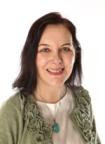
Sally Prue is a writer for children of all ages, from picture books up to Young Adult fiction. Her novel Cold Tom won the Branford Boase Prize and the Smarties Silver Award, and Song Hunter won the Historical Society’s Young Quills Award. Her other jobs have included being a Time and Motion clerk, an accompanist, and a piano and recorder teacher. Sally is married, has two grown up daughters, and lives on the edge of a small but very beautiful wood in Hertfordshire, England. She blogs at The Word Den and is also to be found on her website and on Twitter: @sally_prue.

(This review first appeared in Norman Geras' Normblog.)

Sending a book out into the world is an unnerving experience for a writer, as once people have got hold of it there's no knowing what they will think. For example, I have been lucky enough to receive several reviews containing kind mention of a character called Alice... but there is no Alice. There never was an Alice in any of my books. The girl I think they have in mind is called (wait for it) Stefanie. And she always has been.

Hold on to that thought, if you will, whilst we pay a visit, as I did recently, to Leominster, an English country town boasting many splendid hanging baskets and a heritage centre that is quite often open. And on a corner near a pub (I can't actually remember the pub, but most places in old English towns are near pubs) is a shop window displaying some extremely surprising weaponry. There is, for example, 'Sting', which, as every Lord of the Rings fan knows, is an elfish blade with the handy (unless hiding in the dark) habit of shining blue when in the proximity of orcs. There one can also, if over the age of sixteen, buy what purports to be Arwen's sword, which I don't remember from the book; and there are several other pieces of lethal Lord of the Rings equipment. Which just goes to show that there are a lot of nutters about – though presumably not in Leominster, or they would have bought up the shop.

For, devoted admirer though I am of The Lord of the Rings, there's no disputing that it has led to a lot of trouble. There are all the palely imitative books of quests, holy violence and silly names, for a start; then there are the hundreds of computer games, the sword-waggling role-players, and the couple of film adaptations. The last of these was, admittedly, hugely impressive. (Indeed, the only experience that has come close, for me, to the vertiginous awe of zooming over the Isengard of Peter Jackson's version, was once at the Comedy Theatre, looking down from the gods at Dawn French's cleavage.) But even this colossal film consists largely of nazgul, orcs, trolls, balrogs and wargs, from none of whom one would ever even dream of buying a second-hand car.

Yet, as has been elegantly argued on Normblog, a person isn't necessarily to blame for an indirect consequence of his actions. I myself don't see The Lord of the Rings primarily as a promoter of picturesque violence; and, what's more, I don't think that Tolkien did, either. I don't think the book is fundamentally about kings, or magic, or any of the related snobberies that so many of its fans delight in. It's true that there are heroes of ancient lineage (though the heir to the greatest throne is poor, alone, incognito, rather ugly, and seventy years old), and people do spend a lot of time knocking seven bells out of each other; but all that willy-waving and bending-of-the-knee isn't important. It's just a very beautifully and intricately realised and fascinating side-show. In The Lord of the Rings all power, for good or evil (and most power is shown accelerating with horrible rapidity towards evil), is ultimately futile. It's the little man who's vital, as he creeps, trembling and wounded, to victory (of a sort) while the big pretty fellas are busy marching magnificently hither and yon. The book chronicles the splendour and terror of the gods (OK, they're called elves or wizards here, but in their beauty, song and immortality they have much in common with gods), but it shows their fading and banishment, too; and man himself is depicted in his irresistible diminishment from hero to humanity. How about that? Just about the whole history of literature in one book. But then, epics are, most often, accomplished in retreat.

I first read The Lord of the Rings as a teenager. It was the first long book I ever read, and perhaps the first grown-up book I ever enjoyed. It has adventure, and humour, and horror, and a great variety of styles, and blokes I fancy (that Faramir, eh? Cor!) and love and comradeship and a huge delight in the miraculous beauty of the natural world. There is, it's true, a race that views warfare as the pinnacle of its civilization, but, hey, in the end all their proud warriors are outfought by a hobbit (a half-sized, ignorant, and unassuming countryman, basically) and a girl. The language in which they do it! And so King Theoden departed from his realm, and mile by mile the long road wound away, and the beacon hills marched past: Calenhad, Min-Rimmon, Erelas, Nardol. But their fires were quenched. All the lands were grey and still; and ever the shadows deepened before them, and hope waned in every heart. Oh, the pity of it! I remember my husband reading that bit to my children by the meagre light of our tent's flickering gas-lamp.

But in the end, for me the book isn't about the soldiers (though, a book that means many different things to many different people isn't a bad definition of a masterpiece). For me The Lord of the Rings is about the triumph of the modest and ordinary; and this happens, essentially, because the extraordinary and immortal cannot evolve to fit into a new world-order. The world is saved (or, more accurately, some of it is able to continue) because pity for the weak triumphs over self-preservation and even justice; and Tolkien leads us to feelings of pity, too: to the pity of a creature degraded by guilt and long suffering almost to the point of being a beast. Tolkien watches the passing of many things, lovely and hideous, weak and strong, heroes and demons, and he mourns and celebrates in equal measure. The Lord of the Rings is a valediction to much that is most valuable; but it is also a benediction on the new, though less splendid, world of the common man.

A writer of another famous long book, Philip Pullman, was quoted recently as saying that The Lord of the Rings tells us nothing about the human condition. Well, let me leave you with a passage from Tolkien's trilogy that marked the moment when I first grasped my own mortality. It's spoken by an old, lonely creature who was himself once almost a hero.

I sit beside the fire and think
of how the world will be
when winter comes without a spring
that I shall ever see.

The Lord of the Rings is published by Harper Collins.

More reviews by Sally:


The Dean's Watch by Elizabeth Goudge

Emma by Jane Austen

Monday, 3 January 2022

Awards Season! Part 3


Here's the third and final part of our virtual awards. Our contributors give a prize of their own choice and their own naming.  As usual, too, at this time of year, we give our grateful thanks to all the contributors who generously give their time, insights and enthusiasm to the blog. We couldn't keep going without you!

Paul Dowswell's prize for Book by an author I’ve just discovered goes to 
The Girl with the Louding Voice by Abi Daré.

I’m not an adventurous reader. My most recent good reads were Geoff Dyer’s Another Great Day at Sea, and David Mitchell’s The Thousand Autumns of Jacob de Zoet – both magnificently written and both entirely mainstream. But a good friend, who reads widely, recommended Daré’s book, and I bought it on a whim.

Narrator Adunni is a 14-year-old Nigerian girl, married off by her father to Morufu, an old man who, she tells us, looks like a goat. Adunni’s education comes to an abrupt end. She, wanting to become a teacher, is devastated. The book has the makings of a grim misery memoir but it is actually engaging, heartening and funny.

Daré brilliantly captures Adunni’s idiosyncratic Nigerian English, and I read on, transfixed as she pits her wit, intelligence and cunning against the terrible hand she has been given. Best of all, Daré conjures a world I’ve never imagined before – something all the best fiction should do.

Graeme Fife
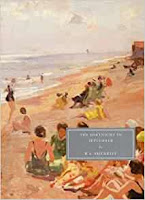
: No prizes, but R C Sherriff's The Fortnight in September, an unexpected marvel, took me aback. Recommended by a dear friend and by an author whose output is dominated by that silly First World War play, it's beautifully observed, understated in its telling, acutely detailed and, albeit the story is, on the face of it, barely dramatic, it tells volumes about human relationships, how they are shaped, interact, develop, reveal themselves in strength and weakness. It's the work of an author who reflects deeply and strips away all flashiness of expression in an admirable quest for directness and truth. (Full review coming next week ... )

There are other books which have charmed and beguiled me this year. The novels of  J B Priestley richly deserved revisiting. Hadley Freeman's House of Glass is utterly bewitching and beautifully crafted. The story it tells not only compelling but necessary. Emily Wilson's translation of Homer's Odyssey is a tour de force.

Val McDermid: 
The McDermid Medallion for the book that made me cry more than once goes to Sarah Hall's Burntcoat. It’s an extraordinary narrative about love and art in a time of pandemic. It’s not our particular plague but it deals with the wrenching pain of loss, the divisive othering, the despair and the moments of hope we’ve all lived with these past months. But it’s also astonishingly uplifting, joyous even, not least because Sarah Hall writes of the physicality of love as well as its emotional impact. Her prose is engrossing -- dynamic, rich and authentically emotional. I read Burntcoat over two days, and I resented setting it aside to deal with the obligations of my own life. It moved me to tears and at the end, I felt as drained as if it had been a tale of grief and glories told by my best friend.

Ignaty Dyakov-Richmond
's award for A book I will keep on my desk and recommend to my clients over the next few years goes to How To Live by Professor Robert Thomas

At a time when we seemingly depend on pills and vaccines as never before, Professor Robert Thomas, a practising consultant oncologist and professor at the University of Cambridge, refreshingly reassures us that there is plenty we can do ourselves to sustain our health and wellbeing. With over 497 cited sources, it is still a very straightforward read and due to its structure can be used as a reference book too.

So many thoughts in the book resonate with me and provide answers to the current challenges we face: from lowered energy to the pressure on the NHS to the ever-increasing taxes we pay for healthcare, and to climate change. In the words of Professor Thomas, “The more I delve into the research from around the world, the more convinced I am of the influence of lifestyle over the genes we are born with."

Diamond Dystopian Award
, awarded by Jane Rogers for the best dystopian book of the year, goes to The Animals in That Country by Laura Jean Mckay (Scribe)

It’s already won a bunch of other prizes, including the Arthur C Clarke award, although I wouldn’t call it Sci Fi. Set in a very real Australia, it features a pandemic which causes humans to understand animal communication, a dignified dingo named Sue, and a foul-mouthed, alcoholic granny with no inhibitions. What the animals say is totally unexpected and often devastating – many humans are simply driven mad. But granny Jean and dingo Sue set off on the mother of all road trips to rescue Jean’s grand-daughter, and I defy anyone to put this book down unfinished. The tears in my eyes at the end were both of laughter and sorrow. The most original book I’ve read for years.

Linda Newbery
presents the Newbery Notable Award for Seasonal Uplift to The Midnight Library by Matt Haig. We've all wondered about the alternative lives we could have led - if only we had done something differently, or better. What if we had the chance to sample them, and live in them? It's an intriguing premise that's cleverly handled, as suicidal Nora finds herself in a library stacked with books that are portals to the infinite lives she might have lived. With a nod to It's a Wonderful Life in its focus on how small things in our lives can affect others, this is an ideal read for the turn of the year when we're all likely to be reflecting on what has, hasn't, and could have happened, and what lies in store. (See Julia Jarman's review.)

Sally Prue: The Glacier Award for the Slowest Book is presented to Nathaniel Hawthorne for 
The House of the Seven Gables.

Slowness in a book is not generally celebrated, but The House of the Seven Gables is a book so glacial, so majestically constipated, as to be mesmerising.

It begins as it means to go on, with a long (well, it seems long) description of the generations who lived in the house of seven gables (seven? Surely several of those must be otiose?) before the action (sorry, wrong word) begins.

I read this book years ago, and was very soon hypnotised by it. This means, sadly, that my memories are rather vague. There’s a death-dealing curse, and much gradual decay, and, best of all, surely the longest, slowest, and most incremental death-scene in the history of literature.

The House of the Seven Gables is gloriously ponderous, quite magnificently leaden.

And a simply extraordinary read.

Thanks to all those who've been so generous with their virtual awards! Normal service resumes next week - follow us for a great reading recommendation every Monday.

Monday, 16 March 2020

Guest review by Sally Prue: EMMA by Jane Austen


"So all in all I have decided not to go to see the new film of Emma, delightful though it may be. It would, I’m afraid, trample on my dreams."

Sally Prue is a writer for children of all ages, from picture books up to Young Adult fiction. Her novel Cold Tom won the Branford Boase Prize and the Smarties Silver Award, and Song Hunter won the Historical Society’s Young Quills Award. Her other jobs have included being a Time and Motion clerk, an accompanist, and a piano and recorder teacher. Sally is married, has two grown up daughters, and lives on the edge of a small but very beautiful wood in Hertfordshire, England. She blogs at The Word Den. She is also to be found on her website and on Twitter: @sally_prue.

I was quite looking forward to the new film of Jane Austen’s Emma (yes, there are other Emmas: Charlotte Bronte’s, for one). 

Emma is probably the finest book I’ve read. I wouldn’t quite recommend it as a comfort read, but it’s a great book for clearing the mind of the detritus of modern life.

There’s no one like Jane Austen for resetting the moral compass.

So, anyway, I was quite looking forward to the film of Emma. But then I came across an interview with Eleanor Catton, admitting that when she accepted the commission to write the screenplay she hadn’t read the book.

Now, I’ve probably read Emma a dozen times, and I’m still discovering stuff: not just the odd joke, but really important things like, for instance, the solution to the problem of Mrs Elton. Mrs Elton, for those who have not yet had the irritation of knowing her, is one of those people who Knows Best. In this, it has to be said, she rather resembles Emma herself, and the difference between the manifestations of their pride, condescension and motives is a complex and interesting one. Anyway, Mrs Elton irritates the hell out of more or less everyone, causes a lot of grief with her meddling, and then gets off scot free … or so I thought the first seven times I read the story. But Austen actually condemns Mrs Elton to a terrible (though much-deserved) fate; and the fact that this fate won’t strike her until long after the book ends just goes to illustrate what a work of consummate genius Emma is.

Still, Eleanor Catton is a much-lauded writer, and perhaps she managed to spot all the vital subtleties first time.

But then I read an interview with the costume designer, full of joy at the sumptuousness of the costumes Emma and her friends would have worn; and then there was another interview (I think with the director) explaining that nowadays Emma would be spending her life on Instagram showing off the latest fashions. Now, in the book even the most critical of Emma’s acquaintances believes her to be not personally vain, and the general community of Highbury (and Emma is a book set very firmly in its community) is nearly all of it slightly hard-up and full of cheerful stratagems for remaining respectable. Even the cake at the wedding which opens the novel is shared around the town. As for the wedding at the end of the book, that, too, is distinguished by its lack of show:

The wedding was much like other weddings, where the parties have no taste for finery or parade; and Mrs Elton … thought it all extremely shabby, and very inferior to her own. – “Very little white satin, very few lace veils; a most pitiful business! Selina would stare when she heard of it.”

So all in all I have decided not to go to see the new film of Emma, delightful though it may be. It would, I’m afraid, trample on my dreams.

And what is so completely dreamy about Emma?

For a start, it is very funny indeed.

It’s full of interesting and believable characters, with some of whom you’ll fall in love.

The plot is mind-boggling and has been called the first detective story (though it is a detective story where the identity of the detective is itself for a large part of the book a mystery).

It employs (and quite possibly invents) two revolutionary literary devices, stream-of-consciousness and free indirect style, and it has great fun with them, while never forgetting that it is bad manners to baffle or alienate the reader.

It has a really proper ending.

Oh, and it is quite possibly the finest novel ever written. The name Austen is a version of Augustine, which means great or magnificent. Fair enough, I’d say.

And the solution to the problem of Mrs Elton?

Well, it took me about seven readings to notice it, but you might get it first time.

It’s well worth the trouble.


Have you seen the new film adaptation? What did you think? Please tell us in the comments!

See also: JANE FAIRFAX by Joan Aiken

LONGBOURN by Jo Baker

Monday, 6 January 2020

NEW YEAR ROUND-UP: More authors and booksellers tell us what's on their reading piles


***


Susan Price:  Having just finished reading Dennis Hamley’s wonderful, subtle The Hare Trilogy, deciding what to read next will be difficult. My friend Karen Bush has just sent me Inheritance, a collection of short stories by a Robin Hobb, a writer we both admire. Another friend, Linda Strachan, has sent me her Guide To Writing for Children, which is a must-read. Visiting my local charity shop resulted in the purchase of Bryson’s A Walk In The Woods. And I firmly intend to re-read Isabella Tree’s Wilding, which I found exciting the first time.

***


Ross Bradshaw of Five Leaves Bookshop, Nottingham:  Have I read the Australian writer Patrick White before? I can't remember but a customer said I really have to read Riders in the Chariot (Vintage), which is about four independently damaged and discarded people wandering round the wreckage of a once fine city ... oh dear. But the cover blurb says there is a possibility of redemption. I hope so.

Discourse on Colonialism by Aime Cesaire (Monthly Review) comprises a short essay and material about this essay, first published in 1955 and is our bookshop open book group read in January. We try to vary our reading between fiction and non-fiction, and this came out of our discussion of James Baldwin's Go Tell It on the Mountain. The bookshop recently put on a talk by Priyamvada Gopal on her Insurgent Empire (Verso) which was inspirational, as part of an irregular series of events on race and Empire and this is a developing theme among our intellectual and activist customers. It's decades since I read Frantz Fanon and Edward Said but their work seems to be reaching a new generation. I need to revise.

I'm a sucker for Patti Smith so I'm saving her Year of the Monkey (Bloomsbury) for the two day Christmas break (poor old retailers, eh?). At heart I want to be Patti Smith, sitting in a cafe in New York munching sourdough toast with olive oil dribbled on it, drinking black coffee and rocking out in the evening. I do wear the same cap as she does, which is a start but it's too late to have been a friend of Robert Mapplethorpe and Allen Ginsberg. Here she wanders round the American west coast, writing her short dreamlike essays, illustrated by her usual Polaroid pictures.

***


Wes Magee:  In 1975 I traipsed to the Poetry Society HQ in Earls Court, London, and listened to a bespectacled, slight young man talk about his recently published first book. He reported the book’s unheralded emergence, and how ‘traffic continued to flow along the Brompton Road.’ Thus did I discover Ian McEwan’s collection of short stories, First Love, Last Rites, and marvelled at such a confident debut. Since then he has gone on to become a multi-award-winning author, whose novels unfailingly surprise with their virtuosity. I have read the lot, and it is with high anticipation that I look forward to opening his 18th, Machines Like Me, on New Year’s Day, 2020.

***


Rachel Phipps of The Woodstock Bookshop: The book I am most looking forward to reading is Actress by Anne Enright, which comes out at the end of February. I have to come clean and admit I read the proof, but a member of staff has snaffled it and I desperately want to re-read it. She is such a good writer, and this is about an actress and her daughter and their relationship – the daughter’s attempt to reconstruct and understand her mother’s life. I loved it and can’t wait to read it again, which is rare. I have a few days break over Christmas and will take books that I meant to read properly and haven’t – Ducks, Newburyport by Lucy Ellman, which I have been eyeing in the shop since it first appeared and reading little bits of here and there. It is over a thousand pages which does tend to deter people, but the few pages I have read are enticing. And A Kitchen in the Corner of the House, a collection of stories by Tamil writer Ambai, beautifully produced by Archipelago Books.

***


Linda Newbery:  I've already had one go but am allowing myself a second slot, for non-fiction. These two titles, Animal Languages and The Hidden Life of Trees, will complement each other: both look at the lives and communications of non-human creatures, from whale songs and the apparently complex information shared by prairie dogs to the mysteries of the 'wood wide web' by which trees nurture each other and create ecosystems. Both should illuminate how much in the natural world is overlooked by our anthropocentric short-sightedness.

***


 Daniel Hahn: Books I’m excited about for the early months of next year? OK, I’ve narrowed it down painfully to, um, thirteen, some of which I’ve read and some I’m looking forward to. My pair of top tips, though, both of which I have read and mean to read again:

Fernanda Melchor’s Hurricane Season, translated by Sophie Hughes, is an utterly ferocious piece of storytelling from Mexico; it’s a village story, in part a story of mystery and myth, but told with uncompromising realist brutality and a kind of incandescence from which it’s impossible to look away.

Colum McCann’s Apeirogon is a novel of Israel and Palestine – it is huge and thrillingly original and political and intimate and perhaps the best book I’ve read this year. But I’m not telling you any more than that. Just order it now.

But oh, there’s so much else besides those two. Also in January/February we have Bae Suah’s Untold Night and Day, currently next on my TBR; Andrew Krivak’s strange and mesmerising The Bear (I loved this – a proper read-in-a-couple-of-sittings kind of book); Intan Paramaditha’s The Wandering, which I have not yet read but which looks intriguingly like a sort of grown-up Choose-Your-Own-Adventure story from Indonesia; and Paul B. Preciado’s bold, provocative and thought-provoking An Apartment on Uranus. Then through the spring we have the very short and very gripping Elly, by Maike Wetzel, and many new books by familiar greats: Samanta Schweblin coming in April, and Judith Schlansky, Andrés Neuman and Yuri Herrera in June. June is also when we get David Trueba's Rolling Fields (I loved this) - oh, and there’s a début by Elaine Feeney to look out for. It's called As You Were - I’m only fifty pages in and it’s already bursting with emotional power.

***


... and finally, an unusual approach from Sally Prue:  I've just read a library book chosen by a friend (just get anything! I'd said) about Edward VII's mistress Mrs Keppel. It was scattered with dreadful ahistorical generalisations and horrible snobbishness, and I enjoyed it hugely. I have therefore resolved that next year I shall read a) completely random books (I've usually neglected the bottom shelves in the library because of the strain to the knees and eyes) as well as b) as some scorned ones. For instance, I’ve never read Jeffrey Archer. Can he really be as bad as all that. Can he? I shall find out!


Monday, 24 December 2018

READING AHEAD part 1: what's in our sights?


What's on our reading piles? New publications, old favourites to return to, neglected classics, authors we've sampled and intend to read more fully? Here are the choices by ourselves and guests - including some new faces. A big thank you, as ever, to our many contributors - this wouldn't happen without them. We hope you'll find something to entice you here - and don't miss part 2 on New Year's Eve! 


Stephanie Butland: I was lucky enough to read an early copy of The Confessions Of Frannie Langton, by Sara Collins, which comes out in April 2019, and it was one of the highlights of my reading year. A dark and beautifully written tale of murder, slavery, sugar and opium, it’s also a historical novel that feels painfully relevant to our times. I felt as though I held my breath through most of it. Gloriously good.


Philip Womack:   I'm most looking forward to continuing my way through Anthony Powell's A Dance to the Music of Time - I've reached volume 5, and have been savouring it, coming to love its slow, perceptive movements. Ben Schott's P G Wodehouse homage, Jeeves and the King of Clubs, looks like it will prove a treat over Christmas. On the children’s side, I’m excited about Alison Moore’s Sunny and the Ghosts, about a boy whose parents buy an antiques shop full of spectral presences. And, as ever, like a warm bath I’m returning to my eternal dip in Samuel Pepys’s diaries, which I’ve been reading, on and off, for almost 15 years.


Linda Sargent: Dreams of the Good Life by Richard Mabey has been on my to-be-read pile for some time and it’s not through any lack of enthusiasm that it’s still there, quite the contrary. I’m an admirer of both Mabey’s writings and also the subject of this book, Flora Thompson. I first read her Lark Rise to Candleford in the early seventies while studying Economic History at the University of Sussex and was immediately captivated. Despite being set in the nineteenth century, the rural Oxfordshire life she describes and the stories she tells, strongly resonated with my own background as the child of a farm worker in mid twentieth century Kent, as did her ambition to be a writer (although in my case that is still a work in progress...). It’s a book I’m savouring, for me part of the pleasure of this pile.


Adele Geras: I’m going to start 2019 by reading The Wych Elm, the latest novel by Tana French. I’ve loved many of her previous Dublin-set thrillers, especially Faithful Place and Broken Harbour but have deliberately avoided finding out about this one, which is meant to be somewhat different. I’ll begin as soon as I’ve finished Lethal White by Robert Galbraith (J K Rowling) which is my Big Christmas Treat Read!


Yvonne Coppard: For 2019, I’m returning to If on a Winter's Night a Traveller by Italo Calvino, first read some years ago. It defies categorisation: a combination of narrative sequence and a journey into the reader’s own consciousness, intellect and experience. This time I will read more slowly, and uninterrupted; maybe I’ll finally understand what’s going on.

As a fan of Khaled Hosseini, I’m also keen to read his beautiful but devastating Sea Prayer, inspired by the death of a three-year-old Syrian refugee, Alan Kurdi.


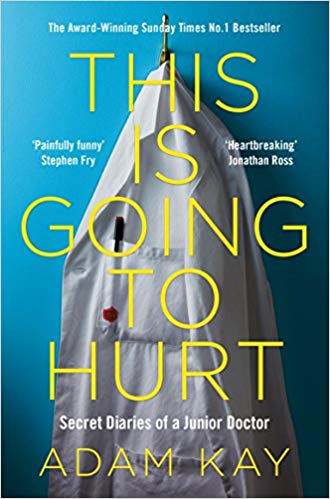
Graeme Fife: I’ve come to many authors late but, stoutly rejecting any sense of embarrassment about it, I rejoice, rather, in the discovery. James Baldwin’s Go Tell it on the Mountain, the autobiographical novel about his coming to maturity in Harlem, grappling with a difficult relationship with his preacher father, introduced me to new riches in American fiction. Adam Kay’s This is Going to Hurt…? Essential reading, I’d say. Scalpel in one hand, tickle stick in the other and huge compassion and humanity between. I’d not be without Seamus Heaney’s 100 Poems, a posthumous collection made by his family. Ah, but doesn’t his fine-tuned observation and framing speak for us all in our searching and contradictions.


Celia Rees: I very much admired Kate Atkinson’s Life After Life and A God in Ruins and I’ve been saving Transcription as a special treat for the New Year. Female spies, Second World War and the post war period, all subjects and themes close to my heart. I’ve already reserved it for a post on Writers Review. Pebbles on the Beach, by Clarence Ellis, was first published in 1954 and is now reissued with an introduction from Robert Macfarlane. I’ve collected pebbles since I was a small child, so pounced on it when I saw it in the wonderful South Kensington Books. I’m really looking forward to reading it and applying my new knowledge on beach and shore side. Another on my list of New Year Intended Reading is Deborah Robertson’s Declutter - the get real guide to creating calm from chaos. That could present something of a challenge…


Sue Purkiss: I'm looking forward to reading Elly Griffiths' new book, Stranger Diaries. I'm a big fan of her Ruth Galloway series, and this has had great reviews, so I'm sure it's a treat in store.

And I intend to revisit an author I haven't read for many, many years - A J Cronin. He wrote hard-hitting books which often dealt with poverty and inequality in the 1930s, and I'd be interested to see if I still find them as impressive as I did when I first came across them.


Sally Prue: My reading is haphazard and serendipitous, and the classics I haven't yet read are the ones I've been putting-off for half a century, so in some ways it's easier to say what I won't be reading (Proust and Anthony Powell are strong contenders, here). But Zola's Germinal was amazing, so perhaps some more of Les Rougon-Macquart if I happen to come across anything; and of course there's nothing quite as comforting as nestling down with a good old Trollope.


Caroline PitcherMy mind keeps returning to a novel I read earlier this year, Sugar Money by Jane Harris. Based on a true story, it is told in lilting, rhythmic Creole by young Lucien from Martinique in 1765. He hero-worships his elder brother Emile and insists on joining him on a mission to smuggle back slaves from English owners on Grenada and return them to French friars. The vicious rivalry between slave-owning nations had not really occurred to me before reading this novel. Jane Harris has written a rollicking adventure with a touching sibling relationship, told in Lucian’s charming voice. All this serves to highlight the grisly cruelty and violence of the slave trade.

All my life, over and over again, the same scene, repeating in my mind.


Katherine Langrish: Among the books I'm looking forward to (re-)reading this Christmas is Ursula LeGuin's novel The Lathe of Heaven which I loved as a teenager. It doesn't seem to get the same attention as The Dispossessed and The Left Hand of Darkness (all such wonderful titles) but is just as brilliant. Quiet George Orr is too terrified to sleep because he believes his dreams change reality. When his initially sceptical shrink discovers this is true and starts manipulating George's powers for the good of humankind, things get really serious. Original, poignant, often funny, the book is a magnificent exploration of unintended consequences and the dangers of uncontrolled power.


K M Lockwood: I admit I do judge a book by its cover. When I saw Lucy Rose’s artwork for The Familiars written by Stacey Halls, I knew I coveted it. I pleaded and received a review copy. A glance reveals a noose, a fox, parchment and plumes. Inside, you find women, witchcraft and Pendle Hill. My sort of book - due out in February.

Help the Witch is a short story collection from Tom Cox published by Unbound and illustrated by Joe Mclaren. It too looks dark and imbued with foklore – but far more modern. Interesting to compare and contrast.


Paul Magrs: There are two reading projects that I must return to when 2019 begins. I am reading Blockbusters – one for each year since my birth. I began with Mario Puzo’s The Godfather from 1969 and I’ve been having an amazing, eye-opening time. I’ve been through Love Story and Jaws and I’m as far as 1977. Judith Guest’s Ordinary People is next.

My other project is tackling the Beach House Books – i.e. the accumulation of heaps of novels everywhere in our house, overspilling into the Beach House. I’m putting myself on a book-buying ban once again, and I’m hiding from the world all January.


Anne Fine: I suddenly realised that neither of my daughters was living in this country while Posy Simmonds was doing her cartoons for the Guardian. Everyone’s coming for Christmas, so I’ve bought both daughters her superb collection, Literary Life Revisited. Posy is unbelievably clever. She’s put her finger on every aspect of the writing trade. You recognise everyone in every frame, and all of the situations and dilemmas.

And the greatest joy is that these books are so (comparatively) heavy that, though both my daughters will devour them during the holiday, at least one is likely to abandon her copy before the flight home. So that’ll be me in the New Year, steeped in delicious, genius Posy. I can’t WAIT.