Showing posts with label writing. Show all posts

Monday, 14 September 2026

Guest review by Jon Appleton: THE WELL by Elizabeth Jolley


"Wickedly funny, harrowing, mischievous and moving, The Well deserves its status as modern Australian classic."

Jon Appleton
is a freelance writer and editor based in London.


‘I don’t want other people coming here poking about in our lives. Kathy I want to tell you this so that we can go on the way we were.’

The 1980s were a fantastic time for Australian women writers. Interest was high: platforms to read and speak abounded in every state, awards and grants liberated authors from teaching loads and other work, colour supplements profiled their lives with each new book. There were even critical books and collections of essays devoted solely to women writers.

No wonder. The standard was dazzling, the personnel intriguingly diverse. There were younger writers like Helen Garner and Kate Grenville, writers embarking on the literary life in their 40s and 50s, like Marion Halligan and Olga Masters, and long-established writers being given new consideration, like Thea Astley, Jessica Anderson and Amy Witting.

Then there was Elizabeth Jolley, something of an outlier.

Jolley was born in Birmingham, in 1923, and migrated to Australia in 1959 with her academic husband and three children. (One of whom had been born within weeks of Mr Jolley’s first wife’s daughter’s birth …) Elizabeth Jolley had a trunkload of manuscripts on arrival which were relentlessly rejected by editors for 15 years until a local press snapped up a collection of short stories, and then another, and then a novel.

After which novels and short story collections poured forth, making her one of the most prolific of all Australian writers, which was a distorted picture as much of the work had been begun, and abandoned, and refashioned, before making it into print. She won award after award and attracted ravishing reviews, domestically and abroad – her books regularly appeared in the UK and America.

On panels, she cut a striking figure – with short, cropped grey hair, she had a clipped, almost girlish voice. She was very tall and habitually wore hippyish skirts and flat sandals. She peered out through squinty spectacles.

I read her stories avidly but if you’ve never encountered her work, here’s a list of reliable ingredients in a work by Elizabeth Jolley.

· Sexual obsession, especially between women

· Fathers and daughters

· Sexual abuse

· Leider music (Jolley’s mother was Viennese)

· The liberating sensation of dance

· Small-town oppression

· Nurses and patients

· Sexual repression, especially in prim, professional women

· The freedom and danger of frontier country

· A novelist’s obsession with their subject material (and its consumption of them)

You’ll find them all in her 1986 novel, The Well, one of Jolley’s best known works, and winner of Australia’s top literary prize, the Miles Franklin Award.

Late in the book, Jolley rallies: ‘She had not come home, at sixteen, from boarding school, in the middle of a term, to keep house for her father, her grandmother having died suddenly, and not learned how to speak to the men.’

The woman in question is Hester Harper, middle-aged or older, fighting to keep control of the only person she has been allowed to love; a feckless, rather vapid social-climber called Kathy, who she takes in from an orphanage – or was it jail? – as a young teenager and with whom she cultivates a totally interdependent life in a remote country town.

But inevitably the outside world encroaches, perhaps most dangerously of all, a young man they strike down whilst driving at night. There are no witnesses, and they pitch the body into an abandoned well on their property. But it turns out he isn’t dead – he’s also a thief - and he joins a throng of men determined to destroy the women’s privacy.

‘She understood too, at once, that she needed to be looked after, cared for, more than ever. She had never felt so afraid and so alone.’

And so resourceful, determined Miss Hester Harper – despite her ailing physical and mental well-being – will stop at nothing to preserve her sanctuary – but at what cost?

Wickedly funny, harrowing, mischievous and moving, The Well deserves its status as modern Australian classic. I’m pleased it’s just been reissued by Virago for today’s readers to enjoy.

The Well is published by Virago Modern Classics.

More of Jon's recommendations:

Whistler by Ann Patchett


Clock Dance by Anne Tyler

An Honest Man by Ben Fergusson


Monday, 22 January 2024

Guest review by Jon Appleton: THE PLOT by Jean Hanff Korelitz


"We’re spared none of the agony of revelation. Truly, I felt I was being drawn through a mangle..."

Jon Appleton is a freelance writer and editor based in London.

I suspect that many readers of this blog are genetically fascinated – and appalled – by the idea of novels about writers. As if being a writer isn’t challenging enough, why invent the tortured life of a comrade to add to the maelstrom of creative woe and anxiety in the world?

Maybe it’s cathartic.

I’m about to read Last Resort by Andrew Lipstein (Weidenfeld & Nicolson, 2022). Here’s the blurb:

Caleb Horowitz is twenty-seven, and his wildest dreams are about to come true. His manuscript has caught the attention of the literary agent, who offers him fame, fortune and a taste of the literary life. He can't wait for his book to be shopped around to every editor in New York, except one: Avi Dietsch, a college rival and the novel's 'inspiration.'

When Avi gets his hands on the manuscript, he sees nothing but theft - and opportunity. And so Caleb is forced to make a Faustian bargain, one that tests his theories of success, ambition and the limits of art.

Sounds juicy, doesn’t it? (I guess there have always been a lot of novels about novelists and always will be.) But the book I want to persuade you to read is The Plot, a wholly persuasive thriller by Jean Hanff Korelitz, a new writer to me, who has also written The Undoing, which is a ‘major TV series’ and a host of other novels which I’m keen to discover.

Here’s the blurb:

When a young writer dies before completing his first novel, his teacher, Jake, (himself a failed novelist) helps himself to its plot. The resulting book is a phenomenal success. But what if somebody out there knows?

Somebody does. And if Jake can't figure out who he's dealing with, he risks something far worse than the loss of his career.

A beautifully simple idea. What really impressed me about this thriller was how long it takes for Jake to not only seize upon the genius of stealing the story – it’s told to him in conversation, in a brilliantly awkward encounter between two egocentric misfits; and Jake, to his credit, is a grafter; he’s published three failed novels – before it occurs to him to write Crib. So it’s agonising to watch how swiftly successful he becomes knowing, inevitably, he’ll be undone in a long, painful, suspenseful, drawn-out exposure. And I think we know early who will engineer his downfall – the title has a clever second meaning – but we’re spared none of the agony of revelation. Truly, I felt I was being drawn through a mangle as the months and weeks passed.

The writing is grimly witty. Jean Hanff Korelitz acknowledges in the afterword that writers are ‘hard on ourselves. In fact, you couldn’t hope to meet a more self-flagellating bunch of creatives anywhere. And yet, at the end of the day, we are the lucky ones.’ She also spoke of being allowed to write uninterrupted but supported by her immediate family during the lockdowns of 2020. These ambiguities flavour the novel.

Stephen King is an admirer of the book, and we know he’s a huge fan of taking the writing game seriously but also sending it up. I hope readers of Writers Review will embrace this fantastically bracing novel and feel horror and relish in equal measure.

The Plot is published by Faber.

Jon is a regular contributor here. More of his choices:

Lonely Castle in the Mirror, by Mizuki Tsujimura, translated by Philip Gabriel


Shuggie Bain, by Douglas Stewart


Tom Lake, by Ann Patchett


An Honest Man, by Ben Fergusson


Monday, 8 August 2022

Guest review by Cindy Jefferies: THE MASTER by Colm Tóibín


"Henry James was such a consummate observer, and Tóibín gives us this in spades."


First published in 2001 for children, Cindy Jefferies found success with her Fame School series with Usborne Books, obtaining 22 foreign rights deals. Latterly writing fiction for adults as Cynthia Jefferies, her first title The Outrageous Fortune of Abel Morgan was published in 2018, followed a year later by The Honourable Life of Thomas Chayne, set during the English Civil Wars. Both titles are now available in paperback.

One of the delights of reviewing for Writers Review is that one can choose any book for adults. Although we all, as writers, wish to see our most recent novel given as much favourable publicity as possible - sales, after all, are vital - there is something very pleasing, to me at any rate, about seeing one of my earlier books being appreciated. Perhaps that is why I am so often drawn to earlier works of authors I admire.

There is much to admire about Colm Tóibín's work. I first read The Blackwater Lightship, and was immediately captivated. But I had a fine copy of The Master on my shelves for a while and neglected to pick it up. Was it the subject? The Master is about Henry James, who I read voraciously in my teens and early twenties. Had I finished with James? Was he no longer interesting to me? Did I enjoy Tóibín so much only because I liked it when he wrote of Ireland, the land of my mother? How we so casually reject gems waiting patiently for our attention!

I had not finished with James, and Tóibín had many insights about him. But The Master is a novel. So who is the master here? Both men inhabit these pages. Characters, whether real or imagined must dance to the writer’s tune. James was a man of the mind, and Tóibín inhabits that mind to stunning effect. No one can truly know what thoughts inhabit the corners of another’s brain, but Tóibín is impressive at conjuring what might have been there.

We follow the Master as he travels from London, where Oscar Wilde is having more theatrical success than he, to Italy and France. He moves through society, lauded by many who invite him to more gatherings than he can cope with. He strives to remain polite to those who irritate him but often longs for solitude. He moves from place to place, haunted by memories, as are we all. It is hard to settle. He has no wife, no home of his own, but has no wish to return to America. He is a drifter in Europe, living in his mind.

I absolutely loved this novel. I was in James’ mind, travelling with him, relieved with him when he found the perfect place in England in which to finally settle. Henry James was such a consummate observer, and Tóibín gives us this in spades. We learn about the people he meets, his dearest friends as well as those for whom he has little time. His perhaps conflicted sexuality is there, love is there, grief at the loss of those most dear to him. He is not a perfect man, but he does his best.

Running throughout the novel is his work. He is having trouble with his hands, engaging a man to take dictation, which works wonderfully well. He is writing short stories, and when not writing them, thinking about them. It is this that most impressed me about an highly impressive novel. As with all writers, James’ life informs his work, and his work informs his life. The two are bound together in a private dance which only he, and we, through reading the novel can experience.

Leonard Woolf, in I think the second volume of his autobiography, Beginning Again, describes how even when quite traumatic things happen there is a corner of his writer’s mind which observes with interest, and stores away what he has seen or heard to be perhaps used at a later date. Woolf thinks that this splitting of the mind to enable both the observer and the experiencer is common to writers, and I think he is right. Tóibín describes it beautifully in The Master. It is just one of the things that gives this novel such great depth and I commend it to you.

The Master is published by Picador.

Cindy is a regular contributor to Writers Review. Here are some of her recent choices:


Monday, 31 January 2022

Guest review by Philip Womack: FRANCIS PLUG - WRITER IN RESIDENCE by Paul Ewen


"There is something impish about Plug, a kind of naughty nature spirit thrust into the world of the mundane ..."

Photograph: Tatiana von Preussen
Philip Womack has written eight novels for the young, including, most recently, Wildlord. He has also published How to Teach Classics to Your Dog: A Quirky Introduction to the Greeks and Romans, for adults.

I had not read Francis Plug: How to Be A Public Author by Paul Ewen, but had heard good things, and so fell upon this sequel with eagerness, hoovering it up over the course of three days during the Christmas break.

Francis Plug is an author on the edge. He’s had some success with his first book, but even so, still lives in a garage. Despite his constant, heroic drunkenness, and a disastrous interview on Radio 4 (in the course of which he yells KNICKERS, though thankfully it is not broadcast), he is offered a position as Writer in Residence at Greenwich University. The writer’s dream. A stipend, congenial colleagues, eager students. He decides to take the “in residence” bit literally, and surreptitiously commandeers an empty office, putting a camp-bed up, and making the campus his playground.

Plug is both menace and maverick. He slopes off to the pub when he should be researching his novel or performing the (very limited duties) of his post. In speech and thought he rushes from non sequitur to non sequitur. His cultural range is vast, ranging from Doctor Who to Doestoevsky. One minute he is informing you that the singer Moby is descended from Herman Melville, the next he is buying a Hello Kitty purse. And yet, it all makes a strange kind of sense, as when he is supposed to teach a creative writing session, and brings a tyre he’s fished out of the Thames:

“Student: What’s with the stinky tyre?

FP: This tyre is from the past. It’s embedded with stones. See? They represent the passing of time. I have reunited it with solid, dry land.”

His other task is to bring in famous authors for the university’s literary festival. He wildly overpromises, offering Philip Roth, amongst others. There are many encounters with real-life scribblers, which range from the surreal to the hilarious. The comic set pieces are finely judged and, often, thrillingly close to the bone. Which of us writers has not had a moment when we would rather bury ourselves in a wine glass than give a talk? The only author he manages to hook in for the Festival ends up feeding the pages of his book to a shredder. Wonderful.

Interwoven with the action are Plug’s ruminations on his next novel, in which a nuclear bomb explodes in Greenwich; there are also well-considered literary critiques on campus novels (Plug is supposed to be writing one himself - the joke, of course, being that we are reading it). Some serious points are also made (a little too seriously, if you ask me - my only complaint) about tuition fees and writer’s incomes.

One of the worries many authors have about the increasing professionalisation of the writing life - creative writing courses, residencies, prizes, university posts and so forth - is that everything will shape into a corporate blandness. Writers are becoming a kind of bureaucrat, efficient administrators, reliable colleagues to the Academy. Workshops hone away rough edges and controversial ideas in prose and poetry; large publishers, worried about reputational consequences, discourage eccentricity.

Plug is a delicious, delirious antidote to all that. There is something impish about him, a kind of naughty nature spirit thrust into the world of the mundane. His optimism in the face of disaster is a tonic. Long may he reign - and I'd like to see him dancing on the tables at the Booker Prize dinner, please.

Francis Plug - Writer in Residence is published by Galley Beggars Press.

Philip Womack's Wildlord is published by Little Island Press.


Monday, 9 August 2021

Guest review by Jonty Driver: THE CRAFT OF POETRY, a Primer in Verse, by Lucy Newlyn


 "This isn’t a primer ‘about’ verse, but in verse..."

C J Driver is always called Jonty. Later this year the Uhlanga Press will publish Still Further, New Poems 2000-2020.

The Yale University Press has recently published Lucy Newlyn’s The Craft of Poetry: A Primer in Verse. There are other primers: I can see some of them on the shelf immediately in front of me: Unlocked, Reading & Writing Prompts for Practising Poets, by Sue Butler & Helena Nelson (Happenstance Press, 2020); Metre, Rhythm and Verse Form, by Philip Hobsbaum (Routledge, 1996); Rhyme’s Reason, A Guide to English Verse, by John Hollander (Yale NB, 2001); and A Measure of English Poetry, by Anne Ridler (The Perpetua Press, 1991).

Then there are the close relations of primers, such as I Wanted to Write a Poem by William Carlos Williams (Cape, 1967); How to Read and Why, by Harold Bloom (Fourth Estate, 2000); Poetry Notebook 2006-2014, by Clive James (Picador, 2014); A Poetry Chronicle by Ian Hamilton (Faber, 1973); The Poet Who Forgot, by Catherine Cole (UWA Press, 2008) – and I’d better stop there, or the editor will get out a blue pen ... In my view, it’s a brilliant reading list, but Lucy Newlyn’s book bids fair to take a proud place in that little collection.

Ms Newlyn’s book is unusual in two ways. Firstly, it asserts that “to read and write poetry well, you must undergo a practical training in the delights and rigours of poetic craft.” “Practical?” “Rigorous?” “Training?” Let me spell it out, writing poems is not just about having strong feelings that you let overflow into words, vaguely divided into lines to show it isn’t prose (which it clearly isn’t because it doesn’t have to have as a clear meaning as prose presumably must). Almost anything will pass as a poem these days; but not if poets and their teachers were to pay attention to Lucy Newlyn. Indeed, one is never too experienced to learn.

Secondly, this isn’t a primer ‘about’ verse, but in verse. John Hollander used his own poems as illustrations, but most of his primer is in prose. Lucy Newlyn uses her “own verse (freshly written for the purpose) to introduce and exemplify key poetic figures, techniques, forms and concepts.” The setting of the poems is a small village in North Yorkshire where she spent much of her childhood; as a result, each poem stands on its own, in a sense despite its instructive title. For instance, this is a stanza from Lyric: 

Far from the village on the high bleak fell
among all lonely things you walk alone
seeking deliverance in sky and stone
where wind keens low and all the earth is still.

But the village, the beck which runs through it and the Yorkshire moors unify the poems, when the examples in a book of this kind could so easily be disparate. Lucy Newlyn’s fluency is astonishing: it’s not a slim volume – 186 pages and close on 150 individual poems divided into five parts: Foundations, Figures, Techniques, Forms and Concepts. If there are any omissions of form or technique, figure or concept, I haven’t spotted them.
 
A particular favourite of mine is one called simply Line. In part this is because it is dedicated to a friend, Ken Gross, Professor of Literature in the University of Rochester in the USA, but more because in it, Lucy tackles what seems to me a crucial element in poetry that is more and more ignored these days. When I go to poetry readings and can get hold of a text beforehand, I make a habit of marking (with a pencil if it is a book) where the poet/reader makes the break of breath which should signify the line change (there are of course caesuras too). It astonishes me how often the lines as the poet/reader speaks them have no relation to what is on the page. I know then that they have failed to understand the simplest and most basic aspect of poems: why they are divided into lines at all. So, it isn’t uncommon these days to find the article ‘the’ ending one line and its noun beginning the next. As Lucy Newlyn says: “Be alert to the line’s length; / to the turn as it ends before the sentence / and to the points where, artificially contained, / it meets a sudden stop.”

Or, as Yeats put it a good many years ago:

Irish poets, learn your trade,
Sing whatever is well made,
Scorn the sort now growing up,
All out of shape from toe to top...

The Craft of Poetry is published by Yale University Press.

More posts by Jonty Driver:


Italian Life by Tim Parks 


Monday, 25 January 2021

Guest review by Anna Wilson: WRITERS AND LOVERS by Lily King


 'I needed to be reminded that the only constant in this life is change and that “I write [and read] because if I don’t, everything feels worse.”'

Anna Wilson has been a children’s book editor both in-house and freelance for twenty-five years. She has also been a published writer for twenty years. Anna has published 50 books for children and young teens including picture books, short stories, poems, non-fiction and fiction series. Her books have been chosen for World Book Day and been shortlisted for the Hull Libraries Award, the Lancashire Book of the Year Award and the ALCS Educational Writers’ Award. Anna’s recent young fiction series Vlad the World’s Worst Vampire is published by Stripes. Her adult memoir A Place for Everything: my mother, autism and me is published by HarperCollins.

Anna is a Writing Fellow of the Royal Literary Fund and a creative writing tutor for City University, London, the London Lit Lab, the Arvon Foundation and the HarperCollins Author Academy.

This is the novel that got me out of Lockdown Reader’s Block. I know now that I wasn’t alone in not being able to focus on writing or reading last spring, but at the time I didn’t know what had happened to my brain and felt bereft. Then a neighbour lent me this book and I immediately felt less panicked. The main character, Casey, is not experiencing living through a pandemic, but she is grieving the sudden loss of her mother and is also coping with a health scare of her own. She has been trying to write a novel for six years, while battling a huge amount of debt, living in a grim, over-priced potting shed and working arduous, under-paid shifts in a café. So far, so depressing, you might think! But the book is so sharply observed, and so real that I couldn’t help but be swept along by it.

It is also witty and warm. I found myself all but shouting, “yes!” at Casey’s comments on the writing life, as well as on her observation of (some) male writers who seem to think “they should already be famous and believed that greatness was their destiny.” The book is full of such quotable observations, my favourite being that Casey feels she “can’t go out with a guy who’s written eleven and a half pages in three years. That kind of thing is contagious.” She comes up time and again against men who doubt her ability to write a novel that anyone else would want to read. Even her landlord says, “I just find it extraordinary that you think you have something to say.” This reader felt her outrage keenly, and was cheering her on from the side-lines when she finally hit flow state and everything outside her writing dissolved: “There’s a particular feeling in your body when something goes right after a long time of things going wrong. It feels warm and sweet and loose.”

Casey is juggling two lovers while racing to the finish with her novel, both of whom are also writers. One, Oscar, is older and much more successful than she. He is the sort of man she feels she should be with: he is caring and protective of her and has two gorgeous young sons with whom Casey admits to falling more in love than with Oscar. Her other lover is Silas – less of a catch, but infinitely sexier and more of a distraction. The way King writes about the dilemmas of falling for the “wrong” man is funny and convincing.

There is no clear-cut ending to this novel, which felt right given the realism of its setting, characterisation and style. There is more a sense that life goes on, just as writing and loving do, and that sometimes it “goes right after a long time of things going wrong”. For this reason alone, the book arrived in my hands at the right time. I needed to be reminded that the only constant in this life is change and that “I write [and read] because if I don’t, everything feels worse.”

Writers and Lovers is published by Picador.

See also Michèle Roberts' Negative Capability, reviewed by Jill Dawson.

and Anna's review of Unsheltered  by Barbara Kingsolver.


Monday, 14 September 2020

Guest review by Graeme Fife: THE SHAPELESS UNEASE by Samantha Harvey


"No wonder sleep deprivation is used as torture ..."


Graeme Fife has written many plays, stories, features and talks for radio, stage plays and articles for newspapers and magazines, and is now a regular contributor to BBC Radio 4's From Our Own Correspondent. He's the author of a string of books - children's stories, biography and works of history. Great Cycling Climbs, which brings together his books on the French Alps, is published by Thames and Hudson. He says, 'I urge everyone to buy from their independent bookshop, if they're lucky enough - as I am - to have one nearby. If not, by any means possible to counter the sprawl of the online consumer graball.'

Who contemplates with anything but unease the torment of sleeplessness? No wonder sleep deprivation is used as torture. And how to combat it? By going to the doctor?

"I need some sleeping pills, I say. She stares at me as if my tears have appalled her, or somehow confused her. Please, I say. Instantly I regret this because now the power is with her; now my night’s sleep is a favour she can grant. And yet it is. And if it would help to fall at her feet and supplicate myself, I would.

She gets her pills."

From nearly a year of nights longing for sleep, contriving to fall asleep, anything for what Sidney called ‘the certain knot of peace…the prisoner’s release’, comes this gem of a book. A soporific, a dose of Lethe, a wild distraction? No. In the waking hours, the dreamless, nocturnal vacancies when the mind races, loosed upon the increasingly extravagant stratagems for an hour or two of oblivion, Harvey’s deliberations explore the mystery of writing itself. I mean, how many jigsaws can you do without beginning to see the entire world, all patterns of existence, as a fretwork scattering of fragments, a shape-shifting puzzle? Put one puzzle together and another follows. There ain’t no solutions, here, no completion.

Out of her meditation on insomnia - and when insomnia takes over, what else do you do but try to work out what the hell is going on with you? – she ponders time’s fluidity, the static nature of now, the constant shifting of now. She reflects on perception, the way our focus changes in different circumstances, on mortality itself, this wondrous gift we have which can deliver such incomprehension and grief, such accumulations of distress. In our waking hours, welcome or oppressive, Harvey leads us on a quest, the tracking of sensation …

One effect of such inward scrutiny, the remorseless thinking, thinking, thinking about yourself which hours spent in your own wakeful company forces upon you, is the realisation that it becomes ‘indulgent, self-centred and a little mad’. Well, and so it does, but is this not the bold intelligence facing up to the fact that this is what’s involved in knowing yourself, the examined life? And from that exploration comes, for us who pretend to writing, the work.

Harvey ponders writing itself, the process, the mechanics, the effects. She speaks of the cacophony of her (our?) mind, the clashing din of ideas, mostly specious and useless ideas, sometimes a good idea, and how we are assailed by a Babel of voices, counter and kindly, out of which a lone echo of something worth listening to. This is to formalise what is always and ever very informal. ‘How do you get your ideas?’ ‘Not a clue. We’re all in the dark, most of the time.’ Immediately the image springs back at us: in the dark…compelled to watch the slow creeping of the clock’s hands, desperate to give the racing mind rest. As she speaks of those oppressive, slow-moving, sleepless hours, the pattern of the way her mind drifts suggests that similar pattern of formulating sense in words. Writing has saved her life, she says, the next best thing to sleep, sometimes even better. Why? Because she is sane when she writes, it’s the continuum of the dependable.

"Nothing else matters when I write, even if what I write turns out to be bad. I proceed from some open and elusive subconscious formlessness roughly called ‘me’, definable only by being nothing and nowhere, just the silence in which shapes move. Then words. Words harnessing things…the comfort of organisation, of shepherding chaos … "

One aspect of this arresting book which I find most attractive is the dispersal of thoughts, the digressive nature of Harvey’s writing, her curiosity, her penetrating insights, her willingness to follow the unpromising lead just to see where it goes. I wrote in appreciation of this exquisitely written book and wondered, given the attendant torture of insomnia, she might have mixed feelings about it, what it had cost her to write it. She replied (perhaps predictably): ‘My feelings about it aren't mixed, it was a life support and consolation, and I'll always be glad of it.’ Hurray.

I cannot resist quoting one splendid blast of invective:

"Why is Brexit called Brexit, when it isn’t Britain leaving the EU, it’s the UK? Why isn’t it called Ukexit? Never trust something that’s inaccurately labelled. Even the name of this con is a con. Even the name is a shitshow, an almighty, extravagant, eternal show of shit." 

The Shapeless Unease is published by Jonathan Cape

See also Graeme Fife's review of A Telling of Stones, by Neil Rackham, and his many other reviews here by entering his name in the Search box.


Monday, 17 August 2020

Guest review by Jill Dawson: NEGATIVE CAPABILITY by Michèle Roberts


"Feels like being in a café with Michèle, enjoying a glass of French wine and listening to her being funny, irreverent and political, passionate and indiscreet ..."

Jill Dawson
is the author of ten novels, including The Crime Writer, about Patricia Highsmith. The latest is The Language of Birds, about the nanny murdered in the household of Lord Lucan in 1974. She runs a mentoring scheme where established writers work with new ones, Gold Dust Mentoring.


Following a series of devastating rejections, novelist and poet Michèle Roberts decided to keep an account of her life in order to make sense of her shattered sense of self. This wonderful, fearless, surprising memoir is the result. I have been recommending it lately to all my writing students because if there’s one thing all writers need to understand it’s how to cope with rejection, how to survive it and carry on writing.

I should state here that I know Michèle (she was my boss, the Director of the MA in Creative Writing when I taught at UEA) so I don’t doubt I’m biased, but I loved her writing long before I met her: its sexy openness, daring experimentation, vividness and warmth. If you haven’t read her, along with poetry and memoir and short stories, there are fourteen novels. Daughters of the House, shortlisted for the Booker, is a good place to start. 

I devoured this. An honest insight into how another writer – one as established as Roberts no less – feels when a novel gets bounced around by agents and publishers is rare. The book could be read as a companion to her earlier memoir, Paper Houses, which tells of her formative years as a young feminist in the 1970s. Alongside her thoughts on writing, on Creative Writing students who want to produce ‘marketable commodities’, set against her own passionate desire to make art and take risks, there is also a glorious exploration of food, sex, friendship, loss, feminism, art and religion. This intimate memoir feels like being in a café with Michèle, enjoying a glass of French wine and listening to her being funny, irreverent and political, passionate and indiscreet, (although this artlessness, the creation of such a natural-sounding voice is of course the skill of an accomplished writer who makes it look easy).

In one chapter, reading Roberts on rejecting the idea that the male gaze creates desire, I was struck by how powerfully her thinking had influenced me in my twenties. The idea of the radical nature of actively desiring, feeling desire as a woman and not just wanting to be desired, reflected back at twice your natural sexiness is a theme that comes up in my novels a lot. Since I was reading Michèle Roberts in the 1980s at the start of my writing life, I am aware of how much I owe her.

‘Negative capability’ she reminds us, is a term Keats used in a letter to a friend, meaning ‘to be capable of being in uncertainties, Mysteries, doubts, without any irritable reaching after fact & reason.’ Dwelling in the not-knowing, not being able, is of course so much easier to talk about, preach, than to actually practise. Might the concept be extended not just to writing but to living? Perhaps it could more broadly refer to all situations where a person felt out of control, even to ‘not being published, not being read’?

‘Just treading water, swimming, just lying on my back, floating in the present, the buoyant present holding me up and rocking me’, she suggests.

If you want to be buoyed up, nourished, encouraged to be fully alive, to challenge and to doubt, this memoir is a joy from start to finish.

Negative Capability is published by Sandstone Press.

Sunday, 14 June 2020

Lockdown Sunday extra: DAEMON VOICES by Philip Pullman, edited by Simon Mason


"In every chapter there are things I want to store away, remember and use to encourage myself and others."

This is the last of our Lockdown Sunday extras. From now on we will return to our weekly Monday posts.

Linda Newbery edits Writers Review. She has published widely for young readers and is currently working on her second novel for adults.

"I find Post-It notes indispensable. They really came into their own when I was preparing to write about this book. The pages of my paperback copy bristle with so many little yellow stickers that its thickness is almost doubled, and it wasn't a slender book to start with." Philip Pullman says this of The Anatomy of Melancholy by Robert Burton, and I could say exactly the same of Daemon Voices, except that this is a handsome hardback. In every chapter there are things I want to store away, remember and use to encourage myself and others.

Full of delights and insights, this is a compilation of various lectures, essays, introductions, conference speeches and articles written over thirty years and for various audiences including the Children's Book Circle, the Sea of Faith Conference, the Richard Hillary Lecture and the Finnconn Science-Fiction Convention. Collectively they cover a wide range of subjects to do with writing, storytelling and the imagination. If you've heard Philip Pullman speak, you will hear his voice, clearly, as you read.

I'd intended to dip in and out of this collection while reading something else alongside, but on finishing each piece I was eager for the next, and the other book had to wait.  Among my favourites are those in which Pullman comments on paintings and illustrations, in which he has a keen interest (his own drawings are used as chapter heads in the His Dark Materials  trilogy). I've never before studied  Walter Trier's line drawings for Erich Kastner's Emil and the Detectives as closely as when directed to them by Pullman, though they come instantly to mind when I think of the book; now I see their clarity of line and their compositional skill. How inextricably stories and illustrations are linked in books for both children and adults! It's impossible to think of Swallows and Amazons without Arthur Ransome's own drawings (which is why, perhaps, TV dramatisations often disappoint - the borderland of that magical combination of words and images is destroyed by realism). Who shares my nostalgia for the Rupert Bear stories and annuals, written and illustrated by Alfred Bestall? His name meant nothing to me as a child, but the world (or worlds) he created were fantastical in his own distinctive style. "Bestall was full of fancy," writes Pullman; "I'm sure that's the right word for the special quality of lightness, delicacy, charm that his landscapes, his stories, embody." This is in a chapter called Reading in the Borderland - Reading, Books and Pictures, in which Pullman looks at where we go when we read, and how personal and private it is: "We are each alone when we enter the borderland and go on to explore what lies in it and beyond it, in the book we're engaged with. True, we can come back and talk about it, and if we talk well and truthfully and interestingly enough we might entice other readers into it, and they too will explore it - but they too will be alone there until they in turn come back and tell us what they found there ... "

Another great pleasure of these pieces is the close attention and respect Pullman gives to writers he admires. Awarded the 'Carnegie of Carnegies' for Northern Lights he said that the honour had been given to "the wrong PP", and that it should have gone to Philippa Pearce for Tom's Midnight Garden, which is the focus of a chapter called Narrative Tact and Other Classical Virtues. Here Pullman looks at the currently prevalent use of first-person present tense. (I have my own reservations about that, too. I've used both present tense and first person, but never together; when they're combined I find myself wondering why this character is earnestly telling me everything she does, thinks and sees, recording every bodily reaction, all as it happens and supposedly unmediated.) Pullman contrasts "what we often get now, the immediate, the up-close, the hectic of the incessant present tense, and what I might call the classical style of Pearce's writing, which has a great deal to do with how the narrator does her work." Particularly he examines the subtle ways in which the narrative handles time, in a novel which is of course all about shifts in time; and (with diversions to Emma and Vanity Fair) the flexibility of the free indirect style. "And this is where it gets really interesting, because if it's done well we hardly notice the moments when the point of view shifts from outside Tom to inside Tom, from Tom then to Tom now, from Tom him to Tom us. The movement is performed so swiftly and lightly that it seems the most natural thing in the world, even though really it's a complicated psychological manouevre." But then, who is the narrator? Philippa Pearce, surely? But no ... the narrator is the invention of the author just as surely as the characters are, "and every time I read a book where the author is so miraculously in charge of this ghostly being, ... so uncanny in its knowledge and so swift and sprite-like in its movement, I feel a delight in possiblity and mystery and make-believe."

Then there's the bit about his reaction to first reading Blake's poems: "I knew they were true in the way I knew that I was alive... " and the several times when he tells us he doesn't like fantasy, and a most intriguing question he poses towards the end, in a piece on The Good Man Jesus and the Scoundrel Christ ... But I'll have to stop quoting; this is getting ridiculous. You'll just have to read the book for yourself, and see what you find there.

Daemon Voices is published by David Fickling Books.

Monday, 6 August 2018

Guest review by Jenny Alexander: WRITERS DREAMING by Naomi Epel and WHY WE WRITE ABOUT OURSELVES, edited by Meredith Maran


Jenny Alexander has written many children’s books, both fiction and non-fiction, and three books for writers covering different stages in the writing process. Writing in the House of Dreams: Unlock the power of your unconscious mind is about finding inspiration; Happy Writing: Beat your blocks, be published and find your flow is about keeping going with a long project or indeed a long career, and Free-Range Writing: 75 forays for the wild writer’s soul is about extending your range and just having fun with it.

Jenny teaches a wide variety of workshops, both independently and for major organisations such as The Society of Authors, Lapidus and The Arvon Foundation. Her articles about writing have appeared in Mslexia, Writers’ Forum, The Author and Writing Magazine, where she currently has a monthly column, Free-Range Writing Through the Year. Her books are currently their sign-up offer for new subscribers
.


As a writer and teacher of writing, I’ve always been interested in the psychology of creativity so I love reading other writers’ reflections on their personal process, and these two books are full of fascinating interviews. 


I was a dreamer before I was a writer, and my dream life has always been closely connected with my writing - the first book I wrote for writers was called Writing in the House of Dreams. So I was delighted to chance upon this collection of interviews with authors in talking about the relationship between their dreams and writing.

Probably my favourite interview is with Sue Grafton, because she captures the edgy nature of dreams and creative work, the ‘sense of jeopardy’ that comes with handing yourself over completely to the inner world of imagination. She describes the feeling of something mystical powering the writing process. Like me, she does not believe that all dreams have psychological meaning, but engages with them as pure imaginal substance.

I love the way Stephen King compares his writing process with dreaming. He talks about his preparations for writing being like a bedtime ritual; entering into writing feels like falling asleep to the world, and finishing feels like emerging from the dream state in the morning.

Maya Angelou talks about the small mind and the large mind, which is very much my experience of dreaming and writing. They both take you into worlds without limits, and add a new dimension to waking life that makes it feel much bigger.

The whole book is full of great writerly chat, and it’s one you can dip in and out of if you’re busy, though I have to say I was so gripped I read it all in one go on a sunny day in London, sitting on park benches and in cafes. 


I love reading memoirs but one of the things that holds me back from writing one that doesn’t strictly stick to a theme, like I do in Writing in the House of Dreams, is the problem of the ‘and others’ in Meredith Maran's subtitle.

Most of these thoughtful essays address the problem specifically, with many of the authors saying they send the relevant pages to anyone mentioned by name before they go to publication.

Several say that if the person had any objection to being named they would either disguise their identity or omit the passages concerned altogether. Others say they make the judgement on a case-by-case basis.

I like this approach from Sue Monk Kidd:

'Whenever I use someone’s name or reference them, I send them the relevant page or pages of the manuscript before turning the book in. They are usually close friends or family members. I tell them, ‘This is what I’m saying; if you have problems with it, let’s talk about it. I won’t necessarily change the content, but I’ll change your name.'

I think a definite upside to sending the manuscript to anyone you’ve mentioned would be that there wouldn’t be any surprises – you’d have had the discussion before you decide how to proceed. No surprises for the person who is mentioned and none for the author either: several of these essays mention the experience of expecting someone to find a particular thing intrusive and finding they’re fine with that, but have taken serious umbrage about something else the memoirist never dreamed might be problematic.

Related to the question of whether it’s OK to expose other people in telling your own story is the question of why we want to write the memoir at all. The point is made that since memoirs pretty much always risk hurting people, what could make that a risk worth taking?

The most common reason the writers here give is the desire to help or inspire other people who may be experiencing something similar to what they have lived through.

'How can I make my writing better, deeper, truer? Is it true to my voice and my vision? Questions like that often consumed me. They were vital; they still are. But as I got older, the point was not only how I served my work; it was about what my work served.' Sue Monk Kidd

Those are my big takeaways from this book, but there’s so much in it that I’m sure anyone who’s thinking about writing memoir will find the answers to their own questions here.

Writers Dreaming is published by Vintage Books.
Why We Write About Ourselves is published by Plume Books.

Monday, 7 May 2018

Guest review by Anne Rooney: THE WAVE IN THE MIND by Ursula K. Le Guin


Anne Rooney writes fiction for children and non-fiction for both children and adults. Her adult series Story of… on the history of science now runs to 11 titles. It’s published by Arcturus in the UK and North America and has co-publishers in Japan, Korea, China and South America.

She has never had what might pass for a proper job. After a degree and PhD at Trinity College, Cambridge, she was an academic just long enough to decide it wasn’t the right path and then embarked on a writing career. She has held three posts as Royal Literary Fund Writing Fellow, most recently at Newnham College, Cambridge, but mostly just writes, with around 200 books published to date. The most recent is Dinosaur Atlas for Lonely Planet, beautifully illustrated by James Gilliard.


----------------------------

‘A dragon appears in the field…’


The Wave in the Mind is ostensibly about being a reader and a writer, but it’s just as much about being Ursula K Le Guin. The book is a collection to relish of essays, poems, lectures, musings and literary whatevers on reading, writing and imagination written over a long period. If it isn’t a contradiction in terms—even if it is—it is full of profound musing.

Le Guin wears her keen intelligence and scholarship lightly, but never undermines or undervalues them, never makes light of them. We sense a stern guard against the tendency of women to be reductive regarding their own achievements. It’s underlined by the first essay, in which she describes how she has had to pretend (largely to herself) to be a man in order to grasp life. It is terribly poignant to re-read these lines so soon after her death:

“Here I am, old… I just am young, and then all of a sudden I was sixty and maybe eighty, and what next?

Not a whole lot.

I keep thinking there must have been something that a real man could have done about it. Something short of guns, but more effective than Oil of Ulay. But I failed. I did nothing. I absolutely failed to stay young.”

The pieces are too varied and too many to give more than a flavour here. She muses on why the word ‘non-fiction’ doesn’t appear in the OED (in 1998) in a piece on the value, contingency and fragility of ‘fact’ that could have been written in the post-truth, Trumpian world. She returns again and again to her fascination with rhythm and how she feels this is at the heart of all art that uses language. She pleads for honesty, lyricism and a respect for communicative silence. She unpicks the structure and meanings of traditional tales and of some literary greats, including Huckleberry Finn, in which she locates the novel’s power in the tension between Finn’s character and Twain’s silence about it. There is combative creativity, deep respect for other writers, measured and not always hopeful feminism.

Le Guin is best known, of course, for her sci-fi/fantasy novels. It’s a genre not highly regarded by the literati and in academia. (The depth of thought and clarity of expression in this collection should silence anyone who suggests that writing fantasy is an exercise for intellectual lightweights.) Le Guin was aware of low esteem in which her preferred genre is held, but doesn’t spend a lot of time railing against the injustice of it. Her disappointment is dignified and manages to be quietly shaming—though whether the literati and academics are going to feel ashamed is another matter.

Things Not Actually Present  is a brilliant vindication of the fantasy writer’s art. Le Guin has a knack of making profound points sound so blatantly obvious that they brook no contradiction and we wonder why anyone ever thought otherwise. Fantasy, she maintains, can deal directly with universal themes and truths in ways that realist fiction cannot, because realist fiction is hobbled by its inevitable links to one social group, culture or time. This inevitably makes it less immediately accessible or applicable to others. It is an argument for, and deeply rooted in, inclusivity:

‘Fantasies are often set in ordinary life, but the material of fantasy is a more permanent, universal reality than the social customs realism deals with. The substance of fantasy is psychic stuff, human constants … Society in the decades around the second millennium, global, multilingual, enormously irrational, undergoing incessant radical change, is not describable in a language that assumes continuity and a common experience of life. And so writers have turned to the global, intuitional language of fantasy to describe, as accurately as they can, the way “we” live “now”.’

In her hands ‘we’ and ‘now’ become timeless. In her fiction, she explored with acuity the eternal, bothersome and endlessly fascinating business of being human and in The Wave in the Mind she explores the exploration with equal acuity.

The Wave in the Mind is published by Shambhala Publications.

Monday, 9 April 2018

Guest review by Katherine Roberts - CAVE IN THE SNOW by Vicki Mackenzie


Katherine Roberts’ latest novel, Bone Music, invokes the spirit of the 13th century Mongolian steppes to tell the story of Genghis Khan’s rise to power… no Yetis, but it does have wolves! Published by Greystones Press.

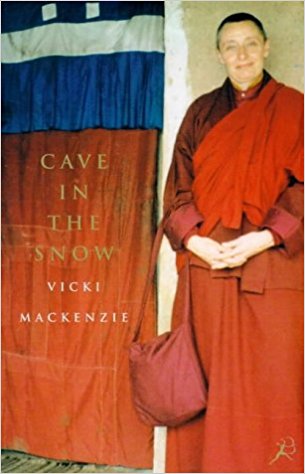
In 1976, many years before Buddhism became trendy in the West, a fishmonger’s daughter from the East End of London retreated to a cave 13,200 feet up in the Himalayas, where she spent the next 12 years of her life meditating with only the wild creatures for company. Her name was Diane Perry, though today she is better known by her Buddhist name of Jetsunma Tenzin Palmo. Cave in the Snow  is the fascinating story of Diane’s life up until 1998, when the book was published, by which time she had emerged from her cave with her new name to embark upon a fierce schedule of talks across the world to fund her new project: building a nunnery for young Buddhist girls. Happily, the funds were raised, and the Dongyu Gatsal Ling Nunnery now exists in the Kangra Valley of northern India, close to the seat-in-exile of His Holiness the Dalai Lama.


Diane Perry’s lifelong quest for spiritual enlightenment resonates with me as an author. We spend months, sometimes years, in our metaphorical caves working on our writing projects with only our characters for company, and then emerge blinking into the world to talk about our published books. The book ‘called’ to me from a local charity shop bargain box, not because of its cover (which on my edition is strangely prosaic with its photograph of Tenzin Palmo, dressed in her Buddhist robes, standing beside what I think must be the Tibetan flag), but because of its evocative title coupled with the interesting blurb on the back. How could a woman raised in the East End of London in the aftermath of the Blitz survive alone in a cave in the Himalayas for so many years? Why did she feel the need to retreat there? And what did she discover during her long and lonely years of meditation?

In Tenzin Palmo’s own words, referring to a period when she worked at the Department of Employment to raise funds for her return to India prior to entering her cave: “I felt very sad - there were all these middle-aged guys saying ‘What have I done with my life?’ and young married people with mortgages, already trapped.” Authors also tend to view society like this, from the outside as detached observer rather than as part of the group, and it can be dangerous to look too long or too deeply at what actually matters in life. Shortly afterwards, Tenzin Palmo entered her cave, but not before carrying out a few essential renovations with the help of the locals to give it some proper walls and a door she could close against the elements and wolves. As she says in the book: “It was a very pukka cave.”

Tenzin Palmo did not write in her cave. She read her Buddhist texts and meditated in her box-bed, which was not big enough to allow her to lie down. She grew vegetables outside in the summer months, and - like St Francis of Assisi - was visited by the animals and birds of the mountains. She conversed with wolves, saw the prints of the elusive snow leopard outside her cave in the snow in the depths of winter, and also a huge footprint that may have belonged to the legendary Yeti. It seems she also survived possible breast cancer, and a serious eye infection. And, through all these hardships, she thrived.

It must have been a profound experience, and I kept wishing that Tenzin Palmo had written this book herself, rather than having to read her story secondhand. But Vicki Mackenzie has written a clear and faithful account based on her interviews with Tenzin Palmo, and part of the allure of a spiritual quest is the difficulty of capturing such a mystery in words. Perhaps the best any writer can hope to do is sketch down the bones, and leave it up to the individual reader to supply the flesh and the colour. If you are curious to know more, Jetsunma Tenzin Palmo is still teaching - see her website for details.

Cave in the Snow is published by Bloomsbury.

Monday, 7 August 2017

Guest review by Chitra Soundar: DAILY RITUALS - HOW GREAT MINDS MAKE TIME, FIND INSPIRATION, AND GET TO WORK by Mason Currey


Chitra Soundar is an Indian-born British writer, storyteller and author of children’s books, based in London. When not writing stories or not visiting schools, Chitra fills her well with her nephews, taking photos of flowers and birds, going to museums and attending dancing classes. Find out more at www.chitrasoundar.com or follow her on twitter via @csoundar.

I was constantly moaning on Facebook about not writing enough. The truth was that I was writing a lot – but I wasn’t spending enough time ruminating on the characters and the plot. An artist friend who watched me whinge and moan suggested I read Daily Rituals – a book put together by Mason Currey, which actually started as a blog.

In his introduction, Currey says, “My underlying concerns in the book are issues I struggle with in my own life. How do you do meaningful creative work while also earning a living? Is it better to devote yourself wholly to a project or to set aside a small portion of each day?”

I was bogged down by the same questions – can you do creative work, write the next best British Asian middle grade novel if you’re working to a deadline? Can you do good work if you spend three days a week at a day-job and hardly have time to think about anything else? Can a modern writer who still has to pay the mortgage, bills and an occasional treat claim their place on the artistic pedestal?

I’ve often blogged about my writing process, the preoccupation with time, filling the well, spending time between writing and thinking.

So someone suggesting this book to me felt like a gift. It was unsolicited advice from the universe to let go of the how and just focus on the what – because if anything this book tells me there is no one way to do the “art”. What works for a writer in France in the 1800s might not work for Stephen King in a park trailer.

When I started reading Daily Rituals, I was amused and awed by the genius, pettiness and even the arrogance of many. While many respected the writing, some dreaded it and others could operate only in excesses.

Currey has chosen a wide range of writers, musicians and artists across generations, continents and some cultural diversity. Many of the accounts have been scoured from interviews, memoirs, newspaper clippings and such. But the short accounts from each artist reads like a story. A little glimpse through the window of a famous artist who we admire and would love to emulate.

Not sure if I can drink and dine out every evening like Francis Bacon or write in the family sitting room like Jane Austen surrounded by the noises of siblings, but I did find a kindred soul in Henry Miller. Like him I prefer to write from dawn to noon and anything I write after that is counterproductive to the work in progress.

P G Wodehouse and Stephen King have different rituals but they did solid work and had goals for each day. One writer I would have liked to see is Alexander McCall Smith whose rituals have been published widely. He is also a musician (apart from being a medical law professor) and he talks about his writing rituals here and here.

Writing places also seem to vary – from sheds to basement to a desk in the corner of a bedroom to writing with the company of snails. While some wrote after a coffee, others needed a stiff drink. Each of their muses seemed to ask for different things.

Did it stop my clamouring? Did it make me more confident of my methods? While any of these rituals cannot guarantee genius, it was reassuring to know that there is no way to approach it. There is no formula, there is no secret code that you get to find out only if you’re inducted into the hall of fame. There is just YOU. By that I mean ME. What works for me is surely only what works for me. I have to reflect on my own habits and discern the things that work and follow those rituals.

When we find that magic ritual – we should hold on to it. I know; it does cause huge amount of stress within our families.

o “I will not write until the genie appears out of this eco-lamp!”

o “I need to lock myself in the family bathroom for four hours in the morning to write.”

o “I can only write in cocktail bars between 6 pm and 9 pm and this entire table is taken for my enormous antique typewriter.”

Just kidding. Mine are much more sensible – I just live in a different country from my family or chloroform them until I’m done in the morning.

I wanted to share this book with all of you because we all wonder about the muse at some point – especially when there is a deadline and the words are stuck and wouldn’t flow down. Or we overwork – draining our creativity on to page and suffer from anti-social thoughts like – why do I have a family? Why do I have to take a shower today? What is the meal between breakfast and lunch? We feel guilty on days we don’t work, we get an idea during a holiday and we abandon our companions to the sharks in the ocean and hide in a dry corner with a notebook or a laptop.

So if you’re a regular output no-nonsense writer or I-write-when-I-want writer, this book will interest you. If not anything else it will give you the courage that whatever your method, there were more crazy ones out there!

Daily Rituals is published by Picador.