Showing posts with label France. Show all posts

Monday, 31 August 2026

Guest review by Peter Crawley: THE JOURNAL OF HÉLÈNE BERR: a Young Jewish Woman's Life in Occupied Paris, translated from French by David Bellos


"The beauty in this in many ways tragic journal is the awakening of spirit, the blossoming of defiance and the hardening of determination not to be beaten by the ranks of evil."

Peter studied social, political and economic geography, and later languages at The Goethe Institut in Freiburg-im-Breisgau, Germany. Having written aural histories, obituaries and magazine articles throughout his life, in 2011 he returned to writing full-time. His first published novel, Mazzeri, about the shaman of Corsica, was published by Troubador in 2013. Subsequent works include Ontreto (Lipari, Sicily), Boarding House Reach (Norfolk), The Wind Between Two Worlds (London), The Truth in Fiction (short stories), What you Don’t Know About Me (a novella), and Constant Tides (Messina, Sicily), which has been translated into Italian. Theo’s Voice, a story of aphasia, is his latest work. Peter’s interests include listening to and researching personal histories and landscapes, believing that both our epoch and our surroundings shape us as much as our DNA. He lives in Midhurst, West Sussex, with his wife, Carol, and is currently writing a second novel set in Lipari, Sicily.

These days, if one was to lose an hour or two to the second-hand bookstalls of the Left Bank, or an afternoon to the gentle majesty of the Jardins de Tuileries, one might be forgiven for thinking le vieux Paris was forever thus – light of heart, perhaps even carefree. Yet the city was not always so.

In June 1940, Hélène Berr was nineteen when the German Army marched down the Champs-Élysées; she was studying English language and literature at the Sorbonne where, later, she was awarded the coveted Diplôme d’Études Supérieures for her thesis on ‘Shakespeare’s Interpretation of Roman History’. Born into a middle-class, secular Jewish family, Hélène was what some would have called strong-willed and others independent. Her father, a former artillery lieutenant wounded in the First World War, was deputy chairman of a major chemical and industrial group, and, as such, Raymond Berr was deemed by the Nazis to be a person of use, which meant his family were afforded protected status; a status that endured only until they were deported on the 27th of March 1944, Hélène’s twenty-third birthday. Two years earlier, the young woman had begun a diary, in which she recorded the passage of twists and turns that led her to that wretched day; a diary she deposited, often only pages at a time, with Andrée Bardieu, the cook who had remained in her father’s employ for more than half a century.

The first page of Hélène’s Journal, as it has become known in David Bellos’ brilliantly empathic translation, finds her wandering down the Avenue Victor Hugo, her thoughts consumed with the challenges of falling out of love with Gérard and in love with Jean, both of whom subsequently fled the country to join Free French Forces and in doing so survived the war. What these entries don’t tell us, however, is that by this time Hélène was working for the L’Entraide Temporaire, a clandestine organization committed to saving Jewish children from deportation. A letter to her sister, written on the day Hélène was arrested, reveals her use of codewords – Henri for her father; Minnie for her mother, Gaston Bébert for police station, Marcel for the police – and many of the entries describe her shepherding orphaned children to safety, while disguising their true destination. The narrative is almost poetic in its flow and the writing of the highest quality, yet the beauty in this in many ways tragic journal is the awakening of spirit, the blossoming of defiance and the hardening of determination not to be beaten by the ranks of evil, both foreign and domestic.

Some would call Hélène’s Journal a rite of passage through a dystopian landscape in which Jewish adults, adolescents and children were considered less than human and therefore treated inhumanely; I would call it an awakening, if not a clarion call. And to those who turn a tin ear to the Holocaust, I would say read this story of a young woman’s resistance – a resistance both physical and intellectual – and rage that one so talented, so compassionate and courageous, should be taken from the world before her time.

Much of her Journal is given over to philosophy and reflection, to the agonies and ecstasies of adolescence, and to the price one pays for being both ordinary and otherwise. Hélène understood her life was soon to end, and in one passage reasons that after death one lives on, if only in the memory of those still living. Now, because of her Journal, the name Hélène Berr will live on and remind us how truly fortunate we are to be light of heart and carefree.

There are three other exceptional books that deserve mention: the first is Anne Sebba’s Les Parisiennes (Weidenfeld and Nicolson), a fascinating and meticulously researched account of how the women of the city ‘lived, loved and died’ through the occupation; the second is Irène Némirovsky’s Suite Française (Vintage) which, although classified as fiction, provides a stark reminder of what it took to survive; and the third is A Life In Secrets (Abacus), Sarah Helm’s exceptional history of ‘Vera Atkins and the lost agents of the Special Operations Executive’, in which we come to know the women, and some of the men, parachuted into France during the Second World War, the majority of whom were never to return. Neither Irène Némirovsky nor Hélène Berr lived to see the war’s end; both were murdered, brutally, by the Nazis.

Like so many, their names must never be forgotten.

The Journal of Hélène Berr is published by MacLehose Press. The French edition is published by Tallandier.


Peter's latest novel, Theo's Voice, is published by Troubador

Monday, 10 August 2026

Guest review by Jude Hayland: THE OLD WIVES' TALE by Arnold Bennett


"A masterpiece that has long been overlooked as Bennett appears to have slipped out of bookish fashion."

Initially a short story writer for women’s magazines, Jude Hayland was published extensively both in the UK and internationally for many years. After completing an M.A. with distinction in Creative and Critical Writing, she switched to writing full length fiction and has now written four novels with a fifth close to completion. Her genre is best described as book group fiction, concerned with the complexities of families and relationships, although her fifth is something of a departure with a setting in London during WW2. She also blogs on all matters writerly, runs creative writing workshops and particularly enjoys sharing her near lifelong reading and writing experiences through talks to U3a and similar groups.

No wonder Arnold Bennett despised the literati of his day and avoided their company - a victim of their snobbery and Virginia Woolf’s outright mockery of his writing, he remained disdainful his whole life of the elitism he found amongst his contemporaries.

Yet he was extremely successful financially and extraordinarily prolific. Between 1892 and 1931, he wrote 34 novels, endless articles and reviews, short stories, plays and wrote a daily journal. He also spent some years as an editor at Woman Magazine which, he claimed, helped him to learn a great deal about the secret nature of women as well as about ‘frocks and household management.’

I agree with him. Bennett’s ability to explore the emotions and complexities of his female characters, to portray them with acute sensitivity and insight is, for me, one of the highlights of his novels.

The Old Wives’ Tale was published in 1908 and I first read it at the age of 20, prescribed reading for the Modern Fiction course of my English Lit degree. I loved it then – for its narrative, spanning the second half of the 19th century and the opening years of the 20th, the carefully evoked settings of provincial Bursley in the Potteries and Paris, and the host of vividly and sympathetically drawn characters.

But coming back to the novel, decades later, is to find, of course, so very much more.

Bennett sets his protagonists against the backdrop of key social and political moments in both Bursley and Paris and such events certainly play an overarching role. But it is really the effect of time itself upon human lives that is his subject, the inevitable yet bewildering rapid passing of time – something that was of no particular interest when I read the novel at the age of 20 but decades on, resounds starkly.

Constance and Sophia Baines, sisters appropriately defined by their names, grow up in the family drapers’ shop in the square in Bursley with conflicting desires for their lives. Constance, biddable, acquiescent, anticipates a predicable path whilst Sophia, restless, rebellious, seeks something far beyond such a prescribed existence. Rashly eloping with the handsome travelling salesman, Gerald Scales, she is soon living with him somewhat precariously in Paris.

Bennett himself was living in Paris when he wrote the novel which was inspired, as he states in his journal, by an encounter with a solitary middle-aged woman, inordinately stout and with pendent cheeks in a Parisian restaurant. Initially repulsed by her, he consequently became curious about what lay in her past to bring her to that moment – she was once young, slim, perhaps beautiful …her case is a tragedy.

The novel is structured in four parts, namely Mrs Baines, Constance, Sophia, whilst the fourth entitled What Life Is reunites the sisters towards the end of their lives after many years estranged and is intensely poignant as the two women confront the disparity between their adolescent hopes and the realities that time has wrought. ‘And what have I lived for? What is the meaning of it?’ The riddle of life itself was killing her, and she seemed to drown in a sea of inexpressible sorrow, Bennett tells us of the once impulsive and ardent Sophia.

To me, The Old Wives’ Tale is a masterpiece that has long been overlooked as Bennett appears to have slipped out of bookish fashion. Yet it tells the story of two women (three including the matriarchal Mrs Baines) who discover their own strength and resilience when the lives they had anticipated take very different turns, a theme as relevant now as when the novel was published in 1908. Both sisters find themselves victims of circumstance, of domestic as well as political change and twists of fate. Sophia does more than simply survive the Siege of Paris and the Commune of 1870 and prospers, discovering a stalwart, astute mentality to replace her youthful fecklessness whilst Constance, wishing only for the predictability of Bursley and the drapers’ shop, is forced to confront events that threaten such prosaic stability.

But then this is a realist novel. Bennett believed that literature should be accessible to ordinary people and the concerns of his novels are the concerns of ordinary lives perpetually shadowed by the extraordinary. As Sophia observes towards the end of her life, humanity walks ever on a thin crust over terrific abysses and The Old Wives’ Tale catches this very simple yet startling truth.

The literary cliques and elites that Bennett so despised might have scorned his concern with the mundane and commonplace, but, like the greatest and most enduring of writers, his strength lies in his ability to portray such lives with empathy and conviction.

The Old Wives’ Tale is a memorable and masterful example of his craft.

The Old Wives' Tale is published by Penguin Classics. 

The Legacy of Mr Jarvis by Jude Hayland is published by Matador.

Monday, 20 June 2022

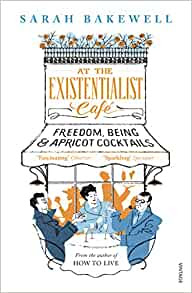
Guest review by Graeme Fife: AT THE EXISTENTIALIST CAFĒ - FREEDOM, BEING & APRICOT COCKTAILS by Sarah Bakewell


"Bakewell has sailed what might have been tempestuous waters with assurance, understanding, sympathy and love."

Graeme Fife is a regular reviewer here. He has written many plays, stories, features and talks for radio, stage plays and articles for newspapers and magazines, and is a regular contributor to BBC Radio 4's From Our Own Correspondent. He's the author of a string of books - children's stories, biography, works of history and fiction. His novel of the French Revolution, No Common Assassin, tells the story of Charlotte Corday.

Philosophy…brilliant minds describing society as it could, should be? The crux is language. Imannuel Kant speaks of Ding an sich which we may translate ‘the thing itself’. Fine, but what is thing in this or any application? From universal thing we move to the mystery of being … the essence of humankind? The core, impression, elusive oneness of One? Philosophy can be a trial and I’ve always found it baffling, often beautiful in many respects, but a cerebration too far in most. I therefore came to Sarah Bakewell’s At the Existentialist Café: Freedom, Being and Apricot Cocktails, captivated by her wonderful study of Montaigne in How to Live, more drawn by cocktails and the company of the people drinking them in the Paris café – de Beauvoir, Sartre and their friend Aron – than by the inevitable task of coping with more rarefied talk of disquisition and the quests and riddles, byways and shadowy alleys down which ‘love of wisdom’ may lead, numb-headed as this must seem, be. How foolish. All this before I’d read a page? There’s so much more.

The context of the book, beyond the intellectual thinking and talking shop of the Latin Quarter cafés in Paris, animates its narrative. Between the two wars, all Europe was in turmoil. About Germany we know, too well; in Britain, too, the faltering of all that had been certain and the shocking prospect of uncertainty: foundations of the old order rocked, ancient empires blown away. No system of thought was safe from question, now. France, a nation deeply divided on many fault lines for a long time, saw a brief ascendancy of the Left: socialism and communism offered, apparently, an answer to, through challenge of, the domination of the Establishment namely accepted wisdom, rooted tradition, all that was sure, innate, even benevolent before that very Establishment oversaw the horrors, the devastation of land and wholesale slaughter, 1914-18.

Bakewell is particularly astute in exploring the climate of Occupied France and the moral dilemmas it threw up: Patriotic or Personal? Nation or Friend? Protest – violent or non-violent? Discuss. Thought of itself can be arid and off-putting. What counts equally is the heart of the story not its clothes and jewellery.

To Paris came news of phenomenology, a philosophical approach to knowledge and understanding which originated with Husserl in Germany, a country whence so many of the modern thinkers had come. I attempt no definitions here. Bakewell’s learning and clarity deserve better than any amateurish upstaging. That said, from the intense deliberations of the threesome in a café over its famous apricot cocktails came the enunciation of a way of thinking about human affairs christened existentialism…ah, existence. How, in this new cosmos when all seemingly permanent structures had been near shattered, even obliterated, to consider humanity’s place and purpose? Perhaps by looking, just that, looking at what’s there still, a kind of permanence. Greek phenomenon means 'that which appears, is visible’. Simple? Far from it and Bakewell is a wonderful guide. Her clarity – and passion – for and about the subject informs a story which could so easily threaten to overwhelm.

She investigates a process of thought about the entanglements of morality imposed by new order which had eroded certitude to a degree unimaginable hitherto. More than a starting anew, a need to address a wholly different problem. ‘A future humanity living in isolated pods beneath the Earth’s surface’ as E M Forster imagined in a short story? Huxley’s Brave New World? As Bakewell writes of commentators on this disintegration: ‘They set out to detect and capture the quality of experience as we live it rather than according to the frameworks suggested by traditional philosophy, psychology, Marxism, Hegelianism, structuralism or any other of the -isms and disciplines that explain our lives away.’ Add, for example, that the French Revolution foundered, in large part, because the small-minded bigots at its heart, the drivers of its bloody excesses, believed, that virtue or, in their word, civisme, being a good egg in Whitehall parlance, could be inculcated by law and edict.

From that age of Fascism, a violent curse out of the perverted sense of rectitude imparted by a weighted fist, Bakewell cites Paul Ricoeur, a pioneer of the new thinking: ‘The relentless persecution of this man (a Czech activist) proves that, in the event of a people’s extreme abjection, philosophical pleading for subjectivity is becoming the citizen’s only recourse against the tyrant.’ Subjectivity? Feeling. Humanity.

Bakewell has sailed what might have been tempestuous waters with assurance, understanding, sympathy and love. It’s a story that needed to be told on issues which demand consideration.

At the Existentialist Café is published by Other Press (NY).


Read this Q & A with Graeme about his novel of the French Revolution, No Common Assassin


Monday, 17 August 2020

Guest review by Jill Dawson: NEGATIVE CAPABILITY by Michèle Roberts


"Feels like being in a café with Michèle, enjoying a glass of French wine and listening to her being funny, irreverent and political, passionate and indiscreet ..."

Jill Dawson
is the author of ten novels, including The Crime Writer, about Patricia Highsmith. The latest is The Language of Birds, about the nanny murdered in the household of Lord Lucan in 1974. She runs a mentoring scheme where established writers work with new ones, Gold Dust Mentoring.


Following a series of devastating rejections, novelist and poet Michèle Roberts decided to keep an account of her life in order to make sense of her shattered sense of self. This wonderful, fearless, surprising memoir is the result. I have been recommending it lately to all my writing students because if there’s one thing all writers need to understand it’s how to cope with rejection, how to survive it and carry on writing.

I should state here that I know Michèle (she was my boss, the Director of the MA in Creative Writing when I taught at UEA) so I don’t doubt I’m biased, but I loved her writing long before I met her: its sexy openness, daring experimentation, vividness and warmth. If you haven’t read her, along with poetry and memoir and short stories, there are fourteen novels. Daughters of the House, shortlisted for the Booker, is a good place to start. 

I devoured this. An honest insight into how another writer – one as established as Roberts no less – feels when a novel gets bounced around by agents and publishers is rare. The book could be read as a companion to her earlier memoir, Paper Houses, which tells of her formative years as a young feminist in the 1970s. Alongside her thoughts on writing, on Creative Writing students who want to produce ‘marketable commodities’, set against her own passionate desire to make art and take risks, there is also a glorious exploration of food, sex, friendship, loss, feminism, art and religion. This intimate memoir feels like being in a café with Michèle, enjoying a glass of French wine and listening to her being funny, irreverent and political, passionate and indiscreet, (although this artlessness, the creation of such a natural-sounding voice is of course the skill of an accomplished writer who makes it look easy).

In one chapter, reading Roberts on rejecting the idea that the male gaze creates desire, I was struck by how powerfully her thinking had influenced me in my twenties. The idea of the radical nature of actively desiring, feeling desire as a woman and not just wanting to be desired, reflected back at twice your natural sexiness is a theme that comes up in my novels a lot. Since I was reading Michèle Roberts in the 1980s at the start of my writing life, I am aware of how much I owe her.

‘Negative capability’ she reminds us, is a term Keats used in a letter to a friend, meaning ‘to be capable of being in uncertainties, Mysteries, doubts, without any irritable reaching after fact & reason.’ Dwelling in the not-knowing, not being able, is of course so much easier to talk about, preach, than to actually practise. Might the concept be extended not just to writing but to living? Perhaps it could more broadly refer to all situations where a person felt out of control, even to ‘not being published, not being read’?

‘Just treading water, swimming, just lying on my back, floating in the present, the buoyant present holding me up and rocking me’, she suggests.

If you want to be buoyed up, nourished, encouraged to be fully alive, to challenge and to doubt, this memoir is a joy from start to finish.

Negative Capability is published by Sandstone Press.

Monday, 25 March 2019

Independent bookseller feature No.6: Borzoi Bookshop, Stow-on-the-Wold: SIXTEEN TREES OF THE SOMME by Lars Mytting


"Don't rush it - you could miss the vital hints which help solve the mystery."


I am Aloÿse Packe and I have worked for the independent Borzoi Bookshop in Stow-on-the-Wold for the past 29 years. The shop has been in the town since the late 1970s. During this time there have been three owners and twice as many shop dogs. There have been too many changes to go through here but some of our customers are still the same and they certainly appreciate our quirky individualism. We have just moved premises within Stow, so please don’t think we have closed - we have just moved. We are the official bookshop for the Chipping Campden Literature Festival held in May; we hold regular book signing events, and we run a successful book club for Daylesford Organic. We love to chat to our customers about books, as Linda will testify, so please drop in.

I chose The Sixteen Trees of the Somme because it has tremendous all-round appeal. I have read it twice. Usually I find this an annoying thing to do but I enjoyed it just as much the second time round. In fact I found so much more in the detail.

Lars Mytting, the author, is better known in the UK for his best selling non-fiction book Norwegian Wood: Chopping, Stacking and Drying Wood the Scandinavian Way. Wood plays an enormous part in this atmospheric family saga spanning the twentieth century.

Edvard is brought up by his grandfather on a remote farm in Norway. Following his grandfather’s death in 1991 Edvard decides to delve into the mystery of the death of his parents in France where, as a small boy, Edvard went missing for four days. Intertwined with this is the story of Einar, Edvard’s great uncle, a skilled cabinet-maker who was estranged from his family. The story moves to Shetland where Edvard meets Gwen Winterfinch, a young aristocratic Scottish girl, whose own family story is entangled with Edvard’s. Together, they travel to France hoping to find the truth about a missing inheritance. The chapters set in France are poignant and deeply moving. It is appropriate that the paperback edition was released in October 2018 as we remembered the end of hostilities in 1918.

Through the descriptive passages on wood we discover the link between the main characters. Trees have deep roots. The idea of a family tree is deeply symbolic.

To begin with the book moves slowly but take heed – every little piece of information fits into the jigsaw puzzle (rather like stacking wood). Don’t rush it – you could miss the vital hints which help solve the mystery. Ponder on the love story – attractive, wild, girl versus the sensible committed girl next door. This book may not stand the test of time but it is a really good read.

The Sixteen Trees of the Somme is published by MacLehose Press. 

Monday, 27 November 2017

Adèle Geras: THE ACCIDENT ON THE A35 by Graeme Macrae Burnet


"The answers to the mysteries are both satisfying and surprising"

The first novel I read by Graeme Macrae Burnet was His Bloody Project, which I thought was wonderful. A historical novel, a thriller, in a Scottish 18th century setting with several entirely beguiling narrative voices making up a story which was both brutal and also touching in many ways. Above all, this book did what I love books to do: it created a world. By the time you reached the end, you knew exactly what living in a Scottish croft was like: who your neighbours were, what the landscape looked like, how your days would unfold.

His next book, The Disappearance of Adèle Bédeau, is set in Saint Louis, a small town near Strasbourg. I was attracted to the name for obvious reasons but when I read it I was bowled over by the versatility of this writer who could move between Scotland and France with such ease; who could conjure up an urban landscape as well as a rural one. The Disappearance introduces us to a detective called Georges Gorski, with his snobbish wife Céline and his teenage daughter, Clémence. While I was reading it, I kept on thinking: this is like Simenon: simply told, not terribly dramatic or violent. A quiet book with things going on under the surface. When I reached the end, and the author's 'revelation' that the book was a translation from the French, I was full of admiration...a twist in the tail/tale that took me by surprise and delighted me with its cleverness. Burnet had invented a writer called Raymond Brunet....and it's Brunet's novel he's translating. As he says, in the post script to The Disappearance, quoting from Simenon: Everything is true but nothing is accurate.

I went back to read the Translator's Note on the first Gorski novel, and its full cleverness is only revealed when you open The Accident on the A 35. For this novel describes what happens when Raymond Brunet's father dies in a car accident. The first Gorski novel foreshadows the second almost entirely. It's very clever. Graeme the Scottish writer is counting on a couple of years dulling the memories of all but his most careful readers, and indeed, I'd forgotten the details of this amazing dovetailing of the two books.

Two Raymond Brunet novels, we're told, have come into the possession of the writer. This one describes, very carefully and in enormous detail, what happened when his father died. It's Raymond Brunet who is the model for Raymond Barthelme, the teenager in the novel we're reading. Gorski's wife has left him for the moment and the question of whether the two will be reunited is almost as gripping as the mystery.

And there is a mystery to which we seek an answer. In fact, there is more than one and we are with Georges, trying to get to the bottom of where a rich lawyer was when he said he was meeting with his colleagues and friends in order to discover whether the accident is truly accidental. His son also wants to find out what his father was really up to. We follow them both. Gorski has a drink problem. We spend a lot of time hanging round cafés and bars. The boy is a prototypical disaffected French teenager: all existential angst with a strong whiff of 'je m'en fou-tism". Everyone that Georges and Raymond meet along the way is beautifully described. You can see/hear/smell every single one of them. The answers to the mysteries are both satisfying and (to me) surprising, though I have to say I'm not terribly good and guessing things in books and perhaps I ought to have seen at least one shock coming.

Saint Louis is a dull little town. Nothing much happens. If you want sensation and thrills and rushes of dramatic action, this is not the book for you. But if you want to mooch along drab French streets and smell the coffee and the brandy and meet the denizens of the establishments where Gorski drinks and passes most of his time, then you'll love this, as I did. There's another Brunet novel in the pipeline. I for one can't wait.

The Accident on the A35 is published by Contraband.