Showing posts with label society. Show all posts

Monday, 15 April 2024

Guest review by Susan Elkin: NEVER LET ME GO by Kazuo Ishiguro


" ... Of course, she (Kathy) is terrified but Ishiguro’s drawing of her character is a masterclass in understatement, repression and denial."

Susan Elkin
taught English in secondary schools for 36 years, latterly developing a parallel career as a writer. Since 1990 she has written over 5000 articles for newspapers and magazines, English text books, how-to books for teachers, a book about careers in theatre and latterly three volumes of memoir: Please Miss We’re Boys (2019), The Alzheimer’s Diaries (2022) and All Booked Up (2024). She lives in South London.


I read Never Let Me Go casually when it was published in 2005. Then it got taken up by several examination boards as a GCSE set text and I was commissioned by Hodder to write a study guilde – which meant a lot of very careful analytical thinking. I’ve written five of these on different titles and it’s certainly an effective way of honing very attentive reading skills – like teaching without the students.

Never Let Me Go presents a world, more or less like our own, except that there is a parallel breeding programme of clones whose organs are gradually harvested when they reach maturity. There’s a complex, albeit patchy, system for making it as humane as it can be which often, rereading again now after 11 years, reminds me of animal welfare concerns in real life: hideous things go on but meat eaters simply don’t want to think about that. In the same way, people on the periphery of Never Let Me Go need kidneys, livers and hearts for transplant but choose not to think too hard about the source.

The novel is narrated by Kathy H and although her attention to detail is punctilious, she is the most unreliable of narrators. She is coming to the end of an unusually long eleven year stint as a “carer” and looking back at Hailsham, the beloved institution, now closed, where she and her friends Ruth and Tommy were brought up. Soon she will have to start her “donations” – chilling choice of euphemism. There is nothing voluntary about this. She faces a series of four organ-harvesting operations which will end in death. Of course, she’s terrified but Ishiguro’s drawing of her character is a masterclass in understatement, repression and denial.

We never meet the organ beneficiaries or see the surgery in action. The author isn’t interested in that sort of detail. He doesn’t dwell on science and specifics either. We simply see Ruth and Tommy and others in “recovery” (another sinister euphemism) centres where there is always an officially appointed carer. Instead the novel focuses on relationships and personalities and, crucially, explores whether or not you are fully human if you are cloned and unable to reproduce. Do you have a soul because if you don’t then does that make you expendable? There’s a lot of emphasis on creative art at the enlightened Hailsham to prove that you do – but what’s the point if you’re only being bred to die?

Well, there have been other novels about organ harvesting: Spares by Michael Marshall Smith (1996), Under the Skin by Michael Faber (2000) and, in a sense, My Sister’s Keeper by Jodi Picoult, (2004) for example. So why did Ishiguro choose to visit this topic? My contention is that organ removal isn’t the main thrust of the novel. The donation programme is merely the setting.

Never Let Me Go is actually a compelling, but searingly bleak, novel about the death which awaits us all: a parable about mortality. As children “we’re told but not told” as Miss Lucy says in the novel. We know about death – vaguely. Then, as we grow up, most of us choose not to think about it much. And we bolster our denial with euphemisms.

All religions offer some sort of explanation of death in order to enable their believers to face the future without fear or despair. Unbelievers have to face knowing that their lives will “complete” (yet another Never Let Me Go euphemism) possibly after being “all hooked up” and with “drugs, pain and exhaustion”. In the novel the rumours about the possibility of deferral represent a religion of hope – which is eventually dispelled by Miss Emily. “Your life must now run the course which has been set for it” she tells Kathy and Tommy. And that, of course, is true for all of us.

Never Let Me Go, pubished by Faber, was adapted as a film in 2010 with Carey Mulligan as Kathy. Inevitably it lost most of the subtlety of this fine novel.


Susan Elkin’s Study and Revise for GCSE: Never Let Me Go by Kazuo Ishiguro was published by Hodder Education in 2016.

Monday, 5 February 2024

Guest review by Jane Rogers: OPEN WATER by Caleb Azumah Nelson


"Since I finished the book its mood and flavour have haunted me and I’ve found myself thinking, with great admiration, of how technically accomplished this writer is."

Jane Rogers
has written ten novels, including The Testament of Jessie Lamb, Man-Booker longlisted and winner of the Arthur C Clarke Award 2012. Other works include Mr Wroe's Virgins (which she dramatised as a BBC drama series), and Promised Lands (Writers' Guild Best Fiction Award). Jane also writes short stories, radio drama and adaptations, and has taught writing to a wide range of students.

Her dystopia Body Tourists is now available in paperback. For more information, see Jane's website.


This novel deservedly won the Costa First novel award in 2021. It’s narrated in the second person by a young Black man living in London. (And incidentally, it is the most successful novel-long use of the second person that I have come across. Often the second person starts to feel clunky or contrived, but here it simply pulls the reader into intimacy with the narrator.)

He meets a girl and falls in love, but nothing in his life is simple; the girl is his best friend’s girlfriend and both of them are riddled with guilt about betraying the best friend. He’s grieving for the death of his grandparents and also utterly weary of the casual racism and violence served up as standard to a young Black man in London. He’s tired of being an outsider, tired of being afraid, tired of trying to hide his fear. Nevertheless there are moments of joy and freedom, when he reaches ‘open water’: when his girlfriend tells him she loves him; when he dances at an all-Black jazz club; when he dances at Notting Hill Carnival.

This book made a huge impression on me because it’s the first thing I’ve read which has absolutely taken me inside the experience of a young Black man. I thought I understood racism, but here the reader experiences it with the narrator, and that is qualitatively different to understanding it in theory. There’s a troubled, alienated flavour to the writing, which circles around from the chronological progress of the love affair, to touch on events in the recent and distant past; at times the reader is as bewildered and lost as the narrator. But Azumah Nelson skilfully holds the novel together with key phrases which are repeated and riffed upon, in a way more reminiscent of poetry or jazz, than prose fiction. The narrator asks himself repeatedly, ‘How do you feel?’ and the use of second person makes this a question for the reader as much as the character. He refers to being ‘seen’ by other Black people, and most especially by the girl he loves; the police, who stop him and accuse him of robbery, look at him but do not see him. In this book Black people are rarely ‘seen’ as individual human beings worthy of respect, by the White population. And the painful questions, ‘What is a joint? What is a fracture? What is a break?’ recur in different orders, referring to different kinds of love and heartbreak, throughout the novel. Since I finished the book its mood and flavour have haunted me and I’ve found myself thinking, with great admiration, of how technically accomplished this writer is.

Open Water is published by Penguin.

Jane is a regular contributor to Writers Review. Here are more of her choices:


Home Fire by Kamila Shamsie


The Great Derangement by Amitav Ghosh

Monday, 18 December 2023

Guest review by Graeme Fife: EMPEROR OF ROME - RULING THE ANCIENT WORLD by Mary Beard


"In this age of fake news, media trolling, flummery and misinformation it seems to me most salutary to read such a thoroughly scrupulous examination of a time which yielded to different pressures ..."

Graeme Fife is a regular reviewer here. He has written many plays, stories, features and talks for radio, stage plays and articles for newspapers and magazines, and is a regular contributor to BBC Radio 4's From Our Own Correspondent. He's the author of a string of books - children's stories, biography, works of history and fiction. His novel of the French Revolution, No Common Assassin, tells the story of Charlotte Corday.

The word comes from imperator, the title with which (usually victorious) legionaries hailed their commander and derives from imperium, the blanket term for power, the official directive to rule either by applied or threatened physical force or indirect pressure, law, the full weight of empire…think imperative, imperious, imperial.

The first recognisable emperor, though not so acknowledged in his lifetime, Gaius Julius Caesar gave his name to Czars, Tsars and the Kaiser, each foremost in autocratic rule. Beard titles her study in the singular to give tighter focus to the various men who occupied the position (some of them ‘mad, bad and dangerous to know’? That’s the first assumption to assess) and to the role itself – where and how did the emperor live, how was such a vast domain, or imperium, administered, the paperwork, the countless clerks, scribes, placemen and officials who managed the unwieldy bureaucracy, the day-to-day work, the communication – in a world when even relays of horse-rider couriers travelled slower than carrier pigeons. It is, therefore, a study – and a magnificent study – of the mechanics of autocracy, the main difference between what we know – or presume - about autocrats and the Roman version in that many of our autocrats are or have been elected by popular vote, in itself a chilling fact. There are parallels however, and Beard’s rigorous scrutiny brings to light much of the exhibitionism, false statement and posturing which helped to substantiate the power of men who were not elected and often came to their position by selection – largely of loyal soldiers (think Putin and the KGB … my comparison not hers, for she is firm about not drawing parallels and that’s wholly to the credit of this most readable book) or because there really was no one else and few anyway, with blood connection to the inaugural emperor, Caesar Augustus, himself the adopted son of his uncle Julius who could trace his own family connections back to the goddess Venus (you get the idea?) or else by being jostled into place by an ambitious mother.

There was a lot of loose talk and false message purveyed, much of it by writers with their own agenda – of lampoon or critique – or else by hearsay and Beard’s scepticism is welcome: how, she asks, can we know? Easy enough for us to see through the arrant stupidity of Trump declaring, in a presidential address, no less, that the reason the Americans prevailed against the British in 1812 was that they held the airports and thus controlled the skies but it’s less easy to call out slippery Bunter/Johnson lies when the bleat re-echoes: ‘But it wasn’t me sir.’ Not to make it stick, at least.

What, then, are we to make of Vespasian’s celebrated last words: ‘Blimey, I think I’m becoming a god …’ A joke or wry comment on the absurdity of the whole thing from a weary cynic? Or those of Augustus, asking friends gathered at his deathbed whether he had ‘played his part properly in the comedy of life?' implying that it had all been for show, a huge act. Hard-nosed self-knowledge or throwing the solution back at them in a political climate where protest or censure, even robust question was risky?

Again, I draw a parallel and with apology but in this age of fake news, media trolling, flummery and misinformation it seems to me most salutary to read such a thoroughly scrupulous examination of a time which yielded to different pressures of news. It all amounts, finally, to what another Roman summed up in his infamous question: ‘quis custodiet ipsos custodes?’ (Juvenal Satire VI 347f)

There is scandal aplenty but Beard is resolutely cautious about the truth of what often probably amounts to little more than tittle-tattle. Perhaps it just shows that the Roman were as prurient, suggestible and avid for lurid stories about the monarchy as any people, in any time, in whatever condition – and on people, populus, the Populists depend. It is for us to be sceptical, cautious and Nell Gwynn nailed it when an angry anti-Catholic crowd mobbed her carriage in London. She pulled down the window and screamed at them: ‘No no no, I am the king’s Protestant whore.’

Beard concludes this most compelling and richly engaging book:

‘The Romans will not and cannot give us the answers [to our problems]. But exploring their world does help us to see our own differently. While I have been writing Emperor of Rome over the last few years, I have thought hard about that view of autocracy as fundamentally a fake, a sham, a distorting mirror. It has helped me to understand ancient Roman political culture better – and has opened my eyes to the politics of the modern world, too.’

Emperor of Rome: Ruling the Ancient World is published by Profile.


Monday, 14 August 2023

Guest review by Penny Dolan: AN ENGLISH LIBRARY JOURNEY (with detours to Wales and Northern Ireland) by John Bevis


"Whether to geographers, to history and design enthusiast, to local studies nerds and a mix of casual readers, a useful enterprise ... such fascinating oddments as the photographic pioneer brothers and their very own Stuffed Ox ..."

Penny Dolan is a children’s storyteller and writer. Her last novel for older children, A Boy Called Mouse, was nominated for the Young Quills Historical Fiction Award, and she is currently completing a companion book. She posts on The History Girls, on An Awfully Big Blog Adventure as well as being a regular contributor here, and can be found on Twitter @PennyDolan1.

After a librarian friend suggested An English Library Journey by John Bevis, I borrowed a copy - from my local library, of course.

Although published in 2022, this hardback book has been given a vintage look and cover. A slightly eccentric account, it made an interesting interlude between reading-group commitments and non-fiction titles.

However, to my mind, despite the title and all the library locations, Bevis’s account does not feel like a geographical study: focus on specific landscapes, topography or economic regions. The book is a chronological account of visits to almost two hundred English libraries and what gives the content relevance is that his trips took place between 2010 and 2019.

This was the decade shaped by the Big Crash, the EU referendum, Osborne’s austerity, the ‘Big Society’ idea and the subsequent decline in government and local authority funding, especially to libraries. Bevis’s lightly amusing quest ends by revealing the damage done to the public library service and the success and failures of various cost-cutting initiatives.

The author, it must be noted, is not a librarian but a freelancer. An occasional builder, decorating and gardener, Bevis has also been a typesetter for the V&A, poet and writer, designer, printer and publisher, and bookseller at Whitechapel Art Gallery.

He does, though, respect books and libraries. In his dramatic opening chapter, he describes how, as a nine-year old, he helped when fire broke out in an upper room at the Guildford Royal Grammar school. Though the flames had been doused by the fire-brigade’s hoses, water was running through to the school’s precious library below.

He became ‘part of a human chain stretching the width of the school grounds . . . books were passed hand to hand or cradled four or five at a time . . . I do not remember how many hours we worked but the effort seemed endless . . .All the books that passed through our hands were saved. . . .’ They were all aware of the rare 15th Century chained library nearby but safely out of reach of the fire.

The chapter develops into a short history of library provision , from early circulating and subscription libraries, the library acts, Carnegie’s philanthropic provision and the growth of the public library service during the twentieth century. Clearly, Bevis loves everything about books.

But how did this journey begin? Years later, after a health scare, Bevis becomes his wife’s chauffeur. Once he has driven her to her work at a variety of prisons, he has the middle of the day free. His plan is to find the nearest library’s computer suite and continue with his writing project and commissions.

This is when the eccentricity begins. Bevis must have a membership card to use the computers, but he can only get that by pretending to be “resident”. After outwitting the system a few times, he finds himself the proud holder of five different library cards. Inspired, he now starts on a personal quest to collect a membership card from as many libraries as he possibly can.

An English Library Journey is his account of all the libraries visited on this odd quest, year by year. The locations seem quite unconnected: for example, in Section One, dated 2019, he briefly records visits to Telford and Wrekin; Isle of Wight; Shropshire; Central Bedfordshire; Luton; Essex; Norfolk; Surrey, Nottinghamshire. Some libraries are given only a few lines, while other entries are much fuller than others.

Bevis’s interest is mainly architectural, along with comments on the how the building appears within its general setting. He writes that Leamington Spa’s ‘broad streets and terraces’ remind him of ‘TV and costume drama” and hint at ‘an England that’s too good for the English’. Meanwhile, Milton Keynes’s library ‘had made no space for itself but had blended into the constructed homogeneity of (the) town centre and Darlington Central was ‘a magnificent edifice with an art gallery’ and many ‘bare rooms and the scant library itself rather rattling around in the family mansion.’ It is ‘trying to downsize.’

Bevis includes the history of many buildings, noticing the architecture and occasionally the architectural firm. Newport, Shropshire, has a ‘modern generic fit-out . . . but the upper storeys are a family at war: the left hand building stolid in its plain stay-at-home Neo-Georgian brich while to the right is the crazy cousin, A Gothic stone gateway with castellated battlements (is) all that’s left of an 18th Century folly that housed a wool merchant and a draper. ‘ Luton’s influential Central library is ‘a pale floating box on peg leg pillars’; March (Cambridgeshire) has a feisty glass wedge of a building, now it its tenth year and, after a run of depressing visits, he finds that Slough is unexpectedly ‘bucking the depressing trend. . . A wrapped aluminium and glass cultural flagship.’

Although rather startled by the noise and the range of activities – music sessions for babies, Knit and Natter groups, the strange behaviour of some computer users - he is very conscious of the design of the interior of some individual libraries, the layout of space and shelving, the windows and light and atmosphere, as well as the ease and kindness with which he gets his card.

The book has a slightly uneven style, with some visits clearly more interesting and longer than others. Occasionally, as part of his quest, he tries visiting two or three libraries in one day. Yet, gradually, as the journey continues, Bevis’s observations darken. The design and lettering on his library cards also leads him into the history of library unions and consortiums around London, particularly the subsequent withdrawal of richer authorities, unwilling to keep sharing their stock. He draws attention to private providers, describing how one giant company went bankrupt, with several library contracts taken back in house by local authorities.

He notices the publicity given to Little Free Libraries, and telephone box libraries, pointing out that not only are they not true libraries, they rarely occur in areas that are without library provision. To them that have, more shall be given? He highlights the hub model (where a single, central librarian looks after smaller, mainly volunteer run-libraries) as a way of cutting staff costs, the council’s biggest worry. Alongside, he notes that volunteers come from a certain age and class, creating a model that works in prosperous areas but not in poorer communities.

Bevis also notes cuts in hours, the growing use of self-service tills, the long term thinning of library book-stock, in number and in depth and the practice of proudly including a “library” among several council services within one site, mainly because the library is often diminished by the practice. When he visits the ‘Rowntree Library Cafe’ in York, he seems appalled by the meagre offer of three sets of shelves. How can this shadow be publicised by the council as a valid library?

Revisiting one site, several years on in the decade, he finds the library that was always so busy has no more than a dozen users during the time I was there. . . It is the result of some other order of catastrophe.’

Of course, along with his descriptions and interactions with local people, Bevis does discover successful locations and libraries, such as the provision in Richmond on Thames, although even then he points out that the authority is ‘fortunate to ride austerity with the wealth of its populace and a below-average social fund budget.’

An English Library Journey was a slightly uneven experience for this reader. At times, I felt cross that Bevis’s card-collecting wheeze was wasting staff time and resources, that some visits were too brief, simply a chance for him to tick off that card, and also that his attention was more focused on his work in the computer suite rather than the work within the main areas of the library and books as a whole. I would have liked more about the books on offer in these libraries.

However, re-reading it, I felt that Bevis’s account, with its growing emphasis on spreading the word about our libraries, whether to geographers, to history and design enthusiast, to local studies nerds and a mix of casual readers, was probably a useful enterprise along with such fascinating oddments as the photographic pioneer brothers and their very own Stuffed Ox.

Additionally, although Bevis’s journey is two, three or more years out of date, An English Library Journey could also be a useful reminder about the need for extra vigilance about the coming rounds of cuts.

An English Library Journey is published by Eye.

More reviews by Penny:

Lessons in Chemistry by Bonnie Garmus

The Secrets of Wishtide by Kate Saunders

The Cold Cold Ground by Adrian McKinty


Monday, 6 March 2023

Guest review by Graeme Fife: THE SCOTTISH ENLIGHTENMENT - THE SCOTS' INVENTION OF THE MODERN WORLD by Arthur Herman


"The cover quotes Irvine Welsh: ‘Every Scot should read it.’ No. Everyone, I say, should read it..."


Graeme Fife is a regular reviewer here. He has written many plays, stories, features and talks for radio, stage plays and articles for newspapers and magazines, and is a regular contributor to BBC Radio 4's From Our Own Correspondent. He's the author of a string of books - children's stories, biography, works of history and fiction. His novel of the French Revolution, No Common Assassin, tells the story of Charlotte Corday.

The cover quotes Irvine Welsh: ‘Every Scot should read it.’ No. Everyone, I say, should read it, everyone interested in why the society of these islands is what it is, the fault lines, the tensions - we English with our damnable class structure, the Irish riven with unionism and the legacy of Anglo-Irish interference, the Scots, freer of tribalism, these days, if divided on political issues… Little Englanders, imperious and sentimental, sniffily call them ‘dour and practical’ whereas they’re less judgemental, more ecumenical.

I once taught at a public school (groan) whose governors came from the ancient Fishmongers Company and, puzzled, I asked the Headmaster whether they went from rich to not so rich. He replied: ‘From rich to extremely rich: they own most of Scotland and Ireland.’

Still true and if not in practical exactitude, the repercussions linger, our royal family persists in its depredations, the mockery of the tartans continues to astonish…

Of the obvious stars of the Scottish Enlightenment we already know – the engineers, the doctors, the philosophers; their contribution is undisputed and essential to a cultural shift in Europe overturning centuries of stagnation and ecclesiastical strait-lacing. Oddly, one element in Scottish society which contributed to the reshaping of idea and social regeneration was the kirk, that centre of bigotry and fearsome moral control exemplified by extreme Calvinist preachers like John Knox – his polemical pamphlet The First Blast of the Trumpet Against the Monstruous Regiment of Women (1558) insisted that the power wielded by queens ran contrary to the dictates of the Bible. However patriarchal the tone, nevertheless his fierce Protestant belief that the mediation of a priest harms the liaison between man/sinner and God, underpins a more egalitarian principle than in any society structured on class divisions opposing the wealthy few and the lesser many, where people are expected to do what they’re told by those with money, land and therefore power. Such an egalitarian ideal not only proved to be very influential but, in the words of Thomas Reid, an Aberdonian theologian: ‘Settled truth can be attained by observation’ is, incontrovertibly, ‘a science of human freedom’ and, indeed, provided the core impulse of the American revolution against despotism. 

 The grip of the kirk gradually waned, though Burns was still put on what we might call his local kirk’s ‘naughty seat’ for his dalliances. In the Scottish novel Sunset Song (Lewis Grassic Gibbon), the recording angel keeps Burns waiting at the Pearly Gates while he hides the Virgin Mary, in case the lecherous Ayrshire Lothario should corner her. As the kirk’s bigotry faded so a new community of thought informed the thinking of Scottish moral philosophers. Thus Adam Smith, born in Kirkcaldy, fused the ‘soft’ side of the Enlightenment, the belief in man’s innate goodness, its faith in the power of education to enlighten and liberate, and the ‘hard’ side, its cool and sceptical distrust of human motives and intentions. Smith cannot resolve this tension and it continues to permeate modern life and mustn’t be ignored. (The ‘soft’ side informs the French revolutionary insistence that human virtue may be enforced through law.)

Commerce and trade matter: the increasing wealth of Glasgow based on various trading enterprises and industry, Scots venturing out to distant markets and returning to establish a new hub which didn’t depend on ‘English gold’, to cite Burns. Two major cities, now: Glasgow and Edinburgh, new-built, models of grace in design. The eventual erosion of clan feudalism counts, too, in the emancipation of a society more and more independent and free-thinking, sponsoring the main flow of cultural influence from north to south instead of an imposition as it had ever been from south to north. Enterprise and education, the marriage of theoretical and practical, germane to the straight-talking, more open-minded Scot than the hidebound toffs of their more potent neighbour with whom they were – increasingly unwillingly – united. The cruel repression of that determination to shake off the chains – Jacobitism, the violence of the redcoats – stirs much beyond resentment; it fuelled clarity of mind on the issues pertinent. Herman stresses the presence in Scotland of a willingness to pursue a mix of education, religion, language and an ability to manage social contact better, in contrast, for instance, to the more rigid ‘them and us’ of the aristocratic / plebeian travails of England. Education, above all, and a trust of technology – the industrial revolution which ensued on the freeing of minds – ‘mehr Licht’ in Goethe’s last words – show themselves pre-eminent in Scottish society even as England insisted on books books books, the older the better. All very well but where are mathematics, engineering, making? Death to Privilege… the message of the Scottish radicals, out of sterner pious ideals, maybe. If only it were so.

The Scottish Enlightenment is published by Fourth Estate.  

Sunset Song by Lewis Grassic Gibbon is reviewed (and highly recommended) by Graeme here.


Read this Q&A with Graeme about his French Revolution novel, No Common Assassin:


Monday, 27 February 2023

Guest review by Cindy Jefferies: UNSETTLED GROUND by Claire Fuller


"These characters are beautifully drawn by Fuller with their frailties and difficulties with the modern world laid bare."

First published in 2001 for children, Cindy Jefferies found success with her Fame School series with Usborne Books, obtaining 22 foreign rights deals. Latterly writing fiction for adults as Cynthia Jefferies, her first title The Outrageous Fortune of Abel Morgan was published in 2018, followed a year later by The Honourable Life of Thomas Chayne, set during the English Civil Wars. Both titles are now available in paperback.

Unsettled Ground took me back to my teenage years, when I was made melancholy by reading some of the Russian classics. There is something of the plight of those serfs here. But while they suffered grinding poverty with no recourse to a better life, this is a very modern, English tale of two marginalised country dwellers.

Jeanie and Julius are fifty-one year old twins, living with their mother in a cottage that hasn’t been updated, perhaps ever. They do have a solid fuel Rayburn, but no bathroom and an earth closet outside. They scrape a living from their large garden, producing fruit and vegetables for sale, as well as eggs. Julius gets occasional work, but nothing permanent, while Jeanie has a weak heart and has never been employed outside the home. When their mother dies suddenly the twins are thrust into the horror of having no money for any sort of funeral, and their precarious existence begins to implode.

This novel made me both sad and angry at the plight of these two characters, especially Jeanie, who has few resources to cope in a society where data is king and electricity for charging gadgets essential. I have known people like this and these characters are beautifully drawn by Fuller with their frailties and difficulties with the modern world laid bare.

There was a point at which I wondered if I could bear to carry on reading but I’m glad I did. There are secrets in this family to be unravelled and they are revealed with skill. Unsettled Ground settles at last into an ending I could believe in without giving me sleepless nights. The gentle, unquestioned love between sister and brother is beautifully done throughout the novel. Highly recommended.

Unsettled Ground is published by Fig Leaf

More of Cindy's choices:


Monday, 28 November 2022

Guest review by Graeme Fife: THE SCENT OF DRIED ROSES by Tim Lott


 "I have, so to speak, just been turned inside out by a book."

Graeme Fife is a regular reviewer here. He has written many plays, stories, features and talks for radio, stage plays and articles for newspapers and magazines, and is a regular contributor to BBC Radio 4's From Our Own Correspondent. He's the author of a string of books - children's stories, biography, works of history and fiction. His novel of the French Revolution, No Common Assassin, tells the story of Charlotte Corday.

I have, so to speak, just been turned inside out by a book. We all know the injunctions: the Delphic Oracle – know thyself, echoed by Polonius; Socrates – the unexamined life is not worth living – Sophocles – what is neglected runs away from us. However paled into cliché the familiar axiom may become, its truth still holds. Tim Lott’s The Scent of Dried Roses – an intriguing title whose disclosure I leave to him – offers a salutary lesson in the essential value of self-scrutiny. His writing is merciless in its pursuit of detail and causation. He lets nothing slip. Not only does he bring to light with merciless resolve the various conflicting influences, bodily and mental, that test us, the vicissitudes which unsettle and undermine us. He also, as if inadvertently, uncovers how the patterns and habits of life in this country altered so radically after the Second World War. It’s an important element in understanding who we are, where we are now. Post-war austerity, the emergence of a different class, the rise of an entirely new human species, hitherto unclassified and uncatalogued, the teenager, with all the accretions of teenage culture and shifted values, disturbing the accepted continuum, life as she has always been lived. No longer. The resultant rage in the enquiry: ‘What is going on? What has happened to us?’ Empire, colonies, British hegemony, all gone or given away, the very fabric of life in this throne of kings, this sceptr’d isle shredded. A queen, even? Queenies still did the knees-up in Bethnal Green but Southall, where Lott grew up, saw a new influx, from abroad, a place we’d rarely had to go because we were already here. No longer. Changes altered the scenery, just as the knowns of childhood distintegrate in adulthood.

With the shifts in life and its acquisitions – all, to those of us growing up through the grey into technicolour, as medical science confronted a new phenomenon, depression – everything changed. How? We’d always had nutters and loony bins but now? Unhappy and a bit worse? Here’s a pill.

Well, Lott’s story is more complex than that, of course but it’s a story that need to be told and Lott tells it marvellously well, with one proviso: in a striking image he exposes the perils of belief, often desperate, in fixity. The painting which seems so ordered, locked in a frame, a moment fastened for all time, the permanence of our viewing, is never more than a construct, a seemingly motionless truth pinned down like a dead butterfly in the flux of reality.

Lott explores that flux, the watching eye unblinking, the listening ear pricked and the colour of the detail he registers is staggering in its range. I admit that the immediate resonances prejudice me a little – the fact (eg) that we both learnt Marian Richardson handwriting at primary school, a dullness soon ditched. Ditched, the very word is like a bell … you know the rest. We look and often do not see, listen but don’t hear, forgetting that both might lead to a sort of conclusion. It may be a paradox that one conclusion is the need to discard the quest for certainty, fixity, the definite, like an anchor. A useful, I’d say essential, paradox. And Lott calls it ‘the awesome responsibility that accepting uncertainty and insignificance entails’. [p 267]

Above all, this troublesome truth is what emerges most forcefully and altogether welcome, from this very often painful, always exhilarating, if difficult, memoir which, presented as personal, reaches out to a wider humanity in a way that only unflinchingly honest introspection can. Honesty can be overused in critique, a slick judgement of writing about self when that writing purports to be record, the untailored result of what is there, palpably there: us, our very self. Does that make fiction dishonest, then? Of course not. In books is found knowledge, even if, as the preacher warns, knowledge leads to sorrow. The vale of tears? Hmm. I once undertook a job of interpreting for a French street theatre group, because the organiser told me that, at the end of the show, ‘grown men cry’. And so they should.

You know what purgative means. Lott has, in this restlessly managed careful exposé, made forensic pathology of the heart and mind a kindly operation. Forensic is the adjective for forum where, in ancient Rome the law courts were sited. I use forensic because in writing of the hurts and desires, the tribulation of heart and soul, a certain legalistic dispassion does not go amiss. Reporting on the fevered heat takes a cool head. There is that here.

The Scent of Dried Roses is published by Penguin Modern Classics.

Monday, 17 October 2022

Guest review by S C Skillman: SAPIENS: A BRIEF HISTORY OF HUMANKIND by Yuval Noah Harari


"He offers many intriguing insights, one of the first of which is the vital role ‘gossip’ plays in human evolution and life."

S C Skillman
lives in Warwickshire, and writes psychological, paranormal and mystery fiction and non-fiction. She is a member of the Society of Authors and the Association of Christian Writers. Her non-fiction books on local history are published by Amberley and include Paranormal Warwickshire and Illustrated Tales of Warwickshire; her next book, A-Z of Warwick, will be released in 2023. She has been asked to offer a fourth history book for Amberley, which she is now researching; meanwhile, her new novel is out with publishers, and she is working on the sequel. She was born and brought up in Orpington, Kent, and has loved writing most of her life. She studied English Literature at Lancaster University, and her first permanent job was as a production secretary with the BBC. Later she lived for nearly five years in Australia before returning to the UK. She has now settled in Warwick with her husband and son, and her daughter currently lives and works in Australia.


In this book Harari gives us an overview of who we are, where we came from and why we behave as we do, reaching many bold and enlightening conclusions derived from numerous scholars’ views. He narrates a story of random causal chains and surprising consequences, of competing theories and contradictions. In an approachable and engaging style, he offers many intriguing insights, one of the first of which is the vital role ‘gossip’ plays in human evolution and life. As he remarks, ‘Homo sapiens is a story-telling animal’.

Across ‘the Arrow of History’, he sees a trend towards Global Order: diversity moving to unity. He discerns the great transformations, beginning with The Agricultural Revolution – in his view, wheat cultivation was a disaster on every level; it initially appeared good but then became (literally) a millstone round our necks. He asks how human society first began to consider men superior to women and traces this idea back to the beginning of the Agricultural Revolution. He can find no good biological explanation for the universality and stability of the patriarchal system: a challenge to us to seek the true cause!

Biology and culture, we learn, have always been at war with each other: biology enables, culture forbids. Events, circumstances, and power relations transformed ‘figments of imagination’ into cruel social structures, such as racism. He then explores Cognitive Dissonance, a vital asset: establishing and maintaining a human culture depends upon the ability of humans to hold contradictory beliefs and values.

In 1500 AD, history chose the Scientific Revolution, with Copernicus in the field of Astronomy; and from then on, we have seen massive growth in human power. Science, industry, and military technology intertwined only with the advent of the capitalist system and the Industrial Revolution which then quickly transformed the world.

Three universal orders, Money, Empires and Religions, have laid the foundation of the united world of today. Money succeeded where gods and kings failed: it is built on our trust in an imaginary future. Now many of us live up to the ‘Capitalist-Consumerist Ideal’. Imperial ideology from Cyrus the Great onwards has tended to be inclusive and all encompassing: empires actively spread a common culture, and they have created the world as we know it. Despite the 300 year-long Explore and Conquer Mentality, he sees good emerging from Imperial Expansion and points out that history ensured a peaceful and orderly end to Empires in the twentieth century. We now head into a new global empire: major planetary problems such as climate change and the energy crisis can only be solved globally. Immensely powerful currents of capital, labour and information turn and shape the world with a growing disregard for the borders and opinions of states.

Religion he sees as the third great unifier of mankind: to unite globally, a religion must be universal and missionary. We progressed from Animism (a belief in demons, ghosts, fairies, holy rocks, springs, and trees) through to the Agricultural Revolution, when we moved on to Polytheism (a world controlled by a group of powerful gods). With the coming of Christianity and Islam, the monotheist idea played a central role in world history and succeeded. Now all these worldviews co-exist along with several new natural-law religions, among which he lists liberalism, nationalism, and different types of humanism.

He considers the forces that make cultures succeed; history disregards the happiness of individual organisms, but nevertheless, extreme widespread poverty has been largely conquered along with international war and violence. The Gilgamesh Project hopes to eliminate the ageing process, though social chaos would probably result.

Now we have reached a Permanent Revolution and ecological turmoil might endanger our survival. ‘Perhaps,’ the author speculates, ‘65,000 years from now, intelligent rats will look back gratefully on the decimation wrought by humankind.’ He warns of the collapse of the family and the community, giving way to ‘Imagined Communities’ – consumer tribes which determine our identity and sense of belonging.

He then considers how humans achieve ‘happiness’. We are significantly happier if we live in tight-knit and supportive communities. The key to our happiness is a sense of meaningfulness and purpose. But do we know the truth about ourselves?

From natural selection to intelligent design – that is the journey of our race. The Scientific Revolution may bring in bionic life. But he acknowledges, as soon as we predict something, that changes the outcome. Finally, after ten thousand years of sapiens history, we are more powerful than ever before, but we never find satisfaction.

A fascinating survey which challenged several of my prior assumptions and helped me see many things afresh.

Sapiens is published by Vintage.

S C Skillman's Illustrated Tales of Warwickshire is published by Amberley Publishing.


Monday, 5 September 2022

Guest review by Nick Manns: BILLY NO-MATES by Max Dickins


 " ... he discovers that his predicament is universal. Men have a friendship problem."

Nick Manns taught English in comprehensive schools in south London and the Midlands for 20 years. He is the author of four novels for young adults, including Control Shift and Dead Negative, and is a founder and director of Dyslexia Lifeline, a company based at De Montfort University, Leicester.

‘Our friends are curators and co-authors of our life stories. They have a voice in much of what we’re doing, in our characters and in many of the memories that we make together.’ So said Professor William Rawlings in a recent Radio 4 programme called To Absent Friends.

‘Absent friends’ would have been a good title for Max Dickins’s book, because it focuses on the fact that in Western society most 30-something men have vanishingly few close friends – just under half in a recent large-scale survey said they had no male friend with whom they could share their worries or seek advice. In the UK, three in four suicides are male. Suicide is the biggest cause of male death in the under-45 age group. Compared with women, men fare badly once involuntarily separated from a life partner. Three-quarters of the public funerals in Britain each year – roughly 4,000 – are for men.

But Dickins didn’t start from this end of the telescope, and nor is his book written in shades of black. Part autobiography; part dissertation and part comedy script, it hurtles through the lanes and byways of the strange and lonely world of (straight) men, asking the right questions, taking part in activities (think Louis Theroux) – and brimming with compassion and good humour. In the right hands, this book can spark conversations and change lives.

So much for the blurb. Billy No-Mates is a quest – a journey of discovery – and it begins with a problem. Dickins confides to his two (female) flatmates that he’s going to ask his long-term girlfriend (Naomi) if she’ll marry him. One of his cohabitees asks, ‘Tell us then – who are you thinking for best man?’

This becomes the blue touch paper for what follows. Working at glacial speed, Dickins writes down the names of (very few) candidates on Post-its and sticks them on his bedroom wall. Standing back and surveying his work, he describes his list as ‘a cemetery of friendships’ – and promptly Googles ‘Getting married – no best man’. To his astonishment (and to this reader’s), he discovers that his predicament is universal. Men have a friendship problem.

One of the academics he consults – an American psychologist – is very direct:

‘You don’t have any friends to call your best man because of the culture in which you were raised. It doesn’t have anything to do with who you are naturally. How you feel now is not the way you were born. What happened to you, Max? What specifically got in the way?’

This response comes down firmly on one side of the nature/nurture divide. But it isn’t the only view. Some evolutionary psychologists posit a genetic disposition, that men’s social isolation reflects a pre-historic division of labour (hunter-gatherer). Women looking after hearth and home; big butch men building alliances and killing creatures (and each other). The problem with this way of thinking is that it lets men off a shed-load of hooks (‘Can’t clean the bathroom darling, I’ve not got the right genes’). It’s also pretty depressing (kill me now).

Thankfully, that’s not the only game in town. Dickins discovers that pre-school boys are more emotionally expressive – both in range and intensity – than little girls. But once they start school (‘shades of the prison house’ and all that) they slowly but surely change: boys ‘start to behave like boys and girls start to behave like girls.’ And boys learn to stifle emotions: they stuff them away because tender feelings aren’t for public display. They start to invest in their future of isolation. Boys’ friendships grow thinner and noticeably cooler from the age of 16 and by the time they’re 30, many men are so caught up in the responsibilities of romantic relationships, family commitments and work, that old friendships wither and die.

This isn’t the same for women. Dickins reports on numerous studies that suggest women are better at maintaining (and deepening) their relationships. They have more freedom to acknowledge and express feelings without the risk of the usual male put-downs (‘Shut up you wuss’). They invest more time on keeping in touch; friendship is seen as a valuable component of who they are.

Taking stock of all this, Dickins is characteristically upfront: ‘Somewhere along the way I’d let work dominate my identity. I had let a vague notion of “my career” crowd out almost everything else. I was working all the time, often way past the point of being productive. I didn’t know who I was when I wasn’t working: I didn’t know what to do. Ambition was not just a healthy part of my ‘self’ – there was nothing else there at all. I wasn’t so much a human being, as a human doing.’

Many men will recognise themselves from Dickins’s account. They know that male response to experience is carefully policed; that expressing feelings can invite either an awkward silence or a move to shift a conversation onto something more congenial. Men keep the lock turned on each other’s lives.

But acknowledging a problem isn't the same as fixing it and in the second half of the book, armed with research findings and with a modicum of self-knowledge, Dickins starts to do some field work: society becomes his lab. Does he have the capacity to revive old friendships? Can he make new friends? What support is there out there?

To make new friends, a psychologist suggests that rowing might be a good place to start, yet when he arrives for his first session, he discovers that his co-rowers are all fifty-something women, which wasn’t really part of the plan. He joins a male choir (apparently a sure-fire way of making friends) and finds the experience powerfully satisfying. Attending a stag weekend is repulsive (for all the usual reasons) and organising a weekly five-a-side football match ends in failure. But he finds a men’s group rewarding.

Although he had gone to the group full of preconceptions – expecting that it would be run by ‘an old bloke known as White Falcon who would be wanging on about the rejuvenating power of eating tiger hearts’, it was nothing like that. It was a strictly no-banter zone: a place where men of all ages and ethnicities could discuss issues that concerned them. The watchword, Dickins writes, was ‘responsibility’. The men worked together to find solutions to problems ‘that men tend to push on to the women in their lives’ – the ‘emotional labour’ that is mysteriously absent from the obligations recited in conventional marriage ceremonies.

Although he goes on to recount other experiences (a day with a woman from RentAFriend; an absorbing interview with a man who peopled his house with sex dolls), the men’s group seems to offer a way to help attendees reconnect with buried bits of themselves. Kenny – the convenor of the group – says of men: ‘Showing off: we’re good at that, but showing up? That’s a new thing. A different sort of energy.’

Soooh, what did Dickins learn – and did he find a best man? To answer the last question first – yes, he did – but you’ll have to read the book to find out what happened on the great day (no spoilers). And as for learning, it is obvious that Dickins has the capacity for prolonged introspection and a powerful desire to fix what he regards as broken. He does the research and explores options but at the end of it all, the role models live within his domestic sphere. He writes of his flatmates: ‘It was how they showed up that was crucial. Unafraid to show emotion, nor to disclose information about themselves. Through their approach and example, the space that (they) created allowed me to express the full breadth of myself. To rediscover the bits of me that I had hidden until I couldn’t see myself any more. This was full-fat friendship.’

Billy No-Mates is published by Canongate.

More of Nick's reviews:


Monday, 20 June 2022

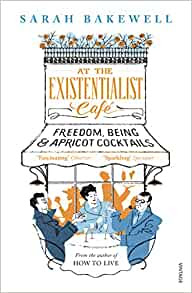
Guest review by Graeme Fife: AT THE EXISTENTIALIST CAFĒ - FREEDOM, BEING & APRICOT COCKTAILS by Sarah Bakewell


"Bakewell has sailed what might have been tempestuous waters with assurance, understanding, sympathy and love."

Graeme Fife is a regular reviewer here. He has written many plays, stories, features and talks for radio, stage plays and articles for newspapers and magazines, and is a regular contributor to BBC Radio 4's From Our Own Correspondent. He's the author of a string of books - children's stories, biography, works of history and fiction. His novel of the French Revolution, No Common Assassin, tells the story of Charlotte Corday.

Philosophy…brilliant minds describing society as it could, should be? The crux is language. Imannuel Kant speaks of Ding an sich which we may translate ‘the thing itself’. Fine, but what is thing in this or any application? From universal thing we move to the mystery of being … the essence of humankind? The core, impression, elusive oneness of One? Philosophy can be a trial and I’ve always found it baffling, often beautiful in many respects, but a cerebration too far in most. I therefore came to Sarah Bakewell’s At the Existentialist Café: Freedom, Being and Apricot Cocktails, captivated by her wonderful study of Montaigne in How to Live, more drawn by cocktails and the company of the people drinking them in the Paris café – de Beauvoir, Sartre and their friend Aron – than by the inevitable task of coping with more rarefied talk of disquisition and the quests and riddles, byways and shadowy alleys down which ‘love of wisdom’ may lead, numb-headed as this must seem, be. How foolish. All this before I’d read a page? There’s so much more.

The context of the book, beyond the intellectual thinking and talking shop of the Latin Quarter cafés in Paris, animates its narrative. Between the two wars, all Europe was in turmoil. About Germany we know, too well; in Britain, too, the faltering of all that had been certain and the shocking prospect of uncertainty: foundations of the old order rocked, ancient empires blown away. No system of thought was safe from question, now. France, a nation deeply divided on many fault lines for a long time, saw a brief ascendancy of the Left: socialism and communism offered, apparently, an answer to, through challenge of, the domination of the Establishment namely accepted wisdom, rooted tradition, all that was sure, innate, even benevolent before that very Establishment oversaw the horrors, the devastation of land and wholesale slaughter, 1914-18.

Bakewell is particularly astute in exploring the climate of Occupied France and the moral dilemmas it threw up: Patriotic or Personal? Nation or Friend? Protest – violent or non-violent? Discuss. Thought of itself can be arid and off-putting. What counts equally is the heart of the story not its clothes and jewellery.

To Paris came news of phenomenology, a philosophical approach to knowledge and understanding which originated with Husserl in Germany, a country whence so many of the modern thinkers had come. I attempt no definitions here. Bakewell’s learning and clarity deserve better than any amateurish upstaging. That said, from the intense deliberations of the threesome in a café over its famous apricot cocktails came the enunciation of a way of thinking about human affairs christened existentialism…ah, existence. How, in this new cosmos when all seemingly permanent structures had been near shattered, even obliterated, to consider humanity’s place and purpose? Perhaps by looking, just that, looking at what’s there still, a kind of permanence. Greek phenomenon means 'that which appears, is visible’. Simple? Far from it and Bakewell is a wonderful guide. Her clarity – and passion – for and about the subject informs a story which could so easily threaten to overwhelm.

She investigates a process of thought about the entanglements of morality imposed by new order which had eroded certitude to a degree unimaginable hitherto. More than a starting anew, a need to address a wholly different problem. ‘A future humanity living in isolated pods beneath the Earth’s surface’ as E M Forster imagined in a short story? Huxley’s Brave New World? As Bakewell writes of commentators on this disintegration: ‘They set out to detect and capture the quality of experience as we live it rather than according to the frameworks suggested by traditional philosophy, psychology, Marxism, Hegelianism, structuralism or any other of the -isms and disciplines that explain our lives away.’ Add, for example, that the French Revolution foundered, in large part, because the small-minded bigots at its heart, the drivers of its bloody excesses, believed, that virtue or, in their word, civisme, being a good egg in Whitehall parlance, could be inculcated by law and edict.

From that age of Fascism, a violent curse out of the perverted sense of rectitude imparted by a weighted fist, Bakewell cites Paul Ricoeur, a pioneer of the new thinking: ‘The relentless persecution of this man (a Czech activist) proves that, in the event of a people’s extreme abjection, philosophical pleading for subjectivity is becoming the citizen’s only recourse against the tyrant.’ Subjectivity? Feeling. Humanity.

Bakewell has sailed what might have been tempestuous waters with assurance, understanding, sympathy and love. It’s a story that needed to be told on issues which demand consideration.

At the Existentialist Café is published by Other Press (NY).


Read this Q & A with Graeme about his novel of the French Revolution, No Common Assassin


Monday, 7 February 2022

Guest review by Jane Russ: WIDOWLAND by C J Carey


"Widowland asks you to reconsider your life and where you would fit into this nightmare."
 

Jane Russ
is writer and series editor for the UK Nature series of books from Graffeg publishing. The books are not only about the physiology of the animal or bird but about myth, legend, art and literature too. Jane's sixth book, The Native Pony Book, came out in July and joins her others about hares, foxes, owls, red squirrels and robins in this very successful series.

A dystopic, feminist tale chillingly told.

It is 1953, Hitler won the war thirteen years ago and Edward and Wallis are within weeks of being crowned. England is a rundown outpost of Europe, with anything worth having being sent to the mainland. There is an overall feel of the shabby and the rundown.

In the early days after the war, the general populace do not take the ‘take-over’ lying down but the new regime is quick to establish that all transgressions will be dealt with promptly and firmly. If you are caught pulling down an Alliance flag, you will be hanged from the flagpole. Gilead reimagined in the UK.

A rigid individual classification code is in place. Created in Germany this caste system is imposed on the female population in all the subjugated lands of the Empire. At fourteen, all females are called for classification, with ‘Nordic type’ being the highest caste - ASA Female Class I (a). Naturally as time passes, the official titles are overtaken by the shorthand used in everyday life. All the names came from the Leader’s (Fuhrer's) female family members: Gelis are the top, the most perfect specimens. Klaras are fertile women, Lenis are professional women, Paulas are teachers, nurses and carers. Magdas are factory and shop workers, whilst Gretls are domestic and kitchen staff. At the very bottom of this female pyramid are Friedas, the widows and spinsters, over 50, without children and without a man to serve. There is nobody below a Frieda, they are literally the lowest of the low.

Naturally women moved around in these classifications as their fortunes ebbed and flowed. This ebb and flow showed in their general health and well-being too as benefits like better food and clothing were based on the caste classification. Where each group could shop, what they could wear, what rations they were allocated, every last thing was designated and administered by the Woman’s Service throughout the country. A Geli, whose work and general quality of life put her at the top of the ladder, had all the best of what was available and even, depending on who she knew, sometimes more than that.

The heroine of Widowland is Rose, a Geli. The state has decreed that any hint that the past was better than where you are now is to be outlawed. To this end Rose has the unenviable job of editing women of distinction, determination and strength out of books like Jane Eyre and even fairytales. Whilst this is of itself a vile thought, it is not what this book is about. (We should note here that some American states are, as we speak, outlawing books that do not fit their ultra-Conservative, ultra male dominated, racist, anti-Semitic take on what America should be. A vile thought indeed.)

Widowland asks you to reconsider your life and where you would fit into this nightmare, I have found it has really stayed with me as a concept. It is also about the awakening of the understanding that however much one is indoctrinated, the core human concept of right and wrong is much harder to eradicate. The populace are kept ignorant of the lives of other classifications. Everyone can spy on everyone and a Geli will not have a friend who is a Leni and certainly not a Gretl, and as far as Friedas are concerned, they know only other Friedas and are not considered as worthwhile by any other level of female.

Rose gets pulled into a secret assignment to find out who is writing graffiti on important buildings such as the British Museum and others across the country, all near libraries. The graffiti reads, Strengthen the female mind by enlarging it and there will be an end to the blind obedience. This is a quote from Mary Wollstonecraft, (never shy and retiring in her attitude to the position of woman in society) and Rose recognises it. The only lead on who is perpetrating this heretical street painting spreading across the country, is that it is coming from the Widowlands, the derelict and tumbledown areas of large conurbations where the Friedas live. There have been several incidents in Oxford so Rose is tasked with infiltrating the Widowlands there. The Alliance Leader is due to arrive from Germany in two weeks for the coronation and this has to be a thing of the past by then.

Rose’s cover is that she is gleaning information for a book being written by the Protector of Britain about the Folklore and family history of the indigenous peoples. On her trip to Oxford she is confronted with a world so outside her lived experience that she finds it hard to interview the Friedas she has been sent to meet. The house they live in is a broken slum, with no saving graces, except that Rose recognises that they have made it seem like a home. After about an hour and without preamble three men enter and, as if it were possible, wreck the tiny house even more from top to bottom. Every piece of repaired china is smashed, every sagging chair is slashed and, even though recognised as a Geli, Rose is powerfully manhandled and slammed against the wall. Having completed their destruction in a few short minutes, they leave without explaining or commenting.

This event starts the chain of events that will lead to the exhilarating climax of the novel. Several interesting and well drawn characters fill out the story on the way and we are drawn along in a whirlwind of emotions.

If you are female, the lives of the women in this book will ask questions of your understanding of what it takes to be one. If you are male it will show you where male supremacy could lead (and where America is heading at the moment?) Widowland is the heart of darkness in this all too believable tale of female segregation and subordination. Although set in 1953, this is a novel that deals with issues very relevant to the life of woman today.

Widowland is published by Quercus. C J Carey is the pseudonym of Jane Thynne.