Showing posts sorted by relevance for query Abel Morgan. Sort by date Show all posts

Monday, 19 November 2018

Guest review by Yvonne Coppard: THE OUTRAGEOUS FORTUNE OF ABEL MORGAN by Cynthia Jefferies


"Two narrative strands that together weave a heart-wrenching, epic story ..."


Yvonne Coppard is a writer of children’s fiction, non-fiction for adults and occasional columns and articles in a variety of publications. She is currently a Writing Fellow of the Royal Literary Fund, working with businesses and public service organisations to promote clear, understandable English in written communication. See more on her website.

In 1660 Christopher Morgan returns from war and exile in Europe to reunite with his wife and start a new life in rural England. But his hopes for the future are blighted by events that leave him bereaved, impoverished and struggling to care for his young son, Abel. Christopher becomes reluctantly complicit in the activities of a violent and unscrupulous smuggler, Daniel Johnson. Eventually, he finds the strength to take a stand against Daniel: soon afterwards, Abel goes missing.

Here the novel divides into two narrative strands that together weave a heart-wrenching, epic story following the fortunes of Christopher and Abel through the years and across the world. Christopher searches relentlessly for his son. A false lead takes him to Constantinople, where he rescues a young Irish slave boy from a terrible fate but does not find any clue to his own son’s whereabouts. Meanwhile, Abel believes that his father is dead and that he has no-one left who cares about him. Enslaved, first to a fisherman and then sold on to a pirate ship, Abel embraces the pirate life and concentrates on survival, whatever the cost. He eventually gains freedom and fortune and settles in Jamaica. He has learned to concentrate on his own survival, whatever the cost to his soul and spirit.

The historical settings for all the locations have been well-researched. Constantinople comes to life so vividly, you can almost smell and taste it. The tale is often dark, but the pace has light and shade and the main characters are convincing and worth the reader’s investment. More than once, Christopher comes tantalisingly close to finding Abel, but is thwarted by timing or circumstance. Both characters lurch from one peril to another; time and again they are beaten down by fate and circumstance. They are forced to battle with malevolent forces, both within themselves and without. And yet they rise, and rise again, finding unexpected crumbs of kindness or an extended hand from a stranger, even in the cruellest of circumstances. The reader’s hope is never quite lost.

There are many satisfying themes in this novel for those who seek them. Love and loss, the compulsion to connect; the fragility of moral integrity under pressure; the possibility of redemption and the triumph of the human spirit over unspeakable odds are among them. But most of all this is a refreshingly old fashioned, action-packed historical story.

The Outrageous Fortune of Abel Morgan is published by Allison and Busby.

Monday, 27 January 2020

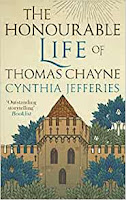
Guest feature: Q&A with Cynthia Jefferies on THE HONOURABLE LIFE OF THOMAS CHAYNE


'One of a novelist’s jobs is to reflect society and provoke thought. I hope I can do that, while also striving to entertain.'

The Outrageous Fortune of Abel Morgan, Cynthia Jefferies' first novel for adults, was published in 2018 and is reviewed here. Her follow-up, The Honourable Life of Thomas Chayne, is linked, developing a minor character from the first book. It has recently been published in hardback.

Writers Review: This novel is linked to your first, The Outrageous Fortune of Abel Morgan, though it pre-dates it. Was the idea for this story already taking shape in your mind as you finished the earlier one?

Cynthia Jefferies: I knew I would have liked to find out more about Ptolemy when I put him in the first book, because he only had a small role. Any more might have unbalanced the novel but he intrigued me. I had mentioned in The Outrageous Fortune  that he had never been able to settle after his experiences during the English Civil War. Why? What had it been like to live through that violent time? When it came to choosing a theme for the second book he was an obvious candidate, though I have Celia Rees to thank for the suggestion to base the second novel on a minor character.

WR:  Many writers find it difficult to strike the balance between authentic historical background and the demands of fiction. You evidently drew on many sources for information of the period - were there times when you felt overwhelmed by your research, or on the other hand did you find that it boosted your confidence?

CJ: It certainly boosted my confidence to have an idea of the realities of the period. On the other hand I was writing fiction, and that means leaving a lot out. I love the research, but believe strongly that too much detail can quickly make a good story collapse under the weight of facts. That’s not to say that I wanted to write an alternative history. I have been as accurate as I could, while not dwelling too much on the minutia. Likewise with the language. Little things like an enemy being pistoled instead of shot give a feeling of being in the period while not forcing the reader to wade through too much that is unfamiliar. Readers might learn things reading my fiction. I hope they do, but it’s not my job to educate. My job is to entertain, and also to offer something to think about.

WR: Was it always your intention to depict a son loyal to the King while the father sides with the Parliamentarians - did you ever consider having it the other way round?

CJ: I did think about it being the other way around but my interest in the storming of Cirencester led me to write it the way I did. Cirencester was an economically depressed wool town with plenty of reason to support parliament, although many surrounding landowners supported the king. I wanted to put Ptolemy in the position of having to attack a town and inhabitants he knew well. I wanted him, and the reader to be confronted with that terrible situation, so common in civil wars. However, I didn’t set out to make his father change sides. That came about through reading about the period and the way his father’s character developed.

WR: You've drawn extensively on the Civil War history of Gloucestershire, where you live. In your research, did you come across any chance finds or locations that became important in the story? And did you visit all the settings, e.g. Flint Castle?

CJ: I have some very useful street maps, and a facsimile of a map of the UK in the 17th Century. I find maps essential! In fact Flint Castle was a gem of a find when I was searching for somewhere in the north for Ptolemy and Richard to go. I drove up there with my eldest son and we spent a very rainy few days, looking at the ruins of Flint and other places mentioned nearby. The river doesn’t come to the walls any more, but you can see quite clearly how it did. I also stayed in Bristol overnight and spent two days walking about the streets. Being a flaneur (is there a feminine for that word?) is vital for me when researching a novel, so yes, I have visited everywhere. Living on the west coast of Scotland for a few years informed those locations. I have been to Oxford many times, and Norfolk too.

WR:  "When war comes in, morality becomes a poor relation." Why did you choose the title The Honourable Life ...  and do you want readers to question that during the course of the novel?

CJ: Actually the word 'honourable' was suggested by the publisher to complement 'outrageous' in the title of the first novel. I do though want readers to think about honour and morality within the story. Aphra makes Ptolemy think a little about slavery and women, but his is a 17th Century morality and he can’t see through our eyes. In addition, he does not have a naturally rebellious nature. He does like to think he is very honourable but he can also be naive.

WR: You seem to feel quite at home with 17th Century weaponry, battle strategies, domestic life, medicine and seafaring. Was any of this particularly daunting to write about?

CJ: Well I hope I did a reasonable job. It wasn’t usually daunting but occasionally I wanted to know something very specific and it could be tricky finding the information. Facts about doors on board ships of the time for instance. In the end I fudged that one, having found a sliding door on an earlier vessel, which gave me enough to work with. Fortunately, with fiction it’s usually possible to swerve around something one isn’t sure about, although I far prefer to know the truth.

WR:  The novel covers a vast span of time - from Thomas's birth to his fifties. How did you avoid any sense of hustling the reader forward?

CJ: Perhaps because I was so enjoying making the journey with him! I really don’t know, but am very glad you think it didn’t feel rushed. Writing in the first person has immediacy. It feels to me like having a conversation with the character. During a normal conversation we tend to leave out great swathes of ordinary life in order to describe the more interesting bits. I think what Ptolemy did while telling his story was to refer to the boring bits obliquely. For instance, his years in Bristol, building his career are mentioned a little in his letters to Aphra and as a backdrop to his visits home, but little is revealed of the day to day work, or of any specific friends he made. The years drift by, as they do in real life.

WR: So far you've chosen male perspectives as your viewpoint character. Did it just happen like this, or was it a deliberate choice?

CJ: I’ve been asked this many times and I’m still not sure of the answer! I think it’s too simplistic to say that men get all the best stories, and women are largely written out of history. Of course that is true, but I have no problem imagining strong female characters, or persuasive plots for them. For some reason I don’t understand, boys and men have always been my go-to main characters of choice, in spite of needing to write girls in much of my modern fiction for children. I know that I naturally write more comfortably as a man, although I’ve never been one! Sometimes I wonder if there’s something linking the male side of my brain with creating stories? Is that even possible? I have no idea. All I know is that whenever I start a story, I write a male character and have to deliberately bring in women as the plot develops. Whether my male characters are believable or not is a question I can’t answer!

WR:  What next - will you stay in the 17th Century, or are there other periods you're keen to explore?

CJ: To some extent that depends on what a publisher wants. There is more I want to say about the 17th Century, and oddly, considering my last answer, I have a woman’s story firmly in my head!

Apart from the 17th Century, which I find so interesting because it seems to be balanced on the cusp between medieval and modern history, I have also always been fascinated by ancient history. The Bronze Age Trojan war found Stone Age sling shot warriors acting as mercenaries. What did they think when they left their island and arrived at Troy with all the metal weapons there?

How new technology informs a community is so interesting. Man’s ingenuity has always been impressive. It’s one of the things that gives me any hope about our climate emergency. We have been lazy for many generations, plundering the wealth of our world because it was easy. Now we are having to think again. I look at the sudden explosion of manufactured vegan food on offer, the race towards cleanly produced electricity for transport because the demand is there. Inventors are excited about the need to be different. Meanwhile we can be taught and encouraged to be frugal, and to find pleasure in it. One of a novelist’s jobs is to reflect society and provoke thought. I hope I can do that, while also striving to entertain.

Thank you, Cynthia Jefferies, for answering our questions.

The Honourable Life of Thomas Chayne is published in hardback by Allison & Busby.

The Outrageous Fortune of Abel Moran is reviewed here.


Monday, 18 May 2026

Guest review by Cindy Jefferies: LISTEN WITH FATHER - HOW I LEARNED TO LOVE CLASSICAL MUSIC by Caroline Sanderson


"A wonderful journey full of fascinating asides."


First published in 2001 for children, Cindy Jefferies found success with her Fame School series with Usborne Books, obtaining 22 foreign rights deals. Latterly writing fiction for adults as Cynthia Jefferies, her first title The Outrageous Fortune of Abel Morgan was published in 2018, followed a year later by The Honourable Life of Thomas Chayne, set during the English Civil Wars, followed in 2019. Both titles are now available in paperback.


Caroline Sanderson has written a very touching and erudite hymn to her father. I should say at once that I have a personal interest in this book because I know Caroline. She is a kind and generous person, is easily moved and when she does a thing she does it to the best of her ability. This book is a perfect example of that. All the same, I wouldn’t have chosen to review it if I hadn’t been so impressed by it.

When she was a little girl, Sanderson adored her Father and enjoyed listening with him to the classical music he liked so much. As she grew older she still loved her Dad but came to prefer David Bowie’s take on music. It wasn’t until after her Father had died that she began to wonder what exactly he had loved so much about classical music. She decided to choose some of his favourite CDs and listen again. That decision and what followed became a paean to her much loved Father and a new appreciation for her of classical music.

A short overture sets the scene and then she begins with Mozart. The book has chapters on 8 composers and one singer, the unforgettable Kathleen Ferrier. It would be entirely possible to use this book as a primer, a way in to music one has never appreciated before, but there is much more to it than that. This well researched book will tell you about the composers and their lives, as well, importantly, how Sanderson felt when she heard the pieces again as an adult. The audience reaction to the first performance of Stravinsky’s Rite of Spring is fascinating, as is Sanderson’s unsettling memory of watching Fantasia with her Dad. How brave of her to re-visit Stravinsky’s work after such a disturbing introduction!

I love the way Sanderson is so down to earth about her musical journey while also thrilled when she realises she is beginning to hear the music at a different level. I also enjoyed the little asides, the realisation, for instance, that she’s probably particularly enjoying the triangle while at a concert, simply because she enjoyed playing the instrument at primary school. Her attention wavers; she notices what members of the audience are wearing, she wishes her Dad were with her to explain why he loved Brahms so much. And yet, she sticks at it and slowly gets there. The hard work of deep listening pays off. And more, she finds other pieces that her Dad didn’t introduce to her, but for which she develops an affection all by herself.

Listen With Father is a wonderful journey full of fascinating asides. There are people and books between these pages as well as music. It is a private journey that is also a wonderful signpost to the world of classical music.

Sanderson doesn’t forget the bibliography, arranged by composer. To complete the work, a useful note of the recordings Sanderson listened to is also there. What a perfect volume to enjoy and maybe to set one off on one’s own journey into deep listening and a new love of music.

Listen with Father is published by Boundless.

More of Cindy's choices:

The Wolf Border by Sarah Hall

The Master by Colm Toibin

Thirteen Moons by Charles Frazier

Orbital by Samantha Harvey

Monday, 2 March 2026

Guest review by Cindy Jefferies: FORBIDDEN NOTEBOOK by Alba de Céspedes


"... such a strong feminist novel. The 1950s are a world apart from the 2020s but that is not to say that feelings were any different then from ours now."

First published in 2001 for children, Cindy Jefferies found success with her Fame School series with Usborne Books, obtaining 22 foreign rights deals. Latterly writing fiction for adults as Cynthia Jefferies, her first title The Outrageous Fortune of Abel Morgan was published in 2018, followed a year later by The Honourable Life of Thomas Chayne, set during the English Civil Wars, followed in 2019. Both titles are now available in paperback.


Set in post war Rome, and published in 1952, Forbidden Notebook has at its centre the daily life of Valeria Cosseti. She is a typical wife and mother. She washes the family clothes and cleans the house regularly. She shops for food and cooks it for her husband and two grown children. She also has a job in an office to help keep the family afloat.

The story begins when Valeria is going to the tobacconist one early Sunday morning to buy some cigarettes to put on the night table for her husband Michelle to find when he wakes. He always sleeps late on a Sunday. While at the shop she sees some notebooks with shiny black covers. On a sudden whim she asks for one but the tobacconist tells her that he is only allowed to sell tobacco on a Sunday and certainly not notebooks. Perhaps it is the act of being denied, but suddenly she is desperate to have a notebook and begs the tobacconist to sell one to her. He agrees, but tells her to hide it under her coat in case the police see it.

Valeria feels furtive. What on earth impelled her to do such a thing? And where can she put it? She wants to keep this impulse buy to herself but doesn’t have even a drawer for her own personal use. Nowhere is hers alone in the small house. Her daughter Mirella likes to go to her wardrobe and borrow clothes, the linen cupboard isn’t safe, the desk has been taken over by her son Riccardo … in the end, feeling more and more agitated by what she has done she throws it in the ragbag in the kitchen.

Ostensibly a novel about the daily chores and activities of the Cosseti family it is very much more. Writing in the notebook becomes a guilty secret for a woman who has never kept secrets from her family. She moves it from place to place, desperate for it not to be found because it quickly becomes an account of her internal thoughts, wishes and fears. She is at the heart of her family and it is apparent that they all love her, but the demands on her are many. She sometimes struggles to be the person they all think she is. No one seems to expect her to have an internal life of her own. If she differs from their expectations of her they smile indulgently and tell her to rest, which is almost impossible for one who has so much to do.

This book is such a strong feminist novel. The 1950s are a world apart from the 2020s but that is not to say that feelings were any different then from ours now. I found Valeria in turns heroic, pathetic, irritating and impressive. She is a woman of her time, in a country that has recently lost a bruising war. She has great self doubt as she starts to write, but finds herself putting down on paper not only her concerns about her daughter and the company she keeps, her son’s career and her husband but also her innermost thoughts about her own life, which she has hardly allowed herself to recognise up until now. Where the notebook leads her, what she does with her life and whether the notebook is discovered, all play out while she sits up late, after everyone has gone to bed, which is virtually the only time she has to put her thoughts down without being interrupted. Valeria lived with me for a long time after I finished the novel. 

Alba de Céspedes achieved something very special when she created Forbidden Notebook. The Financial Times called it ‘an exquisite, tormented howl,’ and it certainly is a tour de force. Is it about a life wasted, or a life found? I still find it hard to decide. Read it and ponder …

Forbidden Notebook is published by Pushkin Press, and was also chosen by Nick Manns in our Books of the Year feature.

Monday, 4 March 2024

Guest review by Cindy Jefferies: WHEN THE DUST SETTLES by Lucy Easthope


"For the lay reader this is an extraordinary book. For a writer it is gold."

First published in 2001 for children, Cindy Jefferies found success with her Fame School series at Usborne Books, obtaining 22 foreign rights deals. More recently she has written fiction for adults as Cynthia Jefferies. Her first title under that name, The Outrageous Fortune of Abel Morgan, was published in 2018, followed a year later by The Honourable Life of Thomas Chayne. Both titles are set during the English Civil Wars.

I don’t usually review non-fiction. Not because I don’t read it. I read a lot for research but perhaps that’s it. I tend to review the novels I read for relaxation, while non fiction, however interesting, for some reason gets lumped with work, which is very unfair. This book, by Lucy Easthope, has propelled me out of my curmudgeonly attitude and made me determined to review more of the excellent non-fiction out there. In addition, this book would be a brilliant resource for many novelists. How could I not review it?

I came across Lucy Easthope’s name when I saw she had been booked to appear at our local Stroud book festival in November 2022. The strapline on the book is “Stories of love, loss and hope from an expert in disaster.” That intrigued me, and I booked tickets. It was electrifying! Lucy is a very engaging person. Cheerful, and yes…funny; a great speaker and absolutely devoted to her career in disaster management. But there’s much more to her than that, and she also seemed comfortable in referring occasionally to the ups and downs in her personal life. I learnt a lot that evening and my partner queued afterwards to buy a book and get it signed. I asked if I could borrow it some time but for that most prosaic of reasons, forgetfulness, it just didn’t happen. A year drifted by, then one day I happened to notice the book on his table.

“Oh! I meant to read that,” I said. “I’m going away on a writer’s retreat soon. Do you mind if I borrow it now?” And so I did.

Lucy Easthope has an engaging style and I was instantly hooked. She was telling me so much that I didn’t know. What a disaster expert is, for starters. And, chillingly, what the dust in the title can refer to. So much important work is done, even months and years after a disaster, analysing the dust created in a disaster such as the twin towers in the USA. Loved ones left behind want and need a body to say farewell to, but of course this is often impossible. DNA testing of such dust and fragments can result in tiny particles being found and identified long after the initial trauma has passed. Families are left with the horrific prospect of receiving minute amounts of matter several times, sometimes years apart. Then they have to decide whether to have yet another funeral to honour the person they loved and lost. One thing Easthope feels very strongly is that the people left behind have to be considered much more. What is vital to her is to help a person and a community to begin to recover, or at least start to move forwards.

In the hours and days after a disaster, whether a plane crash, a tsunami, a terrorist attack or a fire, multiple agencies swing into action. Police, ambulance workers, firemen, and all the science that goes with police work in a crime scene. We are all used to seeing these people on our TV screens and I had known that these things are rehearsed from time to time. Now I was reading an expert’s account of how what happens afterwards can make or break the recovery of those left behind. A blood-smeared cinema ticket could mean the world to someone who has almost nothing else to remember their loved one by. Such things, rather than being maudlin, can comfort, in the knowledge that the person was doing what they loved just before they died.

The blurb on the flyleaf of the this book tells us just how experienced Lucy Easthope is. She is the UK’s leading authority on recovering from disaster. From the 2004 Tsunami, 9/11, the 7/ 7 bombings, the Salisbury poisonings, Grenfell and the Covid 19 pandemic; she is the one who has answered the call, packed her bag and gone to support everyone involved. She holds authorities and government to account. She lets us see into the briefing rooms, how politics can get in the way and how simple thoughtlessness, or lack of understanding can make it so much harder for those left behind to begin to turn towards recovery. I am writing this during the Covid 19 enquiry. I have no doubt that Lucy Easthope will figure somewhere, unknown to most of us but vital to the process. For this was the overdue disaster, the one we really should have been ready for and weren’t.

For the lay reader this is an extraordinary book. For a writer it is gold. Between the pages we have an insight into exactly what goes on during, after and long after a disaster has happened. Any thriller writer who has a disaster in their plot would be well advised to read it.

I couldn’t take it in one breathless sitting. Occasionally it almost became tedious in the awful inevitability of what happens over and over again, although every disaster is also unique. But I was drawn back to it after a short break and never felt like abandoning her story. I simply had to read it to the end, and then sit and ponder.

Her matter of fact style helps to stop what she says ever being sensational or overwhelmingly ghastly. But we are dealing here with torn bodies and traumatised people. The people who pick up the pieces are so often heroic and almost broken by what they do. That Lucy Easthope is still standing is a testament to her desire as a young child, growing up near Hillsborough, to help, and she does this in spite of her own issues. We can thank her for thinking about us so carefully, and seeing through experience what works best to help us recover. We can all hope that a disaster never engulfs us, but if it does, she will be there somewhere: in the notes the recovery workers study, in the plans she has drawn up and usually in person, whether in a pop-up mortuary or a warm and welcoming place for families to gather. She strives to make sure the materials are there to ensure the proper collection and labelling of the remains of lives, so that eventually, those left behind can grieve and begin their own recovery. Little do we know how much we need her - so thank you, Lucy Easthope.

When the Dust Settles is published by Hodder.

Monday, 21 February 2022

Guest review by Cindy Jefferies: THE WOLF BORDER by Sarah Hall


"She’s the real deal, and I really shouldn’t be admitting to not knowing her work until now!"


First published in 2001 for children, Cindy Jefferies found success with her Fame School series with Usborne Books, obtaining 22 foreign rights deals. Latterly writing fiction for adults as Cynthia Jefferies, her first title The Outrageous Fortune of Abel Morgan was published in 2018, followed a year later by The Honourable Life of Thomas Chayne, set during the English Civil Wars, followed in 2019. Both titles are now available in paperback.

I came to read Sarah Hall by way of a friend who recommended her. Hall is a multi award winner, including being shortlisted for the Man Booker twice so far. Surely she’ll win it one day. Why on earth hadn’t I come across her before? But I hadn’t, now I have and am eternally grateful to Claire, who put me right.

I like to support my local library, which is only a few yards away from my house. I love the randomness of what’s in and what’s out. The only Sarah Hall when I looked online was The Wolf Border, published in 2015, so that’s what I picked up. But I have lots more treats in store. She has now written six novels, and several collections of short stories. Apparently she started her writing career by publishing poetry in literary magazines. Of course she did. She’s the real deal, and I really shouldn’t be admitting to not knowing her work until now!

So to The Wolf Border. I love reading about wolves, and I do enjoy a good plot. When you add in wonderful descriptions of landscape, well researched human and wolf biology and superlative phrases I had to read again, either for the pure poetry, or for the wisdom within them … well! Finding everything in one novel is rare. They don’t come along every day. Unputdownable can also mean so plot-driven that you’re left gasping but ultimately unfulfilled. Literary can mean difficult. Not here.

Rachel is an expert on wolves. She lives on a reservation in Idaho, protecting the wolves in her care. She has a good team. She has a few friends, and brief affairs with men. Her upbringing in Cumbria was unusual, her mother not easy to love, or even to like. She has very little contact with mother or brother. Perhaps she is something of a lone wolf, but that’s too easy. Life isn’t that simple, and Hall writes real, complex characters, easy to believe in.

When Rachel goes back to Cumbria after several years away it is to visit her mother, who is dying, and to meet a landowner who has a plan to introduce wolves back into the UK. He has a vast estate, friends in high places, and the money to invest in the project. Rachel doesn’t think much of Thomas the earl, but the idea is intriguing, and the land reasonably suitable. The space the pair would have while in quarantine is generous, and eventual release into a huge area, though not as good as being totally wild, is close to the next best thing. There are too many deer on the estate and it is clear that the wolves would be self-sustaining and would improve the environment in several ways.

Hall doesn’t shy away from the complexities of making such a project happen. There would be opposition and encouragement both locally and more widely. The high salary Rachel is offered isn’t the thing that sways her. It’s the possibility of making it work. Yes, they would still be captive, but the amount of land they would have would enable them to live their own lives, naturally. Hunting their own food, and maybe, one day raising their own young. She takes the job, but has unwittingly brought something with her from Idaho which will have a profound effect on her life in England.

Thank you, Sarah Hall, for a thoroughly enjoyable and thought provoking novel. My next trip will be to the bookshop for your latest!

The Wolf Border is published by Faber.

Here is a Q&A with Cynthia (Cindy) Jefferies on her novel set during the Civil War, The Honourable Life of Thomas Chayne.


Monday, 28 September 2020

Guest review by Yvonne Coppard: THE BEEKEEPER OF ALEPPO by Christy Lefteri


 " ... truly brought home to me the lived experience of the people behind the daily headlines, and the astonishing power of the human spirit to endure and overcome."

Yvonne Coppard
is a Writing Fellow of the Royal Literary Fund and writer of fiction for children and adults. See more on her website. 


Nuri and Afra live peacefully with their young son, Sami, in the hills above Aleppo. Afra is a talented artist; Nuri and his cousin, Mustafa, are beekeepers running a successful honey business. When Syria descends into chaos and violence, Sami is killed and Afra is suddenly struck with trauma-induced blindness. Still, they cling on, hoping for better times. Then the beehives are destroyed, Mustafa flees the country and Nuri is threatened by soldiers who later come to the house looking for him. 

"Our feet sank into inches of water, full of the lizards and insects that had made this space their home. I’d dug this hideout last year. Afra wrapped her arms around me and buried her face in the crook of my neck. We sat like this in the darkness, both blind now, in this grave made for two. In the deep quiet her breathing was the only sound left on earth. And maybe she was right. Maybe we should have died like this and nobody would need to take our bodies … above us and outside things moved and broke and cracked. The men must have entered the house now." 

After this, there is no choice but to leave. Nuri and Afra put themselves into the hands of people smugglers and make the perilous journey through the various camps in Europe for displaced people, heading for the UK where Mustafa has found asylum. The story of their flight is told by Nuri, mostly in flashback, while they are in temporary accommodation awaiting a decision about their future from the UK authorities.

The desperation that drives people to undertake such a terrifying journey with scant hope of success is conveyed so convincingly that, even though I knew Nuri and Afra had survived, my heart was in my mouth as Nuri recounted their experiences. Nuri is sometimes aware of hallucinations and periods of disconnection but does not connect them with trauma. He hides his symptoms from the friendly social worker, fearful that he will be dismissed as mad, desperate to keep some last shreds of dignity.

Christy Lefteri spent time as a volunteer in a refugee camp in Athens. That experience shows in the detailed, vivid story woven from what she saw and heard there; a convincing account of loss, betrayal and, ultimately, resilience. It is told with warmth and compassion and touches of gentle humour. The level of detail and the authenticity of the places and characters created makes it impossible not to be drawn in to, and moved by, Nuri and Afra’s dogged stoicism. In the face of unspeakable things, they refuse to give up hope. This book is first and foremost a compelling, page-turning novel, devoid of the strident political messages and sub texts that often infuse what we see and hear in the media about refugees, asylum seekers and economic migrants. It is the first fiction I have read that truly brought home to me the lived experience of the people behind the daily headlines, and the astonishing power of the human spirit to endure and overcome.

The Beekeeper of Aleppo is published by Bonnier.

See also: The Optician of Lampedusa by Emma-Jane Kirby, reviewed by Tracy Chevalier

More reviews by Yvonne Coppard:

Flaneuse by Lauren Elkin

Plainsong by Kent Haruf


Adventures in Human Being by Gavin Francis


Monday, 18 July 2022

Guest review by Yvonne Coppard: THE ELEGANCE OF THE HEDGEHOG by Muriel Barbery, translated from the French by Alison Anderson


"There is joy, there is humour, there is sorrow: here is Life, writ large in all its complexity."

Yvonne Coppard
is a Writing Fellow of the Royal Literary Fund and writer of fiction for children and adults. See more on her website.


Sometimes, there is a fine line to be drawn between the craft of beautiful writing and the pompous display of a writer’s skill. The Elegance of the Hedgehog invites you to choose which side of the fence you favour. Its publication provoked heated discussion. It seems to be a love-it-or-hate-it read. Certainly, it’s a book that demands proper attention, not one you want to pack for a lazy beach read. The joy of this book is the portrayal of the eccentric and entertaining characters; also in its cultural and philosophical references and entertaining observations of people and society. This novel made me stop reading and think for a while. If you want a thrilling, can’t-put-down book, look away now. This one take time and effort.

Renée Michel is the concierge for the eight fashionable apartments at No 7, Rue de Grenelle in Paris. To the residents she is the drab stereotype of an uneducated, middle aged woman with little self-awareness and few aspirations. She wears dreary clothes, eats cheap food and watches daytime TV. She is reliable, good at her job, but she lives a small life. Renée fosters this perception because it’s good for business, but she is hiding in plain sight. She is an autodidact, an acute observer, well versed in art, philosophy, music, literature and gourmet dining.

In one of the upper floor apartments, twelve-year old Paloma Josse lives a privileged life with her parents and sister. But she too, is playing a stereotype while hiding her real self. Like Renée, Paloma is much more intelligent and observant than she seems. Her outlook on life is both precocious and pretentious. She hates the world she has been born into and has decided to end her life on her thirteenth birthday by burning the apartment down, unless she is presented with a compelling reason not to. Meanwhile, Paloma has her suspicions about Madame Michel not being quite what she seems.

When a new tenant, the fabulously wealthy and cultured Ozu Kakuro, moves into the building an unlikely but deep bond develops between the three characters. Comfortable with each other, they reveal something of their true selves and undergo a degree of personal transformation.

There is joy, there is humour, there is sorrow: here is Life, writ large in all its complexity. The Elegance of the Hedgehog is worth the time and effort – and a shout out to Alison Anderson for a superb translation, too.

The Elegance of the Hedgehog is published by Gallic Books.

Yvonne is a regular reviewer here. For more of her choices, see:

The Beekeeper of Aleppo by Christy Lefteri

Flaneuse by Lauren Elkin

Plainsong by Kent Haruf

The Outrageous Fortune of Abel Morgan by Cynthia Jefferies

Adventures in Human Being by Gavin Francis

American Dirt by Jeanine Cummins


Monday, 23 March 2020

Guest review by Cindy Jefferies: EMPRESS DOWAGER CIXI by Jung Chang


"...what an accessible writer Chang is ... scrupulous in her research but brings the story alive by her vibrant style."


First published in 2001 for children, Cindy Jefferies found success with her Fame School series with Usborne Books, obtaining 22 foreign rights deals. Latterly writing fiction for adults as Cynthia Jefferies, her first title The Outrageous Fortune of Abel Morgan was published in November 2018. Her second title The Honourable Life of Thomas Chayne came out in November 2019 and is set during the English Civil Wars.

At the end of Jung Chang’s biography of the Empress Cixi, Chang says “looking back over the many horrific decades after Cixi’s demise, one cannot but admire this amazing stateswoman, flawed though she was.”

In modern China Cixi is not admired but Chang has done much painstaking research and has a different story to tell. Cixi was born in 1835. At 16 she was chosen to be a concubine of the Emperor Xianfeng, who was 19. Cixi had caught the young emperor’s eye and was one of several accepted. She was very ambitious, interested in politics and highly intelligent but the life she undertook was not for the faint-hearted and she was not chosen to be the Empress, but was ranked on the sixth of eight rungs for concubines.

Enclosed in the harem she became friends with the girl chosen to be empress. Having lost the Opium war against the British, the country was now obliged to accept imports of damaging opium, made in India and a valuable export for the British although it was banned in the UK. There was also the largest peasant rebellion in Chinese history, due to terrible famine. Cixi had opinions about all this, but voicing them could have led to her execution.

The emperor was frail and it was of great moment when Cixi gave birth to his first son. She was elevated to just below Empress Zhen in rank. When the Emperor died in 1861 his only son was five and the country was in a terrible situation. The Emperor had a closed door policy, but Cixi could see that this was making China weaker. Extraordinarily, with Empress Zhen supporting her she overthrew the regents in a bloodless coup and as Empress Dowager, she became the ruler of China, sitting behind the yellow silk screen behind the throne.

The story of the rule of Cixi must place her as one of the greatest female rulers in history. During her long life she steered this vast country from a medieval state to a modern one, introducing the telegraph, trains, modern education and governance and a more humane legal system. She fought wars, revolt, betrayal and made some mistakes. But she loved her country and believed in its people. European nations and Japan took brutal advantage while China slowly embraced the 19thC. Britain has little to be proud of at this time, with a few individual exceptions.

Anyone who has read Wild Swans will know what an accessible writer Chang is. She is scrupulous in her research but brings the story alive by her vibrant style. Just shy of 500 pages, I found the book almost unputdownable. China today is a superpower, and it seems the present ruler Xi is determined to be as absolute as Cixi, and to rule for life. But where Cixi wished her nation to become a democracy, Xi shows no sign of giving his people similar freedoms. I found myself wondering what the Empress Dowager would think if she could see her country now.

Empress Dowager Cixi is published by Vintage.


Monday, 16 June 2025

Guest review by Cindy Jefferies: ORBITAL by Samantha Harvey


"This jewel of a book is out there, like our beautiful planet in space; silent, modest, wonderful, waiting to be found."

First published in 2001 for children, Cindy Jefferies found success with her Fame School series with Usborne Books, obtaining 22 foreign rights deals. Latterly writing fiction for adults as Cynthia Jefferies, her first title The Outrageous Fortune of Abel Morgan was published in 2018, followed a year later by The Honourable Life of Thomas Chayne, set during the English Civil Wars, followed in 2019. Both titles are now available in paperback.

I can’t think of a more divisive recent novel. Friends and acquaintances either loved or loathed this 2024 title. Ian McEwan’s On Chesil Beach, written in 2007 attracted similar strong emotions. Both are novellas, both were shortlisted for the Booker Prize but McEwan, having won in 1998, dipped out in 2007, while Harvey went on to win in 2024.

Major prize winners are always open to a superfluity of opinions. It goes with the territory. Critics are asked for their reviews, book groups, along with huge numbers of the general, book reading public rush to buy or borrow, so they can see what the fuss is about. So what was the fuss about in 2024?

The major complaint seemed to be that ‘nothing happens’ in Orbital. I beg to differ. Admittedly, in spite of it’s 136 pages I didn’t find it a quick read. Orbital demands attention. Once one does pay the story the compliment of starting off with an open mind, and being ready to concentrate; it, for me at any rate, repays every reading moment. What is there to be said about orbiting the Earth multiple times for nine months? Well, quite a lot as it happens. There are the many facts sprinkled through the narrative. Harvey thanks NASA and ESA for the wealth of information made available and my goodness, these facts don’t disappoint, nor does the way she relates them with her quiet, authority.

The novel rotates with the space station, passing developing weather patterns, ambling past the ink dark Atlantic, or brilliantly lit Europe, over and over again, measuring the hours of astronaut time as if they are living Earth sunrises and sunsets, though at seventeen and a half thousand miles an hour. The pace of the novel suggests Earth time, while for the astronauts the days pass quickly, with so much to do, so much essential exercise, experiments, housekeeping. Hanging in their sleeping bags, asleep, head over heels over head…

And of course there are other stories, the astronaut’s stories. Each individual is out of reach of a loved one to embrace, short of Earth knowledge, though seeing the planet more entirely than anyone living on its surface. Such a disconnect at so much distance, such possible domestic disasters, and yet not one wants to go home early. Hidden illness, the death of a Mother, and yet somehow, the six of them are sufficient unto each others’ equilibrium.

Don’t expect great drama, fallings out, or violence in the space station. A hand’s breadth away from disaster, the metal holds, in spite of its age. And, so do the six men and women within it. This jewel of a book is out there, like our beautiful planet in space; silent, modest, wonderful, waiting to be found.

Orbital is published by Vintage. 

See also Samantha Harvey's The Shapeless Unease, reviewed by Graeme Fife


More of Cindy's choices: 

The Wolf Border by Sarah Hall

The Enchanted April by Elizabeth von Arnim

Unsettled Ground by Claire Fuller

Lillian Boxfish Takes a Walk by Katherine Rooney

Monday, 15 September 2025

Guest review by Cindy Jefferies: THE HUMMINGBIRD by Sandro Veronesi, translated by Elena Pala


"Funny, serious, clever, controlled, sometimes a little demanding but always rewarding."

First published in 2001 for children, Cindy Jefferies found success with her Fame School series with Usborne Books, obtaining 22 foreign rights deals. Latterly writing fiction for adults as Cynthia Jefferies, her first title The Outrageous Fortune of Abel Morgan was published in 2018, followed a year later by The Honourable Life of Thomas Chayne, set during the English Civil Wars, followed in 2019. Both titles are now available in paperback.
 
Sandro Veronesi is an Italian writer who is the only person who has won the Premio Strega prize twice. His is a formidable talent, but he wears his skill lightly. His work is funny, serious, clever, controlled, sometimes a little demanding but always rewarding. He has every right to demand our attention, because what he writes, and how he writes it is often unexpected and usually brilliant.

His hero in this novel, Marco Carrera, is a man whose life seems to stand still. A series of misfortunes happen and he has to deal with them. He doesn’t always want to, they affect him deeply, but he invariably does what he can to help. His life is both ordinary and extraordinary, as many human lives are. Veronesi relates the entire life of this man, bringing in along the way many fascinating thoughts and facts, which, because they interest the writer, also interested this reader.

Did you realise that not many languages in Europe have a word to describe what you become if your child dies? Widow, widower, orphan, that’s it. We have to look to Sanskrit, many of the African diaspora languages, Hebrew, Arabic or ancient and modern Greek to find a word to describe it. Who knew? In case you worry that Veronesi is irredeemably gloomy he also quotes Lady Bracknell.

Did you know that the BBC, along with several countries, banned the 1933 song Gloomy Sunday, because it had inspired people to kill themselves? It was only unbanned in 2002. There are many versions of it around now, from Bjork to Billie Holliday.

There are some fascinating thoughts about seeing. Marco is an Ophthalmologist.

Marco loves Luisa all his life.

His father collected sci-fi novels.

Oddly, I can’t remember much about Marco’s mother except that she called him The Hummingbird because he stopped growing. Medical intervention eventually helped, after she had objected strenuously to her husband insisting on taking their son for treatment.

There is something about the direct way Veronesi tells us Marco’s story that is very touching, and the nearer we get to the end, the more touching it is.

The only other thing I can say, except to urge you to read this novel, is that the first paragraph said something conversationally, to me as a writer, that I so agreed with I had to put the book down and walk around for a few minutes before going on. That doesn’t often happen, but when it does it is curiously electrifying.

Thank you Sandro Veronesi, for the whole book: the plot, the characters, the musings and facts, even the occasional lists. And last, but by no means least, thank you for your fascinating and useful acknowledgements. I’m sure I shall have cause to refer to them again.

The Hummingbird is published by Weidenfeld & Nicolson.

Monday, 4 April 2022

Guest review by Cindy Jefferies: THE ENCHANTED APRIL by Elizabeth von Arnim

 
"If that advert had been a real and current one I would have applied immediately!"

First published in 2001 for children, Cindy Jefferies found success with her Fame School series with Usborne Books, obtaining 22 foreign rights deals. Latterly writing fiction for adults as Cynthia Jefferies, her first title The Outrageous Fortune of Abel Morgan was published in 2018, followed a year later by The Honourable Life of Thomas Chayne, set during the English Civil Wars, followed in 2019. Both titles are now available in paperback.

The month of April in England comes in for both praise and disfavour. Robert Browning yearned for it while abroad, though where are the green shoots of the elms these days? T. S. Eliot had it the cruellest month, and looking at the frosted magnolias near my house I do have a certain sympathy for that point of view. But in truth, who could not love the Spring, with its birdsong and all those brave early flowers? We can always sow more seed if we’ve been caught out by a late frost. Some plants, like my winter lettuces, and those courageous tulips can stand up to all that April can throw at our gardens.

However, it is not an English April that Elizabeth von Arnim wishes to eulogise in her novel. On the contrary, her character, Mrs Wilkins, shopping on a wet London day, wishes to escape it. She had not suffered a long, Covid-19 winter, as have we, but she was not altogether happy, and sheltering from the sooty London rain she read this advertisement in The Times.

To Those Who Appreciate Wisteria and Sunshine. Small medieval Italian castle on the shores of the Mediterranean to be let furnished for the month of April. Necessary servants remain. Z,Box 1,000, The Times

To be honest, if that advert had been a real and current one I would have applied immediately!

The novel was written in 1922, when servants were more common. At the same time, the idea of a married woman, travelling unaccompanied by her husband, to a place so far from home, to have a month’s holiday without him, well! That would have been somewhat unusual in 1922. Would Mrs Wilkins have dared to book the castle if a slight acquaintance had not agreed, along with two other women, to share the castle and its costs? Good for them say I! And so it turned out to be, in various, unsuspected ways.

This is a very funny book, but also poignant, sympathetic and at times thought provoking. It is also a wonderful way of making a virtual escape from the pandemic and drifting up to the castle gardens, overlooking the sea. There, we can lie back in the past, in our sun loungers with a glass of wine, and enjoy the fragrances, and the slow passing of time demonstrated by flowers going over, only to make room for different buds to appear.

"All the radiance of April in Italy lay gathered together at her feet. The sun poured in on her. The sea lay asleep in it, hardly stirring."

I guess the author was very keen on gardens. She evokes the parade of flowering plants so beautifully I could almost smell their delicious aromas. The very names made me wish I were there. Judas tree, peach trees, freesias, irises, roses (oh the petals!) tamarisk, daphnes, lilies, fig trees, plums, olives and as she puts it, modest weigela. I can feel that wonderful warm breeze on my skin with the plum blossom falling, this very moment.

Of course a fine description of plants and place doesn’t make a novel. The author causes her characters to work hard in the plot, and she paints each one with care and humour. Nothing earth-shattering happens. The days pass, jockeying for position occurs. Each woman has their own way of managing their lives, some perhaps better than others. Stray men come and go, food is served and wine drunk. Manners are mostly preserved. As the month of April comes to a close I found myself wishing they could stay longer, so that I could stay too. This is a novel I will shelve, and take down during a particularly nasty storm on a February weekend. Ah!…balm for the soul!

There is a film, which I have not seen, but was well reviewed. I shall seek it out. I wonder if the scent of flowers is evoked successfully on film? It certainly is within these fine pages.

The Enchanted April is published by Alma Classics Evergreen (the edition shown) and also by Penguin Modern Classics.

Cynthia Jefferies' The Honourable Life of Thomas Chayne is published by Allison and Busby.


Monday, 22 April 2019

Guest review by Cindy Jefferies: THIRTEEN MOONS by Charles Frazier


"So lyrically written that I was quite bereft when I got to the end..."


First published in 2001 for children, Cindy Jefferies found success with her Fame School series with Usborne Books. They obtained 19 foreign rights deals and are still in print in the UK. Latterly writing fiction for adults as Cynthia Jefferies, her first title The Outrageous Fortune of Abel Morgan was published in November 2018. It comes out in paperback in August 2019. At present she is working on another title for adults.


Charles Frazier’s first book, Cold Mountain, was a best seller on both sides of the Atlantic. His second, Thirteen Moons, came nine years later, and it shows. I have enormous respect for writers who take their time against exhortations by publishers, booksellers and readers. A novel takes its own time, or it should, but everyone needs to make a living, and that can work against our best endeavours. I have no idea precisely why Thirteen Moons took nine years, but I like to think that at least one of the reasons might be because he refused to be rushed.

The title refers to the way the First Nations people in the novel trace their seasons. Frazier educates us as to where we are in the year by way of these thirteen named moons. They quietly pace his novel, the life story of Will Cooper told in the first person. He is a bound boy at the start, a twelve year old orphan, sent alone to the edge of the Cherokee Nation to run a trading post.

For anyone who loves to read of the natural world this is a delight, and also a sadness, especially now, as we appreciate just how much damage we continue to do to the world.

In this wonderful novel we get vivid images of how people think about the land and its inhabitants. The buffalo and elk for example are long gone from the mountains and valleys, and the deer are far fewer, but none of the Cherokee in this novel speak of the numbers of skins they traded being a reason for the animals' demise, just of their vanishment, as if they have simply moved on. That made me think a lot about the balance of nature, and how outside forces offering manufactured goods to make life easier can make change almost impossible to resist.

The Cherokee are a huge influence on Will Cooper, and as a white man he works hard in many ways to protect their land and their way of life. The fate of the First Nations is a matter of history, and shame, and so of course he does not have a quiet life, but even during the worst of times, when violence comes, his story is told reflectively, in the voice of an old man thinking about the past. That voice is so persuasive I could almost believe I was sitting by the fire, listening to him in person.

I was completely captivated by Will Cooper. His loves, his behaviour good and bad, his humour, and wonderful descriptions of riding through the country in good weather and bad. He describes deep snow, thrashing rainstorms and hot sun. The names of places are wonderful, and the way the flora and fauna were used to support life is fascinating. In addition, it is all so lyrically written that I was quite bereft when I got to the end.

Thirteen Moons is published by Sceptre. 


Monday, 8 December 2025

Guest review by Cindy Jefferies: THE MAGICIAN OF TIGER CASTLE by Louis Sachar


"I was expecting the jacket design to clearly demonstrate that this was a departure for Sacher, an important one, from children’s to adult writing ..."

First published in 2001 for children, Cindy Jefferies found success with her Fame School series with Usborne Books, obtaining 22 foreign rights deals. Latterly writing fiction for adults as Cynthia Jefferies, her first title The Outrageous Fortune of Abel Morgan was published in 2018, followed a year later by The Honourable Life of Thomas Chayne, set during the English Civil Wars, followed in 2019. Both titles are now available in paperback.


I am in a bit of a quandary with The Magician of Tiger Castle. The thing is, Writers Review doesn’t generally feature books for children. I should be in the clear, though. After all, on the back of the book it does say that it is Sacher’s first adult novel. The thing is, I don’t quite believe it.

In the distant past, when I was a school bookseller, I loved Sacher’s first book, Holes. It was quite different from anything else I’d read. It is a children’s book about a corrective institution that forced boys to dig a series of deep holes in the desert for … apparently, no reason at all. After 20 years or so it’s still in print and still popular. So, when I read in the Bookseller that his first novel for adults was due in a couple of months I got quite excited. I requested a review copy from Mountain Leopard Press, an imprint of Headline, and they kindly sent me one. It arrived a few days ago and I immediately sat down to read it.

The jacket jumped out at me as surprisingly not looking like a book for adults. Jacket designs and fashions vary of course, but I suppose I was expecting the jacket design to clearly demonstrate that this was a departure for Sacher, an important one, from children’s to adult writing. Don’t get me wrong. I like the jacket. There are a couple of cheerfully snarling tigers, a fairytale castle and at the bottom, a couple of innocent looking rats. There are daisies threaded along the top and sides and hints of magic to come with a cauldron and a couple of bottles. The illustrations are rather lovely. If my ten-year-old granddaughter saw it she would immediately pick it up and start reading. She loves a bit of magic in her fiction.

Having read the novel, I can honestly say that I did enjoy it. I like Sacher’s humour and his occasional ‘make you stop and think’ sentences. I like the way the magician starts his story in the present, having just taken a tour of the castle and then swiftly takes you back to 1523, the last time he was there. I like the fact that he tells his story in the first person. In short … read it if fairy tales are your thing. Sacher is a very good writer.

I can hear you muttering to yourselves. But … ?

But I can’t stop asking myself if this book is for children or adults. Does that matter? Well no, if you’re an adult. Possibly yes if you are an adult who doesn’t want their child to read the single swear word uttered once, S**t. Also, if you don’t want your child to read a story which hinges around a princess who is expected to consummate her marriage to a prince she doesn’t love. Perhaps, in that case, give it a miss. Though it’s all pretty saccharine stuff. There are a couple of ribald remarks that would either pass a child by or not, depending on their age and understanding. A child might ask a couple of possibly awkward questions about the bits they don’t quite understand. But there are no sex scenes, the word sex isn’t mentioned.

I can remember reading way beyond my understanding when I was a child, taking what I did get and glossing over the bits I didn’t. I think a lot of book mad young readers do that, unless their reading matter is heavily controlled.

So, I’m left trying to second-guess the publisher. It’s clear they want adults to read this charming story. Fine. It also seems clear from the jacket illustration that any child who enjoys Sacher’s work will see his name and happily pick it up and start reading. Fine? Well I’m fine with it, but that word adult is on the back of the book. Why?

I have writer friends who have crossed over from writing for children to write for adults. I’ve done it myself. I can’t remember any of our books for adults being labelled as such. Admittedly, I changed my first name when I wrote for adults, but mine really were not for 7-9 years, the age most children read my children’s books. And the adult novel jackets didn’t shout children, and the font was small. Holes is an excellent teens novel which adults might also enjoy. Personally, I would have wanted to launch this novel as that, or simply let the book find its own audience.

Perhaps Mountain Leopard Press is hoping that this will be Sacher’s breakout book, leading to many more on the adult shelves? Perhaps they will bring out a teens version, taking off the word adult from the jacket? Who knows? That has successfully been done with books for teens that are also published for the adult market.

Perhaps I will attract criticism for not standing up well enough for children’s innocence?

I only have one real issue with the writing. It’s his choice of the word 'regent' for a servant of the king. I would perhaps have called that particular servant the king’s chancellor, or maybe enforcer. In my experience, a regent is a person who rules on the king or queen’s behalf when the monarch is unable due to ill health or young age. King Sandro is very much able to rule and certainly does! The regent is officious but definitely takes his orders from the king. Apart from that quibble, it’s a well written and enjoyable fairytale.

Now I’m off to ask my son if I can allow my granddaughter to have a look at it!

The Magician of Tiger Castle is published in hardback by Mountain Leopard Press.

Monday, 8 August 2022

Guest review by Cindy Jefferies: THE MASTER by Colm Tóibín


"Henry James was such a consummate observer, and Tóibín gives us this in spades."


First published in 2001 for children, Cindy Jefferies found success with her Fame School series with Usborne Books, obtaining 22 foreign rights deals. Latterly writing fiction for adults as Cynthia Jefferies, her first title The Outrageous Fortune of Abel Morgan was published in 2018, followed a year later by The Honourable Life of Thomas Chayne, set during the English Civil Wars. Both titles are now available in paperback.

One of the delights of reviewing for Writers Review is that one can choose any book for adults. Although we all, as writers, wish to see our most recent novel given as much favourable publicity as possible - sales, after all, are vital - there is something very pleasing, to me at any rate, about seeing one of my earlier books being appreciated. Perhaps that is why I am so often drawn to earlier works of authors I admire.

There is much to admire about Colm Tóibín's work. I first read The Blackwater Lightship, and was immediately captivated. But I had a fine copy of The Master on my shelves for a while and neglected to pick it up. Was it the subject? The Master is about Henry James, who I read voraciously in my teens and early twenties. Had I finished with James? Was he no longer interesting to me? Did I enjoy Tóibín so much only because I liked it when he wrote of Ireland, the land of my mother? How we so casually reject gems waiting patiently for our attention!

I had not finished with James, and Tóibín had many insights about him. But The Master is a novel. So who is the master here? Both men inhabit these pages. Characters, whether real or imagined must dance to the writer’s tune. James was a man of the mind, and Tóibín inhabits that mind to stunning effect. No one can truly know what thoughts inhabit the corners of another’s brain, but Tóibín is impressive at conjuring what might have been there.

We follow the Master as he travels from London, where Oscar Wilde is having more theatrical success than he, to Italy and France. He moves through society, lauded by many who invite him to more gatherings than he can cope with. He strives to remain polite to those who irritate him but often longs for solitude. He moves from place to place, haunted by memories, as are we all. It is hard to settle. He has no wife, no home of his own, but has no wish to return to America. He is a drifter in Europe, living in his mind.

I absolutely loved this novel. I was in James’ mind, travelling with him, relieved with him when he found the perfect place in England in which to finally settle. Henry James was such a consummate observer, and Tóibín gives us this in spades. We learn about the people he meets, his dearest friends as well as those for whom he has little time. His perhaps conflicted sexuality is there, love is there, grief at the loss of those most dear to him. He is not a perfect man, but he does his best.

Running throughout the novel is his work. He is having trouble with his hands, engaging a man to take dictation, which works wonderfully well. He is writing short stories, and when not writing them, thinking about them. It is this that most impressed me about an highly impressive novel. As with all writers, James’ life informs his work, and his work informs his life. The two are bound together in a private dance which only he, and we, through reading the novel can experience.

Leonard Woolf, in I think the second volume of his autobiography, Beginning Again, describes how even when quite traumatic things happen there is a corner of his writer’s mind which observes with interest, and stores away what he has seen or heard to be perhaps used at a later date. Woolf thinks that this splitting of the mind to enable both the observer and the experiencer is common to writers, and I think he is right. Tóibín describes it beautifully in The Master. It is just one of the things that gives this novel such great depth and I commend it to you.

The Master is published by Picador.

Cindy is a regular contributor to Writers Review. Here are some of her recent choices: