Showing posts with label religion. Show all posts

Monday, 19 January 2026

Guest review by Graeme Fife: GOD'S SECRETARIES - the Making of the King James Bible, by Adam Nicolson


"Nicolson relates the arguments dispassionately with perception, in lively writing: deft portraits of characters, strengths, quirks and all."

Graeme Fife
 is a regular reviewer here. He has written many plays, stories, features and talks for radio, stage plays and articles for newspapers and magazines, and is a regular contributor to BBC Radio 4's From Our Own Correspondent. He's the author of a string of books - children's stories, biography, works of history and fiction. His novel of the French Revolution, No Common Assassin, tells the story of Charlotte Corday. His new novel, Memory's Ransom, a compelling wartime story, is published by Conrad Press.

*

tantum religio potuit suadere malorum. (Lucretius De rerum natura)

‘I have glorified God in Greek and Latin, the consecrated languages spoken by the Lord on Earth’: Christopher Smart, Jubilate Agno)

Many of us grew up with the sonorities of the King James Bible attuning our ear to the glories of the English language. Nicolson tells a story not only of the remarkable process of rendering the original Greek and Hebrew in what was, effectively, an entirely new language, he broadens his canvas to create a sharp portrait of the England into which James I of Scotland came as successor to Elizabeth I, under whose aegis the turbulence of religious division and factional rivalry had extended a reign of terror, the vicious excesses of extremism visited on the people of a nation subject to the caprices of a succession of bigoted monarchs dealing with vicissitudes of creed and the challenge of external enemies beholden to a different faith and pretended universal church.

The James Bible was not the first vernacular edition of the sacred text and many former translators had suffered vicious intolerance for their desire to make the Bible available to all God’s children, releasing it from the stranglehold of Latin. James, his childhood blighted by neglect and the persecution visited on his mother, was an awkward, socially inept man but a man of books, quick in temper but studious in manner. Under his immediate supervision, a gathering of groups of scholars set about rendering the Bible in a language which would make scripture available to be read in church and intelligible to every listener. Nicolson’s account of how this highly complex operation evolved and succeeded is riveting. He explores not only the process of translation per se, but the interaction of scholars in all their egocentricities, vanities, personal likes and dislikes. How to coordinate the work of teams of Translators – the approving capital was added at the time – to produce an integral work? It was a fiendishly difficult task and I quote one example only of many to illustrate how beautifully they succeeded in evincing a melodious and accurate translation based on ‘heard rhythm’ the majesty of a new English matching the majesty of the sentiment enshrined in scripture itself, but also a plain simplicity and directness, which delivered to the people as a whole a call to and retaining their attention. ‘Behold: I tell you a mystery…’

James came to a country riven with faction and disagreement, himself very shortly the target of a group of Catholic fanatics who wished to restore their faith to the land and its people: the gunpowder conspirators. The new King sought peace and consensus, to be, as it were, the sun that shone on all as against the effect of other faiths which kept people in ‘ignorance and darkness’.

Studied reference was made to those versions which had preceded this new rendition and I don’t quote the Tyndale here, let Nicolson make his own assessment, but the new reading delivers what he calls ‘a pace of deliberate and magisterial slowness … as solemn and orderly as the beginning of a steady and majestic march’. These are word written to be heard, remember, for their simplicity of effect and for their emotional power: ‘and the Spirit of God moved upon the face of the waters.’

Now, in the Hebrew the word means ‘surface’ but at the time in English that meant ‘the superficies or upper part’ and thereby drains any sense of the deep force of the creative power deployed by the Demiurge and ‘face’ has, as Nicolson nicely stresses ‘a rich plain Englishness to it’. That is, above all, the beauty of this Bible, the move away from the denser, often tangled diction of the contemporary dramatists to the language which would, later, inform so much of the homespun diction of the American founding fathers and on to the work of a novelist like Melville, a glorious, heartfelt simplicity which gives, for example, Lincoln’s Gettysburg address such emotional strength, even its melodious sway. Moreover, punctuation used as a sort of musical notation, rests and pauses to increase the dramatic effect in recital.

There are anecdotes aplenty and I particularly enjoyed the tale of one of the Translators, Miles Smith, Bishop of Gloucester – and most were, as well as eminent scholars and linguists, in holy orders - being so bored by a sermon that he walked out and made for the ale-house. Some were insufferable bores and pedants themselves but, in sum, they produced an astonishingly fine work which no other version rivals. T S Eliot said of the New English Bible (yawn) that it ‘astonishes in its combination of the vulgar, the trivial and the pedantic’. It’s flat and entirely lacks the sensitive concentration on words that any true translation absolutely requires; it also lacks soul and musicality, both of which inform the James Bible. As a clarion for peace in a quarrelsome, fissile realm, what better?

There were objectors – this was religion - and Nicolson relates the arguments dispassionately with perception, in lively writing: deft portraits of characters, strengths, quirks and all. As for James, a man of books himself – he once said that he would be glad to be held captive along with the other chained prisoners in a library of protected books – his inspiration and authority unleashed a work of English in what some regard to be its apogee of style.

God's Secretaries is published by Harper Perennial

More of Graeme's choices:


The Go-Between by L P Hartley

Monday, 21 July 2025

Guest review by Jane Rogers: STONE YARD DEVOTIONAL by Charlotte Wood


"I first read Stone Yard Devotional in great greedy gulps. It is intense and nakedly personal, and left me wanting more on every page."

Jane Rogers has written ten novels, including The Testament of Jessie Lamb, Man-Booker longlisted and winner of the Arthur C Clarke Award 2012. Other works include Mr Wroe's Virgins (which she dramatised as a BBC drama series), and Promised Lands (Writers' Guild Best Fiction Award). Jane also writes short stories, radio drama and adaptations, most recently of Anita Desai's Clear Light of Day which was a Radio 4 afternoon play. She has taught writing to a wide range of students.

Her new short story collection Fire-Ready, in which several of the stories are about the climate emergency now or in the future, is now available in paperback. For more information, see Jane's website.

I first read Stone Yard Devotional in great greedy gulps. It is intense and nakedly personal, and left me wanting more on every page. Afterwards I re-read it more slowly, with my writer’s head on, trying to work out how Charlotte Wood has made this, her seventh novel, so compelling.

At first glance it’s not riveting subject matter. A burnt-out environmental activist goes on retreat to a small religious community in rural New South Wales, near the town where she grew up. She then decides to stay there permanently.

If you were to pitch this idea to a publisher, I wouldn’t fancy your chances.

But the novel is, as they say, unputdownable, and has won accolades around the world including shortlisting for last year's Booker prize.

The unnamed narrator is initially bemused by the nuns’ prayers and psalms: ‘The words seem to make no sense. There’s a lot about evil-doers trying to destroy the psalm’s narrator. All day long they crush me. All this warbled by a bunch of nuns way out here on the high, dry Monaro plains, far from anywhere.’ Her critical observations of life in the nunnery are intercut with memories of her beloved parents and her grief at their early deaths.

Three events disrupt monastic life. The first is a plague of mice, caused by a drought in the north. First they nest in the piano; soon they have eaten all the electrical wiring and infested every room, to the point that nuns are emptying traps every hour and an excavator has to be brought in to dig a pit deep enough for the stinking corpses and the layers of lime which must cover them. ‘Opening the car door now takes mettle. Yesterday I lowered myself too heavily into the seat and felt a squirming sensation at my back that made me roar and hurl myself from the vehicle … A dozen mice exploded into the air from behind the cushion.’

The second is the discovery of the bones of Sister Jenny, who had gone missing after leaving the convent to work in a women’s refuge in Thailand. Covid shutdowns complicate the return of her remains, and her coffin is accompanied back by the third disruptor, Helen Parry. Now an internationally famous climate activist, and the convent’s most celebrated former member, Helen Parry is returning to her home town to visit her dying mother.

The tension between activism and retreat from the world is a vital thread running through the novel. Early on the narrator quotes to herself, firstly from Joan Baez: Action is the antidote to despair. And then in opposition, from Hippocrates, First, do no harm. She chronicles the harm done by even the most well-intentioned of activists (‘Every minuscule action after waking means slurping up resources, expelling waste, destroying habitat, etc’ ), and develops real respect for the nuns’ spiritual work; their slow careful observation, the depth of their attention. I was reminded of Death of a Salesman’s Willy Loman: ‘Attention must be paid.’

Other threads include mothers and daughters (the narrator was close to her earth-loving, honest, kindly mother; Helen Parry was beaten in public by hers, who spent long intervals in the local asylum, while Helen was left to bring herself up.)

In an interview for Literary Hub Wood says, ‘I realised early on that I have this place of silence and stasis, which is not good for a novel. I thought, I’m kind of writing a still life painting.’ Her solution is to use an episodic diary form, shifting seemingly randomly from one time period or place or event to another. In the course of a few pages she goes from the nuns’ diet, to their chickens eating live mice, to a childhood memory, to the arrival of Sister Jenny’s bones, to a dream, to pangs of guilt at having bullied Helen Parry as a child. The reader is expected to join the dots – the reader is an active player. And I believe this is the key to the novel’s strength. Wood cites W B Yeats as a powerful influence on her book, and the LitHub interview features a quote from him, which guided her in her work.

‘Only that which does not teach, which does not cry out, which does not condescend, which does not explain, is irresistible.’

Wood has followed his advice with consummate skill, and – to this reader at least – her novel is irresistible.

Stone Yard Devotional is published by Sceptre.

See also: a Q &A feature with Jane about Fire-Ready, her short story collection. 


Monday, 28 October 2024

Guest review by Fiona Mountain: THIS THING OF DARKNESS by Harry Thompson


"An immense, brave, tragic and hauntingly profound story, richly told. I honestly believe it’s one of the best historical novels ever written."

Photograph by Hugh Dickens
Fiona Mountain
is an award-winning novelist. Her debut novel, Isabella, tells the haunting love story of Bounty mutineer Fletcher Christian and his cousin, Isabella Curwen, and was shortlisted for the Romantic Novel of the Year Award. It was followed with Pale as the Dead and Bloodline, which combine history with mystery and feature 'ancestor detective', Natasha Blake. Bloodline is the winner of an Edgar Award from the Mystery Writers of America. Fiona grew up in Sheffield and moved to London aged eighteen, where she worked for the BBC for ten years. She now lives in the Cotswolds with her family.


This is historical fiction at its finest; a based-on-fact novel with gripping, page-turning pace which at the same time engenders a fascination for its subject that is sure to send readers hunting out biographies to find out more about the real life protagonists and events surrounding them.

This Thing of Darkness recounts the legendary, world-changing voyage of HMS Beagle, shining the spotlight on the brilliant young captain, Robert FitzRoy, whose fate has been obscured by his famous passenger, Charles Darwin.

FitzRoy and Darwin were intellectual equals and it’s the deep friendship they shared which drives the novel and provides the source of conflict as the two friends turn into enemies, their ideological differences slowly tearing them them apart, leading one to great acclaim and the other to tragedy. The two men disagree over God’s creation and as Darwin grows in stature, FitzRoy slowly and painfully fades under the burden of his traditional morality and practical responsibilities. This Thing of Darkness is a thrilling seafaring adventure which fans of Patrick O'Brian will appreciate. As the Beagle sails around the Pacific there is plenty of violence and danger and storms at sea. But fundamentally it’s a novel about ideas and relationships.

Harry Thompson achieved success as a writer of comedy at the BBC: one of his credits being the creation of Have I got News For You. This is his only novel, written a few months before his untimely death, aged 45. It was long-listed for the Man Booker Prize and it’s a phenomenal achievement and legacy. The breadth and depth of the research is incredible, immersing readers in the life on board a ship on a voyage of discovery. The characterisation, the complexity of the debates and the sheer power of the story arc is sublime, and as all the best historical fiction should do, it makes you question thoughts and beliefs and look at the world and your place in it with fresh eyes. It teaches you and leaves you wanting to learn more.

An enigmatic figure, the fourth great-grandson of Charles I, Robert Fitzroy was a man ahead of his time. He believed in equal rights for those who, in Victorian drawing rooms, were considered to be savages. I was fascinated to learn that he’s the father of meteorology. He showed how storms can be predicted and he began telegraphing shipping forecasts and installing storm warning systems which saved countless lives at sea, but his work was delayed in England because ship owners lost money when their boats didn’t go out because of the forecasts.

The theory that was borne on The Beagle led to Darwin losing his belief in God. Emotionally fragile, Robert FitzRoy, a secret manic-depressive, eventually lost his life to suicide.

This is an immense, brave, tragic and hauntingly profound story, richly told. I honestly believe it’s one of the best historical novels ever written.

This Thing of Darkness is published by Headline Review.

Monday, 6 March 2023

Guest review by Graeme Fife: THE SCOTTISH ENLIGHTENMENT - THE SCOTS' INVENTION OF THE MODERN WORLD by Arthur Herman


"The cover quotes Irvine Welsh: ‘Every Scot should read it.’ No. Everyone, I say, should read it..."


Graeme Fife is a regular reviewer here. He has written many plays, stories, features and talks for radio, stage plays and articles for newspapers and magazines, and is a regular contributor to BBC Radio 4's From Our Own Correspondent. He's the author of a string of books - children's stories, biography, works of history and fiction. His novel of the French Revolution, No Common Assassin, tells the story of Charlotte Corday.

The cover quotes Irvine Welsh: ‘Every Scot should read it.’ No. Everyone, I say, should read it, everyone interested in why the society of these islands is what it is, the fault lines, the tensions - we English with our damnable class structure, the Irish riven with unionism and the legacy of Anglo-Irish interference, the Scots, freer of tribalism, these days, if divided on political issues… Little Englanders, imperious and sentimental, sniffily call them ‘dour and practical’ whereas they’re less judgemental, more ecumenical.

I once taught at a public school (groan) whose governors came from the ancient Fishmongers Company and, puzzled, I asked the Headmaster whether they went from rich to not so rich. He replied: ‘From rich to extremely rich: they own most of Scotland and Ireland.’

Still true and if not in practical exactitude, the repercussions linger, our royal family persists in its depredations, the mockery of the tartans continues to astonish…

Of the obvious stars of the Scottish Enlightenment we already know – the engineers, the doctors, the philosophers; their contribution is undisputed and essential to a cultural shift in Europe overturning centuries of stagnation and ecclesiastical strait-lacing. Oddly, one element in Scottish society which contributed to the reshaping of idea and social regeneration was the kirk, that centre of bigotry and fearsome moral control exemplified by extreme Calvinist preachers like John Knox – his polemical pamphlet The First Blast of the Trumpet Against the Monstruous Regiment of Women (1558) insisted that the power wielded by queens ran contrary to the dictates of the Bible. However patriarchal the tone, nevertheless his fierce Protestant belief that the mediation of a priest harms the liaison between man/sinner and God, underpins a more egalitarian principle than in any society structured on class divisions opposing the wealthy few and the lesser many, where people are expected to do what they’re told by those with money, land and therefore power. Such an egalitarian ideal not only proved to be very influential but, in the words of Thomas Reid, an Aberdonian theologian: ‘Settled truth can be attained by observation’ is, incontrovertibly, ‘a science of human freedom’ and, indeed, provided the core impulse of the American revolution against despotism. 

 The grip of the kirk gradually waned, though Burns was still put on what we might call his local kirk’s ‘naughty seat’ for his dalliances. In the Scottish novel Sunset Song (Lewis Grassic Gibbon), the recording angel keeps Burns waiting at the Pearly Gates while he hides the Virgin Mary, in case the lecherous Ayrshire Lothario should corner her. As the kirk’s bigotry faded so a new community of thought informed the thinking of Scottish moral philosophers. Thus Adam Smith, born in Kirkcaldy, fused the ‘soft’ side of the Enlightenment, the belief in man’s innate goodness, its faith in the power of education to enlighten and liberate, and the ‘hard’ side, its cool and sceptical distrust of human motives and intentions. Smith cannot resolve this tension and it continues to permeate modern life and mustn’t be ignored. (The ‘soft’ side informs the French revolutionary insistence that human virtue may be enforced through law.)

Commerce and trade matter: the increasing wealth of Glasgow based on various trading enterprises and industry, Scots venturing out to distant markets and returning to establish a new hub which didn’t depend on ‘English gold’, to cite Burns. Two major cities, now: Glasgow and Edinburgh, new-built, models of grace in design. The eventual erosion of clan feudalism counts, too, in the emancipation of a society more and more independent and free-thinking, sponsoring the main flow of cultural influence from north to south instead of an imposition as it had ever been from south to north. Enterprise and education, the marriage of theoretical and practical, germane to the straight-talking, more open-minded Scot than the hidebound toffs of their more potent neighbour with whom they were – increasingly unwillingly – united. The cruel repression of that determination to shake off the chains – Jacobitism, the violence of the redcoats – stirs much beyond resentment; it fuelled clarity of mind on the issues pertinent. Herman stresses the presence in Scotland of a willingness to pursue a mix of education, religion, language and an ability to manage social contact better, in contrast, for instance, to the more rigid ‘them and us’ of the aristocratic / plebeian travails of England. Education, above all, and a trust of technology – the industrial revolution which ensued on the freeing of minds – ‘mehr Licht’ in Goethe’s last words – show themselves pre-eminent in Scottish society even as England insisted on books books books, the older the better. All very well but where are mathematics, engineering, making? Death to Privilege… the message of the Scottish radicals, out of sterner pious ideals, maybe. If only it were so.

The Scottish Enlightenment is published by Fourth Estate.  

Sunset Song by Lewis Grassic Gibbon is reviewed (and highly recommended) by Graeme here.


Read this Q&A with Graeme about his French Revolution novel, No Common Assassin:


Monday, 17 October 2022

Guest review by S C Skillman: SAPIENS: A BRIEF HISTORY OF HUMANKIND by Yuval Noah Harari


"He offers many intriguing insights, one of the first of which is the vital role ‘gossip’ plays in human evolution and life."

S C Skillman
lives in Warwickshire, and writes psychological, paranormal and mystery fiction and non-fiction. She is a member of the Society of Authors and the Association of Christian Writers. Her non-fiction books on local history are published by Amberley and include Paranormal Warwickshire and Illustrated Tales of Warwickshire; her next book, A-Z of Warwick, will be released in 2023. She has been asked to offer a fourth history book for Amberley, which she is now researching; meanwhile, her new novel is out with publishers, and she is working on the sequel. She was born and brought up in Orpington, Kent, and has loved writing most of her life. She studied English Literature at Lancaster University, and her first permanent job was as a production secretary with the BBC. Later she lived for nearly five years in Australia before returning to the UK. She has now settled in Warwick with her husband and son, and her daughter currently lives and works in Australia.


In this book Harari gives us an overview of who we are, where we came from and why we behave as we do, reaching many bold and enlightening conclusions derived from numerous scholars’ views. He narrates a story of random causal chains and surprising consequences, of competing theories and contradictions. In an approachable and engaging style, he offers many intriguing insights, one of the first of which is the vital role ‘gossip’ plays in human evolution and life. As he remarks, ‘Homo sapiens is a story-telling animal’.

Across ‘the Arrow of History’, he sees a trend towards Global Order: diversity moving to unity. He discerns the great transformations, beginning with The Agricultural Revolution – in his view, wheat cultivation was a disaster on every level; it initially appeared good but then became (literally) a millstone round our necks. He asks how human society first began to consider men superior to women and traces this idea back to the beginning of the Agricultural Revolution. He can find no good biological explanation for the universality and stability of the patriarchal system: a challenge to us to seek the true cause!

Biology and culture, we learn, have always been at war with each other: biology enables, culture forbids. Events, circumstances, and power relations transformed ‘figments of imagination’ into cruel social structures, such as racism. He then explores Cognitive Dissonance, a vital asset: establishing and maintaining a human culture depends upon the ability of humans to hold contradictory beliefs and values.

In 1500 AD, history chose the Scientific Revolution, with Copernicus in the field of Astronomy; and from then on, we have seen massive growth in human power. Science, industry, and military technology intertwined only with the advent of the capitalist system and the Industrial Revolution which then quickly transformed the world.

Three universal orders, Money, Empires and Religions, have laid the foundation of the united world of today. Money succeeded where gods and kings failed: it is built on our trust in an imaginary future. Now many of us live up to the ‘Capitalist-Consumerist Ideal’. Imperial ideology from Cyrus the Great onwards has tended to be inclusive and all encompassing: empires actively spread a common culture, and they have created the world as we know it. Despite the 300 year-long Explore and Conquer Mentality, he sees good emerging from Imperial Expansion and points out that history ensured a peaceful and orderly end to Empires in the twentieth century. We now head into a new global empire: major planetary problems such as climate change and the energy crisis can only be solved globally. Immensely powerful currents of capital, labour and information turn and shape the world with a growing disregard for the borders and opinions of states.

Religion he sees as the third great unifier of mankind: to unite globally, a religion must be universal and missionary. We progressed from Animism (a belief in demons, ghosts, fairies, holy rocks, springs, and trees) through to the Agricultural Revolution, when we moved on to Polytheism (a world controlled by a group of powerful gods). With the coming of Christianity and Islam, the monotheist idea played a central role in world history and succeeded. Now all these worldviews co-exist along with several new natural-law religions, among which he lists liberalism, nationalism, and different types of humanism.

He considers the forces that make cultures succeed; history disregards the happiness of individual organisms, but nevertheless, extreme widespread poverty has been largely conquered along with international war and violence. The Gilgamesh Project hopes to eliminate the ageing process, though social chaos would probably result.

Now we have reached a Permanent Revolution and ecological turmoil might endanger our survival. ‘Perhaps,’ the author speculates, ‘65,000 years from now, intelligent rats will look back gratefully on the decimation wrought by humankind.’ He warns of the collapse of the family and the community, giving way to ‘Imagined Communities’ – consumer tribes which determine our identity and sense of belonging.

He then considers how humans achieve ‘happiness’. We are significantly happier if we live in tight-knit and supportive communities. The key to our happiness is a sense of meaningfulness and purpose. But do we know the truth about ourselves?

From natural selection to intelligent design – that is the journey of our race. The Scientific Revolution may bring in bionic life. But he acknowledges, as soon as we predict something, that changes the outcome. Finally, after ten thousand years of sapiens history, we are more powerful than ever before, but we never find satisfaction.

A fascinating survey which challenged several of my prior assumptions and helped me see many things afresh.

Sapiens is published by Vintage.

S C Skillman's Illustrated Tales of Warwickshire is published by Amberley Publishing.


Sunday, 31 May 2020

Lockdown Sunday extra: Ann Turnbull chooses THE ANCHORESS by Robyn Cadwallader


"engrossing ... brought to life in an imaginatively convincing way."

Ann Turnbull has been writing stories for young people of all ages since 1974. Her most recent book is In That Time of Secrets, a young adult novel about the persecution of Catholics in 1605, set in the Black Country. Find out more at www.annturnbull.com

This compelling novel tells the story of a young woman in medieval England who becomes the anchoress in a rural church. Her difficulties in settling to a life of prayer and contemplation have been brought to life in an imaginatively convincing way. The anchorhold is minutely described. Sarah measures it out: nine paces long by seven paces wide. There are two small windows into outer rooms, one for her servant to use, the other for visitors. She is also provided with a squint into the body of the church, which gives her a view into part of its interior - but the squint is angled so that she has no direct view and cannot be seen. A large crucifix dominates her cell, and a small window high up lets in a little light.The door is bolted. Under the stone floor are the bones of one of the two previous anchoresses. In this damp, cold place she prepares to spend the rest of her life.

Sarah is attended by a servant and a young girl who are there to make her life run smoothly and give her time for reading, prayer and contemplation. But she is an object of much interest to the women of the surrounding villages, who call in, one by one, to see her and talk to her. They don't come in need of spiritual help so much as information about her and to chat about the life of the village. One of the women says she thought she'd pop in just to be friendly, because "don't you long for a good natter sometimes, Sister?" The villagers are fascinated by the anchoress, and as they talk about their own lives the story expands to include the entire community.

Some of the chapters switch to the point of view of Father Ranaulf, a priest at the priory. Ranaulf has been appointed Sarah's confessor and visits her regularly, advising her on her reading and how to practise her calling. From Ranaulf's chapters we get a sense of the wider context of the anchoress's life and how it is overseen.

Two dark events haunt Sarah. One is the memory of how the lord of the manor had pursued and tried to force her, and how he remains a danger to young women. The other is the death in childbirth of her beloved sister, Emma. Sex and childbirth and the danger and grief they present for women are at the heart of this story. There have been two previous anchoresses, one of whom is buried beneath the floor of the cell and causes Sarah fear in her darker moments. The story of the other one is gradually revealed. Sarah struggles to subdue hunger and cold and to keep up with her spiritual reading. At first she is too hard on herself and is embroiled in outside events, but in the end a way forward becomes clear.

This is an engrossing book, which brings to imagined life the experience of becoming an anchoress. The style is not at all archaic, even though Sarah's lifestyle seems so alien now. And I found the ending very satisfying.

The Anchoress is published by Faber.

Monday, 20 August 2018

Guest review by Sally Prue: THE DEAN'S WATCH by Elizabeth Goudge


Sally Prue is a writer for children of all ages, from picture books up to Young Adult fiction. Her novel Cold Tom won the Branford Boase Prize and the Smarties Silver Award, and Song Hunter won the Historical Society’s Young Quills Award. Her other jobs have included being a Time and Motion clerk, an accompanist, and a piano and recorder teacher. Sally is married, has two grown up daughters, and lives on the edge of a small but very beautiful wood in Hertfordshire, England. She blogs at The Word Den. She is also to be found on her website and on Twitter: @sally_prue.

At a young age, disorientated by a relentless barrage of pop music, I decided that life was too short for the blazingly new. Far better, I thought, to ignore books and music for their first decade or so, by which time most of the rubbish was likely to have been discarded.

Art, it seemed to me, was more like gold than milk: the best was all too often buried under the worst.

The pace of life has increased since then, and this time-scale has shortened; but, although I’m far, far less serious and sensible nowadays than I was when I was young, I’m not sure that I’ve essentially changed my mind. For this reason the current craze among publishers for reissues of old books is very welcome, and I’ve seized upon Hodder & Stoughton’s new editions of Elizabeth Goudge’s books with greedy delight.

The Dean’s Watch, as I discovered when I picked it up, I’d read long ago, though I had only the haziest recollection of the plot. It’s the sort of book that would be hard to get published as a new book today, both because most of the main characters are in their declining years (though there is one touching and unusual story of young love) and also because the theme is one of faith – and not only that, but some of the faith is religious, at that.

Less fashionable still, it’s a story which, while it features fear and frustration and misunderstanding, also embraces kindness and beauty and generosity. It even shines an affectionate and respectful light on obscurity, poverty, mental illness, and even ignorance.

The book begins with the epitaph of one George Routledge, watchmaker, which is to be found in Lydford churchyard:

Integrity was his mainspring and prudence the regulator of all the actions of his life; humane, generous and liberal,

His hand never stopped till he had relieved distress.

From which it might be inferred that the hero of this novel is not the dean himself, but the maker of his watch; but in fact the dean and the watchmaker are twin heroes: one famous, powerful and feted, one poor, bullied and obscure, each fearful in his own way, both crippled by shyness, and both revolving around the huge brooding cathedral which strikes such awe of different kinds into them both.

The Dean’s Watch is the story of how, through what might be called a friendship, they both find freedom.

It was written fifty eight years ago.

And, like the Dean’s Watch, its gold is still shining.

The Dean's Watch: The Cathedral Trilogy is published by Hodder and Stoughton.


Monday, 12 March 2018

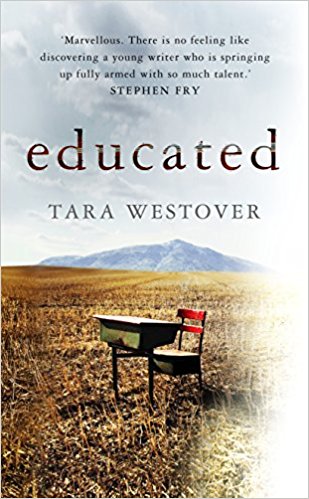
EDUCATED reviewed by Adele Geras


Adele Geras has written many books for children and young adults and six novels for adults, the latest of which is Love or Nearest Offer, published by Quercus in paperback. She’s working on a historical novel for adults. She lives in Cambridge.

The cover of Tara Westover's Educated  is striking. The passage quoted on the back of the book tells you something of what this memoir is about: the author's journey from Idaho to a PhD from Cambridge, a path strewn with astonishing descriptions of life in her extraordinary family. It also demonstrates some of the power of Westover's writing style: plain, sinewy and elegant, all at once. 

You couldn't make it up... that's what people say when what they've read or seen takes them aback to such an extent that they find it an effort to (in another popular form of words) get their heads round it.

I read Educated about two months ago and I'm still thinking about it. It's been universally praised. I predict that it will be on every shortlist it can possibly be on. It will be passed from one friend to another and anyone who reads it will come away moved, touched, horrified and above all knocked sideways by Westover's gift for telling her story in such a powerful and resonant way. She writes most beautifully, with a gift for conveying at the same time the terrible, violent, abusive things that attended her childhood and family life and at the same time, the tenacity of the bonds she feels binding her to her parents and siblings.

She sees them clearly as they are: a man and a woman adhering to a Survivalist Mormon belief so powerful and paranoid that the children are unregistered with school or any other government agency and have spent their entire lives working in their father's scrapyard (with no Health or Safety supervision) or, in the case of the girls, helping with their mother's herbal remedies for family and neighbours. Westover's mother is a self-taught midwife and in thrall to her narcissistic and overbearing husband. Some of her siblings are more sympathetic than others, and one brother is a brutal abuser. The physical harm described in the book is startling and deeply shocking. If this were fiction (you couldn't make it up) your editor would say: you can't put that in your novel. No one would believe it. But it did happen to Westover and how she escaped her family and gained a brilliant PhD from Cambridge University can be seen as an (again, scarcely believable) happy ending.

But Cambridge is not unalloyed bliss. Tara Westover has suffered greatly and hasn't been in contact with most of her family for years.

I finished this book full of admiration for its courageous and hugely talented writer and I hope very much that she finds happiness in her life from now on. I can't wait to read her next book, whatever it turns out to be, and I can safely say that if you start reading Educated, you will not be able to put it down. And you certainly won't be able to forget it.

Educated is published by Hutchinson.

Monday, 4 September 2017

Guest review by Joanna Rossiter: LILA by Marilynne Robinson


Joanna Rossiter grew up in Dorset and studied English at Cambridge University before working as a researcher in Parliament and as a copy writer.

Virginia Woolf's seascapes, Thomas Hardy's Wessex, the moors of the Brontë sisters and the blitzed bombsites of Rose Macaulay have all informed her writing. She is particularly interested in the bonds between people and places.

The Sea Change,  her first novel, was picked by Richard & Judy as part of their 2013 summer book club and was also chosen as the 2014 Bath Literature Festival's Big Bath Read.

She lives and writes in Oxfordshire with her husband and two children and is currently working on her second novel, set on the remotest island on earth.


In one of the very first conversations between the two main characters of Lila, the old preacher remarks after talking about his past that "I suppose the next time I tell it, it will be a better story. Maybe a little less true. I might not tell it again. I hope I won't. You're right not to talk. It's a sort of higher honesty, I think. Once you start talking there's no telling what you'll say."

As with all the best novelists, Robinson has an uncanny ability to distill the theme of her entire story into just a handful of sentences. Lila is a novel that is full of these miniature epiphanies - glimpses of the bigger picture in the book's small details. The light and water and wind that pervade Lila’s experiences of both nature and the towns she passes through are all imbued with symbolism: the river that Lila bathes in outside her drifter’s hut; the cracks of light coming in through the curtains of the St Louis whorehouse, the lanterns hanging in the trees of the revival meeting where Lila is selling apples as a girl. Always laced into these physical details is a sense of the spiritual - or at least an interrogation of their potential symbolism.

Lila herself is constantly questioning the relationship between the physical world and the spiritual world and whether or not they overlap. Is there any room for the spiritual when life for Lila is simply a daily struggle to survive? This is a question that never really leaves her even after she is safe and warm with a roof over her head. Water and its ability to make her physically clean and quench her thirst is also the means of her baptism and spiritual rebirth. But this symbolism does not sit easily with Lila; she wrestles with its portent and what it means for her old way of life, which she looks upon with nostalgia as well as hopelessness. She refuses to let her life be reduced into a simple trajectory of sinner turned saint.

Lila is the third novel in Marilynne Robinson's critically acclaimed Gilead trilogy. It follows the story of an orphan drifter who is raised on the run by a woman called Doll and works in a St Louis whorehouse before arriving in the small town of Gilead and unexpectedly marrying the town's preacher.

The concept of a fallen woman made good might appear trite in the hands of a novelist less skilled than Robinson. But, just as Lila's inner life, richly enjoyed by the reader, remains a mystery to the man she marries, the plot's air of simplicity soon gains depth as the novel progresses.

Lila challenges many of her new husband's convictions about the nature of life and death and the notion of a spiritual journey where the old life is left behind for a new clean life. She prefers to see divine wonder and grace interwoven through each of her experiences from her childhood through to the story's present. This is reflected in Robinson's masterful handling of the narrative which weaves together memories from Lila's fraught past with her more comfortable present.

The complexity of human goodness and divine grace is also reflected in the fact that the first person to show her unconditional love is not the preacher but Doll who takes her from a place where nobody answers her cries and raises her as her own child - to Lila there is arguably more divine love in this simple maternal act than all the small Christian kindnesses shown to her in Gilead, which seem contrived in comparison.

Once again it is a physical act of love - that of a woman caring for a child - that provides the starting point for Lila's spiritual questions. Ames, her preacher husband, is happy to muse from the pulpit or on paper - he likes to write letters. But Lila's theology is altogether more physical and internal - rooted in the landscapes and objects around her and in the people she loves. Even her love of the preacher is conveyed more through physical objects than words: the smell of his woolen jumper which she takes to use as a pillow or his garden which she tends.

Her constant conversational refrain of "that's a fact" seems to underline this connection to the physical. And yet Robinson also bestows it on Lila ironically: unlike the preacher, Lila's thought life is composed of questions rather than statements. Since she cannot find answers for even the most fundamental of questions about herself - her real name, the identity of her mother and father - she questions the nature of everything that follows. She experiences the world empirically, only ever asserting as fact the feelings most familiar to her: hunger, distrust, the cold. She is always reluctant to commit herself to words because that would involve revealing the inner life she has guarded so carefully over the years.

The fact that Ames only ever knows his wife in part and it is only the reader who is privy to lila's thoughts perhaps tells us something about Robinson's own philosophy for the novel as a form: to reflect the loneliness of human experience - the fact that no one can ever truly know the thoughts of another, the constant divorce between thought and word, and how the novel can paradoxically in a small way remarry the two to act as windows into the souls of others.

When Ames remarks that the more a story is told the less familiar it feels he is conveying something of this paradox: the novel as an artistic form gives the reader both the impression of closeness to its subjects and yet a sense of distance too - one is, after all, escaping the real world for a set of fictional characters removed from our own experience. For Robinson there seems to be a spiritual truth buried in all this: Lila wrestles with a God who, in spite of people's flawed attempts to make him known, remains mysterious - a God of questions as well as answers.

Lila is published by Virago.

Friday, 5 August 2016

THE ESSEX SERPENT by Sarah Perry, reviewed by Linda Newbery


"This complex, satisfying portrayal of characters poised on the brink of the modern age is held together by a fresh and exhilarating sense of place and atmosphere."

The 1890s: a wealthy young widow moving to a new location; a village haunted by fear and superstition; sea-mists and strange effects of moonlight; experiments with hypnotism; the dread of tuberculosis; exchanges of letters to advance the plot - you might think you're in familiar territory here. But there is nothing hackneyed about Sarah Perry's handling of her materials.

The Essex Serpent takes us through a year, mainly in a rural community near the river Blackwater in Essex, and partly in London. On the first morning of the year a naked drowned man is found at the river's edge, his neck oddly twisted; this tragedy sets rumours flying of goats killed in the night, inexplicable stirrings in dark water and supernatural punishments for collective guilt, all of which the local vicar tries to combat with reassurances and prayers.

Sarah Perry's characters spring from the page. The reader is soon enamoured of Cora Seaborne; newly released from an unhappy and even abusive marriage, she is no victim, but an energetic, independent and fiercely honest woman with a passion for fossil-hunting, drawn to Aldwinter by the serpent rumours. Could it be a living fossil, an ichthyosaurus that has somehow survived into the modern age? (I've only recently read and reviewed Tracy Chevalier's Remarkable Creatures, whose heroine Mary Anning is frequently referred to here as an inspiration for Cora - viewed from the other side of Darwinism, as it were, more than fifty years after her astonishing finds.) Cora's free-thinking is matched by that of her companion, Martha, a socialist, who is acutely aware of class divisions and the inadequacy of London housing.

In a recent Guardian interview, Sarah Perry said that she aimed for 'a version of the 19th century that, if you blinked, looked a little like ours. I wanted to write a version of the Victorian age that wasn’t a theme park of peasoupers and street urchins. The more I looked, the more I found that not a great deal has changed – an ineffectual parliament, the power of big business and the insecurity around housing. And contemporary Conservatism going back to this idea that morality and poverty are in some way linked.' Martha tells a wealthy acquaintance. "We are punishing poverty ... If you are poor, or miserable, and behave as you might well expect a poor and miserable person to behave, since there's precious little else to pass the time, then your sentence is more misery, and more poverty." She saw 'his wealth and privilege coat him like furs'.

For all the novel's skilful plotting, with many well-drawn minor characters playing their part, the relationships seem to have the unpredictability of real life. Cora's experience of marriage has not inclined her to look for a new partner, yet she inspires love in at least three others, including the married clergyman Will Ransome. Although she and Will disagree on almost very point of faith and reason, he admires her as a sparring partner, and seeks her out for conversation. Cora's autistic son Francis, withdrawn, absorbed in his collections of strange objects, finds affinity with Will's consumptive wife and her obsession with the colour blue. Luke Garrett, a young surgeon who is central to the London part of the plot, is in love with Cora and quickly jealous of her affection for Will. The criss-crossing of relationships - the children's as well as the adults' - keeps the reader guessing to the end, as does the question of whether the serpent really exists. I hoped it wouldn't - but no spoilers.

This complex, satisfying portrayal of characters poised on the brink of the modern age is held together by a fresh and exhilarating sense of place and atmosphere. There's relish and even black humour in Sarah Perry's descriptions of the river and marshes: '... something alters in a turn of the tide or a change of the air; the estuary surface shifts - seems (he steps forward) to pulse and throb, then grow slick and still; then soon after to convulse, as if flinching at a touch. Nearer he goes, not yet afraid; the gulls lift off one by one, and the last gives a scream of dismay.'

And I shall certainly be looking out for noctiluminescence in late summer skies.