Showing posts with label John Newman. Show all posts

Monday, 29 December 2025

BOOKS OF THE YEAR Part 3: chosen by our contributors


Here's the final part of our roundup and our chance to thank our reviewers for their generous contributions throughout the year. We couldn't do this without you! Thanks too to all our followers. We hope everyone's found something here - or maybe several titles - to add to your reading pile for 2026.

John Newman
chooses something old and something new: My reconnection with the work of Rosemary Sutcliff continued this year and I was really thrilled to find a second hand hardback edition of Knight’s Fee complete with Charles Keeping illustrations. I f could not recall reading of how Randal, an abandoned kennel boy overcomes adversity to become a knight. Sutcliff brilliantly uses his rise to explore how the Saxon and Norman population find a common enemy in the French and those attempting to usurp the throne at the end of the eleventh century.

Sometimes picking up a proof copy can lead to a major reading experience. Such is the case with Solvej Balle’s On the Calculation of Volume. The story of how an antiquarian book dealer awakes continuously on the 18th November and how she attempts to adapt is told a day at a time. I'm now up to Volume 3 of a planned septology and I can’t stop recommending them.

John Newman is an independent booksellers at Newham Books. 

Penny Dolan chooses A Voice in the Night by Simon Mason, the fourth in his excellent ‘DI Wilkins’ crime series: Two murders, set in a rather unlovely Oxford: the stabbing of a security guard and a mysterious death-by-drowning of a retired academic.

DCS Wainwright, the ruthless new Superintendent at Thames Valley Police, wants both murders solved. She also wants one of two officers out of the service. Will it be handsome, black, college-educated DI Raymond Wilkins? Or his ‘past partner’: trailer-trash, trackie-bottomed, single-parent DI Ryan Wilkins, who must have ‘no responsibility’, yet somehow fixes on essential facts?

Though each Wilkins goes their own way in sorting out the mystery, they also face painful responsibilities in their own lives. A Voice in the Night, with its compelling heart, makes my Book of the Year 2025, though I must add that the three earlier DI Wilkins novels are worth reading first.

Mary Hoffman
: My fiction-reading has involved a lot of re-reads. I discovered Elly Griffiths’ wonderful Ruth Galloway series of detective novels in June and have read all fifteen and am now re-reading them. The first is The Crossing Places and I heartily recommend them. The heroine is middle-aged, not slim and fashionable, but is a forensic archaeologist. Yet Ruth Galloway is not short of male admirers.

I’ve also been re-reading my way through my extensive Anne Tyler collection and am six books in so far. I got the latest Jackson Brodie novel by Kate Atkinson at Christmas last year – Murder at the Sign of the Rook (Doubleday), so of course I then had to re-read all the others. And I belong to a book group which also sometimes supplies titles I know already, including my own choice, The Leopard (Collins and Harvill Press) by Giuseppe Tommasi di Lampedusa, partly inspired by the recent Netflix series, which played fast and loose with the plot but was beautifully cast and filmed. It was first published in Italy in 1958 and the English translation two years later, both after the author’s death. I must have first read it in sixth form; anyway, I seem always to have known it and it remains one of my favourite books. 

Other favourite re-reads of the years have been Hilary Mantel’s The Mirror and the Light, which I enjoyed much more second time round and Irène Nemirovsky’s Suite Française, which ditto. Our last book club title of the Year is Pip Williams’ The Dictionary of Lost Words and it is a corker.  It may be hard to write a page-turner about a (fictional) girl helping to compile the OED, but Williams has done it. Happy reading!

Mark Davies has also chosen The Dictionary of Lost Words: Set largely in Oxford, the novel is structured to track the creation of the Oxford English Dictionary in the late nineteenth and early twentieth centuries through the life of the first-person character, Esme. As the daughter of one of the editors, Esme's awareness of the significance of words begins as a small child. As a adult, she is employed at the Dictionary, and determines to try to include 'lost' words of a more feminine derivation, having realised that the Dictionary was a male-dominated domain: the editors and compilers were men, the majority of cited sources were written by men, and most of the researchers were men. By retrieving otherwise ignored or mislaid words, and by talking to working class women, Esme collects the basis of her own small alternative 'Lost Words' dictionary. This feminist theme is interwoven with the simultaneous activities of the suffragette movement and the nursing of soldiers injured in the First World War, making the book both engaging, thought-provoking, and educational.

Mark Davies is an Oxford local historian, public speaker and guide. His latest publications are A Jericho Scrapbook: Inside an Oxford Community Saved from Destruction and Jericho - a Celebration.

Jane Dalton: My pick is The Glass Hotel by Emily St John Mandel. Ostensibly a warning of the devastation wreaked by ponzi schemes, this strange and haunting novel carries an undercurrent of a world in which women pay the price for men’s crimes and selfishness.

Chief among them is Vincent, who at school was straight-As pupil but whose talents go unrecognised. Without a career, she becomes a fake trophy wife to the "super-rich" Jonathan Alkaitis, while her half-brother Paul plagiarises her video work. He squanders his college education funded by his mother, whereas Vincent is haunted by the loss of her own beloved mother.

The many different shifts in time, perspective and tenses - present and past, including Paul justifying his actions to a therapist in later years - make for a read that’s as unsettling as offensive messages written on a hotel window - a key plot point.At the end, I had to return to the start to better relish the nuances and detail of the rich narrative in context.

Jane Dalton is a journalist for the Independent. Her first novel is currently out on submission to publishers. 

Leslie Wilson's choice is When I Was, by Miranda Miller. What struck me about this novel was the vulnerability of people trying to be adults, and somehow never managing it; the deeply insecure parents are imprisoned by their class and difficult background, trying to negotiate the world without enough tools to do so, at least not enough to fool other adults that they know what they're doing, and aren't we all like that at times? The four children are also struggling through their lives, particularly the youngest, an observant, sometimes truculent little girl who loves her parents in spite of their failings. The family relationships ring absolutely true.

There are passages of wonderful comedy, particularly the abortive excursion to Brighton in a hire car, which turns out a disaster, particularly for the car. There's  also deep and devastating sadness. Engaging, perceptive and compassionate, this is a novel that’s hard to put down.

Leslie Wilson’s latest novel is The War’s Not Over Yet.

Jane Rogers
chooses Juice by Tim Winton: I love Winton’s work but I’d read enough utterly depressing cli-fi dystopias to feel reluctant about starting this. Juice is set in a lawless, scorched, barren Australia 200 years in the future – how could it not be grim? But Winton is a compelling writer. His narrator spins his tale to save his own life, at the hands of a lone killer who holds him, and the child he is trying to protect, captive. There are layers and layers of suspense, not just about the narrator but about his mother, wife, and child, and about the violent climate justice organisation both he and his captor have worked for (the chief targets are heirs to Big Oil). Winton is brilliant at raising complex moral issues; blame, revenge, honesty, and love. The astonishing humanity of the story makes it much much more than the recital of bleakness I was fearing. And his introduction of honourable AI in the final third of the novel raises questions which continue to haunt me.

Jane Rogers' latest publication is a short story collection, Fire-Ready.

Becky Jones:
 The book I loved most this year was The Wedding People by Alison Espach. It was the first book for a long time that hooked me on the very first page. Phoebe, a divorced academic, arrives at the Cornwall Inn to find she is the only guest who is not there for the elaborate week-long wedding of Lila and Gary. When the bride realises, she is furious – this depressed stranger could ruin her meticulously planned celebrations. As things pan out, however, Phoebe becomes important to her in ways neither of them could have imagined.

What I loved about this book was the writing – sometimes I find myself aware of the craft of writing which can sometimes detract from the enjoyment as a reader. But with this book, I could admire the writing whilst laughing and crying and being fully absorbed in the story. The premise was perfect – a week-long wedding in a hotel. It was a stage set for drama, full of surprises with wonderful, fully formed characters and sparkling, funny dialogue. But what I loved most was the way themes of loneliness, depression, grief and being different were treated with such humour. An uplifting read.

Becky Jones' first novel, Searching for Amy, was published this year.

David Breakell
has chosen The Master and Margarita by Mikhail Bulgakov, translated by Hugh Aplin: Written in the era of Stalin's show trials, this political satire cum fantasy horror was finally published only when the author - and Stalin himself - were both long dead. In a surreal Moscow where most of the humane, moral characters are to be found in a mental institution, Bulgakov skewers Soviet society with prose which is, at turns, darkly comic and terrifying. For me, its most compelling aspect is the 'novel within a novel': the eponymous Master is struggling to complete his manuscript, a historical novel which reimagines a single day - the day of Christ's crucifixion - from the point of view of Pontius Pilate. In the hours after Christ's death, Pilate tries, unsuccessfully, to alleviate his sense of guilt. Sprinkled through the text of the main narrative, these chapters provide a brilliant counterpoint to its satirical message. But also perhaps hope for the Master and Margarita.

David Breakell's first novel is The Alchemist of Genoa - read a Q&A with David next Monday.

The choice of Alison Layland is Audrey Magee's The Colony: There’s something about islands, and I realised recently that I've visited quite a few in my reading this year, all of them as exciting and intriguing an experience as a real-life trip across the sea currents.

In The Colony, the inhabitants of a small island off the coast of Ireland are visited by an English artist and a French linguist, who battle one another for the soul of the island’s people and their language, to the bewilderment of the islanders themselves. In a microcosm of colonialism, their desires and actions have profound consequences. This is a beautifully written, engaging read with brilliant characterisation and dialogue, and so much between the lines.

Other excellent island-based novels I’ve read this year are: Little Great Island by Kate Woodworth; Wild Dark Shore by Charlotte McConaghy; Muckle Flugga  by Michael Pedersen; Island by Jane Rogers. Maybe I’ve been drawn to island-set novels recently as my novel, After the Clearances, is largely set on the fictional island of Ynys Hudol, inspired by Bardsey off the north-west coast of Wales.

Alison Layland's latest publication is After the Clearances.

Nick Manns
recommends Forbidden Notebook by Alba de Céspedes: In Rome, one Sunday in November 1950, Valeria Cossati walks into a tobacconist’s and asks the shopkeeper for cigarettes and a child’s exercise book. The shopkeeper says it’s forbidden to sell non-tobacco products on a Sunday. With sudden urgency (‘I need it’), Cossati persuades him to break the law, and with the notebook hidden beneath her coat, walks into the street, past a watching policeman.

‘I need it’ marks the point when de Céspedes’ character steps beyond the role of compliant housewife and selfless mother and speaks for herself. The ‘forbidden notebook’ – her diary of domestic events – becomes a document of resistance: reports from a strange country.

Written five years after the fall of Italian fascism; 18 months after the publication of The Second Sex, Valeria Cossati walks towards our own time. She says, ‘This is what I saw; this is what I worked out.’

Nick Manns has written four novels for young adults and is the founder-director of Dyslexia Lifeline.  

Paul Dowswell couldn't decide on just one, so chose three! Firstly, A Village in the Third Reich. Julia Boyd, who also wrote the fascinating Travellers in the Third Reich about tourism in Hitler’s Germany, excels in this captivating account of the Nazi-era lives of the people of Oberstdorf in the Bavarian Alps. Not a good bedtime read for anyone worried about the state of the world; It gave me nightmares.

Secondly, Long Island by Colm Toibin. I loved Brooklyn, both film and book, so was keen to catch up with Eilis Lacey, Tony Fiorello and Jim Farrell. We’re now in the 1970s and all is not well. Toibin writes so well about the longings and disappointments of his characters and leaves us on a cliff edge. I eagerly await the third instalment.

Lastly, Abbey Road. David Hepworth is a music journalist with a keen eye for the sort of ‘fancy that’ information my fellow music trainspotters love. He's also a successful publisher with a keen understanding of the £££ that oils the wheels of art. This book is a highly readable history of the famous London studio and, simultaneously, the history of recorded sound.

Paul Dowswell's latest title is Aliens: the Chequered History of Britain's Wartime Refugees

From our own Adèle Geras: Andrew Michael Hurley’s Saltwash is a book that lingers in your mind long after you finish reading it. It’s not as frightening as some of his others (try Starveacre for the most terrifying last paragraph I’ve read in years) but it does have what Hurley has always excelled at: an atmosphere that settles around you as you read like drizzle in an out of season seaside town. This is exactly what Saltwash is. I’m very partial to such settings. A man goes to meet a friend in the oddest seaside hotel you’ve ever visited. The friend isn’t there at first but turns up later. There’s a big party on that night, as it happens, and many strange guests are ready to attend. I shan’t say another word! Merry Christmas to all WR readers.

Adele Geras' latest novel, under the pseudonym Hope Adams, is Dangerous Women.

Linda Sargent'
s choice is What you are looking for is in the Library by Michiko Aoyama, translated by Alison Watts: a Japanese bestseller and it’s easy to see why. The story unfolds as we follow the interlinking lives of five characters from a range of ages and backgrounds, but all are at some kind of turning point in their life. They arrive at a community centre/library and are directed to the librarian Sayuri Komachi, who has an uncanny, almost magical, gift for deep empathy and she directs them to seemingly unlikely books that turn out to be exactly what they need. All the while she makes tiny felt gifts and all five of the characters in this story are given one, which is also significant in their progress too. I especially liked Masao’s crab which ends up on his daughter’s bag and is a pathway to their greater connection too. It is a book about community, connection, listening and kindness. Perfect for these somewhat overwhelming times in the world and emphasising the necessary treasure provided by libraries and librarians. I loved it.

Linda Sargent's most recent publication is Tosh's Island.

Jon Appleton
chooses The Light of Day by Christopher Stephens and Louise Radnofsky, a compelling addition to the canon of queer British history.

Roger Butler was the first British man to publicly admit his homosexuality, lighting a touchpaper at a time (1960) when society condemned ‘inversion’, before sexual acts between consenting men were legalised. Christopher Stephens was a young Oxford student who became the older man’s friend and was gifted, upon Roger’s death, an episodic letter which revealed not only the unrequited longing Roger had for him (about which he knew) but the man’s extraordinary life as a private citizen turned activist during the early years of gay liberation. Extracts are interspersed with Christopher’s reflections on the friendship, on his own story, on the tricky matter of offering the right levels of affection and admiration to those we revere – not just in their lifetime but after they’ve died. It’s a compelling mix and part of the reason it’s my book of the year is that just a few streets away from where Christopher visited Roger in East Oxford, I made visits to my own friend and hero, writer Jan Mark, and since her death I have grappled with many of the questions Christopher confronts.

Jon Appleton is editor of the gab, which celebrates 20th century children’s literature: lettersfromrobin.com/the-gab

And finally ... a great note to finish on, with good advice for all of us! Venkatesh Swamy recommends Slow Down and Be Here Now, by Laura Brand, illustrated by Freya Hartas. These are times where the normal is rush, rush, rush. One keeps lurching from crisis to crisis and leaps from opportunity to perceived opportunity. For many, life has become one merry-go-round with no stop button. There have been days when I feel that I have been shot out of a cannon. Here’s a book for those moments. 

Slow Down and Be Here Now is a book that immediately needs to be introduced into children’s lives (maybe adults too). As are other titles in the Slow Down series. Written by Laura Brand and illustrated by Freya Hartas, it starts off with a simple tip - Be Here Now! 

Each of the short 46 chapters is fascinating and some of my favourites are: Watch a Duck Coat its Feathers, See a Grasshopper Jump, Watch a Family of Hermit Crabs Move House. And if I get the time, I will do just that. 

The book’s premise? When it is almost impossible to find joy, feel peace or follow curiosity, there are ways you can look after yourself, calm your body and mind, and being immersed in nature is just one of them. All you need do to see them is slow down.

Venkatesh Swami is the proprietor, with Swati Roy, of Eureka! Bookstore in New Delhi.

We'll be back to normal next week. Follow us for a great reading recommendation every Monday!

Monday, 2 January 2023

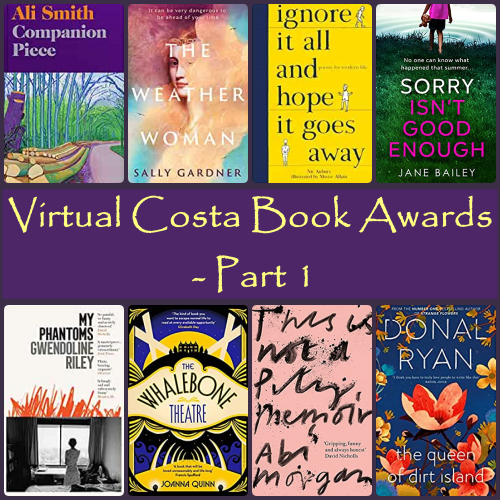
Virtual Costa Book Awards Part 3: Linda Newbery and guests


Here's the final batch of virtual awards. We're luckier than the real Costas - we can award as many as we like! For this final post, alongside some of our regular or previous guests we welcome two new ones: Louise Ellis-Barrett, editor of Armadillo, the online children's book magazine and blog, and author and screenwriter Frank Cottrell-Boyce. Thank you to all our guests for their choices, and congratulations to all our virtual winners.

JOHN NEWMAN of Newham Books awards the Virtual Costa Novel Prize to Seven Steeples by Sara Baume.


Sarah Baume’s latest work, shortlisted for the Goldsmiths Prize, traces seven years in the lives of Bell and Sigh as they inhabit a rented cottage in rural Ireland along with their two dogs. What they do in their cottage is never explained; instead the minutia of their lives is explored with real warmth and a level of detail never applied to their actual relationship. We learn about the contents of each room and how their routines shape them. We discover ways the cottage and its environs are changed by the weather and the seasons. This is a greater focus then how they adapt and relate to each over time. Even so, you feel they want to be together and there is something deeply reassuring about this. And all the time you wonder if they will ever climb an overshadowing mountain to view those Seven Steeples. This is a small book with big themes and not a word is wasted.

PENNY DOLAN's choice is a second Virtual Costa Novel Prize vote for Bonnie Garmus for Lessons in Chemistry (also chosen by Helena Pielichaty in Part 2):

Set in 1960’s America, the novel is about a brilliant young chemist, Elizabeth Zott, whose life’s purpose is scientific study, no matter what. And there is an awful lot of what in Zott’s life: an unschooled childhood; loneliness and loss, single motherhood, type-casting and brutal misogyny from the academic establishment.

Yet Lessons in Chemistry is a delight. As light and swift to read as a fairy tale, the sometimes painful plot turns with wit and humour until the clues and relationships click into place or as deserved. This is a book about determination, hope and the fight for equality, with a fictional heroine I could not help cheering for, despite the fact she would not care whether I did or not. Besides, how often does good fortune spring from one daughter stealing another’s perfectly packed lunchbox? Thank you, Bonnie Garmus, for a bright book in a dark time.

JON APPLETON awards the Virtual Costa First Novel Prize to Taymour Soomro for Other Names for Love:

A dazzling coming-of-age novel in which Fahad is flung from his comfortable, knowable London life into unfamiliar, primitive-seeming Pakistan at the demands of his formidable father who wants to mould his son in his own uncompromising image. Both father and son are grappling with their identities: Fahad is gay but is forced to be restrained and secretive while his outgoing, fearless father is facing the erosion of his authority and influence in his local community. The novel is about love and taboo and family ties, all sparely evoked with a strangely haunting immediacy. Perhaps most impressive of all is the way the story leaps across time and space to begin again, years later, losing none of the novel's cohesion.

LINDA NEWBERY awards the Virtual Costa Novel Prize to Patrick Gale for Mother's Boy:

Mother's Boy
is a thoroughly engrossing, moving and informative novel based on the life of the reclusive Cornish poet, Charles Causley - taking in his wartime experiences as a coder and his first forays into writing drama. The viewpoint alternates between Causley and his devoted mother, Laura, who has her own story. With a sure eye for detail Patrick Gale conjures social and domestic life and draws inferences from Causley's poetry and correspondence to portray his secretive inner life and sexuality. As I'd felt sure that Mother's Boy would feature strongly in the real Costas this year had they happened, it has to be my choice for the novel award.

JANE ROGERS awards the Virtual Costa Biography Prize to Osman Yousefzada for The Go-Between:

This memoir tells the magical tale of a Pashtun boy born into a poor immigrant community in Birmingham, who has become a world-celebrated artist and designer. His mother is a skilled seamstress but it is Osman, as a young boy, who chooses the fabric and delivers the garments. The loving descriptions of his mother’s fabrics reveals a fascination and talent which has since shaped his life, as a fashion designer for the likes of Beyonce and Lady Gaga. Both parents are illiterate, deeply devout Muslims. At puberty Osman, like other Pashtun boys, is banished to his father’s side, the world of men. He fares better than his sisters, though; they are removed from education around the age of 11, and from then onwards kept hidden from the sight of any men. Yousefzada finds himself torn between his people’s culture and the white culture he has to absorb at school, where racism and ignorance are meted out by pupils and teachers alike.

What is most compelling about this wonderful book is its child’s eye view of the complications and contradictions which surround him. He never judges, he simply tries to understand.

YVONNE COPPARD gives the Virtual Costa Biography Prize to Stanley Tucci for Taste - My Life in Food:

If you love Italian food, you will surely love this. Have a napkin handy just in case you start drooling. Stanley Tucci’s obsession with food borders on the disturbing in places - is he really joking when he insists that cutting spaghetti with a knife is an unforgiveable, if not capital, offence?

Tucci writes with warmth, wit and occasional flashes of insight about the life passion for good food that was instilled by his Italian American family. Humour, like the food, infuses everything, even the brief poignant passages touching on matters such the untimely death of his first wife.

Best of all, there are recipes scattered throughout the book. I will not be trying timpano anytime soon; Tucci’s savagely funny description of Christmases ruined by this monstrous culinary beast is persuasive. Thankfully, though, most of the recipes seem to infuse the very pages with aromas and tastes that will draw you into the kitchen to have a go.

LOUISE ELLIS-BARRETT awards the Virtual Costa Children's Book Prize to Belladonna by Adalyn Grace:

It was not a difficult choice to nominate the deliciously, captivatingly dark Belladonna as my book of the year. It is a richly imagined web of intrigue, a rich gothic romance, dark and spectacular. Jinxed as a baby to see all those around her fall and die, it is perhaps a wonder that Signa comes of age and reaches the time at which she will inherit her family wealth. Signa is a mystery; her life is full of mystery, one that only deepens as the story unfolds. Never far from her side Death makes a fascinating and dangerous shadow and primary character in the story causing us, as readers, to question our own preconceived ideas. I was quickly addicted to the writing, the characters and this story which promises and delivers so much. A sequel is promised in 2023, I for one cannot wait!  

FRANK COTTRELL-BOYCE awards the Virtual Costa Children's Book Prize to Lissa Evans for Wished:

It was unusually difficult to choose a winner as it’s been a year of terrific books by the likes of Maisie Chan, Phil Earle and SF Said but I’m going to go for Wished by Lissa Evans. Because - like Groundhog Day or The Phoenix and the Carpet - it takes a really simple, funny conceit and works it until every possible laugh, tear and scrap of wisdom has been wrung from it. Ed and Roo are sent to stay with an elderly neighbour - Miss Filey - while their house is being done up.
 
There they discover that Miss Filey’s birthday candles really do grant wishes. But only for as long as the candle is burning. LIssa Evan’s background is comedy and this is a VERY funny book. It contains the funniest cut from one scene to another I’ve ever come across. But it’s also full of heart and wisdom. When the children finally come to realise that Miss Filey has unfulfilled wishes of her own, I defy you not to shed a tear.

PATRICK GALE awards the Virtual Costa Novel Prize to Jessica Andrews for Milk Teeth:

My nomination is a fantastically original novel that was oddly overlooked given how well her debut, Saltwater, was received: Jessica Andrews' Milk Teeth.


What would you have chosen, in any of the five categories? (Novel, First Novel, Biography, Poetry, Children's). Please tell us in the comments!


Monday, 27 December 2021

Awards Season! Part 2


Here's the second batch of virtual awards, made by our contributors to a book of their choice. Thanks to all our reviewers for giving us such great recommendations! Come back next week for the final part.


Yvonne Coppard: The Evie Award for best unreliable narrator 
goes to Notes on a Scandal  by Zoe Heller.  Barbara is a frumpish, unpopular history teacher whom nobody warms to. Sheba, the new new pottery teacher, is the opposite: a charismatic free spirit who seems to have it all. When Sheba starts a sexual relationship with a pupil, Barbara becomes her confidante.

The depth of Barbara’s sexual repression, jealousy and malice, hidden from the world and from herself, is revealed only to the reader in this gripping, masterly novel. Shortlisted for the Booker, it’s up there with Lolita and The Great Gatsby.


Amanda Craig
awards the Craig Cup for Most Underrated Children's Book to: Philip Womack's Wildlord. It's one of a clutch of recent new YA titles about the intersection between the mortal world and supernatural beings that readers will recognise as the fiercer kind of fairy.

In the English and Celtic tradition, proper fairies aren't twee and pretty, but unpredictable, frightening, mischievous and even dangerous manifestations of nature; and these stories often also address mankind's selfish destructiveness of the natural world, and the possible revenge of it upon us.

This is Womack's eighth novel, and one with a propulsive plot, a sympathetically vulnerable hero and an evocative style. Most of all, it has a moral centre about the importance of love and trust. This story, with its universal appeal ,deserves a wider audience.

Anne Cassidy: A Book I read Again and Again -
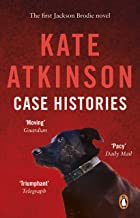
awarded to Kate Atkinson for Case Histories.  I read a lot of crime. Every couple of years I feel the need to revisit this almost perfect book. It's a crime novel that foregrounds the stories of the families of victims. This wasn’t a whodunnit but more an examination of the devastation caused by murder and loss. The examination of family life before and after the crimes is knife edge and utterly believable. The focus is on three unsolved murders and then we meet Jackson Brodie, the ex-cop, the damaged hero, who seems to blunder his way through the terrain to find the killers, to bring peace to the loved ones. There are bits of this book that I unashamedly cry at every time. A terrific crime story. Can’t wait until I read it next time!

The Celia Rees Award for Most Influential Children's Fantasy Novel goes to: The Box of Delights.

John Masefield's novel, published in 1935, is exactly that - a box of delights. It contains themes, characters and motifs that occur again and again in British children's fantasy fiction: shapeshifting, time travelling, a young protagonist on the cusp of adolescence singled out as having special powers, a wise old magician, a magical object that must be guarded at all cost, an epic battle between the forces of light and the forces of darkness, an evil, cunning and ruthless enemy and his equally unpleasant female companion, a midwinter setting with extreme weather, the timely intervention of mythical figures from British folklore - it's all there!

Katie Fforde
gives The Fforde Award for the book she didn't expect to fall in love with to The Dictionary of Lost Words, by Pip Williams. Quirky, imaginative and beautifully written, this is for people who love words, who are feminists in the very best sense. It’s about a little girl who is the daughter of a man among a team of many who are writing the dictionary. She discovers that some words are considered to be no longer useful. They are often words to do with women. We follow her life and the life of the dictionary and others involved in its creation. Highly recommended.

Adèle Geras' prize is the Snowglobe Award for the Best Short Book which Creates an Entire World, and the first winner is Claire Keegan's Small Things Like These.

A few days ago, I found a book which is as close to perfection as any I've read all year. It's tiny: a mere 75 pages and I read it in two sittings. I could have read it in one, but needed to think about it. It's the most extraordinarily beautifully- written tale, which encompasses huge themes and enormous emotions and manages to take you to the heart of a family in a specific place and time. Bill Furlong is a coal merchant in a small Irish town. He and his wife have six daughters. It's Christmas Eve, and the day before that. By the end, we are part of this town. I felt as if I'd been handed the most beautiful snowglobe, even though this place has darkness deep within it. A worthy winner of my award.

Sue Purkiss
awards the Purkiss Prize for a book (actually a whole series) that brings comfort - to the Inspector Gamache series by Louise Penny. 

Life’s a bit on the tough side at the moment, isn’t it? Of course, there are lots of good things too – but sometimes they threaten to be overwhelmed by the bad stuff.

The Inspector Gamache series offers a retreat from all this. Three Pines, where the books are mostly set, is a tiny village in the forest in Quebec. It’s not on any map, it doesn’t show up on a satnav: it’s a refuge. It’s peopled by eccentrics: Ruth, the mad old poet, Gabri and Olivier, who run the bistro and the B&B, Clara the artist – and eventually, Inspector Gamache himself, who is strong, clever, kind and incorruptible.

The characters are complex and satisfying, the stories are gripping – and the food! Ah, if only I had time to tell you about the food… Plus, there are seventeen books in the series.

John Newman of Newham Bookshop awards Newman’s Page Turner of the Year or A Reason to Remain to Sarah Winman.

Everybody loves a feel-good book and this year we really needed stories which celebrate friendship and the ties that bind. Sarah Winman gave us a real gift in the shape of  Still Life and I want to both celebrate it and of course unconditionally recommend it to you all. Spanning several decades of the last century we encounter lives interlinked by war, tragedy and change. Its roots are in London's East End but the core and real heart of it is very much centred in Italy and most especially the city of Florence which the author clearly loves. The big themes of the novel are addressed with a light touch via suitably diverse characters you quickly care about and leave behind with reluctance. This was my page turner of the year and one I felt privileged and confident to place in the hands of other like-minded souls.

Monday, 31 May 2021

Independent Bookseller feature no. 13: John Newman of The Newham Bookshop, IN MEMORY OF MEMORY by Maria Stepanova, translated by Sasha Dugdale


"Part travelogue and part philosophical, social and historical enquiry, written with intelligence. wit and great perceptiveness."

John with colleague Vivian Archer
The Newham Bookshop was established in 1979 by local parents as part an educational charity, as a non-stigmatising gateway to literacy and numeracy support for adults and a source of income for the various projects. We have always been underpinned by values that are inclusive and which celebrate diversity. THE focus is on multiculturalism - valuing everyone and learning from each other in a vibrantly diverse part of East London. We are community-focused, supporting local and London-wide events, conferences and festivals.

I've personally been involved with the shop since the mid 80’s, first as an employee in 1989, then children’s buyer. Vivian Archer, manager since 1987, encouraged me to return to bookselling when John and Jean, stalwarts of the children’s shop, retired. I have never regretted the move for one moment and despite the almost ceaseless changes within the industry I never ever wake up reluctant to go to work! 

We've been supported by many authors over the years, with regular events and signings. One of our earliest and most important supporters was the late writer and compiler of oral histories Gilda O’Neill, who was always generous with her time and never missed an opportunity to point people in our direction. Benjamin Zephaniah and Michael Rosen have also been hugely supportive, giving us the confidence to develop the events which are now integral to our business. More recently we've enjoyed working with a host of locally-based authors, including Courttia Newland, Onjali Q. Rauf, Salena Godden, Irenosen Okoji, Vaseem Khan and Luan Goldie. It's a must for bookshops to cultivate relationships with authors and illustrators and develop ways of working together.

During these periods of enforced isolation over the last fourteen months I have found myself slowing down and as I have adapted to having less choice about how I spend both my working and social life. It has also occurred to me that I have rediscovered a sense of freedom to do two things I have not immersed myself in as thoroughly since childhood, namely being outside in nature and being inside with a book. I have had so much time to walk, read and reflect on both of these activities without distraction for long periods and it has been both a solace and a boon in these sad and difficult times. Suddenly books that I might have put aside to read later were being read and digested.

Into this unexpected space I received a proof copy of this particular book and I knew I wanted to revisit it when I was kindly asked to submit a review as I had found it both stimulating and engaging for a number of reasons. As a lover of books, it is difficult not to be drawn to Fitzcarraldo Editions, an imprint that takes its name from the typeset it uses and which houses pages between blue or white covers which just to hold is an aesthetically pleasing experience.

I studied history as an undergraduate in the late 1970’s and within this I had also taken a course on the Emancipation of the Jews in Europe taught by the late Chimen Abramsky. At the same time, I knew little about the day to day lives of Russian Jewry in the late Tsarist and Soviet periods. Stepanova’s family lived through and ultimately her branch of her family survived these times although others were victims of Pogroms and the Holocaust itself. How they did so is revealed through shared memories, correspondence and other artefacts.

The book began in the author's mind when aged ten but the major impetus came when the author engaged with the contents of her late Grandmother's Moscow apartment which provided links to a journey across time and place to locate members of her family and the worlds they inhabited. What follows is part travelogue and part philosophical, social and historical enquiry written with intelligence, wit and great perceptiveness.

Stepanova, in partnership with her English translator, has created a wide ranging, beautifully written exploration of a family history which links to major events and social history in Russia and parts of Europe where her ancestors and their descendants studied and made lives for themselves over the course of the Twentieth Century. There are enlightening sections on the large numbers of Russian women, including her own great grandmother, who studied medicine in Paris before the First World War as well as a son’s moving letters to his mother from the Siege of Leningrad. Stepanova seems to question how does one put these lives into the context of their times and how do we know whether in relation to Post Memory if “things were better back then”

W.G Sebald is something of a torchbearer as Stepanova introduces links to other personages and their artistic legacy which often coincide with my own interests and preoccupations as does the writing of Sebald himself. These memorably emerge as essays within the book taking in themes which include the self-portraits of Rembrandt and photographer Francesca Woodman and the art of Joseph Cornell. Perhaps most movingly, Stepanova revisits Charlotte Saloman’s haunting “Life? Or Theatre” a work that I first encountered when I saw some of the original paintings in Amsterdam in 1988. The essays had me turning to my bookshelves and Googling images of the works under discussion

Anecdotes are many and I have no space to share them here but they seem to reveal as much about the human condition as anything else and highlight the impact of family secrets and links to personal histories we can perhaps all identify with. What survives does not always link us reliably or definitively to the past as Stepanova herself discovers. “Here is time passing, the human is washed away but objects keep their outline” Maybe it is the tangible things that matter most. I certainly think so as although I have my memories and photos aplenty I am best able conjure up one of my own grandmothers each time I use her bone-handled tomato knife.

In Memory of Memory is published by Fitzcarraldo Editions 2021

Read more independent bookseller features:

Books and Ink, Banbury (now Winchcombe)