Showing posts with label Tudor England. Show all posts

Monday, 29 June 2020

THE MIRROR AND THE LIGHT by Hilary Mantel, reviewed by Celia Rees


"I doubt I'll read a better book this year, or any year."

Celia Rees is a leading writer for Young Adults with an international reputation. Her titles include Witch Child (shortlisted for the Guardian Children's Fiction Prize), Sorceress, (shortlisted for the Whitbread - now Costa - Children's Book Award), Pirates!, Sovay and Glass Town Wars. The chance discovery of an old family cookery book has now taken her writing in a new and different direction. In 2012, she began researching and writing her first novel for adults, Miss Graham's Cold War Cookbook, to be published by HarperCollins in July, 2020.
Twitter: @CeliaRees  instagram: @celiarees1

For me, Hilary Mantel is the consummate writers' writer. She has such great range from Beyond Black, through A Place of Greater Safety,  to the The Mirror and The Light, the final part of the Wolf Hall trilogy; she conducts daring experiments with style; her use of language is deft but precise and she effortlessly handles complex historical events and great casts of characters with consummate skill. There seems to be nothing she cannot do. In choosing to present real events and real people through the guise of fiction, she inevitably invites criticism from a certain historians, criticism she handles with panache and brio, as if to say, 'bring it on!' She lends courage and conviction to any writer of historical fiction. It is our right and our duty to shine a new light on what is known of the past, bring long dead time to life. 

Hilary Mantel
I studied Tudor history for 'A' level and at university. For me, Thomas Cromwell was a soulless bureaucrat, ruthless and machiavellian, responsible for the destruction of the monasteries and the death of Anne Boleyn. But worse than that, he was an uninteresting, shadowy, backroom figure, as colourless as his Holbein portrait, which might as well be in black and white. Hilary Mantel's Wolf Hall trilogy changed my view of him instantly and forever. The unusual use of the third person present tense, allowing the reader to be simultaneously both inside and outside his consciousness, brought him roaring into life. We enter into him, thinking with his mind; seeing with his eyes The details are provided by Hilary Mantel's immaculate and meticulously detailed research which is reflected through the mirror of her imagination and ruthlessly and perfectly tailored to the tale. There are no 'info dumps' here. The known facts are amplified by what could have happened, what was possible, what was likely. 

Thomas Cromwell - Hans Holbein 

The novel is framed by two executions. The first of Anne Boleyn. Hilary Mantel takes the well known fact that Anne Boleyn was be-headed with a sword and makes it starkly graphic and very real by adding that sword was made fromToledo steel. Cromwell would know this, being the son of a blacksmith. In turn these two things, the death of Anne Boleyn and Cromwell's lowly origins, will be the cause of his downfall. The book abounds with these kinds of skillful interweavings, sometimes stretching between all three volumes. It is as carefully crafted and honed as sharp as the Toledo blade. 
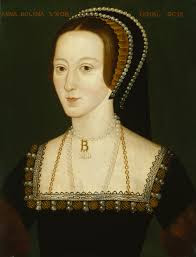
Anne Boleyn
There is so much here. So much more I could say about The Mirror and The Light.  Mirrors and light flash throughout the novel. Speculum Justiciae, ora pro nobis – mirror of justice pray for us – is inscribed on the executioner's sword. This central exchange between Henry and Cromwell gives the book its title:

“Your majesty is the only prince. The mirror and the light to other kings. 
Henry repeats the phrase, as if cherishing it: the mirror and the light.”

Henry is cast as a living specula principum, the model for all princes,when he is anything but and the image of the bloated and ageing King reflected back to him in the eyes of the the young Anne of Cleves is the moment of truth which causes her rejection and Cromwell's ultimate.demise.

It is is a long book, 882 pages, as dense and rich as chocolate ganache. It took me through the first weeks of the lockdown. I'm usually a fast reader but I found I could only read a bit at a time. To say I didn't want it to end would be an understatement. It is another testament to Hilary Mantel's skill that, although you knows what is going to happen, the end approaches with slow, inexorable heart-in-mouth dread. 

I doubt I'll read a better book this year, or any year. Thank you, Hilary Mantel.

The Mirror and the Light is published by Fourth Estate.

See also: A Place of Greater Safety reviewed by Jean Ure.

Monday, 17 December 2018

TOMBLAND by C J Sansom, reviewed by Adele Geras


"A rich, complicated and fascinating novel ... I was swept up in it."

Adele Geras has written many books for children and young adults and six novels for adults, the latest of which is Love or Nearest Offer, published by Quercus in paperback. She’s working on a historical novel for adults. She lives in Cambridge.

When this enormous novel was published in early November this year, it went straight to the very top of the Nielsen Bookscan charts, selling about 45,000 copies. A few weeks before it appeared, there was a piece in the Sunday Times by C. J. Sansom, who is the very opposite of an attention-seeker. It detailed the unspeakable horrors he suffered at a very good Scottish school, and how he was mercilessly bullied by both fellow pupils and staff. He said that this time affected his entire life, and I urge anyone interested to look the article up online. It’s very moving and adds a frisson of pleasure to the good news about the success of the book. We are pleased when bullies are outed and shown up in front of the world. C. J. Sansom has succeeded brilliantly in spite of the dreadful suffering he had to endure and such justice pleases us.

Justice is what lawyer Matthew Shardlake is concerned with. He’s been preoccupied with it over six other novels. He’s now, after many turns of fortune, instructed by the teenage Elizabeth (Anne Boleyn’s daughter, almost a prisoner in Hatfield House) to see what’s going on in Norwich in relation to a relative of hers, John Boleyn, who’s been accused of the murder of his wife.

The novel has two strands which interweave in a kind of irregular pattern. Most of the book is concerned with the over-arching historical story: an account of the Kett Rebellion of 1549. William Kett and his brother Robert are in charge of a huge gathering of people which becomes almost a little town, seeking to petition the Lord Protector for better conditions for their lands and livestock. The care with which Shardlake describes how this ‘town’ operates, how the people come together to administer food, drink, shelter, law and order is told in exhaustive detail. Some say the book is too long. Sansom is accused of concentrating on the fine grain of the historical story to the detriment of the murder mystery. I didn’t find that a problem. Because I know Shardlake so well, and like him so much, I’m happy to listen to his voice speaking about everything. He’s preoccupied with the fate of the rebels and he tells their story with compelling indignation. Later on in the book, there’s a more detailed account of a battle than any I’ve read before, and it’s truly ghastly. Disgusting. Horrible … just as it must be to convey the hideous truth of men eviscerating and dismembering one another and not sparing the women they meet along the way.

The murder mystery is a good one. Is John Boleyn guilty not only of killing his wife but leaving her naked body head down in the mud with her modesty displayed to the world? Other deaths follow this one. As he gets to the bottom of this, Shardlake meets a huge cast of characters of varying degrees of turpitude. The Reynolds twins and their father are probably the worst, but there are many others and one of the things Sansom does so well is examine gradations and varieties of evil. Are people truly wicked, or simply weak? What pressures have brought them to be how they are? What tragedies in their lives can account for their behaviour? Can they be changed, or saved?

There are so many characters in this story that it would be impossible to speak of them all, but as well as the regulars from other Shardlake books, we meet Simon Scambler, the autistic boy who sings like an angel and has a way with horses, silent Jane Reynolds with her white-bandaged hands, and baby Mousy, whose presence in the rebel camp keeps us worried throughout. There are dozens more, every one of them so well rendered that we can see them before us and hear them speaking. Sometimes we can even smell them. There’s also a terrific cameo from the teenage Elizabeth which shows her to be as difficult as any other teenager.

Beyond the history and the mystery, C. J. Sansom is concerned with justice. How it operates in favour of the mighty and often to the detriment of the poor. How men can get away with evil and how powerless most are to fight for their due. Shardlake does his best. He has to compromise; duck and weave to save his own skin, but he is always on the side of what he considers to be right.

It’s a rich, complicated and fascinating novel and if you read it on a Kindle you won’t notice how big it is. I was swept up in it and came out at the end feeling as though I’d been up on Mousehold Heath above Norwich with Kett’s men.

The fact that Shardlake is hunchbacked has always been interesting. We are worried as we read about how he’s managing to cope with pain and discomfort. But it’s only with this seventh novel that I’ve realised what I’m sure occurred to C. J. Sansom right at the beginning of the series: that in a world full of crookedness, this hunchback is the very model of a truly upright man.

Tombland is published by Mantle, an imprint of Pan Macmillan.