Showing posts with label 1980s. Show all posts

Monday, 14 October 2024

MODERN NATURE by Derek Jarman, reviewed by Linda Newbery


"The New York Times described his film The Garden as 'a peculiar blend of reflectiveness and fury', which could apply equally well to this journal."

Linda Newbery
edits Writers Review.

"I have re-discovered my boredom here," Derek Jarman writes, finding at Prospect Cottage, his Dungeness home, an escape from the celebrity he earned through his films and his activism. "All around the traps were set. Traps of notoriety and expectation, of collaboration and commerce, of fame and fortune. At first a welcome trickle, something new. Then a raging flood of repetition, endless questions that eroded and submerged my work, and life itself. But now I have re-discovered boredom, where I can fight 'what next' with nothing."

Well, not exactly nothing. Beginning after Jarman's diagnosis as HIV positive (which gave, at that time, a grim outlook) his 1989-90 journal conveys a time filled with interviews, film projects and visits to London exhibitions and social events, interspersed with the making of his iconic Dungeness garden, constantly planting, propagating and making sculptures from objects found on the shore. The contrasts are stark, moving from the many demands on him in London to the quieter, reflective times at Dungeness. He writes of  "the separation of my two lives ...  work here (in London), sunsets and sunrises there." Always in the background is his sorrow at the death of friends from AIDS and the foreboding of his own, which by the end of the journal seems close, although he lived for another three and a half years, regaining enough health and energy to film Edward II, Wittgenstein and Blue.

Having visited Prospect Cottage and somewhat fallen under the strange spell of Dungeness, its flat horizons, big sky and sparse vegetation, I found that these sections appealed to me most, beautifully evoking that distinctive terrain with the nuclear power station looming in the background. "There are no walls or fences. My garden's boundaries are the horizon," he writes, and of the night sky: "So flat is the Ness that those stars that lie at the horizon touch your very feet and the moon tips the waves with silver ... The nuclear power station is an ocean liner moored in the firmament, ablaze with light: white, yellow, ruby." Both my visits have been in calm July sunshine; the place must be very different in harsh winter weather. Once in this memoir Jarman feared that the cottage roof would be torn off in a gale, while on another occasion a lightning strike at the power station sent him and other residents into a panic, rushing to pack for a hasty evacuation (which, fortunately, wasn't needed).

Derek Jarman is an engaging diarist, full of contradictions and charm. The boldly unconventional film-maker, rebellious activist and one of the first public figures to be open about his HIV diagnosis expresses a wistfulness for pre-decimal coinage and describes himself as too shy to try on clothes in shops; as a student at King's College in London he felt "frightened and confused," convinced that he was the only gay in the world. Almost every writer or artist will identify with the self-doubt he experiences: "All the way back on the train I was plagued with misgivings about The Garden. Looking at the rushes over the last six days, I discovered not one sequence that worked. Glaring faults everywhere ..." At the same time he feels a compulsion to write. "I find it difficult to write each day, but if I don't I'm swamped with guilt. Where does the compunction come from?" So strong was it that even when he temporarily lost his sight while being treated in hospital he dictated his journal entries to his devoted companion Keith Collins (referred to by his nickname HB in the book). 

Those us who were around in the 80s may remember how the AIDS epidemic was viewed by some who saw it as a punishment for homosexuals. "Last week a doctor in the mainstream of research with a leading drug company said that looking for drugs to combat the virus and to prolong the lives of those already infected posed an ethical problem, as keeping them (read me here) alive only exacerbated the situation. Better we should all die quickly. Every day, in many little ways, we are subjected to this terrorism. Our relationships unsanctioned, beyond the law." No wonder there is always anger simmering beneath the surface of Jarman's writing.

As it's a journal, events are understandably related without context, which can sometimes confuse the reader with a great many names, places, and visits whose purpose is unclear. Interspersed with these almost daily records are reminiscences from his childhood, spent in various countries with the RAF father with whom he had a difficult relationship. But it was early in childhood that his fascination with plants and gardening began: at four his parents gave him an illustrated Edwardian book, Beautiful Flowers and How to Grow Them, an unusual gift for so young a child but one which provided a lasting influence: "Flowers spring up and entwine themselves like bindweed along the footpaths of my childhood." The early part of Modern Nature refers constantly to plants in folklore, in herbalism, in classical literature. "If fate had turned out different," he writes, "I am sure I would have been a professional gardener, rather than an enthusiastic amateur."

In between making videos for the Pet Shop Boys, filming The Garden, beginning to research Edward II and frequently staying at his London flat, he spends his time at Prospect Cottage walking the shores of the Ness, collecting and arranging the driftwood, stones and found objects which give his garden its unique character. He reports constantly on the progress of his seedlings and cuttings. Even at his lowest, when friends' deaths are reported with horrible frequency, he finds solace in his plants. "I plant my herbal garden as a panacea, read up on all the aches and pains that plants will cure - and know they are not going to help. The garden as pharmacopeia has failed. Yet there is a thrill in watching the plants spring up that gives me hope."   

The New York Times described his film The Garden as 'a peculiar blend of reflectiveness and fury', which could apply just as well to this journal.


Modern Nature is published by Vintage.


Derek Jarman photograph from Wiki Commons. Others by Linda Newbery.

For more of Linda's nature and garden writing choices, see:


Walden by Henry David Thoreau

The Flow by Amy-Jane Beer


Monday, 4 July 2022

Guest review by Sue Clark: REASONS TO BE CHEERFUL by Nina Stibbe


"Humour is as hard – some would say harder – to pin down on the page than so-called serious stuff ... That’s why, when comedy works, it is such a joy."

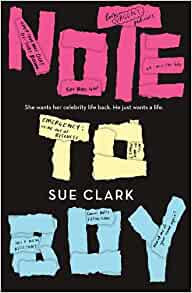
Sue Clark’s comic fiction, Note to Boy, was published in 2020 and received a PenCraft Award for Literary Excellence. She’s been a writer virtually all her professional life. Before her first novel, she was a comedy scriptwriter for BBC radio and TV, as well a journalist, copywriter, PR and jill-of-all-writing-trades. Note to Boy has been described as ‘both funny and tragic’, ‘warm, funny and life-enhancing,’ and just plain ‘terrific.’ She’s currently working on her second novel, another comic creation. Find more on her website and on Twitter: @SueClarkAuthor

I love all kinds of comedic writing – novels, plays, films, TV shows, stand-up routines – bring them on! However, one thing I can never get my head around is why comedy is so often dismissed as a lesser art. As anyone who’s ever tried writing it will confirm, humour is as hard – some would say harder – to pin down on the page than so-called serious stuff. I know. I’ve spent a lot of my time trying! That’s why, when comedy works, it is such a joy.

In Reasons To Be Cheerful, Nina Stibbe manages the extraordinary feat of writing a comic novel that makes you laugh, while reflecting quite deep thoughts about what it meant to grow up in the English provinces in the 1980s. I’m aware, as I write this, that all views on books are subjective, and those on humorous books particularly personal. What tickles my funny bone, may bring yours out in a nasty rash. You may not agree but, for me, Reasons To Be Cheerful is that rare thing, a comedy triumph.

I picked up Stibbe’s book up during the darkest days of the pandemic, mainly, I confess, because of its title. In dire need of cheering up, I hoped this tale of eighteen-year-old Lizzie Vogel, aspiring writer and guerrilla dentist, as she navigates the tricky passage to adulthood, might hit the spot. I wasn’t disappointed. I laughed – once I read the description of trousers worn hoisted high in the “European way” I knew I was in for a treat – but I was also bowled over by its moments of insight.

Winner of both the 2019 Bollinger Everyman Wodehouse prize for Comic Fiction and the 2020 Comedy Women in Print (CWIP) prize, Reasons To Be Cheerful takes Lizzie, also the subject of two of Stibbe’s earlier volumes, Men at the Helm and Paradise Lodge, to the brink of womanhood.

The book teems with entertaining, richly observed characters and absurd situations, mainly centred around the goings-on in the dodgy dental surgery in Leicester. The characters are comic creations, true, but comic creations with depth and heart, whom you mostly care about and are invested in.

Lizzie herself is wonderfully bright and idiosyncratic, rivalling Adrian Mole for endearing naiveté and know-it-all pretension. Like him, she has ambitions to be a writer. I might be wrong, but I feel her character was inspired, at least in part, by the young Miss Stibbe, since they apparently share a love for words and an interest in teeth.

The story, told in Lizzie’s voice, chronicles her chaotic family, and a disparate gang of friends and work colleagues. These include: Adèle, her gloriously uninhibited mother, who believes, “a thoughtful visitor should aim to be fifteen minutes late … and slightly drunk”; Lizzie’s boss, Mr Wintergreen, a monstrous and incompetent dentist who employs Lizzie as his assistant and creepily insists she holds his cigarettes to his mouth for him as he smokes; and Andy, the boy who delivers the dental plates, and becomes Lizzie’s first boyfriend and the object of her sexual desire, though he prefers birding.

The less pleasant side of the 1980s is acutely and dryly observed, from the fashions – one character sports “apricot hair and matching lipstick” – to odious Mr Wintergreen’s racism and Lizzie’s sexist-but-hilarious list of Things Men Don’t Like Women Doing, which she fantasises about sending to a women’s magazine. It includes: “… having a dog, talking about sport, laughing loudly, spending money on fripperies, disagreeing with them, chatting on the phone, climbing trees, talking about dogs, mowing the lawn in flip-flops ...”

Stibbe has the knack – shared by writers like David Nicholls and Kate Atkinson – of holding up a humorous mirror to everyday life without teetering over into caricature. She clearly loves her characters and wants you to root for them – apart from Mr Wintergreen. And every now and then she drops in a line or two that touches your heart and, mid-guffaw, you find you have something in your eye.

To be able to locate that bittersweet spot where absurdity meets truth, and a belly laugh catches in the throat is a gift given to few writers. Nina Stibbe, I believe, has it.

A lesser art, indeed!

Reasons to be Cheerful is published by Penguin.

Sue Clark's Note to Boy is published by Unbound.

Monday, 2 August 2021

Guest review by Keith Gray: SING BACKWARDS AND WEEP by Mark Lanegan


"One of the pleasures of the book is witnessing his passion for his unrealised talent as a singer-songwriter develop, despite his horrific addiction to drugs and alcohol..."

Keith Gray is best known for his novels for children and teenagers including Ostrich Boys, which was shortlisted for both the Carnegie Medal and the Costa Children’s Book Award and was successfully adapted for the stage. His latest book for teenagers is The Climbers, published by Barrington Stoke. Keith lives with his family in Vienna, Austria, where he co-founded the not-for-profit writer development community Sunday Writers’ Club. www.sundaywritersclub.com

Grunge and the 90’s Seattle music scene was part of the soundtrack of my youth. Albums by Pearl Jam, Stone Temple Pilots, Soundgarden and, of course, Nirvana were forever grinding their way through the headphones of my CD Walkman. I was never a particular fan of the Mark Lanegan fronted Screaming Trees, however. But looking back I don’t feel I missed out. Especially not now I’ve discovered Lanegan himself was embarrassed by the songs he sang and felt utter disdain for his bandmates.

One of the surprises of Lanegan’s autobiography is that music wasn’t a life-long passion. This is the singer who’s orbited grunge music before, during and after it was popular. He befriended and dealt drugs to many of its major stars, and nowadays is regarded as a cult figure, heavily influential and acclaimed as a great collaborator with other artists across several musical genres. Yet he starts his story by describing how he stumbled into Screaming Trees half-heartedly as a teenager in the 80s, without any real aptitude or ambition. He hoped being part of the band would be an escape from the ranching town of Ellensburg in Washington State where he hated growing up and where he’d already accrued a handful of petty criminal convictions. A hefty chunk of the word count here is dedicated to his dislike for his bandmates and their songs. But I guess you could say he learned on the job. One of the pleasures of the book is witnessing his passion for his unrealised talent as a singer-songwriter develop, despite his horrific addiction to drugs and alcohol.

Be aware, it’s one of the few ‘pleasures’ of reading Lanegan’s story. The book roughly encompasses the lifespan of Screaming Trees (1985-2000) who turn out to be also-rans within the grunge scene but whose biggest draw was Lanegan’s distinctive vocals. The details are in the performing, touring, incessant arguing and monstrous drug consumption.

The main interest for casual readers will be Lanegan’s friendship with Kurt Cobain but Cobain’s death and Lanegan’s proximity to it is neither the most revelatory nor poignant recollection. Lanegan’s 90’s were not just a car-crash but a pile-up of sex, drugs, drugs, DRUGS and rock ‘n’roll. So much so that the reader feels like a rubber-necker at many shocking anecdotes. Perhaps too many shocking anecdotes? I stopped feeling surprised by the lengths (or depths) Lanegan would go to to find his next fix about halfway into the book. I hung around hoping for more music. I wished there was more music. Although I was never a fan of Screaming Trees, Lanegan’s solo albums and his work with Queens of the Stone Age has been (to my ears) exceptional. But did he need to go through those years as a criminal, a cheat, a liar, a junkie to be able to create such incredible music? Is his songwriting so powerful because he’s been to those dark, dark places many of us can only imagine?

It’s a well written book of no-nonsense muscular sentences. There’s nothing shiny or pretty here. It’s bluntness helps keep much of the emotion or contemplation at arm’s length – which is a surprise if you’re familiar with Lanegan’s lyrical prowess. Yet maybe that’s the point: Lanegan wants to settle scores and tell truths, he’s not here to whine.

There are some lighter (or perhaps slightly less dark) moments. OnThe e of the most publicised is his encounter with Liam Gallagher of Oasis. But these are few and far between and Lanegan was around for the untimely deaths of his beloved friends Cobain, Layne Staley (Alice in Chains) and Kirsten Pfaff (Hole) among others. There is a note of epiphany and hope in the closing pages, dated around about 2002, but it’s still mind-blowing how Lanegan survived his personal addictions and continues to make great music today.

Lanegan’s been praised for his unflinching honesty and he portrays himself as a spiteful perfectionist bearing venomous grudges. He teeters precariously between powerful creativity, utter hopelessness and spiralling self-destruction. Often all within a single day. He either adores people or he loathes them – there’s no room for middle ground. And it’s a rock solid fact that the people he loathed won’t enjoy his book. Not that he’ll give a damn. He’s written his story exactly the way he wanted to.

Sing Backwards and Weep is published by White Rabbit.

See also: Haddon Hall: When David Invented Bowie by Najib, reviewed by Paul Magrs


The Dark Stuff by Nick Kent, reviewed by Paul Dowswell