Here's part two of what's ahead for some of our guest reviewers - whether it's a new publication, a return to an old favourite, or an author newly-discovered. What's on your reading pile or wishlist for the year to come? And it's our second chance to thank our wonderful contributors - this weekly blog wouldn't happen without them! 2021 is the year that brings us a new David Grossman novel, which is always something to be grateful for.
More than I Love My Life, translated by Jessica Cohen, comes out in August. I know very little about it, except that it’s by David Grossman and therefore will be clever and beautiful and generous and humane and surprising, which I reckon is a pretty good start. In the chidlren's/YA world,
The Smell of Other People's Houses was one of my books of the year in 2016, and I couldn't be more excited that the next Bonnie-Sue Hitchcock book is on its way at last -
Everyone Dies Famous in a Small Town comes from Faber in April. We’ve also got Hilary McKay’s follow-up to
The Skylarks’ War to look forward to – anybody who read that first book will share my excitement; we only have to wait till May to meet the next generation, in
The Swallows’ Flight. But before any of these comes Sasha Dugdale’s translation of
In Memory of Memory by Maria Stepanova, due in February, a big and deliciously unusual-sounding multi-genre “exploration of cultural and personal memory”. Can’t wait. (Oh, and I’ve just started reading a proof of Chris Power’s debut novel
A Lonely Man – coming in April – and I can already tell I’m going to love that, too.)
Rosemary Hayes: The reading pile never diminishes but Claire Tomlin’s biography of Charles Dickens and Hilary Mantel’s
The Mirror and the Light have both languished on it for too long and I really will read them next year. The captivating
Where the Crawdads Sing by Delia Owens has alerted me to the books she co-authored with Mark Owens about their time in Africa,
Cry of the Kalahari and
The Eye of the Elephant. I’ve not read any of John Lanchester’s books, so am looking forward to reading
The Wall. A recent discovery is Lisa Jewell and I’m racing through several of her titles. Helen Dunmore’s
A Spell of Winter is on my list as is Kate Grenville’s latest,
A Room Made of Leaves.
Extinctions by Australian author Josephine Wilson is another and, also with Australian connections, there’s the intriguing sounding
Dangerous Women by Hope Adams, aka Adele Geras. Can’t wait for that one!
Sophia Bennett: One of the family’s favourite all-time books is
The Martian by Andy Weir. His new book,
Project Hail Mary, is also set in space, and I expect to be on the edge of my seat. I’ve recently discovered Louise Penny’s
Three Pines series, set in a small village in Canada. If you love contemporary, classic crime fiction, I recommend her. I’m also looking forward to Andrew Marr’s look at
twentieth century Elizabethans, which has resonances with my own series about Queen Elizabeth II (as a detective). And I have my eye on
The Rose Code by Kate Quinn, is about three women who meet at Bletchley Park. Finally, I’m looking forward very much to
Dangerous Women, by a certain Hope Adams. I’m a sucker for anything to do with needlework, history and women in the judicial system. A book that combines all three will be a perfect read.
Savita Kalhan: Kololo Hill by Neema Shah, to be published by Picador, February 2021, promises to be a compelling debut. It is set in the tumultuous time of Idi Amin’s eviction of Asians from Uganda in 1972. I know that Asians were given ninety days to leave the country with only what they could carry, leaving behind their homes, their businesses and belongings, and their money. But I have not read any stories set at that time. In Kololo Hill there are secrets, disappearances, turmoil, violence and fear before Asha and Pran, newly married, and Pran’s mother Jaya, manage to escape into an unknown future.
I read
Djinn Patrol on the Purple Line by Deepa Anapara when it came out in 2020, but already I know I must reread it in 2021. The story is told through the eyes of nine year old Jai, who, with his two best friends, investigates the disappearance of another friend from the slum they live in. It is a vivid and darkly realistic story, leavened by the humour, the naivety and optimism of the child detectives, and that makes this a very poignant read.
Linda Sargent: As usual the older I grow the greater the number of books I want to read grows too. So far, I have only one on my reading ahead list, but Christmas is coming and I live in hope. During this past year, as for many, poetry has become even more crucial in my life and from what I’ve heard and seen of Margaret Atwood’s latest collection,
Dearly, it is high on my list. She manages that rare combination of wisdom, lyricism and simplicity – and, what’s more, reads her own work as if she’s addressing me personally and not some sacred congregation.
Hamnet by Maggie O’ Farrell: how I’ve resisted buying this I don’t know and why it hasn’t been on more prize lists, well, I don’t know that either! Helen MacDonald’s
Vesper Flights: I heard a couple of episodes on Radio 4 and knew it was one for the list. And, finally, Michael Rosen’s
Book of Play is, I’m happy to report, sitting next to me on the to-read pile.
Ignaty Dyakov: Two books I can’t wait to receive for Christmas and New Year are
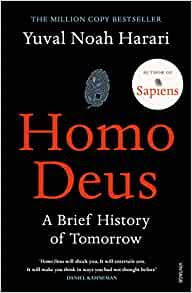
Homo Deus by Yuval Noah Harari and
The Midnight Library by Matt Haig. I have discovered both authors only this November, having read
Homo Sapiens, The Humans and
How to Stop Time alongside each other.
Despite obviously having been written independently of each other, together they have created a wonderful narrative about humankind, our past, and our impact on the Planet and fellow planetary residents, humanoid and otherwise.
Somehow, I feel that Homo Deus and The Midnight Library ought to be read side by side too and I treasure those – as yet only imaginary – moments of morning non-fiction reading and dark evening reads of a novel with modern jazz playing in the background.
Yvonne Coppard: In 2021 I will tackle the toppling stack of panic-bought titles from the first Lockdown, when I feared I might run out of good books. Lined up for the New Year are:
Tidelands, Philippa Gregory, set in the English civil war. I know I’ll love it because, well, it’s Philippa Gregory, innit?
The Woman in Cabin 10, by Ruth Ware. ‘A passenger is missing. But was she ever on board at all?’ is a great tag. The author is new to me, but a Sunday Times bestseller seems a safe bet.
The Ode Less Travelled, by Stephen Fry, is one of my Lockdown projects. It’s a masterclass in poetry, complete with practical exercises. I made a start and promptly mislaid the book. It’s turned up now, and I’m looking forward to indulging a neglected love of poetry.
Gill Lewis: I’m really looking forward to Fifty Words for Snow by Nancy Campbell. Snow represents so much for many people across the world, and there is a palpable ecological grief at the loss of it in some regions due to climate change. And second in my TBR pile is What is Life? by Paul Nurse, where I hope to find some answers to this huge question.
Celia Rees: I’m looking forward to reading Mick Herron’s
Slough House, due to be published February, 2021. I love spy novels and I love Mick Herron’s writing. I eagerly devoured books I - 6 and am eagerly anticipating the seventh in the Slough House series. I’m also thinking of re-reading the Master, John Le Carré.
I also like the Australian novelist Jane Harper, and notice that her next book,
The Survivors, is to be published in February, 2021. I very much enjoyed The Dry and The Lost Man, so I’m looking forward to this one.
The TV series of His Dark Materials has made me want to re-read the Philip Pullman novels, particularly The Subtle Knife and The Amber Spyglass. I fear I read them too quickly the first time round!
Julia Jarman: I will read everything Patrick Gale has written, and am currently enthralled by
A Perfectly Good Man.