Showing posts with label autobiography. Show all posts

Monday, 9 January 2023

Guest review by Penny Dolan: LONG LIVE GREAT BARDFIELD! by Tirzah Garwood


"Tirzah’s unique voice is a large part of the Long Live attraction: she writes in a clear-eyed and personal style, without any idea of intended publication or any need to impress." 


Penny Dolan
works as a children’s storyteller and writer. Her last novel for older children, A Boy Called Mouse, was nominated for the Young Quills Historical Fiction Award, and she is currently completing a companion book. She posts on The History Girls, on An Awfully Big Blog Adventure and can be found on Twitter @PennyDolan1.


My choice for Writer’s Review could be called “My Life as the Artist’s Wife” although the author, writing about her experiences during the first half of the 20th Century, would feel far too independent and unsentimental to employ that description herself.

Long Live Great Bardfield! is the autobiography of Tirzah Garwood, the wife of Eric Ravilious (1903 -1942). He is known for his English landscape paintings, which have an airy, dream-like and solitary quality, and for his work as an official War Artist.

I am very fond of his paintings, which is why, in 2015, I visited the Dulwich Gallery’s stunning Ravilious exhibition, where I came across the name Tirzah Garwood. There, among his paintings, and their rare vestigial human figures, were a few small, well-designed woodcuts that definitely rejoiced in people. I saw a collection of small social scenes and domestic interiors, each one sharpened by a strong sense of movement, humour and fun and the name beside them was Tirzah Garwood. I wanted to find out more about him and about her, these contrasting artists.

In 2018, Persephone Press, who specialise in books by early twentieth century women writers, published Tirzah’s memoir as Book No. 119. The manuscript had been prepared after Tirzah’s death in 1951 by her daughter, Anne Ullmann, with the addition of extracts from the letters of family and friends. The title, Long Live Great Bardfield! was Tirzah’s own comment on her life and experiences. 

Long Live arrived soon after the Dulwich exhibition, war anniversaries and a touch of nostalgia had revived interest in Eric Ravilious and in the other young people from the Royal College of Art’s Illustration and Design course. From what I have read, there was an element of class about this particular course at the Royal College of Art. These students were not “fine artists”, expected to teach more art themselves and/or have an income of their own. These students were trained to be useful to publishers, printers, manufacturers and business. They were artists of the then-modern century, whose skills would re-invigorate British design, making their mark, as Ravilious did, in the world of decorative ceramics, printing and book design.

After being praised for her drawings at school, Tirzah studied at Eastbourne College of Art. She specialised in woodcuts, illustrations, pattern designs and marbling techniques although gradually, as her memoir shows, her own work gave way to all that was involved in running a home. She was very much involved in Eric’s work and career, recognising the “stunners” that would sell well at exhibitions, recording, packing and posting his work to the London galleries and often influencing his work. One of his most popular images, Train Landscape, was created by Tirzah making a careful collage of two of his paintings.

Tirzah’s unique voice is a large part of the Long Live attraction: she writes in a clear-eyed and personal style, without any idea of intended publication or any need to impress. She started writing her memoir “for her descendants” in 1942, while convalescing after an operation for breast cancer, giving her own account of their slightly unconventional life together.

The memoir moves, in a kindly, almost gossipy style, from mundane circumstances through to painful incidents and partings. For the reader, the experience is rather like listening to an indiscreet and friendly aunt who is never afraid to mention an intriguing or medical matter or to describe another’s appearances in too-observant detail, even though, at times, you may have heard part of this story before.

In her telling, Tirzah makes it clear how differently she and Eric were brought up. Her father was a Colonel in the Royal Engineers; she describes a comfortably respectable middle-class family, living in various homes in Sussex, surrounded by relatives, siblings, pets and plenty of space. Her education came through relatives, personal tutors, private day schools and at a boarding school. By contrast, Ravilious, who taught part-time at Eastbourne College of Art, was “not quite a gentleman” socially. His father was a failed antique shop-owner turned chapel preacher and Eric had attended what was then called the Municipal School. School. Tirzah, in her memoir, is very aware of class differences and snobbish attitudes, including her own responses. Although honest, they are not always comfortable reading. 

Although, after marrying in 1930, Eric and Tirzah enjoyed life as part of the London art scene, with Eric working on paintings for commissions and exhibitions, he was restless, wanting new landscapes to paint. In 1932, along with fellow artists Edward and Charlotte Bawden, they moved to Brick House in Great Bardfield, a village in Essex not far from Saffron Walden, and became part of the artistic community that developed in that area.

In Long Live, Tirzah is telling her grandchildren about the joys, interests and enthusiasms of that part of her life. While Eric and Edward explore the countryside and coast, collecting ideas and inspiration for their work, Tirzah and Charlotte are designing and producing marbled paper and managing their homes. If your interest is in history or in the role of women, Long Live is a brisk reminder of the rural conditions of the nineteen-twenties and thirties. Tirzah, who had grown up with servants, describes a time when, outside towns and cities, buckets of water were still hauled from wells, coal and logs were needed for fires, and how unendingly hard all the care, cooking, laundry and domestic work could be, whether in peace or during war-time.

Tirzah does not hide the fact that, although she and Eric remained fond and supportive of each other, their personal lives were complicated by other relationships. Eric often returned to London or to the Sussex downlands, staying at Furlongs, an isolated farmhouse rented by a friend. Although Tirzah did visit him there, describing it as a happy place, and appearing in his painting of tea on the lawn, her own life is mostly back in Essex.


She recognises that Eric’s priority would always be his art, and is unsentimental about his achievements and failings, and her own. Yet in her memoir, she makes it plain that:

“If we believed that people should be free to love whom they liked, it wasn’t because we were ceasing to be good ourselves but because we realised the truth of the fact that you cannot stop people loving each other.”

Eric and Tirzah still spend time together. She finds happiness in motherhood, describing, in somewhat stark detail, the arrival of their sons James and John, and their move to another home in Castle Hedingham. Eventually, the threat from Germany becomes war. Eric signs up as an official War Artist and is posted to different naval sites and airfields around the country In 1942, as their daughter Anne is born, Eric leaves for Iceland, eager to paint the North Atlantic convoys and the frozen landscape.

Tirzah’s memoir pauses somewhat after her apparent recovery and changes in style, before being completed through her own and others words. Tirzah married Henry Swanzy, a BBC producer, in 1946, took up oil painting and illustration again, and lived a cheerful and contented life until her death in 1951, at the age of 42.

Re-reading Tirzah Garwood’s writing for this review, I found her words and her positive spirit a great antidote to pessimism, while her tales of domestic life in rural Essex have reminded me that a little less heat in my home is not absolute hardship, and that circumstances are worse, elsewhere, for others.

Best of all is Tirzah’s inspiring attitude, and her admirable wish to find the best in everything.

“I want to write my life while I am still happy. If I read an autobiography, I don’t like to think of the author as a poor old doddering person with one foot in the grave. Two months ago I nearly died myself. I’m sorry to have to mention such an unpleasant subject but I must be truthful . . . The convalescence following it I very much enjoyed and it has made it possible for me to write this account of my life which otherwise I should never have had time to do . . . I am so happy sitting here that I find it very difficult to write at all. The smell of the May wafting over the orchard wall from the outside lane is so strong and lovely that I feel it should be doing me good in some way!”

* * * * *


ADDITIONAL RAVILIOUS NEWS:

Foxtrot Films' 2021 film, Eric Ravilious - Drawn to War, written and directed by Margy Kinmonth, was nominated in the documentary category of the Big Screen Awards in November 2022, and was awarded Best Documentary at La Femme International Film Festival in Los Angeles. The film will be shown in selected Picture House Cinemas around the UK over the New Year period and is also available in DVD format.


Monday, 3 October 2022

Guest review by Fran Hill: AND AWAY ... BOB MORTIMER, THE AUTOBIOGRAPHY


"He self-effacingly champions the underdog, perhaps because he himself has always felt a little underdoggy, if I’m reading him correctly."

Fran Hill is a humour writer and retired English teacher from Leamington Spa. Her funny teacher-memoir Miss, What Does Incomprehensible Mean? was published by SPCK Publishing in 2020. Her first full-length novel Cuckoo in the Nest is about sibling rivalry in a foster care situation and will be released by Legend Press in March 2023.

I could start this review with ‘You know, Bob Mortimer of Big Night Out and Shooting Stars with Vic Reeves in the 1990s.’ You know.

But that would be disingenuous. Mortimer wasn’t on my radar until his coy but hilarious monologues on the BBC’s Would I Lie to You and appearances on Gone Fishing with Paul Whitehouse. When the autobiography came out in 2021, I impulse-clicked on ‘Order Now’ before I could check my bank balance.

I’ve caught up on those earlier shows now, thanks to Youtube. Some elements are so surreal, I’m left bewildered, but Shooting Stars grew on me. What improvisational genius!

If you saw the first episode of Gone Fishing in 2018, you’ll recall that it starts with Mortimer and Whitehouse bonding over potentially fatal heart conditions and consequent re-evaluations of life’s meaning.

And Away begins similarly in October 2015 when Bob is 56, his life ‘trundling along like a podgy golden retriever being dragged along the pavement by an indifferent owner’. He’s about to embark on a UK tour with comedy partner Reeves to celebrate 30 years in the business. But sudden chest pains propel him to a cardiologist. Tests show that up to 98 per cent of Mortimer’s arteries are blocked. Without urgent surgery, he is in immediate danger. The tour is on hold.

After that first dramatic chapter, the second flashes back to Mortimer’s Middlesborough childhood, and Part 1 of the autobiography is structured like this: a chapter about his slow recuperation from heart surgery, interspersed with coming-of-age stories, including the death of his father in a car crash when Bob is 8, the development of Bob’s shy personality after this, and his early law career. The book is pacy: Mortimer is handy with cliff hangers.

Part 2 recounts his accidental arrival into comedy. A friend invites the lonely, recently love-spurned Mortimer to a comedy night at the Goldsmiths Tavern in New Cross, London, where he encounters Vic Reeves Big Night Out. He says, ‘I felt like I had seen the past, the present and the future of comedy.’ Weeks later, Reeves invites Mortimer onto the stage to play a bit part and the seeds of their farcical double act are sown.

In Part 3, Mortimer tells us about Shooting Stars, the surrealist and bizarre game show that found fame in the early 1990s, with 72 episodes over 8 series and with celebrity guests, some clearly less comfortable with the nonsense than others. Regulars included Ulrika Johnson, Matt Lucas, and Mark Lamarr.

Mortimer also describes his failures. For example, an attempt at proper, scripted TV acting teaches him that his talent is in improvisation: ‘It seems that maybe the one context where I can actually act is where there isn’t any script – just good, old-fashioned storytelling.’

The final sections include detail about Gone Fishing and necessary lifestyle changes since his heart surgery. He also honours key players in his life: his wife Lisa, mum Eunice, and his comedy partner, Vic Reeves. His portrayal of his mother throughout is affectionate and funny: he includes a list of things she taught him, including ‘How to tell if a melon is ripe’ and ‘A blanket beneath you is worth two above’.

He adds similar tips of his own, including 'Keep the filters clean in all your appliances’ and ‘Tired of pie, tired of life.’

Mortimer’s essential kindness and gentleness thread through the book. His degree was in Welfare Law and he self-effacingly champions the underdog, perhaps because he himself has always felt a little underdoggy, if I’m reading him correctly.

Mortimer plays with our minds a little. Watch out for the Would I Lie to You chapters in which he mirrors the show’s format by relating a series of incidents, one of which is complete fantasy. It’s fun guessing.

Similarly, a final final chapter, placed after the chapter entitled The End, is about his favourite music including an obsession with Joni Mitchell.

Right. That’s the review done. Back to Youtube.

And Away is published by Gallery UK.

Cuckoo in the Nest will be published by Legend Press.

Monday, 28 January 2019

Independent Bookseller feature No.4: Rachel Phipps of THE WOODSTOCK BOOKSHOP chooses FAMILY LEXICON by Natalia Ginzburg


"I was hooked from the first page, not just engrossed but totally in love with the book in a way that rarely happens."

  • Rachel Phipps: My first job was at a bookshop, the tiny and wonderful Walrus Books in Burford, run by Katherine Watson who was possibly the best-read person I have ever met. She knew everything, it seemed to me. She had a shelf that she called ‘Ladies’ Light Reading’ that was very popular with the ladies of Burford, and a large poetry section. I worked there during my holidays when I was at school and longed to have a similar shop one day. After my English degree – during which I became slightly better read but still not in Katherine Watson’s league - I worked at Sandoe’s in London, then at Penguin, had periods as a teacher and proof reader and, six children later, opened The Woodstock Bookshop in 2008 (Katherine sadly died just after I opened the shop so she never saw it but I hope she might have approved). We held regular readings in Woodstock for the first few years, and started the annual Woodstock Poetry Festival seven years ago which has featured most of the best poets now writing in Britain. For a full account of the shop and our talks, have a look at our website.
I first came across Family Lexicon when it was published by nyrb editions in 2017 in a translation by Jenny McPhee. I was hooked from the first page, not just engrossed but totally in love with the book in a way that rarely happens. I read it slowly, unwilling for it to end, wanting to stay in that world for as long as possible. When I finished it I turned back to the first page and started again. Partly I loved it because the father in it reminded me of my own father, who died far too young at the age I am now, over thirty years ago. He, too, shouted and bullied and loved and was loved, was a larger than life person who demanded the impossible from those around him but was adored by his children. I also loved the book because of the author's voice. I felt I could listen to her for a very long time.

Family Lexicon is autobiography written as a novel. As Ginzburg says in her Preface, 'Even though the story is real, I think one should read it as if it were a novel, and therefore not demand of it any more or less than a novel can offer.' She wrote the book in the early 1960s when she was living in London, far from her family. She had already written several novels by the time it was published in 1963 and it was a huge success, selling half a million copies and winning the Strega, Italy's most important literary prize. It is the story of her family and her upbringing, written in very colloquial Italian, catching a vanished world.

''My parents had five children. We now live in different cities, some of us in foreign countries, and we don't write to each other often. When we do meet up we can be indifferent or distracted. But for us it takes just one word. It takes one word, one sentence, one of the old ones from our childhood, heard and repeated countless times. All it takes is for one of us to say 'We haven't come to Bergamo on a military campaign', or 'Sulphuric acid stinks of fart', and we immediately fall back into our old relationships, our childhood, our youth, all inextricably linked to those words and phrases. If my siblings and I were to find ourselves in a dark cave or among millions of people, just one of those phrases or words would immediately allow us to recognise each other. Those phrases are our Latin, the dictionary of our past, they're like Egyptian or Assyro-Babylonian hieroglyphics, evidence of a vital core that has ceased to exist but that lives on in its texts, saved from the fury of the waters, the corrosion of time. Those phrases are the basis of our family unity and will persist as long as we are in the world, re-created and revived in disparate places on the earth whenever one of us says, 'Most eminent Signor Lipmann', and we immediately hear my father's impatient voice ringing in our ears: 'Enough of that story! I've heard it far too many times already!''

The voice in which she tells the story is very distinctive, at first almost the voice of the young child she is at the start of the novel but then changing gradually as she moves through the years and grows older. Natalia herself remains largely unknown, but her parents and brothers and sisters, theirs friends, her husband, all the vanished people of a world that no longer exists, are vividly alive through their words and her memories of them. It is a love song to family, to the people who make us and are special because they are our people. It is very funny at times and very sad at others, and I have urged everyone who comes in to the shop to read it – as I now urge you.

Family Lexicon is published by Daunt Books.

Monday, 12 March 2018

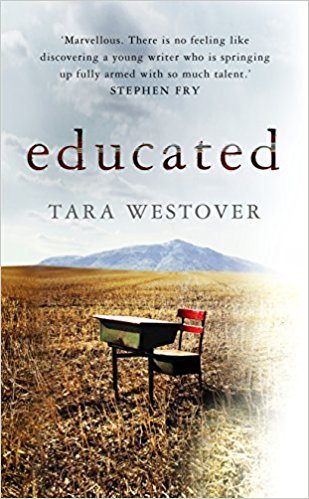
EDUCATED reviewed by Adele Geras


Adele Geras has written many books for children and young adults and six novels for adults, the latest of which is Love or Nearest Offer, published by Quercus in paperback. She’s working on a historical novel for adults. She lives in Cambridge.

The cover of Tara Westover's Educated  is striking. The passage quoted on the back of the book tells you something of what this memoir is about: the author's journey from Idaho to a PhD from Cambridge, a path strewn with astonishing descriptions of life in her extraordinary family. It also demonstrates some of the power of Westover's writing style: plain, sinewy and elegant, all at once. 

You couldn't make it up... that's what people say when what they've read or seen takes them aback to such an extent that they find it an effort to (in another popular form of words) get their heads round it.

I read Educated about two months ago and I'm still thinking about it. It's been universally praised. I predict that it will be on every shortlist it can possibly be on. It will be passed from one friend to another and anyone who reads it will come away moved, touched, horrified and above all knocked sideways by Westover's gift for telling her story in such a powerful and resonant way. She writes most beautifully, with a gift for conveying at the same time the terrible, violent, abusive things that attended her childhood and family life and at the same time, the tenacity of the bonds she feels binding her to her parents and siblings.

She sees them clearly as they are: a man and a woman adhering to a Survivalist Mormon belief so powerful and paranoid that the children are unregistered with school or any other government agency and have spent their entire lives working in their father's scrapyard (with no Health or Safety supervision) or, in the case of the girls, helping with their mother's herbal remedies for family and neighbours. Westover's mother is a self-taught midwife and in thrall to her narcissistic and overbearing husband. Some of her siblings are more sympathetic than others, and one brother is a brutal abuser. The physical harm described in the book is startling and deeply shocking. If this were fiction (you couldn't make it up) your editor would say: you can't put that in your novel. No one would believe it. But it did happen to Westover and how she escaped her family and gained a brilliant PhD from Cambridge University can be seen as an (again, scarcely believable) happy ending.

But Cambridge is not unalloyed bliss. Tara Westover has suffered greatly and hasn't been in contact with most of her family for years.

I finished this book full of admiration for its courageous and hugely talented writer and I hope very much that she finds happiness in her life from now on. I can't wait to read her next book, whatever it turns out to be, and I can safely say that if you start reading Educated, you will not be able to put it down. And you certainly won't be able to forget it.

Educated is published by Hutchinson.

Monday, 23 October 2017

Guest review by Cindy Jefferies: DEAD BABIES AND SEASIDE TOWNS by Alice Jolly


"Jolly’s ability to write about tragedy without making it tragic is extraordinary."


Cindy Jefferies has been writing for for various publishers since 2001, with her Fame School titles being continually in print for over ten years, and translated into 16 languages. In 2016 she was invited to be artistic director of the children’s part of the inaugural Stroud Book Festival in Gloucestershire. Out of that came the idea for a children’s festival, of which she is joint co-ordinator with Rick Vick. She lives in Stroud, and splits her time between writing, festival work, refugee aid and looking after her young granddaughter. She is a member of the Society of Authors and the Scattered Authors' Society. Apart from enjoying a glass of wine with friends she likes parking her mini camper van on the land she owns with her sisters, having a brew-up and enjoying the wildlife.

Profoundly moving, this memoir begins with a traumatic pregnancy and tragic stillbirth. But as Alice Jolly tells us, she has never had much time for the me, me, me, of memoir. This award-winning book, published by Unbound and winner of both the V S Pritchett Award and the PEN Ackerley Award, is many things. It manages to be uplifting and controversial, occasionally funny as well as tragic, and asks at least as many questions as it gives answers.

What is it that drives us on, as human beings? That is the question that remained in my mind when I finished the book. The simple answer is the desire to succeed, but when does that become unreasonable, or foolish? When is it admirable, understandable? Alice Jolly retreated to one seaside town or another, places she describes as the “ultimate act of defiance,” to recuperate between miscarriages. At one point she likens herself and her husband to gamblers. “We have become like gamblers who have lost so much that only a win can save them. Good money after bad.” She tries hard to come to terms with the situation. Unlike so many, they already have one healthy child. Surely they should be happy with that? Perhaps only those who have suffered the loss of a stillborn child will understand, or maybe no one can ever really, at the deepest level, understand what drives another.

At its simplest, this book is about a woman who refuses to accept that her family is complete. But it is also about money. With money, so much more is possible. IVF, donor eggs, adoption, surrogacy. Do these possibilities ameliorate the situation, or make it worse? Other questions arise. Morality, the law, mental health, the impact on others. This is a personal story, but it is also more than that, and I think, an important book. It is, too, beautifully written, honest, and without self pity. I shied away from reading it for a long time because I thought I would find it too emotionally difficult. When I found the courage, my fear was totally unfounded. Not only did the language draw me in, it is also just so darned interesting.

Jolly’s ability to write about tragedy without making it tragic is extraordinary. By managing somehow to stand a little outside her experience she shields the reader, without compromising the truth. This is, perhaps, the writer’s detachment Leonard Woolf describes so well in his autobiography, World Within World. However arrived at, the treatment serves this book exceptionally well. There are thoughts, too about how to process difficulties, and the role of emotional authenticity. Nowadays, “Everybody has to be allowed to feel what they feel, express, process…..But now I begin to realise that there may be events too big to process. Sometimes the only way to survive is to get up and walk on without looking back.”

Alice Jolly surrounds her story with place and time, with just enough detail to make us feel the seasons and years as they pass. Brussels, London and Stroud are all places that have been called home, while the coast is not somewhere to live, but a place to retreat to from time to time. And there is the beautiful house up high in the Cotswolds: a house so draughty that the heating is pointless. The house takes time and energy and emotion while it is renovated, but at last it is beautifully restored, and contains a family that eventually, touchingly, feels complete.

Dead Babies and Seaside Towns is published by Unbound.


Monday, 20 March 2017

THE FACTS OF LIFE by Paula Knight, reviewed by Linda Newbery


"The charm, skill and wit of the drawings, recalling Posy Simmonds, and the cleverness and variety of page design, fully involve the reader in a tale that is very personal but never self-pitying."

Linda Newbery won the Costa Children's Book Prize with Set in Stone, a young adult novel set in Sussex in the late 19th Century. She is the editor of Writers Review.

I don’t have children, and am sometimes expected to account for that to inquisitive strangers. “Oh? Is that from choice, or …?” is a frequent response to what seems to be taken as an admission, rather than a statement, of my childless state. These casual questioners seem unaware that that innocuous “or … ?” might possibly plumb depths of grief or loss (though not in my case) which no stranger has any right to probe. As for the idea of choosing not to have children … such a decision is often viewed as peculiar or selfish. Last year, indiscreet remarks from Andrea Leadsom, then a contender for the Conservative party leadership, prompted explanations from her rival Theresa May about why she’s childless: explanations which no male politician would ever be required to give. Yes, we’re in the 21st Century (where, as Paula Knight points out, the world hardly needs more inhabitants) but still it seems that women are required to be wives and mothers by default; or, if not, to have some good excuse ready for those demanding to know why not. 

The Facts of Life confronts this head on. I met Paula years ago on an Arvon course and have tracked her progress since as a successful illustrator of children’s books.  This is a new departure: a memoir told and shown in versatile comic-strip form. Referring to herself as ‘Polly’, though it’s clearly her own experience she draws on, Paula traces her early and adult years, from her awareness of bodily functions and sex, on through career opportunities, relationships and friends’ pregnancies (exclamations and congratulations followed swiftly by a sense of inadequacy – this shown so neatly in talking heads and speech balloons, no commentary needed) to conception, loss and finally resignation and adaptation. It’s striking how little the Swinging Sixties and the arrival of the contraceptive pill affected the advice given to teenage girls in the 1970s: ‘Polly’, born in 1969, got from parents and teachers the clear expectation that marriage and motherhood were to be her destiny.

Post-viral fatigue syndrome and the break-up of a relationship take Polly into her thirties, when a new man, Jack, offers a new chance. Flexible page layouts animate her dilemma. While an hourglass trickles down the centre of one page, two Pollys face each other from either side: one a paint-spattered artist, the other smugly pregnant, her baby-bulge counterpointing the inward curve of the glass.  On another page, a Janus-headed Polly looks left and right at the pros and cons of being a mother. “’Sometime later’ was here now … “  While examinations and tests continue, a well-meaning acquaintance tells her, “You’ll never know love quite like it unless you have children,“ – a familiar statement that pushes other kinds of love into second or third place. The excitement of conception is followed swiftly by miscarriage, more than once, and we accompany Polly as she cocoons herself against the platitudes offered so kindly by friends. The graphic approach works brilliantly here, as we see her assaulted by music, noise, words and visions. Finally, when the barrage of tests and the whirlwind of expectation and disappointment become too much, Polly and her very supportive Jack begin to examine their future without children.

In one drawing a crack in the wall behind two talking heads widens and splits as Polly counters the assumptions of a former friend preoccupied with childcare. Facing a campaign poster image of the clichéd ‘hardworking families’ beloved of politicians, Polly reflects, “As a person without kids, you must prepare to be effaced in a society where ‘family’ means ‘children’.” But compensations are to be found in the natural world and in new friendships – and, self-evidently, in art. The decision not to persevere is not an ending, but the start of new explorations and a reassessment of values.

There’s quite detailed medical information throughout, but also humour and a light touch. In one drawing, a deceased Polly sits upright in her wicker coffin to ask, “Um, do you have ‘Farewell Regality’ by Rachel Unthank and the Winterset?” If she doesn’t have children, who will be around in her old age to take care of such things? The charm, skill and wit of the drawings, recalling Posy Simmonds, and the cleverness and variety of page design, fully involve the reader in a tale that is very personal but never self-pitying. This is a tricky balance to strike, and Paula Knight is to be congratulated for producing a book which will be of particular value and comfort to people of both genders whose experience is similar to Polly’s and Jack’s, but should also have wider appeal for its insight into the lives of others and for its exploration into the big questions of life: why are we here? What difference can we make in the world? 

The Facts of Life is published by Myriad Editions.