Showing posts with label rock. Show all posts

Monday, 18 March 2024

Guest round-up by Paul Dowswell: HIGH TIMES AND LOW CULTURE, a random selection of rock biographies


"Writers Review usually concerns itself with the classier end of the literary spectrum but on this occasion I’m going to stride manfully into the murky world of the Rock biography ..." 

Paul Dowswell
writes historical fiction and is a frequent visitor to schools, both home and abroad, where he talks about his books and takes creative writing classes. His novels Eleven Eleven and Sektion 20 won the Historical Association Young Quills Award and Ausländer won the Hamelin Associazione Culturale Book Prize and the Trinity Schools Book Award. Recently he has become increasingly concerned about how deranged he looks in Zoom calls.

Writers Review usually concerns itself with the classier end of the literary spectrum but on this occasion I’m going to stride manfully into the murky world of the Rock biography. And not just any rock biography – this last month a friend passed on a random wodge of them when he was having a clear out and it’s these I’ll be writing about as well as mentioning some others by way of comparison. This latest batch have been of variable quality, but good or bad it’s still been fascinating to read them.


Undoubtedly, some rock biogs are terrible. Radio presenter Danny Baker once dismissed David Bowie’s ex-wife Angie’s account of their life together, Backstage Passes, by saying you could open any page and read out any sentence and it would be dreadful. I did just that and came up with ‘Trying to have a relationship with a coke freak is like trying to eat an aircraft carrier.’ But notwithstanding, some rock biogs can be hands-down magnificent. Bob Geldof’s post Live-Aid effort Is that it? brilliantly portrays his early life in the cold-water chill of post-war Ireland and remains interesting when fame kicks in. John Cooper Clarke’s biog I wanna be yours offers the reader a magical picture of childhood in post-war Manchester and only goes off the rails once he becomes famous and, simultaneously, a heroin addict. Here, his unhappy tales of chasing his next fix become dull and repetitive.
 

But for now, let’s get back to this month’s batch:

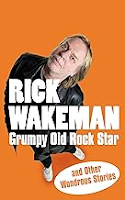
Rick Wakeman's music isn’t my thing but he seems like a genial soul so I've always warmed to him when I’ve seen him on the telly. His book generously credits his ghost writer – something that is not always the case in projects like these - and he quickly establishes his everybloke persona with chapter openers like ‘I love cars. I’ve had a few in my time…’. Alas, I found Grumpy Old Rock Star (Preface, 2009) hard work. On the printed page he comes over like a sozzled but harmless 'I'm mad, me' pub bore who might corner you at the bar. And, good God, his anecdotes are INTERMINABLE. His hearty pub-speak style does grate, and no cliché goes unused. Radio station switchboards ‘light up like a Christmas tree’ when swearing occurs on air, and Rick is living his life ‘on God’s green earth.’ Within are tales of Barry the Perv, Herr Schmitt and Tony ‘Greasy Wop’ Fernandez. Come on, Rick. It’s the 21st Century, not the ‘Hop off you Frogs’ 1980s.
 

Keith Emerson’s Pictures of an Exhibitionist (John Blake Publishing, 2004) is handicapped by the prog keyboard star’s clunky writing style. The book doesn’t credit a ghost writer but you would have thought his editor would have something to say about sentences like ‘From his casual shrug, could I be forgiven my suspicions that a game of deception was being played?’ It’s also rich in muso talk such as ‘By coincidence, Carl’s drum pattern happened to fit a left-handed ostinato figure I was working on…’ But before you know it he’s undermining his role as Prog’s own music professor by regaling us with tales of Emerson, Lake and Palmer sharing a roadside German prostitute.

For anyone who dislikes the prog-rock behemoths (as 1970s rock critics invariably described ELP) there’s plenty here to fuel their prejudice. ‘I’ve got this image of us creating a vast "sheet of sound" that defies conventional structures,’ writes Emerson. ‘There doesn’t appear to be one set time signature or a key structure but the total effect played by the three of us could be very prolific.’ Whimper fearfully and pray for the arrival of punk.
 

Lemmy’s White Line Fever (Simon and Schuster, 2002) is unexpectedly fascinating and he can certainly tell a tale. The Hawkwind and Motörhead bassist, who once said when asked for the secret of his success ‘Just keep going, like Attila the Hun’, is true to his word. Equipped with an iron constitution and an iron will, he burned through 40 years of Motörhead line-ups and died with his boots on a few short years after publication. You suspect, like The Alien, he had acid for blood. Despite his fearsome mien and even more fearsome consumption of amphetamine sulphate, he comes across as quite an old-fashioned and learned sort of chap. He even confesses that his greatest line in describing Motörhead to the world, ‘If we moved in next door your lawn would die,’ was actually nicked from American rock band The MC5. Unlike Rick Wakeman, Lemmy keeps his anecdotes short and to the point and is never less than entertaining. One former manager he describes as ‘a very interesting man… from an anthropological point of view. A complete ******* lunatic.’

Ginger Baker’s Hellraiser (John Blake, 2010) leaves you wondering how he lived so long. His parents’ generation would have called him a tearaway and he was undoubtedly mad, bad and dangerous to know. But among the tales of a decades-long smack habit, multiple infidelities and trying to set fellow band members hair on fire, you can’t help noticing that his daughter Nettie has done a really good job on the ghost writing. 

And to finish, two biogs written by a band accomplice and a journalist respectively, rather than the musicians and their ghost writers. Richard Cole’s Stairway to Heaven (Pocket Books, 1997) and Stephen Davis’s Hammer of the Gods (Pan Books, 2005), both about Led Zeppelin.

The band’s oft told tale reads like a Greek tragedy and by way of comparison, I’d say the best account of them all is undoubtedly Barney Hoskyns’s Trampled Underfoot, where artfully chosen and often quite contractionary quotes illuminate this cautionary tale. (Jimmy Page claims his drug use never affected his playing. The rest of the world disagree.) As a rule of thumb you can tell how crappy a Led Zeppelin biog writer is by the ease and frequency in which they resort to aerial metaphors to describe the ‘flight’ and ‘crash landing’ of the Leds. Hoskyns doesn’t do this and his is a sad and sorry tale which also leaves you in awe of their extraordinary talents and multi-faceted music.

So, what of these two aforementioned accounts? Richard Cole, who was the band’s road manager throughout their 12-year existence, tells a weary tale, from the stale, obvious title onwards. His is a book of paint-peelingly sordid revelations, made even more distasteful by Cole’s corrosive misogyny. If you have pearls, prepare to clutch them. It’s like eavesdropping on the Russian Mafia drunkenly guffawing about how badly they treat the local prostitutes. On one occasion, for example, Cole persuades a gaggle of thirteen and fourteen year old girls to join the group on their private plane at Los Angeles airport. When the plane unexpectedly takes off for New York, the girls become distressed when they realise how much trouble they’re going to get into with their parents, who they probably told they were going to a sleepover with school friends. What larks.


 Stephen Davis’s Hammer of the Gods is also a hair-raising expose of rock piggishness both within the group and their piratical road crew. Herein lurk tales of underage groupies, medieval brutality and Olympic-standard drug use.

But let's not end on such a negative note. Like Hoskyns, Davis loves the Leds. He even sings the praises of their underwhelming In Through the Out Door album, the last they made before their fearsome drummer, John ‘The Beast’ Bonham drank himself to death (48 vodkas, apparently…). Davis is an educated, erudite guide, quoting Primo Levi and snippets of Anglo-Saxon literature and while Cole’s book is a sordid swank along a very seedy avenue, Davis clearly revers his subjects, and finishes his book with a vivid and moving pilgrimage to John Bonham’s grave.

Monday, 2 August 2021

Guest review by Keith Gray: SING BACKWARDS AND WEEP by Mark Lanegan


"One of the pleasures of the book is witnessing his passion for his unrealised talent as a singer-songwriter develop, despite his horrific addiction to drugs and alcohol..."

Keith Gray is best known for his novels for children and teenagers including Ostrich Boys, which was shortlisted for both the Carnegie Medal and the Costa Children’s Book Award and was successfully adapted for the stage. His latest book for teenagers is The Climbers, published by Barrington Stoke. Keith lives with his family in Vienna, Austria, where he co-founded the not-for-profit writer development community Sunday Writers’ Club. www.sundaywritersclub.com

Grunge and the 90’s Seattle music scene was part of the soundtrack of my youth. Albums by Pearl Jam, Stone Temple Pilots, Soundgarden and, of course, Nirvana were forever grinding their way through the headphones of my CD Walkman. I was never a particular fan of the Mark Lanegan fronted Screaming Trees, however. But looking back I don’t feel I missed out. Especially not now I’ve discovered Lanegan himself was embarrassed by the songs he sang and felt utter disdain for his bandmates.

One of the surprises of Lanegan’s autobiography is that music wasn’t a life-long passion. This is the singer who’s orbited grunge music before, during and after it was popular. He befriended and dealt drugs to many of its major stars, and nowadays is regarded as a cult figure, heavily influential and acclaimed as a great collaborator with other artists across several musical genres. Yet he starts his story by describing how he stumbled into Screaming Trees half-heartedly as a teenager in the 80s, without any real aptitude or ambition. He hoped being part of the band would be an escape from the ranching town of Ellensburg in Washington State where he hated growing up and where he’d already accrued a handful of petty criminal convictions. A hefty chunk of the word count here is dedicated to his dislike for his bandmates and their songs. But I guess you could say he learned on the job. One of the pleasures of the book is witnessing his passion for his unrealised talent as a singer-songwriter develop, despite his horrific addiction to drugs and alcohol.

Be aware, it’s one of the few ‘pleasures’ of reading Lanegan’s story. The book roughly encompasses the lifespan of Screaming Trees (1985-2000) who turn out to be also-rans within the grunge scene but whose biggest draw was Lanegan’s distinctive vocals. The details are in the performing, touring, incessant arguing and monstrous drug consumption.

The main interest for casual readers will be Lanegan’s friendship with Kurt Cobain but Cobain’s death and Lanegan’s proximity to it is neither the most revelatory nor poignant recollection. Lanegan’s 90’s were not just a car-crash but a pile-up of sex, drugs, drugs, DRUGS and rock ‘n’roll. So much so that the reader feels like a rubber-necker at many shocking anecdotes. Perhaps too many shocking anecdotes? I stopped feeling surprised by the lengths (or depths) Lanegan would go to to find his next fix about halfway into the book. I hung around hoping for more music. I wished there was more music. Although I was never a fan of Screaming Trees, Lanegan’s solo albums and his work with Queens of the Stone Age has been (to my ears) exceptional. But did he need to go through those years as a criminal, a cheat, a liar, a junkie to be able to create such incredible music? Is his songwriting so powerful because he’s been to those dark, dark places many of us can only imagine?

It’s a well written book of no-nonsense muscular sentences. There’s nothing shiny or pretty here. It’s bluntness helps keep much of the emotion or contemplation at arm’s length – which is a surprise if you’re familiar with Lanegan’s lyrical prowess. Yet maybe that’s the point: Lanegan wants to settle scores and tell truths, he’s not here to whine.

There are some lighter (or perhaps slightly less dark) moments. OnThe e of the most publicised is his encounter with Liam Gallagher of Oasis. But these are few and far between and Lanegan was around for the untimely deaths of his beloved friends Cobain, Layne Staley (Alice in Chains) and Kirsten Pfaff (Hole) among others. There is a note of epiphany and hope in the closing pages, dated around about 2002, but it’s still mind-blowing how Lanegan survived his personal addictions and continues to make great music today.

Lanegan’s been praised for his unflinching honesty and he portrays himself as a spiteful perfectionist bearing venomous grudges. He teeters precariously between powerful creativity, utter hopelessness and spiralling self-destruction. Often all within a single day. He either adores people or he loathes them – there’s no room for middle ground. And it’s a rock solid fact that the people he loathed won’t enjoy his book. Not that he’ll give a damn. He’s written his story exactly the way he wanted to.

Sing Backwards and Weep is published by White Rabbit.

See also: Haddon Hall: When David Invented Bowie by Najib, reviewed by Paul Magrs


The Dark Stuff by Nick Kent, reviewed by Paul Dowswell


Monday, 11 September 2017

Guest review by Paul Magrs: HADDON HALL - WHEN DAVID INVENTED BOWIE by Nejib


"The realization that your glory years can sometimes be quite short ones – ‘this enchanted interlude in my peaceful life as a house lasted for only two springs’ – is, I think, the most important part of this glittering tale."


Paul Magrs lives and writes in Manchester. In a twenty-odd year writing career he has published novels in every genre from Literary to Gothic Mystery to Science Fiction for adults and young adults. His most recent books are The Martian Girl (Firefly Press), Fellowship of Ink (Snow Books) and The Christmas Box (Obverse Books.) Over the years he has contributed many times to the Doctor Who books and audio series. He has taught Creative Writing at both the University of East Anglia and Manchester Metropolitan University, and now writes full time.

One of the reasons I love graphic novels is that they feel like someone has taken hold of a conventional novel and given it a bloody good shake. All the redundant words and phrases and padding and fluff and – especially – all the descriptions have simply fallen out. Leaving lots of lovely empty space.

In ‘Haddon Hall’ – a fabular, fabulous account of David Bowie’s rise to fame as Ziggy Stardust by French-Tunisian artist, Nejib – there’s lots of that lovely space. The pages are organized less like a traditional comic strip than they are a child’s picture book of the era he’s conjuring. There’s just a touch of the Babapapa books created by Annette Tison and Talus Taylor in this tale of the strange menagerie that Bowie gathered about him in 1970. Both narratives tell of polymorphous and perverse other-worldly beings who live in heterogenous harmony inside a home perfectly attuned to their needs.

The story goes like this: one-hit wonder David and his kooky American wife Angie find a dilapidated Victorian mansion in London where they can live out their fantasy of being bohemian aristocrats, throwing open their doors to other experimental souls. Guitarists, poets and cats come slinking through the massive, messy rooms and there are orgies and dinner parties and music festivals galore. It’s a utopian period that Bowie himself captures so brilliantly in those early records. It’s a strange thing: to have these sketchy, sometimes rudimentary figures evoking the time, place and even the music so beautifully. Dream sequences and drug hazes spiral off the page. Flashbacks drain the pages of colour, as we visit David’s youth and his brother’s first schizophrenic episode. Mostly, though, the pages are drenched in the gorgeous, hot pinks and oranges of a lost era.

There are cameos from other icons: Marc Bolan wanders through, full of envy and ambition, pipping Bowie to the post when it comes to getting onto Top of the Pops. Lennon glides through the tale in his limousine, lecturing Bowie on the awfulness of pop fame and how it conflicts with art (‘Look, David. I was at dinner last night with Stockhausen and Nabokov…’) They sit together by the river and the world about them becomes scratchier and darker as Lennon explains how isolating stardom is. And then, when David gives sanctuary to his troubled brother, he also rescues the equally-doomed Syd Barrett, of Pink Floyd fame. As a Bowieologist I know pointed out – this never actually happened. But that doesn’t matter. It should have happened and this queer reimagining of the past installs poor Syd under David and Angie’s wings for a little while.

Best of all, perhaps, is the fact that the whole story is narrated by the house itself. Haddon Hall has lain neglected for years and it talks to us directly of its delight when this strange young couple first came to look inside its doors. (‘I didn’t understand them, but already I loved them.’) The grand old nineteenth century pile has a final flourishing of life, thanks to the hippies and the glam rockers who come to make all kinds of music and love inside its walls.

The curling, sprawling, art nouveau fronds and vines and petals that scroll through the pages like flowery doodles look just like exotic plants pushing their glorious way inside a derelict building. The most wonderful moment of all comes, perhaps, as David writes his opus, ‘Life on Mars?’ – and has his turning point – slaving over his upright piano, ignoring the stacked-up meals Angie brings him (‘You have to eat, sweetie…’), smoking endless cigarettes as he plonks away. It takes a whole page of repetitious images – a Warholian frieze of tinkering, tinkling Bowies - until he hits his perfect tune and the song finally comes together. Visually this is rendered as more of those wonderful, spiraling plants, emerging from the lid of his piano, blowing trumpeting, blaring colour back to the story. It’s a fantastic moment – and distils the creative process into one gorgeous double page spread.

I’ve made it sound too straightforward and twee, perhaps. There are complications aplenty, and some wonderful moments of darkness. It’s a book about imagining your own kind of life and inventing it around you, but it’s cognisant of the pitfalls. Mad brother Terry is always there – pursued by the horrifying, phantom shapes of his affliction. Angie’s hopeless auditions and sheer lack of natural talent make our hearts go out to her, even as she tries her best to shine. Bowie himself is riven and eaten up with his desire to make a breakthrough both artistic and commercial. He almost despairs; he almost gives up. But he’s resilient and endlessly creative – and that’s what this book celebrates so fantastically. Even the frightening bits – the turbulent flights of fancy and the monochrome doldrums - are worth dragging yourself through.

The book leaves him with a new hairdo (clip, clip clip: Angie chops his locks into a spiky, Heinz-red cut) and on the brink of massive fame. ‘On that day, David was finally avant-garde.’ It will also mean the breaking-up of the happy home, and already the commune’s members are going their own ways. Haddon Hall looks back on relinquishing its magical grip on its inhabitants and the story ends softly, and sweetly, with the narrator knowing that its best years are over, just as its friends’ are about to begin. The realization that your glory years can sometimes be quite short ones – ‘this enchanted interlude in my peaceful life as a house lasted for only two springs’ – is, I think, the most important part of this glittering tale.

Haddon Hall is published by Selfmadehero, 2017