Showing posts with label animals. Show all posts

Monday, 7 September 2026

Special feature Q&A: John Ironmonger on THE ANGEL OF ST PIRAN


"Dr Kat Hoobaiter has documented a repertoire of around 80 distinct chimpanzee gestures, showing how apes use them intentionally. It isn’t a huge leap from here to the apes in The Angel of St Piran."

Stephen Joseph Photography
John Ironmonger
was born and brought up in Kenya and took a degree in zoology, followed by a PhD on the ecology of freshwater leeches. His first novel, The Notable Brain of Maximilian Ponder, was shortlisted for the Costa First Novel Award in 2012. His novel Not Forgetting the Whale (also known as The Whale at the End of the World) was an international bestseller. His new novel, The Angel of St Piran, is published this week by Fly on the Wall Press.

John answers questions from Linda Newbery.

Linda: First, congratulations on the publication of The Angel of St Piran. I’ve read an advance copy – it’s based on a striking but certainly not implausible concept, that chimpanzees and humans can communicate verbally, and is very topical with its focus on trophy hunting, as well as being a gripping page-turner.

With your background in zoology, it’s not surprising that animals – and human interactions with animals – are the foundation of much of your fiction. Did you have a career in zoology before turning to writing fiction?

John: Ahh … only very briefly. I worked for three years as a research assistant in Liverpool looking at freshwater leeches, and afterwards I travelled with my wife Sue to Nigeria to lecture in zoology at a new university in the north of the country; but for a whole host of reasons the job didn’t work out and we came back to England. After that I went to work in the IT industry and there I stayed until I started to sell books.

Linda: You came relatively late to writing fiction – what prompted that?

John: I really didn’t come late to writing – I just came late to being published. I’ve been writing fiction since my teens, and over the years I wrote several novels and quite a few that were never finished. I never had much confidence in my skills as a writer, so no one ever read these early stories, and now all are lost forever; this is probably a good thing though because I’m sure they were terrible. But it was a good way to learn the craft.

Linda: Clearly the ground-breaking work of the late Jane Goodall, living and making relationships with chimpanzees, was one of the inspirations for your novel, as you acknowledge in the afternotes. I’ve read of other recent advances, too, in our understanding of how various animals communicate – whales, apes, birds. Is this a field you’ve worked in, professionally or otherwise?

John: As a teenager I worked one long vacation at a research station in Tsavo National Park, Kenya, on a project tracking family groups of elephants in the reserve. It wasn’t intentionally focussed on animal communication, but it was a fascinating introduction to fieldwork. We would often remark to each other that the elephants seemed to communicate. We simply didn’t know how. At university, Jane Goodall’s book ‘In the Shadow of Man,’ was one of our set books. I was gripped by it. I had seen chimps in Uganda, but I had never heard of a researcher living with the apes. It struck me then (and still does now) as an extraordinarily courageous and exciting thing to do. I often thought of it as potential material for a novel. Since Jane Goodall’s work other researchers have pushed forward our understanding of chimpanzee communication. Most recently Dr Kat Hoobaiter from Stirling University, working with chimpanzees in Uganda, has documented a repertoire of around 80 distinct chimpanzee gestures, showing how apes use them intentionally. It isn’t a huge leap from here to the apes in The Angel of St Piran.

Linda: Many of us are revolted by photographs of trophy-hunters posing with their kills, but often this is countered by the idea that managed trophy-hunting can benefit habitats, animal populations and local communities. What’s your view of this argument?

John: Any activity that revels in the killing of a wild animal is morally indefensible in my view. I know trophy hunters will claim to be conservationists, but I don’t accept this for one moment. It is a baseless smoke-screen for their blood lust. Local communities earn almost nothing from hunting, despite the high fees charged by operators. There is far more sustainable income from wildlife tourism. And trophy hunters shoot the largest, strongest, and most reproductively important animals. If trophy hunters were conservationists they would swap their rifles for cameras and become wildlife photographers. But they are too slow witted to handle a camera, and they are too vain to indulge in an activity where they don’t get to appear in the photograph.

Linda: Although the setting for this novel is mainly a Tanzanian island, some sections take place in Cornwall, and two earlier novels, Not Forgetting the Whale and The Wager and the Bear, are set there too. You live in Cheshire now, but do you have links to Cornwall?

John: My mother was Cornish. She grew up in the seaside village of Mevagissey. When I was 17 my parents decided to retire to Mevagissey from our home in Nairobi. They bought the village shop, and I found myself reluctantly dropped into this little isolated community far from anywhere. I hated it. But only for a very short while. Unexpectedly I grew to love it, and for years I wanted to write about it. The village of St Piran in my novels is loosely based on my memories of Mevagissey. It turns out to be a location full of interesting people, with fascinating stories to tell. I’ve used it in three novels so far. As for my links to Cornwall, I still have cousins there, and I still visit when I can. Never often enough, of course.

Linda: Fly on the Wall Press sounds like an interesting independent publisher. How did you come to be published by them – and are there plans for more books?

John: I don’t have a short answer to this question I’m afraid. Can I get away with saying that Orion Books and I parted company after a novel of mine failed to set the world alight. Which was a shame because it was my personal favourite. But it launched when the bookshops were closed during Covid, and big publishers have algorithms that don’t take account of these things. The up-side was that I discovered Fly on the Wall, a small indie with loads of energy that punches way above its weight, and this is where I want to stay. If they’ll have me.

Linda: Your first published book was a non-fiction title, The Good Zoo Guide, published in 1994. Have you any plans to update it? Since writing it, have your views on keeping animals in captivity changed at all? Do you think public attitudes to captive animals, not just in zoos but in dolphinariums and other tourist attractions, are changing?

John: The thought of updating The Good Zoo Guide gives me heart palpitations. It was so much work. I had to visit around 150 zoos, aquariums, bird gardens, safari parks and some grim menageries, and once done, I re-visited the top fifty … twice. It was exhausting. After the book was published it was about ten years before I went back to a zoo. I don’t disapprove of zoos. I would say instead that I really like good zoos and I hate bad ones. There are some animals that, in my view, should never be kept in captivity - like dolphins, polar bears, and whales … but there are many others that can be kept in high welfare habitats, and there are plenty of species that actively need a reservoir of individuals in safe captive conditions because they really aren’t safe in the wild. Public attitudes have certainly changed. The small cages and the city zoos that were popular fifty years ago have almost all been replaced by spacious, out-of-town zoos and specialist collections. And that’s a good thing. So now I visit zoos occasionally. But I’m particular about the zoos I visit.


Linda: Two of your titles, The Year of the Dugong and The Wager and the Bear, could be described as ‘cli-fi’. When writing about animals in particular, the impacts of climate change and nature loss are hard to ignore. Do you think fiction can help to raise awareness and inspire change?

John: I hope fiction can change minds, but I worry that the impact is only marginal. The scale of the climate threat is far beyond any crisis that mankind has ever faced. The changes we are making to our climate are irreversible, and catastrophic. I don’t know how we convince a sceptical political class and an apathetic electorate that we need to act decisively and massively if we are to slow down and maybe halt the damage we are doing. But fiction is all I know, so it is my way of railing against fossil fuel apologists and the forces of climate denial.

Linda: Your books have had impressive reach, being recognised in awards and translated into fifteen languages. Has this, and your zoological background, led to opportunities to take part in animal advocacy?

John: I am very lucky to have been able to reach a wide audience, and I am so grateful to all those publishers around the world who have believed in my books. To be honest it hasn’t led to any particular advocacy opportunities, although I know from my email inbox that readers have been inspired by the stories.

Linda: It’s easy to feel despair when we read about the sheer scale of animal cruelty, on farms, in laboratories, in wildlife crime and in entertainment. But do you see hope for a more compassionate future, and if so, where?

John: Without a doubt we are all much more aware of animal cruelty now than we ever were. Public attitudes have undergone a generational shift. Across the world, people now speak openly about animal sentience, suffering, and rights in a way that would have been fringe even 20 years ago. Factory farming is increasingly seen as ethically indefensible. Cosmetic testing on animals has become socially unacceptable. Circuses no longer keep elephants or lions. No one goes to bull fights when they visit Spain. Catwalk models no longer wear furs. So I do see good reasons for hope. And I applaud people who name and shame trophy hunters online. It is one of the last bastions of animal cruelty.

Linda: Finally, can you give us some recommendations – either of cli-fi novels, or of books that increase our understanding of animals?

John: I’m going to recommend two books that I read this year, although I realise as I say this that both deal with animal extinction. Beasts of the Sea by Ida Turpeinen is a novel that traces the discovery, exploitation, and eventual extinction of a marine mammal known as ‘Steller’s Sea Cow.’ It is a beautiful, lyrical book – translated from Finnish, and it has profound lessons for us on the way we treat the natural world. Today, I’m halfway through reading The Last of its Kind, by Gisli Palsson – a nonfiction book and an impressive piece of scholarship, about the search for the Great Auk – a bird they used to call the ‘northern penguin,’ and how the disappearance of this bird led to the first awakening in the public mind of the reality and finality of extinction.

Linda: Thank you, John. We at Writers Review wish you every success for The Angel of St Piran.  

The Angel of St Piran is published by Fly on the Wall Press

Monday, 30 June 2025

LOST ANIMALS, DISAPPEARING WORLDS - STORIES OF EXTINCTIONS by Barbara Allen, reviewed by Linda Newbery


"Allen says that she wrote this book 'accompanied by many tears', but warns that it is too easy to judge the generations that came before us, while our own shows equal carelessness."

Linda Newbery
edits Writers Review. Her latest novel for adults is The One True Thing.
Mention extinction, and the first animals that come to most people's minds will be dinosaurs, followed by the iconic dodo, woolly mammoth and sabre-toothed tiger. Barbara Allen's book ranges more widely, taking in a number of creatures I (and probably you) had never heard of, and moving closer to the present day, to species whose demise is most definitely down to human activity. Inevitably a sad compilation, it's informative and engaging too, largely thanks to the author's device of giving a 'voice' to a member of each vanished species. Most famous of these is 'Lonesome George', the Pinta Island tortoise who died in 2012 at about a hundred and ten years old - like other animals here he was an 'endling', the poignant term for a lone survivor destined to die unmated and as the last recorded individual of its species.

In the opening, Barbara Allen, a minister in the Uniting Church in Australia, speculates about why she's included some animals rather than others - for example two of those I've just mentioned, the woolly mammoth and sabre-toothed tiger, don't appear here. "What I do know," she acknowledges, "is that no book, with one exception, can contain stories about every extinct species; the only volume that can, and does, cradle those sad tales close to its heart, its core, is Earth." 

The concept of extinction was first used in 1796 by the French naturalist Georges Cuvier, who spoke of animals living in "a world previous to ours". The religious establishment was affronted by this, just as it was sixty years later by the publication of Darwin's On the Origin of Species. We now know that extinctions are caused both by cataclysmic events such as asteroid strikes or volcanic eruptions and by more gradual changes such as pollution, competition for food or shelter, and habitat loss. But how can we know when a species truly is extinct? The IUCN (International Union for the Conservation of Nature) is the global authority, categorising a species as extinct if no sightings have been reported for fifty years - though there are sometimes comebacks from 'Lazarus' species such as the coelacanth, which until 1938 had been known only as a fossil. But it's sobering to note that 41% of amphibians, 27 per cent of mammals and 13% of birds are currently threatened with extinction. More optimistically, the IUCN's Green List analyses conservation efforts and their impact on species recovery.

Allen also writes about 'de-extinction' or 'resurrection science', and how this could be done through cloning and genetic engineering; but she examines the ethics of this, how feasibly it can be done, the effects on other species if, say, mammoths were reintroduced to the Arctic tundra, and whether hubris might result in humans thinking that by 'tinkering' they could do better than nature. And, as she points out, "If we think we can 'replace' a species, then apathy may set in, making us less inclined to protect others."

In the midst of the sixth mass extinction, or Holocene extinction, many of us experience the ecological grief referred to by the American conservationist Aldo Leopold when he wrote of the 'world of wounds' experienced by those who care and learn about the natural world. Allen wonders how best to 'memorialise' the lost creatures, recognising that each led its individual life and was not just a representative of its species. She describes the huge 'Lost Birds' sculptures of Todd McGrain: the passenger pigeon, the Carolina parakeet, the great auk, the heath hen and the Labrador duck, each sculpture positioned, where possible, at the site where the last known individual was shot or sighted. As McGrain says, "at those places haunted by what is missing". Some of the creatures in this book are illustrated with drawings, others by sad photographs of an animal alive or preserved: Qi Qi, the world's only captive Yangtze river dolphin; the Xerces blue butterfly; a stuffed ivory-billed woodpecker; a solitary Quagga in a cage in London Zoo.

Allen's own approach is to give an individual of each species a character and allow it to 'speak' to us, in tones of outrage, resignation, boastfulness or accusation. The Dodo, for example, introduces itself: "What a stupid name! Sets me up as a thing of ridicule; if one is not accorded respect, it is easier to kill ... some individuals in the past and in the present have found it had to believe that I was real, that I was not a made-up character for Alice's Adventures in Wonderland. I wonder when children realize that I was factual, real, rather than a creature of legend or fantasy? But fantasy doesn't exist and now neither do we." The Spectacled Cormorant, which inhabited Bering Island, complains that "Less than a century after we had been 'discovered', we were extinct" - thanks to its short wings and lack of suspicion of humans.

It's hard to comprehend how the once so numerous passenger pigeon could have been allowed to become extinct. The acclaimed bird artist John James Audubon wrote in the 1930s that when a flock passed over "the light of noonday was obscured as by an eclipse". (The book's cover shows a version of his painting of these pigeons, with the birds as blank silhouettes.) A flight of the massed birds could take three days to pass. Of course, they consumed grain and damaged trees and were not beloved by farmers, so they were shot in their thousands, sometimes as part of organised competitions. Forest depletion also led to a reduction in their numbers; efforts to save them came too late. The last known bird, Martha, died in 1914 at Cincinatti Zoo. 

Allen says that she wrote this book "accompanied by many tears". but warns that it is too easy to judge the generations that came before us, while our own shows equal carelessness. The penultimate chapter has the Bramble Cay Melomys, a rodent inhabitant of Papua New Guinea, lamenting as the tides rise higher that humans destroyed it: "not face to face but, rather, through greed, or ignorance, or indifference ... or apathy". Snails, small rodents and amphibians don't attract the attention given to polar bears or snow leopards, but their loss is just as significant as that of the bigger, more iconic species.

It could be argued that the fate of most species on Earth is to become extinct in time, but human activity has produced a current rate of loss estimated to be between 100 and 1000 times the rate of natural background extinction. Allen's book doesn't include any British species, but the recent State of Nature report found that an alarming one in six species, including the once-familiar water voles, hazel dormice and turtle doves, are at risk because of farming activity, pesticide use and habitat loss.

"May we endeavour," Allen concludes, "to add as few names and pages as possible to this book of extinction." Amen to that.

Lost Animals, Disappearing Worlds is published by Reaktion Books


Sightlines by Kathleen Jamie, reviewed by Sue Purkiss


Sarn Helen, a Journey through Wales, Past, Present and Future, by Tom Bullough, reviewed by Alison Layland

Monday, 13 March 2023

Guest review by Penny Dolan: HORSE by Geraldine Brooks


"Her historical and geographical settings feel convincingly well-researched, whether she is describing families and their great estates, life on the Mississippi or the horrors of the American civil war."

Penny Dolan
works as a children’s storyteller and writer. Her last novel for older children, A Boy Called Mouse, was nominated for the Young Quills Historical Fiction Award, and she is currently completing a companion book. As well as being a regular reviewer here, she posts on The History Girls, on An Awfully Big Blog Adventure and can be found on Twitter @PennyDolan1.


Horse,
by Geraldine Brooks, a Pulitzer winning novelist, appeared on my book group’s reading list. Its nomination by a member who, to our surprise, is a part-owner of a racehorse, gave Horse strong equestrian support. Additionally, when our local library supplied not four but eight new hardback copies, it was clear that somewhere in the county was a librarian who thought the novel worth purchasing. But was it worth reading? Here are my thoughts.

Brooks’ wide-ranging novel is spread between three American centuries, being a narrative about the early growth of horse-racing and about the meanings within that word “race”. Horse revolves around three specific ideas: a bay foal that became a prize-winning stallion, a lost equine portrait and a skeleton stored within the Smithsonian Museum.

The cover design gives a glimpse at an old painting which reveals a formally dressed black groom holding the rein of a tall brown horse and a black jockey in the coloured silks of the 1850s. Both men appear wary about being “uncovered”. This groom and the bay horse form the core of Brooks’ novel.

When the reader first meets Jarrett, he is an enslaved boy, working beside his father in the stables of a rich Kentucky landowner. After forming a deep bond with the new-born foal named Darley, Jarrett stays close to the creature during its early years. When the colt, re-named Lexington, passes to another landowner, Jarrett follows.

We see that his life is clearly easier than that of black slaves out in the fields. Jarrett is clothed, fed and treated well, principally because of his value to Lexington. Yet both are at the mercy of the wealth, whims and promises of their owners. For example, although gambler and race-course owner Ten Broek had given his word that Lexington would never be whipped, as soon as he has starts promoting timed, high-stakes races on his track, that promise gets forgotten:

Jarrett ‘could see the horse’s flanks heaving in obvious distress. He turned on (the jockey) Meichon. “What were you rowling him for?” he cried. “You could see it wasn’t in him.”

Meichon looked defiant. “Marse Ten Broek say I ‘ave to ride ‘ard. I think – they say – he ‘as bet against us so ‘e want no person to say he cheat.”

Jarrett threw his head back and cursed the sky.’

Even as Jarrett curses, he knows that challenging the master’s actions could mean being sent out to work in the fields or sold.

Moreover, throughout the book, Brooks emphasises his situation as evident in her chapter headings: at first he is Warfield’s Jarrett, then Ten Broek’s Jarrett and finally Alexander’s Jarrett. He is a man without independence.

Around this historical core, Brooks wraps a contemporary tale about two academics meeting in Washington in 2019. Jess, an Australian, and interested in bones since childhood, is an anthropologist and Smithsonian scholar. who starts to study a forgotten equine skeleton to discover more about the horse’s identity and power of endurance. Theo, an Afro-American art historian, is studying the role of Black men during the early years of horse-racing. When an energetic dog brings the pair together, their quest leads them through all the hidden archives of the Institute. However, their deepening relationship also emphasises social pressures within modern America and the insidious influence of prejudice.

The third thread in the novel lies in that mysterious painting partly seen on the cover. An early character, Thomas J. Scott, is a racing journalist and a hopeful equine portraitist. As he paints Dr Warfield’s horses, he notices how helpful and sensitive the boy is, and does something kind.

“I remembered I’d promised him a painting . . . and as sometimes happens when the stakes are small, the painting came together with an uncommon felicity. I captured the light on that rich bay coat and the intelligent look in the eye. I considered keeping the piece myself. I was glad in the end that I did not, when I saw the look of joy on the boy’s face. It occurred to me then his condition afforded him few possessions he might claim as his own.”

Scott’s painting passes through Jarrett’s family until, in 1954 it becomes the property of Martha Jackson, a New York gallery owner who exhibits bold modern paintings. She has her own secret reason for keeping the small portrait which, in due time, will unlock the equine mystery for Jess and Theo, and act as part of the powerful ending.

Knowing little about gambling or horse racing before reading Horse, I had not realised that equine paintings, such as Stubbs' famous “Whistlejacket”, are an aspect of the business of horse-breeding and were adverts promoting the best bloodlines.

Perhaps, because there are more passionate and personal novels that give a voice to the life on the plantations, Horse does not attempt to offer the reader a close inner experience. Brooks, as a white woman novelist, writes with a distanced third person narrative voice which allows her to expand her themes and also allows her concluding chapters to stand out clearly. In addition, her historical and geographical settings feel convincingly well-researched, whether she is describing families and their great estates, life on the Mississippi or the horrors of the American civil war. I appreciated the contrast between Jarrett’s time, the easy academic life within the museums and galleries and the edgy emotions within Jackson Pollock and the art scene of 50’s New York.

While I did not entirely love Horse, I did love Jarrett as a character, and I enjoyed the care and balance within Brook’s storytelling. I welcomed the world that the novel introduced me to, and the strength of its still-relevant messages. Yes: well worth the read.

Horse is published by Little, Brown.

Monday, 21 February 2022

Guest review by Cindy Jefferies: THE WOLF BORDER by Sarah Hall


"She’s the real deal, and I really shouldn’t be admitting to not knowing her work until now!"


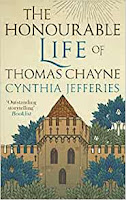
First published in 2001 for children, Cindy Jefferies found success with her Fame School series with Usborne Books, obtaining 22 foreign rights deals. Latterly writing fiction for adults as Cynthia Jefferies, her first title The Outrageous Fortune of Abel Morgan was published in 2018, followed a year later by The Honourable Life of Thomas Chayne, set during the English Civil Wars, followed in 2019. Both titles are now available in paperback.

I came to read Sarah Hall by way of a friend who recommended her. Hall is a multi award winner, including being shortlisted for the Man Booker twice so far. Surely she’ll win it one day. Why on earth hadn’t I come across her before? But I hadn’t, now I have and am eternally grateful to Claire, who put me right.

I like to support my local library, which is only a few yards away from my house. I love the randomness of what’s in and what’s out. The only Sarah Hall when I looked online was The Wolf Border, published in 2015, so that’s what I picked up. But I have lots more treats in store. She has now written six novels, and several collections of short stories. Apparently she started her writing career by publishing poetry in literary magazines. Of course she did. She’s the real deal, and I really shouldn’t be admitting to not knowing her work until now!

So to The Wolf Border. I love reading about wolves, and I do enjoy a good plot. When you add in wonderful descriptions of landscape, well researched human and wolf biology and superlative phrases I had to read again, either for the pure poetry, or for the wisdom within them … well! Finding everything in one novel is rare. They don’t come along every day. Unputdownable can also mean so plot-driven that you’re left gasping but ultimately unfulfilled. Literary can mean difficult. Not here.

Rachel is an expert on wolves. She lives on a reservation in Idaho, protecting the wolves in her care. She has a good team. She has a few friends, and brief affairs with men. Her upbringing in Cumbria was unusual, her mother not easy to love, or even to like. She has very little contact with mother or brother. Perhaps she is something of a lone wolf, but that’s too easy. Life isn’t that simple, and Hall writes real, complex characters, easy to believe in.

When Rachel goes back to Cumbria after several years away it is to visit her mother, who is dying, and to meet a landowner who has a plan to introduce wolves back into the UK. He has a vast estate, friends in high places, and the money to invest in the project. Rachel doesn’t think much of Thomas the earl, but the idea is intriguing, and the land reasonably suitable. The space the pair would have while in quarantine is generous, and eventual release into a huge area, though not as good as being totally wild, is close to the next best thing. There are too many deer on the estate and it is clear that the wolves would be self-sustaining and would improve the environment in several ways.

Hall doesn’t shy away from the complexities of making such a project happen. There would be opposition and encouragement both locally and more widely. The high salary Rachel is offered isn’t the thing that sways her. It’s the possibility of making it work. Yes, they would still be captive, but the amount of land they would have would enable them to live their own lives, naturally. Hunting their own food, and maybe, one day raising their own young. She takes the job, but has unwittingly brought something with her from Idaho which will have a profound effect on her life in England.

Thank you, Sarah Hall, for a thoroughly enjoyable and thought provoking novel. My next trip will be to the bookshop for your latest!

The Wolf Border is published by Faber.

Here is a Q&A with Cynthia (Cindy) Jefferies on her novel set during the Civil War, The Honourable Life of Thomas Chayne.


Sunday, 7 June 2020

Special feature: Q&A with garden designer Cleve West on THE GARDEN OF VEGAN


"It’s not a subject you can really ignore any more, especially now mainstream media is making the connection between animal agriculture and climate change, not to mention the link with pandemics."

Photograph by Chaz Oldham
Cleve West is a highly-regarded garden designer, with six Chelsea gold medals and two Best Show Garden awards to his credit. Recent projects include his Horatio's Garden for Salisbury Hospital's Spinal Treatment Centre (the first of several, all by leading designers) and work with primary school children, bringing them to his own allotment and helping them to set up gardens at their schools. He is a passionate advocate for animals and a committed vegan, both of which inform his gardening practice. The Garden of Vegan covers a wide range of subjects: personal reflections, sustainable gardening and farming, ecosystems, animal abuse, the nutritional and environmental advantages of a plant-based diet, and even his own recipes. As well as photographic illustrations the book includes poignant portraits drawn by Cleve's wife, artist and printmaker Christine Eatwell, of animals photographed as they await slaughter.

Cleve West answers questions from Linda Newbery.

Find out more about Cleve's work and campaigns from his website, and on social media: Twitter @clevewest Facebook Cleve West and Instagram cleve_west


LN: You've been well known for years as a top garden designer. Now it seems from your social media activity that your animal advocacy and championing of the vegan lifestyle have become at least as important as your design career, if not more so. What triggered that change?

Cleve West: It was the shock of seeing the horrors of animal agriculture and the damage it’s doing to our health and the environment. Not speaking out about it felt like complicity. I spent a lot of time wondering whether I should use different social media platforms to keep my advocacy for animals separate from work, but that felt like an apologist approach. I may have lost followers/clients as a result but I’m only showing and speaking about the realities of animal agriculture and the threat it poses to life on earth. If people can’t handle the truth they can look away or keep scrolling until they find a photo of a pretty flower! What’s alarming is that, given the current circumstances, there is still reluctance to engage with these issues that are making the future increasingly uncertain for our children.

LN: In the introduction to your book you say that you'd begun to question the importance of your design work, in spite of (or because of?) having achieved such outstanding success. But you write movingly about the Horatio's Garden you designed at Salisbury, and since then you've brought school groups to your allotment and worked on gardens projects for their schools - in all of which plants and gardening contribute to the wellbeing of others. Does this mark a change in your work ethic?

Horatio's Garden
CW: Yes. Before I was vegan, while I understood the therapeutic value of gardens, I’d often consider my worth as a garden designer in terms of what I actually contribute to the world. Being vegan has accentuated that and made me question Thomas Church’s maxim that “gardens are for people”. I realise it’s impossible not to harm things unknowingly as we build our homes and gardens, but now that we understand more about the many other life-forms that share the garden with us (and that arguably they're more important in keeping things ticking over) it seems fair that they should be given consideration when planning our interventions. Horatio’s Garden and the Bee Kind Garden for Christ Church School have helped me understand how we can garden for both humans and non-human animals alike, but the emphasis is still from an anthropocentric point of view. Natural gardens or gardening for wildlife is still quite challenging as an aesthetic. I don’t have all the answers, so I suppose the short answer is that I’m still learning.

LN: Do you think the horticultural industry has been slow to embrace sustainability? What changes do you applaud, and what changes in attitude are still needed?

CW: Yes, I had a conversation about sustainability with Geoff Hamilton in 1994 when I built my first show garden. It’s disappointing in that almost twenty five years later people are still using herbicides, pesticides, slug pellets and peat products in their gardens. Revelations by Dave Goulson in his brilliant book The Garden Jungle about how chemicals in the plants we buy from nurseries can harm bees are really alarming.

As with transitioning to a plant-based lifestyle, convenience seems to play a major role in stopping consumers from making ethical choices. Profit is also a big factor for nurseries, so I hope that the current crisis will focus the industry on what they can do to create more sustainable products and practices.

LN: I love your book but need little persuading, as I'm already vegan and a veganic gardener (though I hadn't heard that term before!) Are you hoping to reach out more widely - to people who haven't considered veganism and in particular how it might relate to their gardening?

CW: Indeed, the intention is to inspire gardeners to adopt a plant-based lifestyle. When I first started speaking out for animals I used a lot of graphic footage to raise awareness about the cruelty involved in animal agriculture. Naturally, most people looked the other way, so it was a revelation to me when I realised that vegans and gardeners share the same USP… plants. As gardeners we all love plants. We love growing them and eating them, so if a plant-based diet can help us mitigate climate change, reduce the chances of future pandemics (I’m kicking myself for not including that in the book!), feed an ever growing population and relieve the pressure on the NHS by keeping us healthy, it’s a win-win situation on so many levels.

BUPA Garden, Chelsea Flower Show 2008: Gold Medal and BBC People's Choice Award
LN: It's clear on your website that you want your ethos to be evident in every garden you design. Have you ever had to curtail a project because the client wanted something you felt unable to deliver on principle, e.g. because it would destroy a habitat?

CW: To be honest I’m still finding my feet on that one. One or two current projects involve a fair amount of earth-moving which is something I’m feeling increasingly uncomfortable about these days. I’m encouraged by conversations I’ve had with prospective new clients about things like wildlife and biodiversity. People are beginning to acknowledge the importance of the environment and to be interested in enhancing the natural world in their own small way. What I keep reminding myself is that if I walk away from a job, then someone else is going to do it and that person may not be as sensitive to a site nor make any effort in mitigating disturbance to habitats, etc.

LN:  In a recent interview you said that the fire has gone out of you as regards making show gardens. But are you being offered chances either to create show gardens or to take on longer-lasting projects to demonstrate your principles? You're probably in a unique position to influence others by showing the way.

CW: There’s a vegan-inspired show garden on the back-burner (a collaboration with Darryl Moore and Heywood-Condie) but it needs a suitable sponsor. I’d prefer to concentrate on real gardens for now and will be happy to work with clients who appreciate the bigger picture, or indeed to encourage those who haven’t considered the wider environment before but are willing to learn. I’m sure there will be others joining the dots now - it’s going to be interesting to see how the Covid-19 experience will inspire the next generation of designers at future shows.

LN: Anyone involved in animal activism will inevitably come across harrowing evidence, much of it photographic, of gut-wrenching cruelty and abuse. How do you strike a balance between keeping yourself motivated on the one hand, and on the other, becoming so thoroughly sickened at the scale of brutality that campaigning seems hopeless?

CW: Yes, the reality and scale of the oppression, violence and exploitation is beyond anything we can imagine - if you dwell on it too much it can break you. I limit the amount I look at these days but use it to keep the fire stoked and help me remember that while using levers such as the environment and health to persuade people to go vegan, the main reason is to put an end to the unnecessary harm and suffering we cause to sentient beings.

LN: How is your campaigning zeal seen by your garden design peers? Are you seen as extremist / eccentric, or are they willing to listen to you and consider veganic principles in their own work?

CW: That’s a good question. To begin with, when the shock of watching films like Earthlings, Cowspiracy, Forks Over Knives made me try and turn the world vegan in a day, I think many of them thought I’d lost the plot and they were right, I had. A couple of people have called me an extremist but interestingly won’t watch films like Earthlings, Dominion or Land of Hope and Glory. If they did I’m sure they’d understand the true meaning of the word ‘extreme’. It’s difficult being patient when so many animals are slaughtered every second of each day, but over the years I’ve had enough encouraging messages from designers and gardeners (who have either gone vegan or are getting close to it) to feel encouraged, and have stood shoulder to shoulder with a couple at vigils and protests which is great. Of course, there are still quite a few who find the whole subject too challenging or inconvenient to take on board, but it’s not a subject you can really ignore any more, especially now mainstream media is making the connection between animal agriculture and climate change, not to mention the link with pandemics.

LN:  A question about the writing of your book. It's so wide-ranging, comprehensive and fully-referenced that I wonder how on earth you combined work on this with your design business. Did you set aside dedicated time to write, or were you fitting it around your other work?

CW: My assistant at the time, Ruth Lewis, did a great job keeping the design work on track so I could concentrate on writing. I tried to keep it personal to make it more digestible and to help readers relate to it. The fact-checking was a real pain and frustrating (my editor at Pimpernel Press, Nancy Martin, was brilliant at double-checking and keeping me on my toes) because I knew it would be out of date by the time the book was published with new studies and reports (not to mention pandemics!) coming to light. Some people might still look for loopholes or argue with the facts and figures, but even if they were only half-true they should still be more than enough to persuade anyone with an open mind to consider a vegan lifestyle.

LN: Finally, what gives you the most hope that attitudes towards animals will change?

CW: I’m not known for my optimism as far as the human race is concerned but I was buoyed by the heartening messages I received when the book was launched. That said, it’s a challenging read so it’s not going to fly off the shelves! I think economics, the threat of climate change and future (potentially far worse) pandemics will be the main drivers to a substantial shift to a plant-based world but, in the meantime, I’ll keep encouraging gardeners to join this important movement - plants might just be able to save us from ourselves.

LN: Thank you so much for this interview, Cleve. I hope your book will fly off the shelves, and give gardeners and others new insights and inspiration.

Killed at Newman's Abbatoir on 13 December 2017: drawing by Christine Eatwell
The Garden of Vegan is published by Pimpernel Press.

Also: find out more about Horatio's Gardens here, and see a short film about the Salisbury Hospital one (with Cleve talking about it) here: