Showing posts with label Sarah Hall. Show all posts

Monday, 7 March 2022

BURNTCOAT by Sarah Hall, reviewed by Linda Newbery


"There's resilience in the pervading metaphor of the burnt wood whose beauty is enhanced by its near-destruction."

Linda Newbery
edits Writers Review. Best known for fiction for children and young adults, with titles including the Costa Category winner Set in Stone, she has also published one novel for adults, Quarter Past Two on a Wednesday Afternoon, and is currently working on another. Her latest title, This Book is Cruelty Free: Animals and Us, is a guide to compassionate living for teenagers and adults.

Burntcoat is the name of an abandoned industrial building in an unnamed northern town which becomes the home of sculptor Edith Harkness; also, it's the technique she learns from a Japanese master, almost destroying a piece of wood by burning, then scraping off charcoal to reveal the beauty of the grain beneath.

This is the third novel I've read recently that looks at the breakdown of daily life, and how humans survive when the support systems they depend on are abruptly removed. In Jessie Greengrass's The High House, climate change has led to drastically rising sea levels. In The Stranding, by Kate Sawyer, a presumed nuclear disaster has wiped out the northern hemisphere and much of the south, leaving few survivors. The main scenario in Burntcoat is both familiar and not-familiar: there's a pandemic, there's lockdown, there are fears, masks and empty streets, but this is not the pandemic we're living through now. The quickly-spreading disease is plague-like in its symptoms effects, and it lies dormant but menacing for years afterwards in 'carriers' like Edith, which is where we begin the story.

Celebrated for her work, Edith, aged 59 in the later parts of the novel, has completed a monumental piece which is to be a memorial to those who died, and is making preparations for a lonely death.  We piece her life together: her childhood, her art studies, her meeting with lover Halit shortly before lockdown restrictions were imposed, and something of the years between then and now.

The narrative is unusual in the brevity of its sections and its abrupt shifts back and forth in time, and also because it uses first/second-person, addressing a 'you' we can't at first identify. It takes a while to sort out the various characters, merely names dropped in at first. Dialogue is rendered in italics, without speech marks.

Later the 'you' becomes Halit, a Turkish immigrant working as a chef, with whom Edith has an intensely physical relationship, moving into lockdown with him at Burntcoat shortly after they meet. Although there's this interlude of love, trust and intimacy, Edith's life seems to have been shaped for hardship and loss, so that the austerity of Burntcoat - converted into a vast working space below, living quarters above - is a fitting home. "When I was eight, my mother left and Naomi arrived," she misleadingly tells us; her mother suffered a near-fatal brain haemorrhage from which she made a slow partial recovery, bringing up Edith alone. At art school Edith sets herself apart from fellow students, and wins a scholarship to Japan where she aims to "escape the corset of fine art".

The joyous physicality of sex is set against the decaying of bodies as they succumb to disease; but there's resilience too in the pervading metaphor of the burnt wood whose beauty is enhanced by its near-destruction. "A life is a bead of water on the black surface, so frail, so strong, its world incredibly held."

Edith's character blends defiance and acceptance, her story told with measured calmness. I'm full of admiration for Sarah Hall's boldness and range, and her ability to move easily from close-range to detached observation and back again. Although Burntcoat is a relatively short novel it feels big and expansive. I'll be very surprised if it doesn't appear on awards shortlists this year. 

Burntcoat is published by Faber.


Sarah Hall's The Wolf Border is reviewed here by Cindy Jefferies.


Linda Newbery's This Book is Cruelty Free - Animals and Us is published by Pavilion.


Monday, 21 February 2022

Guest review by Cindy Jefferies: THE WOLF BORDER by Sarah Hall


"She’s the real deal, and I really shouldn’t be admitting to not knowing her work until now!"


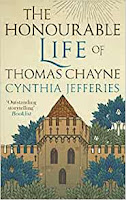
First published in 2001 for children, Cindy Jefferies found success with her Fame School series with Usborne Books, obtaining 22 foreign rights deals. Latterly writing fiction for adults as Cynthia Jefferies, her first title The Outrageous Fortune of Abel Morgan was published in 2018, followed a year later by The Honourable Life of Thomas Chayne, set during the English Civil Wars, followed in 2019. Both titles are now available in paperback.

I came to read Sarah Hall by way of a friend who recommended her. Hall is a multi award winner, including being shortlisted for the Man Booker twice so far. Surely she’ll win it one day. Why on earth hadn’t I come across her before? But I hadn’t, now I have and am eternally grateful to Claire, who put me right.

I like to support my local library, which is only a few yards away from my house. I love the randomness of what’s in and what’s out. The only Sarah Hall when I looked online was The Wolf Border, published in 2015, so that’s what I picked up. But I have lots more treats in store. She has now written six novels, and several collections of short stories. Apparently she started her writing career by publishing poetry in literary magazines. Of course she did. She’s the real deal, and I really shouldn’t be admitting to not knowing her work until now!

So to The Wolf Border. I love reading about wolves, and I do enjoy a good plot. When you add in wonderful descriptions of landscape, well researched human and wolf biology and superlative phrases I had to read again, either for the pure poetry, or for the wisdom within them … well! Finding everything in one novel is rare. They don’t come along every day. Unputdownable can also mean so plot-driven that you’re left gasping but ultimately unfulfilled. Literary can mean difficult. Not here.

Rachel is an expert on wolves. She lives on a reservation in Idaho, protecting the wolves in her care. She has a good team. She has a few friends, and brief affairs with men. Her upbringing in Cumbria was unusual, her mother not easy to love, or even to like. She has very little contact with mother or brother. Perhaps she is something of a lone wolf, but that’s too easy. Life isn’t that simple, and Hall writes real, complex characters, easy to believe in.

When Rachel goes back to Cumbria after several years away it is to visit her mother, who is dying, and to meet a landowner who has a plan to introduce wolves back into the UK. He has a vast estate, friends in high places, and the money to invest in the project. Rachel doesn’t think much of Thomas the earl, but the idea is intriguing, and the land reasonably suitable. The space the pair would have while in quarantine is generous, and eventual release into a huge area, though not as good as being totally wild, is close to the next best thing. There are too many deer on the estate and it is clear that the wolves would be self-sustaining and would improve the environment in several ways.

Hall doesn’t shy away from the complexities of making such a project happen. There would be opposition and encouragement both locally and more widely. The high salary Rachel is offered isn’t the thing that sways her. It’s the possibility of making it work. Yes, they would still be captive, but the amount of land they would have would enable them to live their own lives, naturally. Hunting their own food, and maybe, one day raising their own young. She takes the job, but has unwittingly brought something with her from Idaho which will have a profound effect on her life in England.

Thank you, Sarah Hall, for a thoroughly enjoyable and thought provoking novel. My next trip will be to the bookshop for your latest!

The Wolf Border is published by Faber.

Here is a Q&A with Cynthia (Cindy) Jefferies on her novel set during the Civil War, The Honourable Life of Thomas Chayne.