Showing posts with label waterways. Show all posts

Monday, 27 June 2022

Guest feature by Mark Davies: the best books about Lewis Carroll


"My appreciation of Carroll's versatility as a mathematician, photographer, inventor, diarist and letter writer has grown steadily over the years."

Mark Davies
is an
 Oxford local historian, and the only Oxford guide endorsed by the Lewis Carroll Society. He has helped shape Oxford’s annual Alice’s Day since the first one in 2007, and has participated in French, Dutch, Canadian, Brazilian and British TV and radio documentaries, most notably for BBC 2 and BBC Radio 4. His interest is mainly the many Oxford realities which are hidden away within the apparent fantasy of the ‘Alice’ books, an angle which has enabled him to lecture on this internationally famous topic as far away as Assam in India. "Subsequently, my appreciation of Carroll’s versatility as a mathematician, photographer, inventor, diarist, and letter writer has grown steadily over the years. My fascination with Carroll was initially raised not on account of his books but because of the importance to him and his story-telling of the River Thames, Oxford's waterways having been my original (and continuing) main local history interest. It is because of its diverse watery associations that I became intrigued by Oxford Castle, and republished my book Stories of Oxford Castle in 2017. My biography of the Oxford pastry cook James Sadler, the first Englishman to fly, embraces quite a different element, however!"

After Such Kindness by Gaynor Arnold: a teasingly insightful glimpse of the Victorian Oxford of Lewis Carroll and Alice Liddell, the two protagonists – and yet they aren’t! Yes, there is an Oxford University don with a penchant for photography, and yes his favourite subject is a ten-year-old local girl, and yes the text is scattered with subtle Wonderland and Looking-Glass references, but this is otherwise a quite different, very cleverly contrived, story. Structured as the inner thoughts of the main characters, After Such Kindness engagingly explores the dilemmas posed by the unusual friendship between a mature clergyman bachelor – Arnold convincingly captures Carroll’s playful sense of humour – and an inquisitive and trusting young girl, while sustaining a lurking sense of foreboding through to a thought-provoking finale.

The Looking Glass House
by Vanessa Tait: this fictional interpretation of the creation of Alice’s Adventures is seen from the viewpoint of a constant, yet largely unremarked, fixture during these critical years: the Liddell family governess, Mary Prickett. The Oxford context of the time is convincingly depicted, and some of the burning issues of the day – Darwinism and Nonconformism, for instance – are interwoven with the more immediate tensions within the Liddell household, interpreted by an author who has more right than anyone to comment because Tait is the great-granddaughter of the real Alice herself. To sustain the pace she condenses the real events of 1857 to 1863 into a single fictionalised year, drawing on many well-known facts and suppositions – including Carroll’s rumoured amorous interest in Miss Prickett – and some lesser known details from her own family’s archives.

Lewis Carroll's England
by Charlie Lovett: although this guide to the many English towns and cities associated with Charles Dodgson, the author of Alice, is now more than 20 years old, it remains the most accessible and comprehensive Carrollian guide for the literary tourist. Lovett, a former President of the Lewis Carroll Society of North America, provides admirably clear directions accompanied by over 200 illustrations and photographs, many coming from his own extensive collection. To quote from the cover text, Lovett takes the reader ‘from the tiny Cheshire village of Dodgson’s birth to the Surrey hillside that provides his final resting place … on a journey through Victorian Britain like no other’. True enough, and in between come locations in, most importantly, Yorkshire, Rugby, Oxford, London, the Isle of Wight, and Eastbourne.

Lewis Carroll's Diaries: The Private Journals of Charles Lutwidge Dodgson 
by Lewis Carroll: actually, it is ten books, covering 1855 to 1897 (with a reconstruction of the missing journals of April 1858 to May 1862 – their disappearance being the cause of countless conspiracy theories!). These diaries are the principal source of practically every piece of Lewis Carroll/Alice analysis that has ever been published, and provide a uniquely revealing chronology of the genesis of one of the world’s classic works of literature. These volumes mean that the enigmatic genius of Lewis Carroll is not the sole preserve of academics or historians; through them, he becomes accessible to us all. Transcribed and fully indexed by Edward Wakeling, a renowned world expert, whose extraordinarily detailed and insightful bibliographical and contextual notes provide an unparalleled insight into Victorian Oxford (London, Surrey, Yorkshire, Sussex, and more).

Some of these volumes are hard to get, but there are some remaining copies at the Lewis Carroll Society if interested.

Lewis Carroll: Photographer
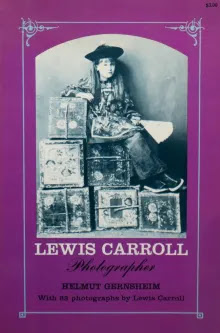
by Helmut Gernsheim: mention the name ‘Lewis Carroll’ and most people will immediately think of the two Alice books. Very few would equate the name to Charles Dodgson, the photographer. This, however, is the aspect of the multi-talented Oxford don which Gernsheim, a professional photographer himself, appraised in his 1949 first edition for the very first time, concluding that Dodgson was ‘the most outstanding photographer of children in the nineteenth century. Many of the black and white plates substantiate this claim, but equally, Dodgson’s mastery of this new invention enabled him to meet and photograph (sometimes uniquely) numerous famous writers and artists, as well as many Oxford contemporaries. As an aside, Edward Wakeling’s 2015 Catalogue Raisonné is a comprehensive listing of every one of Dodgson’s hundreds of known photographs.


Mark Davies' Stories of Oxford Castle is published by Oxford Towpath Press


Mark Davies' Alice in Wonderland: Lewis Carroll and the River Thames in Oxford is published by Signal Books


Monday, 15 June 2020

Guest review by Elen Caldecott: HIDDEN NATURE by Alys Fowler


"It is the story of someone yearning for adventure, yearning for the feeling of being alive and active, but doing so within five miles of their own home."

Elen Caldecott is a writer for young people. She also teaches creative writing in university and community settings. Her latest book, The Short Knife, is an historical drama set during the collapse of the Roman Empire in Britain. It will be published in July 2020 by Andersen Press.

I had decided to write about Hidden Nature before Covid and our state of suspended animation which came with it. But, on re-reading it for this blog, I was struck by its relevance, especially as lockdown lifts and we take small steps towards imagining what normal life might be.

Is this memoir, Alys Fowler writes of her decision to paddle Birmingham’s canal-ways in an inflatable dinghy. She does this in small bursts, over evenings and weekends, catching the bus, or cycling to the next stage of the journey. It is the story of someone yearning for adventure, yearning for the feeling of being alive and active, but doing so within five miles of their own home. It is a memoir in which the plants and animals of the canals and towpaths are companions and friends. They offer reassurance and familiarity to Fowler at a time in her own life when she is coming to terms with her own ‘hidden nature’ as she questions, and finally acts upon, her own sexuality. She emerges from her own state of suspended animation and she does so by meticulous exploration of her own back yard.

I was initially drawn to the memoir as Birmingham is close to my heart. I was an undergraduate there an eternity ago. Local lore had it that Birmingham has more canals than Venice and, while I was a student, many of the canals were undergoing gentrification, acquiring bars and restaurants where there had formally been abandoned warehouses and small-scale industries.

Fowler, who many will know as a gardening writer for broadsheet newspapers, took me on a tour of those familiar paths, but also gave me an education. She is so knowledgeable about the plants and wildlife she sees, and she shares this knowledge in the way friends might share gossip. Buddleia, for example, gets its own few pages. It was, Fowler tells us, an ornamental introduction to the UK that broke free of its garden confines after the Second World War. The urban bomb-sites replicated the exposed limestone of its natural habitat, and the slipstreams of railway embankments encouraged its dispersal until it became ubiquitous. She passes so many of these common, weed-ish, plants as she paddles her dinghy – first ineptly, later with a bit more ept – and she has something wonderful to tell us about each one.

Meanwhile, in the background, her life is quietly imploding. We hear about her husband, his long-term illness and the vicissitudes of caring for him. We hear about the worry of work and moving to a new city. We hear about a growing friendship with someone who will come to be crucial. But none of these threads are the point of this book. Rather, the book shows rather than tells us how the natural world can help to make the Big Problems of Life become a little smaller, a little more manageable.

There is a degree of tension in her descriptions of the people she meets, as opposed to the non-human canal life. Many of the people fishing, barbecuing, smoking, lollygagging about in the liminal spaces of the city waterways, are drawn with a very broad brush. There are some assumptions made about their lives, which aren’t really justified by the brief conversations she reports having with them. But, when Fowler speaks about the joy, the peace and the wisdom to be had by looking for small adventures, close to home, this book is superb.

Hidden Nature is published by Hodder and Stoughton.